
Vial Sealing and Primary Packaging Glossary
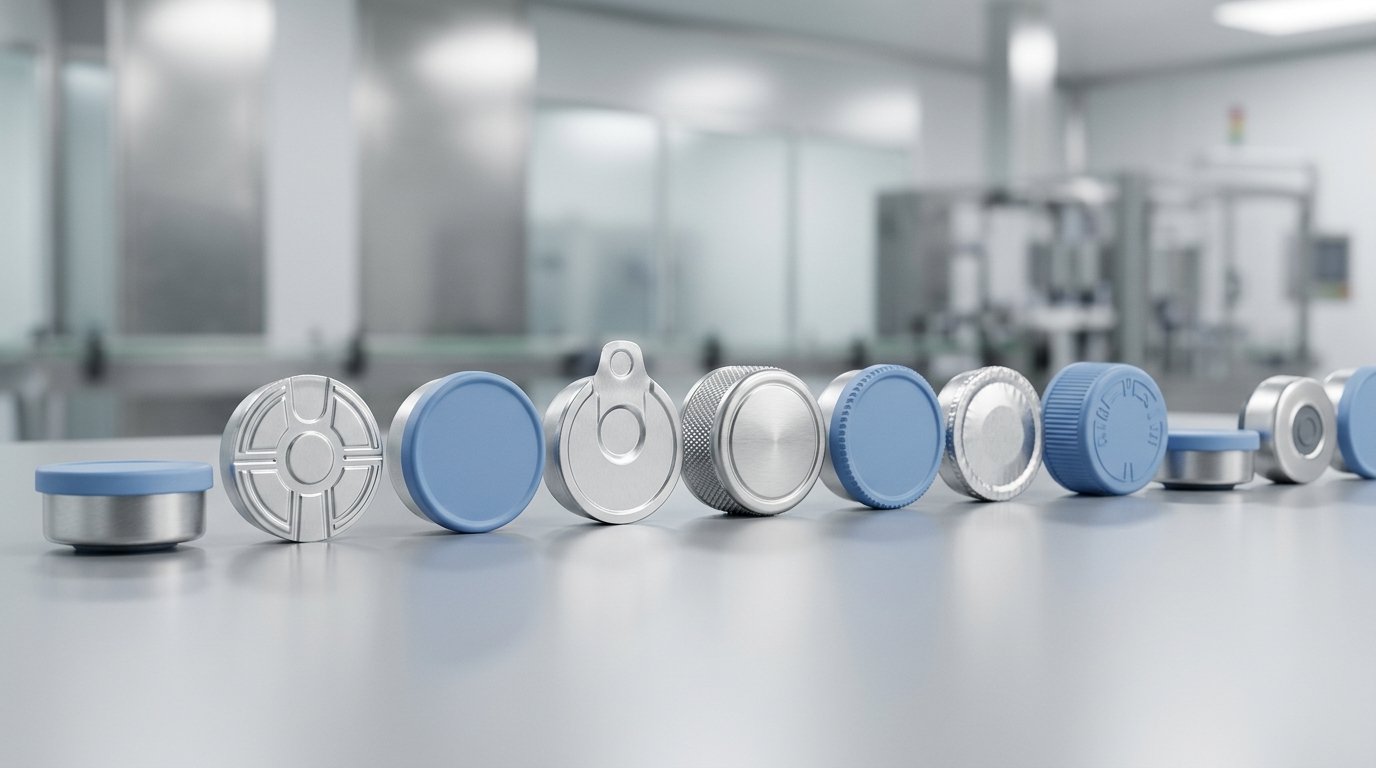
This glossary defines the key terms used in pharmaceutical vial sealing and primary packaging. Each entry is a short, self-contained explainer of what the term means, how the component works, and where it is used, so you can move quickly between concepts as you read the standards and comparison guides. Where a term is also something you can specify and order, the entry links to the product page as well as the definition.
Packaging concepts
- Primary packaging is any material in direct contact with the drug product, such as the vial, stopper, and seal, as distinct from secondary and tertiary packaging. The seal side of primary packaging for injectable vials, and what a buyer has to specify, is on primary packaging for vials.
- Secondary packaging is the layer around the primary pack that does not touch the drug: trays, dividers, cartons, labels and leaflets. For filled vials it typically means trays or dividers and cartons; for syringes it includes the tray, carton and plunger rod, described on secondary packaging for syringes.
- Container closure system is the full set of components that together contain and protect the drug: the container plus the closure that seals it.
- Container closure integrity is the ability of that system to keep microorganisms and reactive gases out for the whole shelf life. For a vial it depends on the crimp holding the stopper compressed against the glass, and it is demonstrated by leak testing under USP <1207>; see vial closure integrity.
Seal and closure types
- Vial seal is the aluminium or aluminium-plastic cap crimped over a vial’s rubber stopper and under its neck flange, holding the stopper in place and showing whether the vial has been opened. It is sized by the vial’s neck finish (13, 20, 28, 32 or 34 mm), not by fill volume; the sizes and designs are on the seals by size index.
- Flip-off seal is an aluminium-plastic vial closure with a plastic flip-top button over a crimped aluminium shell.
- Aluminium-plastic seal is the combination-seal family, an aluminium shell with a moulded plastic top, that flip-off seals belong to. The same family is sold as combi seals, made to ISO 8362-6.
- Tear-off seal is a full-tear-off aluminium seal whose entire top is removed to open the vial.
- Tear-down seal is an aluminium seal opened by tearing down a perforated section, commonly used for oral medicines.
- Pilfer-proof cap is a roll-on pilfer-proof (ROPP) aluminium cap with a tamper-evident pilfer band.
- Tamper-evident seal is any seal with a feature that breaks or detaches irreversibly the first time the vial is opened: a flip-off button, a pull ring, a tear-down disc or a tear-off top. The designs and how each shows tampering are on tamper evident vial seals.
- Serum vial seal is the seal on a crimp-top serum vial, the standard multidose injection vial, in flip-off, tear-off or tear-down form; see serum vial seals.
- Lyophilization seal is a flip-off seal crimped over a freeze-dried vial after the drying cycle, once the stopper has been pressed home inside the chamber; see lyophilization vial seals.
Closure components and materials
- Vial closure is the assembly that seals a vial: the rubber stopper plus the aluminium or aluminium-plastic seal crimped over it. How the stopper, seal and vial neck are specified together is on vial closures.
- Elastomeric closure is the rubber component a needle pierces and that reseals once the needle is withdrawn.
- Butyl rubber stopper is the butyl or halobutyl grade of elastomeric closure used on most injectable vials, chosen for its low permeability to moisture and gases.
- Neck finish is the standardised shape and diameter of the top of a vial, the flange the seal is crimped under. Glass tubing vial necks are dimensioned in ISO 8362-1; the types are compared in vial neck types.
Process and supply terms
- Crimping (or capping) is rolling the skirt of an aluminium seal under the vial neck flange so it holds the stopper under compression. It happens at the capping station after stoppering; see vial crimping explained.
- Fill-finish is the final stage of injectable manufacture: filling, stoppering, freeze-drying where needed, capping, inspection and release. Where the seal enters that line is set out in the vial fill-finish process.
- Ready-to-Use (RTU) seals are washed, assembled in a cleanroom, sterilized by gamma irradiation or ETO and double-bagged, so they can enter an aseptic area without further processing. Ready-to-Sterilize (RTS) seals are supplied clean for the customer’s own sterilization cycle, and Regular seals are the non-sterile presentation; see sterile vial sealing.
- Sub-visible particulate matter is the particles in an injection too small to see, counted at 10 µm and 25 µm under USP <788>; a closure can add to the count but cannot be tested against it on its own. See USP 788 and vial closures.
How Autofits fits in
Autofits manufactures the full range of these seals and caps, FlipTop® aluminium-plastic seals (Optima, Pull Ring, Tear Down), tear-off and tear-down aluminium seals, and aluminium pilfer-proof caps, under an ISO 15378:2017 quality system with an ISO Class 8 cleanroom and high-speed visual inspection.
Explore the rest of the knowledge base: the packaging standards, the learn guides, the seal comparisons, and the application guides covering vaccines, biologics, oncology and the other drug types these closures are made for. To see the closures themselves, browse the full product range.
