
Elastomeric Closure: Definition, Sizes and the Seal That Holds It
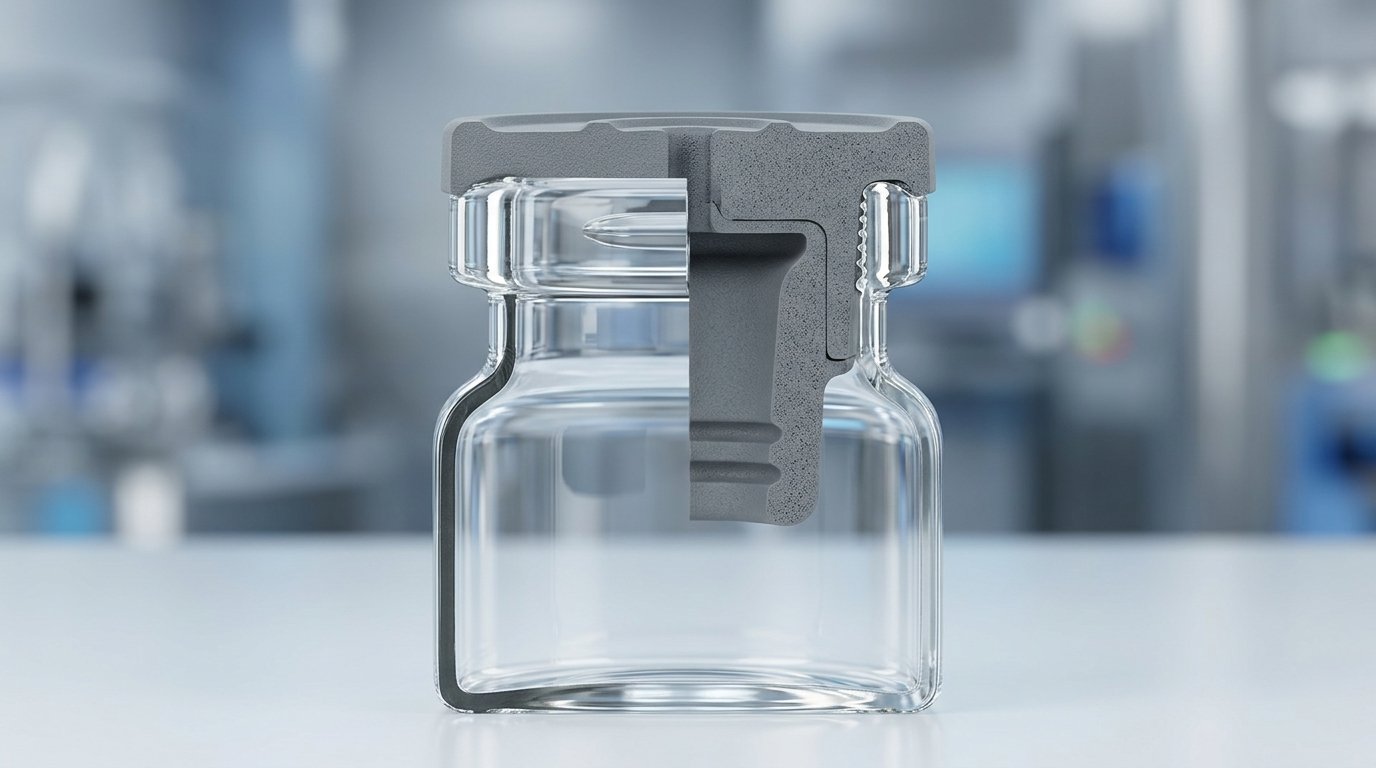
An elastomeric closure is the rubber (elastomer) component that seals a pharmaceutical container, most commonly the vial stopper that a needle pierces and that reseals after the needle is withdrawn. It is the part of the container closure system that forms the resealable barrier between the sterile drug and the outside environment. In a vial, the elastomeric closure works with the aluminium or aluminium-plastic seal crimped over it: the rubber provides the seal, the metal holds it under compression. Stopper and seal share one nominal size, so a 13 mm closure takes a 13 mm seal, a 20 mm closure takes a 20 mm seal, and so on across the 13, 20, 28, 32 and 34 mm range.
This page defines an elastomeric closure, explains what it is made from, describes its function, outlines the standards that govern its material and performance, and sets out the seal dimensions that pair with each closure size.
Key takeaways
- An elastomeric closure is the moulded rubber component (the vial stopper, plus the rubber in cartridges and prefilled-syringe systems) that seals a container and reseals after needle penetration.
- It is the resealable barrier in the container closure system; the aluminium seal crimped over it holds it in compression.
- Stoppers are usually moulded from butyl or halobutyl rubber for low gas and moisture permeability, compared family by family in the vial closure rubber types guide.
- The material requirements sit under USP <381>; functional suitability (penetrability, self-sealing) under USP <382>.
- Dimensions and requirements for closures for injection vials are covered by ISO 8362-2, with freeze-drying closures under ISO 8362-5 and the vial neck itself under ISO 8362-1.
- Size matching is one to one: a 13 mm stopper on a 13 mm neck takes a 13 mm seal. Autofits supplies matching FlipTop Optima seals in 13, 20, 28, 32 and 34 mm.
- Maximum opening force runs 30 N at 13 mm, 35 N at 20 mm and 28 mm, and 65 N at 32 mm, varying with the number of bridges in the design.
- What can migrate from the rubber into the drug is controlled through extractables and leachables studies.
What is an elastomeric closure?
An elastomeric closure is a closure made from an elastomer, a rubber-like polymer that deforms under load and springs back, used to seal pharmaceutical containers so a needle can pass through and the container reseals afterwards. The most familiar example is the grey rubber stopper in an injectable vial, but the term also covers the rubber components in cartridges, prefilled syringes, and similar parenteral delivery systems.
The defining property is elasticity. Because the material is soft and recovers its shape, a needle can pierce it to withdraw or deliver the drug, and when the needle is removed the rubber closes the hole behind it. That self-sealing behaviour is what makes multiple-dose vials possible and what keeps single-dose vials sealed until the moment of use. USP refers to these parts as elastomeric components, and they are evaluated both for what they are made of and for how they perform. Usage of the terms varies, and the distinction between a rubber stopper and an elastomeric closure is unpacked in rubber stopper versus elastomer.
What an elastomeric closure is made of
Elastomeric closures are moulded from synthetic rubber compounds, most commonly butyl or halobutyl (bromobutyl and chlorobutyl) rubber, chosen for low permeability to gases and moisture. The compound is more than the base polymer: it is a formulation that includes fillers, curing (vulcanising) agents, and other additives that give the finished stopper its hardness, resilience, and sealing behaviour.
- Butyl rubber is the workhorse base polymer for vial stoppers because it has a very low permeability to oxygen and water vapour, which protects sensitive drugs.
- Halobutyl rubbers (bromobutyl and chlorobutyl) add halogen to the butyl backbone, improving cure characteristics and chemical compatibility.
- Coatings and laminates (for example fluoropolymer films) are sometimes applied to the surface that contacts the drug to further reduce extractables and improve machinability.
Because the closure contacts the drug product directly, the choice of compound is driven by compatibility with the specific formulation as much as by the mechanical requirements. The material-by-material treatment, including EPDM and silicone, is in vial closure rubber types.
The function of an elastomeric closure
An elastomeric closure has to do two opposing things: form a tight, lasting seal, and still let a needle through and reseal afterwards. Its functional jobs are:
- Sealing. Seated in the vial mouth and compressed by the crimped seal, the stopper’s sealing surfaces press against the glass to keep the contents sterile and protected.
- Penetrability. A hypodermic needle must pierce the stopper with a predictable, moderate force, without the stopper dislodging or the needle bending.
- Self-sealing (resealing). After the needle is withdrawn, the rubber closes the puncture so the container does not leak, which matters most for multiple-dose presentations.
- Resistance to fragmentation (coring). The closure should not shed loose rubber fragments into the drug when pierced.
These functional attributes are evaluated under USP <382>, which addresses how the component performs in its assembled system rather than what it is made of. None of them survive without the crimped seal: the stopper only holds its sealing surfaces against the glass while something keeps it compressed there.
Standards for elastomeric closures
Elastomeric closures are qualified on two fronts: material requirements and functional suitability. A closure is not fully characterised by one alone.
| Aspect | Standard | What it covers |
|---|---|---|
| Material requirements | USP <381> | Physicochemical requirements of the elastomeric material |
| Functional suitability | USP <382> | Penetrability, self-sealing, package-integrity contribution |
| Dimensions and requirements | ISO 8362-2 | Closures for injection vials |
| Freeze-drying closures | ISO 8362-5 | Slotted closures for lyophilisation |
| Vial neck the closure seats in | ISO 8362-1 | Injection vials made of glass tubing |
| Aluminium-plastic cap over the closure | ISO 8362-6 | Caps made of aluminium-plastics combinations |
| Migration into the drug | Extractables and leachables | What can migrate from the rubber into the product |
In practice a drug manufacturer qualifying a stopper looks at the material (USP <381>), the function (USP <382>), the dimensional standard (ISO 8362-2), and extractables and leachables work for the specific formulation. The European Pharmacopoeia carries parallel requirements in Ph. Eur. 3.2.9, its chapter on rubber closures for containers for aqueous parenteral preparations.
How the elastomeric closure and the aluminium seal are matched by size
Stopper, vial neck and seal are all built to the same nominal size, so the match is one to one: a 13 mm elastomeric closure sits on a 13 mm ISO 8362-1 neck and takes a 13 mm seal, and the same relationship holds at 20, 28, 32 and 34 mm. The nominal figure is the neck finish designation shared by all three parts, not a measured diameter of any one of them, which is why a seal’s actual inner diameter reads slightly above the nominal number.
The vial neck is the reference. ISO 8362-1 fixes the glass tubing vial finish, ISO 8362-2 dimensions the closure that seats in it, and ISO 8362-6 dimensions the aluminium-plastic cap that crimps over both. Choose all three in one size family and the assembly closes cleanly. Mix sizes and the skirt either will not pass over the seated stopper or will not roll under the flange.
Two dimensions do the work. The inner aluminium diameter has to clear the seated stopper flange and then be rolled in under the neck. The inner aluminium height has to suit the seated height of the stopper on that neck, which is why a change of stopper compound can matter even when the nominal size does not move: a harder compound compresses less under the capping head and sits taller. The full treatment is in pairing the rubber stopper and aluminium seal.
Specifications: Autofits seals by closure size
Controlled dimensions for the FlipTop Optima aluminium-plastic seal at each nominal closure size, from the Autofits engineering drawings. The seal is selected against the nominal size of the stopper and vial neck, then verified against the seated stopper height on the customer’s own line.
| Stopper and neck size | Inner Ø aluminium seal (D1) | Outer Ø plastic disc (D2) | Total seal height | Aluminium thickness | Bridges | Max opening force | Size page |
|---|---|---|---|---|---|---|---|
| 13 mm | 13.36 mm (min) | 14.99 mm (max) | 7.62–8.38 mm | 0.16–0.20 mm | 6 taper | 30 N | 13 mm seals |
| 20 mm | 20.22 mm (min) | 23.14 mm (max) | 9.02–9.91 mm | 0.16–0.20 mm | 6 taper | 35 N | 20 mm seals |
| 28 mm | 27.60–28.20 mm | 30.10–31.10 mm | 11.06–12.06 mm | 0.17–0.23 mm | 8 | 35 N | 28 mm seals |
| 32 mm | 32.10–32.90 mm | 35.50–36.50 mm | 14.30–15.50 mm | 0.21–0.25 mm | 12 taper | 65 N | 32 mm seals |
| 34 mm | 33.60–34.00 mm | 35.50–36.50 mm | 15.00–16.00 mm | 0.20–0.25 mm | 8 taper | Available on request | 34 mm seals |
Opening force is the force the user applies to break the bridges and lift the plastic disc, and it rises with the number of bridges and the seal diameter. It is a usability figure for the person opening the vial, not a measure of the compression the closure is held under.
Top designs across the range are Bridge, Button (which carries intrinsic tamper evidence from a 12-stem flower under the button disc) and Flower, in glossy, matte, embossed or printed finishes and a wide range of colours customised to requirement. The whole range is on the FlipTop Optima page, and the by-size index lists every format at a given neck finish.
Forms of supply, shelf life and packing
Autofits supplies the seal that pairs with the elastomeric closure in three forms. Regular is the standard non-sterile presentation. Ready-to-Use is sterilized by gamma irradiation or by ETO, washed and assembled in an ISO Class 8 cleanroom and supplied double-bagged so the outer bag can be stripped at the airlock into an aseptic filling area. Ready-to-Sterilize is supplied clean and bagged for the customer’s own sterilization cycle. Tyvek bagging is available as an alternative to the standard bag.
Shelf life differs by form. Non-irradiated seals carry 3.5 years before capping, plus a further 5 years after capping. Ready-to-Use seals carry 2 years before capping, the shorter figure reflecting the sterilization dose already absorbed.
Standard packing follows the size. A 13 mm box holds 15,000 seals as 5,000 in each of three bags; 20 mm holds 6,000 as 2,000 in each of two; 28 mm holds 3,000 as 1,500 in each of two; and 32 mm holds 1,400 as 700 in each of two. The shipper box is 420 × 270 × 320 mm. Packing for 34 mm is available on request.
To request a specification sheet, a sample against your qualified stopper, or a quotation, use the contact page with the nominal neck size, the seal family and the form of supply you need. Autofits does not manufacture the elastomeric closure itself, so give the stopper reference you have already qualified and the seal will be matched to it.
How this works in practice at Autofits
The elastomeric closure forms the resealable barrier; Autofits manufactures the aluminium and aluminium-plastic seals that crimp over it to hold it in place. The range includes FlipTop Optima flip-off seals in 13, 20, 28, 32 and 34 mm, FlipTop Pull Ring seals in 20 and 32 mm, tear-off and tear-down aluminium seals, and aluminium pilfer-proof (ROPP) caps in common sizes with the full range available on request (see the products page). The seal compresses the rubber stopper against the glass so the closure can maintain its seal between needle penetrations.
The aluminium is AA8011 alloy with an epoxy lacquer coating conforming to 21 CFR 175.300, and the disc is polypropylene to 21 CFR 177.1520, moulded in-house on Japanese Toyo injection machines. Heavy metals are held to a maximum 100 ppm total and components are BSE/TSE-free to EMEA/410/01 rev. 3. Every seal passes 100% high-speed camera inspection, at an AQL of critical nil, major not more than 2.5% and minor not more than 4%. Autofits produces these seals under an ISO 15378:2017 quality system, alongside ISO 9001:2015 and ISO 14001:2015 certification and a Drug Master File, in a 75,000 sq ft Nashik facility with an ISO Class 8 cleanroom. The full certification set is on the quality page.
Frequently asked questions
What is an elastomeric closure?
An elastomeric closure is the rubber component that seals a pharmaceutical container and reseals after a needle is withdrawn. The most common example is the vial stopper, but the term also covers the rubber in cartridges and prefilled syringes. It forms the resealable barrier in the container closure system, while the metal seal crimped over it holds it under compression against the glass.
What is an elastomeric closure made of?
Elastomeric closures are moulded from synthetic rubber compounds, most often butyl or halobutyl (bromobutyl, chlorobutyl) rubber, selected for low permeability to oxygen and moisture. The compound also contains fillers, curing agents, and additives, and the drug-contact surface is sometimes coated or laminated with a fluoropolymer film to reduce extractables.
What size aluminium seal fits a 13 mm or 20 mm elastomeric closure?
The match is one to one by nominal size. A 13 mm closure on a 13 mm vial neck takes a 13 mm seal, and a 20 mm closure takes a 20 mm seal. The same holds at 28, 32 and 34 mm. The nominal figure describes the neck finish shared by the vial, the stopper and the cap, so the seal’s measured inner diameter reads slightly above it: 13.36 mm minimum on the 13 mm seal and 20.22 mm minimum on the 20 mm.
What is the difference between an elastomeric closure and a vial seal?
The elastomeric closure is the rubber stopper that forms the seal and lets a needle through. The vial seal is the aluminium or aluminium-plastic cap crimped over the stopper to hold it down against the glass. The stopper creates the barrier; the seal keeps that barrier under compression and provides tamper evidence. Autofits manufactures the seal, not the stopper.
What standards apply to elastomeric closures?
The material requirements of an elastomeric closure are covered by USP <381>, and its functional suitability (penetrability, self-sealing) by USP <382>. Dimensions and requirements for closures for injection vials are in ISO 8362-2, and freeze-drying closures in ISO 8362-5. The vial neck they seat in is in ISO 8362-1, and the aluminium-plastic cap crimped over them in ISO 8362-6. What can migrate from the rubber into the drug is studied through extractables and leachables testing.
Why are vial stoppers usually grey?
Vial stoppers are commonly grey because of the carbon and mineral fillers and the rubber compound used, though stoppers are also produced in other colours. Colour can be used to differentiate closure types or formulations, but it is the rubber compound and its qualification, not the colour, that determine sealing and compatibility.
Related reading
- FlipTop Optima aluminium-plastic seals, 13 to 34 mm
- Vial seals by nominal size
- Pairing the rubber stopper and aluminium seal
- Vial closure rubber types: the material-by-material guide
- USP <381>: elastomeric components in injectable packaging
- USP <382>: elastomeric component functional suitability
- Extractables and leachables in vial closures
Sources
- USP-NF: General Chapter <381>, Elastomeric Components in Injectable Pharmaceutical Product Packaging/Delivery Systems (https://www.usp.org/)
- USP-NF: General Chapter <382>, Elastomeric Component Functional Suitability in Parenteral Product Packaging/Delivery Systems (https://www.usp.org/)
- ISO: ISO 8362-1, Injection containers and accessories, Part 1: Injection vials made of glass tubing (https://www.iso.org/)
- ISO: ISO 8362-2:2024, Injection containers and accessories, Part 2: Closures for injection vials (https://www.iso.org/standard/87251.html)
- ISO: ISO 8362-5:2016, Injection containers and accessories, Part 5: Freeze drying closures for injection vials (https://www.iso.org/standard/65448.html)
- ISO: ISO 8362-6:2010, Caps made of aluminium-plastics combinations for injection vials (https://www.iso.org/standard/52806.html)
- Autofits FlipTop Seals dossier and engineering drawings (working/spec-sheets/)
*Last updated: 2026-08-18. This article is general technical information, not regulatory or compliance advice; confirm current standard editions and requirements with the issuing bodies.*
