
Rubber Stopper vs Elastomer: Definition and How to Choose a Stopper
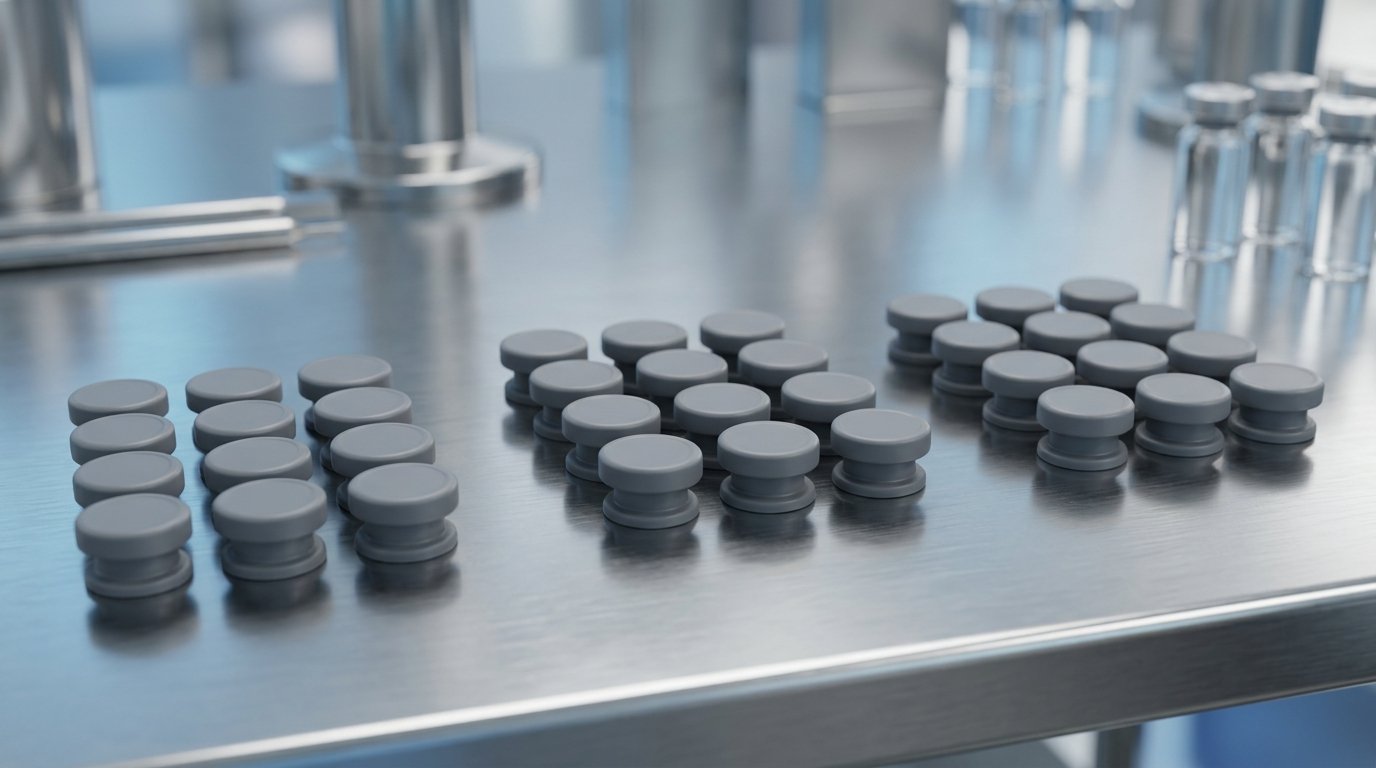
A rubber stopper is a moulded plug of elastomer that seats in the neck of a vial or bottle and seals it; on an injectable vial it is held down by a crimped aluminium seal, lets a needle pass through, and closes the puncture again when the needle is withdrawn. An elastomer is the material it is made from: a rubber-like polymer, such as butyl, chlorobutyl or bromobutyl rubber, that stretches under load and returns to shape. So a rubber stopper is an elastomeric closure, and “rubber stopper vs elastomer” is the finished part against its material, not a choice between two things.
The decision behind the question is which stopper a product uses: its neck size, its design, its elastomer family and compound, and the pharmacopoeial chapters it is qualified against. That choice is made by the drug maker with its closure supplier, and it fixes the aluminium seal that goes over the stopper. After the terminology, the rest of this page walks through that decision and what it means for the seal.
Key takeaways
- A rubber stopper is an elastomeric closure: “rubber stopper” is the everyday name for the part, “elastomeric closure” the standards-facing one.
- “Elastomer” is the material class, rubber-like polymers that stretch and recover; every rubber is an elastomer, but the class is wider than rubber.
- For injectable vials, stoppers are mostly moulded from butyl rubber and its halogenated grades, chlorobutyl and bromobutyl.
- Selecting a stopper runs in order: neck size, design, elastomer family, compound and compendial basis, surface treatment, dose regime, then the seal.
- A stopper is qualified on its material under USP <381>, on its function under USP <382>, and in Europe under Ph. Eur. 3.2.9.
- The aluminium (or aluminium-plastic) seal crimps over the stopper to hold it in place: the elastomer does the sealing, the aluminium does the holding.
- Stopper, neck and seal share one nominal size: 13 mm takes 13 mm, 20 mm takes 20 mm, through 28 and 32 mm.
What is the difference between a rubber stopper and an elastomer?
There is no functional difference to choose between: “elastomer” is the type of material, and a “rubber stopper” is the finished closure moulded from that material, so a rubber stopper is one kind of elastomeric closure. Calling something an elastomeric closure and calling it a rubber stopper are two ways of naming the same part.
An elastomer is a polymer with rubber-like elasticity: it stretches under load and returns to shape when released. That elastic recovery is exactly why elastomers are used for vial closures, because a stopper has to be compressed by the seal, be pierced by a needle, and recover to reseal. A rubber stopper is the moulded elastomeric part that does this in a vial. So when a specification says “elastomeric closure” and a drawing says “rubber stopper”, they are referring to the same component; “elastomeric closure” is the formal term and “rubber stopper” is the everyday one.
Rubber vs elastomer: the material question
“Elastomer” is the wider technical term and “rubber” the older, narrower one: all rubbers are elastomers, but not every elastomer is what people mean by rubber. “Rubber” first meant natural rubber from latex and now also covers the synthetic rubbers, such as butyl, polyisoprene and EPDM. “Elastomer” names the whole class of polymers with that elastic behaviour, which also takes in materials that are not usually called rubber, such as thermoplastic elastomers.
For a vial stopper the distinction has one practical consequence. Most pharmaceutical stoppers are cross-linked, or vulcanised, rubbers, and that curing is what gives them the recovery a crimped, pierced closure needs. When a pharmacopoeia or ISO standard writes “elastomeric”, it is choosing the material-neutral term so that its requirements cover every family a stopper might be moulded from, rather than naming one rubber.
The closure vocabulary, term by term
Most of the confusion in this area is about which word names which physical object. The table fixes each term to one object and one level.
| Term | What it names | Level | Who supplies it |
|---|---|---|---|
| Elastomer | The rubber-like material class (butyl, halobutyl, EPDM, silicone) | Material | Compound supplier |
| Rubber stopper | The moulded closure made from an elastomer | Finished part | Stopper supplier |
| Elastomeric closure | The standards-facing name for that same closure | Finished part | Stopper supplier |
| Vial seal, or cap | The aluminium or aluminium-plastic component crimped over the stopper | Separate part | Seal manufacturer |
| Crimp | The action that rolls the seal skirt under the neck flange | Process step | The filler’s capping line |
| Container closure system | Vial plus stopper plus seal, assembled and qualified together | Assembly | The drug manufacturer |
Two mistakes follow from getting this wrong. The first is asking for a quotation on “13 mm closures” and receiving aluminium seals when rubber stoppers were meant, or the reverse. The second is writing a specification against a polymer family, “bromobutyl”, as though that named a material: it names a base polymer, and a finished compound adds fillers, a cure system and processing aids that move hardness, penetration force and extractables. The compound reference, not the family name, is what belongs under change control.
Related words behave predictably once the table is fixed. A “flip-off cap” or “flip-off seal” is a vial seal with a plastic button that lifts, described in what is a flip-off seal. A “crimp cap” is the same object named after how it is applied. A “pilfer-proof” or ROPP cap is not in this family at all, because it threads onto a screw finish instead of crimping over a stopper. A “closure” on its own is ambiguous and worth avoiding in a purchase order.
Rubber stopper types: naming the elastomer families
The comparison that actually matters is between the elastomer families a stopper can be moulded from, and for injectable vials that is dominated by butyl and its halogenated grades. What follows is the naming, so that a specification can be read correctly. How the families behave against one another is the subject of vial closure rubber types, the material-by-material guide. The narrower head-to-head between the two most often confused is in butyl vs EPDM stoppers.
| Elastomer family | What the name refers to | Where it appears in a specification |
|---|---|---|
| Butyl rubber (IIR) | Isobutylene-isoprene copolymer | The parent polymer; still specified for stoppers |
| Halobutyl: bromobutyl (BIIR), chlorobutyl (CIIR) | Butyl with bromine or chlorine on the backbone | The most common stopper bases; the halogen is named, not the performance |
| Natural rubber (NR) and polyisoprene (IR) | Polyisoprene, from latex or synthesised | Largely confined to plungers and needle shields for parenterals |
| EPDM | Ethylene propylene diene monomer | Named where heat, steam or ozone resistance governs |
| Silicone (VMQ) | Polysiloxane, not a carbon-backbone rubber | Named for plungers, tubing and wide-temperature use |
All five are elastomers, so choosing among them is choosing an elastomer family, not choosing “rubber stopper versus elastomer”. Stopper types are also named by design rather than material: a standard serum stopper is a plug with a flange that is seated once, and a lyophilisation stopper has legs or slots so it can sit half-seated in a freeze-dryer and be pushed home at the end of the cycle.
A rubber stopper is an elastomeric closure
In pharmaceutical packaging, “elastomeric closure” is the precise, standards-facing term for the rubber stopper that seals an injectable vial. The pharmacopoeias and ISO use the elastomer language because the requirements are written around the material class and its behaviour, not around a single trade name for rubber.
That is why the material and functional standards are named for elastomers: USP <381> covers elastomeric components in injectable packaging (the material, and the fragmentation test), and USP <382> covers elastomeric component functional suitability (how the part performs, including penetrability and self-sealing). In Europe the same ground is covered by Ph. Eur. 3.2.9, the chapter on rubber closures for containers of aqueous parenteral preparations. A rubber stopper is assessed under these chapters because it is an elastomeric closure. The container closure system is completed when this elastomeric stopper is held in the vial by a crimped seal.
Selecting a rubber stopper for an injectable vial
Choosing a stopper is a sequence of seven decisions, and taking them in order stops a later one from undoing an earlier one. The first six are made with the stopper’s own supplier and the drug maker’s compatibility data; the seventh, the seal, follows from them.
| Decision | Options | What decides it |
|---|---|---|
| 1. Neck size | 13, 20, 28 or 32 mm | The vial neck finish; stopper, neck and seal share one nominal size |
| 2. Design | Standard serum stopper, or a lyophilisation stopper with legs or slots | Whether the product is freeze-dried in the vial |
| 3. Elastomer family | Chlorobutyl, bromobutyl, or another butyl grade | Barrier needs, sterilisation route and compatibility with the drug |
| 4. Compound and compendial basis | A named compound, qualified to USP <381>, USP <382> and Ph. Eur. 3.2.9 | The markets the product is filed in, and the drug maker’s own compatibility data |
| 5. Surface treatment | Uncoated, lubricated, or coated | Machinability on the stoppering line and the extractables profile the product tolerates |
| 6. Dose regime | Single-dose or multi-dose | A multi-dose vial needs a stopper that reseals across repeated punctures |
| 7. The seal over it | Flip-off, pull-ring, tear-down or tear-off, in the same nominal size | How the vial is opened in use, and whether tamper evidence must be intrinsic |
Neck size and design come first because they are fixed by the vial and the process, not by preference. A 20 mm vial takes a 20 mm stopper whatever the drug, and a product that is freeze-dried in the vial needs a lyophilisation design whatever the compound.
The elastomer family follows from the fill. Biologic products push the choice toward the lowest extractables and leachables profile that will still seal, lyophilised presentations toward the best moisture barrier, because a dry cake takes up water through the stopper over its shelf life, and multi-dose insulin and hormone vials toward reseal performance across many punctures. For injectable vials this is almost always a choice between the halobutyl grades, set out head to head in chlorobutyl vs bromobutyl stoppers. The study design behind the extractables question is covered in extractables and leachables testing for vial closures.
The compound, not the family, is what gets qualified. Two bromobutyl compounds from different formulations can differ in hardness, penetration force and extractables, so the specification names the compound, the pharmacopoeial chapters it is tested against, and a requirement for notice before any change to it. Ph. Eur. 3.2.9 itself asks the drug maker to obtain that assurance from the closure supplier.
The seal is chosen last, because it is ordered against the neck and not against the rubber. What the compound can change is the seated height of the stopper and how much load the crimp leaves behind, which is why capping is re-verified after a stopper change even though the seal size stays the same.
Where the aluminium seal fits
The elastomeric stopper and the aluminium seal are two different components that work together: the stopper is the elastomer that seals and reseals, and the seal is the metal (or metal-plus-plastic) cap crimped over it to hold it in compression. Confusing “rubber stopper” with “seal” is a common source of the terminology mix-up, so it is worth separating them.
The stopper seats in the vial mouth and forms the resealable barrier a needle passes through. The aluminium skirt of the seal is then crimped under the vial neck flange, compressing the stopper against the glass to maintain container closure integrity. On an aluminium-plastic flip-off seal, a plastic button flips up to expose the stopper while the crimp stays in place. The pairing of the elastomeric stopper with the aluminium seal is covered in detail in pairing the rubber stopper and aluminium seal. In short: the elastomer does the sealing, the aluminium seal does the holding.
Specifying the seal that goes over the stopper
Once the terms are straight, the seal specification is straightforward: the seal is ordered against the vial neck finish, one to one with the stopper’s nominal size, and the elastomer family does not enter into it. A 13 mm stopper on a 13 mm ISO 8362-1 neck takes a 13 mm seal, and the relationship holds through 20, 28, 32 and 34 mm. Every size is listed on the vial seals by size hub, with a page each for 13 mm, 20 mm, 28 mm, 32 mm and 34 mm seals.
| Stopper and neck size | Inner Ø aluminium seal (D1) | Outer Ø plastic disc (D2) | Total seal height | Aluminium thickness | Bridges | Max opening force |
|---|---|---|---|---|---|---|
| 13 mm | 13.36 mm (min) | 14.99 mm (max) | 7.62 to 8.38 mm | 0.16 to 0.20 mm | 6 taper | 30 N |
| 20 mm | 20.22 mm (min) | 23.14 mm (max) | 9.02 to 9.91 mm | 0.16 to 0.20 mm | 6 taper | 35 N |
| 28 mm | 27.60 to 28.20 mm | 30.10 to 31.10 mm | 11.06 to 12.06 mm | 0.17 to 0.23 mm | 8 | 35 N |
| 32 mm | 32.10 to 32.90 mm | 35.50 to 36.50 mm | 14.30 to 15.50 mm | 0.21 to 0.25 mm | 12 taper | 65 N |
| 34 mm | 33.60 to 34.00 mm | 35.50 to 36.50 mm | 15.00 to 16.00 mm | 0.20 to 0.25 mm | 8 taper | Available on request |
The nominal figure is a neck finish designation shared by all three parts, which is why a 20 mm seal measures 20.22 mm minimum on the inside rather than exactly 20 mm: the skirt has to clear the seated stopper flange before it is rolled in under the neck. Opening force is what the end user applies to break the bridges and lift the disc, and it rises with diameter and bridge count. Top designs across the FlipTop Optima range are Bridge, Button (intrinsic tamper evidence from a 12-stem flower under the disc) and Flower, in glossy, matte, embossed or printed finishes and a wide range of colours customised to requirement.
Forms of supply, shelf life and packing
Autofits supplies the seal in three forms. Regular is the standard non-sterile presentation. Ready-to-Use is sterilized by gamma irradiation or by ETO, washed to control particles, assembled in an ISO Class 8 cleanroom from double-lacquered aluminium and supplied double-bagged for transfer into an aseptic filling area. Ready-to-Sterilize is supplied clean and bagged for the customer’s own cycle. Tyvek bagging is available in place of the standard bag.
Shelf life is 3.5 years before capping for non-irradiated seals, plus a further 5 years after capping, and 2 years before capping for Ready-to-Use. Standard packing per box is 15,000 at 13 mm (5,000 in each of three bags), 6,000 at 20 mm, 3,000 at 28 mm (1,500 × 2) and 1,400 at 32 mm (700 × 2), in a 420 × 270 × 320 mm shipper. Packing at 34 mm is available on request.
Seal requests are easiest to price when the terminology is used precisely: quote the nominal neck finish, the seal family and top design, the finish and colour, and the form of supply, and name the stopper already qualified for the product, its nominal size and compound reference, so the seal is matched to it. Send it through the contact page. Standard seal designs are typically ordered from 50,000 pieces per size and colour, with a lead time of typically 2 to 3 weeks from order confirmation, both confirmed with the quotation.
How this works in practice at Autofits
Autofits makes the metal half of the closure, not the rubber half. The rubber stopper comes from the drug maker’s qualified closure supplier; the aluminium and aluminium-plastic seals that crimp over it are FlipTop Optima flip-off seals in 13, 20, 28, 32 and 34 mm, FlipTop Pull Ring and Tear-Down seals, all-aluminium tear-off and tear-down seals, and aluminium pilfer-proof (ROPP) caps for screw-neck bottles.
The terminology on this page matters in practice because the seal is specified against the stopper: same nominal neck finish, and a seal height and skirt that suit the stopper’s seated height, which is why capping is re-verified whenever the stopper compound changes. The seals are produced under an ISO 15378:2017 quality system in a 75,000 sq ft Nashik facility with an ISO Class 8 cleanroom and 100% high-speed camera inspection, from AA8011 aluminium epoxy lacquered to 21 CFR 175.300, with polypropylene discs to 21 CFR 177.1520. Which elastomer family a product ends up with is still decided by the fill and the drug maker’s compatibility data, not by the seal.
Frequently asked questions
What is a rubber stopper?
A rubber stopper is a moulded elastomeric plug that seats in the neck of a vial or bottle and seals it. On an injectable vial it is held in place by a crimped aluminium seal, lets a needle pass through, and reseals when the needle is withdrawn. Pharmaceutical stoppers are mostly made from butyl rubber or its chlorobutyl and bromobutyl grades.
Is a rubber stopper an elastomer?
A rubber stopper is made from an elastomer, and the finished part is an elastomeric closure. “Elastomer” is the material class, the rubber-like polymers that stretch and recover; “rubber stopper” is the moulded part made from that material. So a rubber stopper is not something different from an elastomer, it is an elastomeric closure.
What is the difference between a rubber stopper and an elastomeric closure?
There is no difference in the object: “elastomeric closure” is the precise, standards-facing term used by the pharmacopoeias and ISO, and “rubber stopper” is the everyday name for the same component. Both refer to the moulded rubber part that seals a vial and is pierced by a needle. Standards such as USP <381> and USP <382> use the elastomer language because their requirements are written around the material class.
Which elastomer is used for vial stoppers?
Butyl rubber and its halogenated grades, bromobutyl and chlorobutyl, are the mainstream elastomers for injectable vial stoppers, chosen for their very low gas and moisture permeability and their self-sealing behaviour. Natural rubber has largely been superseded for parenterals, and EPDM is used more where chemical or heat resistance dominates than as a general parenteral closure.
How do I choose a rubber stopper for an injectable vial?
Take the decisions in order: the neck size, the design (standard or lyophilisation), the elastomer family, the specific compound and the pharmacopoeial chapters it is qualified against, any coating or lubrication, whether the vial is single-dose or multi-dose, and finally the seal of the same nominal size. The compound, not just the family name, is what should go into the specification.
Is the aluminium seal the same as the rubber stopper?
No. They are two separate components. The rubber stopper is the elastomeric part that seats in the vial and forms the resealable barrier. The aluminium (or aluminium-plastic) seal is the metal cap crimped over the stopper to hold it compressed against the glass and to provide tamper-evident opening. The stopper does the sealing; the seal does the holding.
Why do standards say “elastomeric” instead of “rubber”?
Standards use “elastomeric” because the requirements apply to the whole class of rubber-like materials and to the closure’s behaviour, not to a single named rubber. It is a more precise, material-neutral term that covers butyl, halobutyl and other elastomers, and it describes the finished closure by its defining property, elasticity, rather than by a trade name.
Does the elastomer family change which aluminium seal I order?
No. The seal is ordered against the nominal neck finish of the vial, so a 20 mm stopper takes a 20 mm seal whether it is butyl, halobutyl, EPDM or silicone. What the compound can change is the seated height of the stopper and how much load the crimp leaves behind, because hardness and compression set differ between compounds. That is a reason to re-verify capping after a stopper change, not a reason to change the seal size.
Related reading
- Elastomeric closure: definition
- Chlorobutyl vs bromobutyl stoppers
- Vial closure rubber types: the material-by-material guide
- Pairing the rubber stopper and aluminium seal
- Ph. Eur. 3.2.9: rubber closures
- FlipTop Optima aluminium-plastic seals, 13 to 34 mm
Sources
- USP-NF: General Chapter <381>, Elastomeric Components in Injectable Pharmaceutical Product Packaging/Delivery Systems (https://www.uspnf.com/)
- USP-NF: General Chapter <382>, Elastomeric Component Functional Suitability in Parenteral Product Packaging/Delivery Systems (https://www.uspnf.com/)
- EDQM: Revised general chapter on rubber closures published in the Ph. Eur. Supplement 11.1 (https://www.edqm.eu/en/-/revised-general-chapter-on-rubber-closures-published-in-the-ph.-eur.-supplement-11.1)
- ISO: ISO 8362-1:2018, Injection containers and accessories, Part 1: Injection vials made of glass tubing (https://www.iso.org/standard/74398.html)
- ISO: ISO 8362-2:2024, Injection containers and accessories, Part 2: Closures for injection vials (https://www.iso.org/standard/87251.html)
- Autofits FlipTop Seals dossier and engineering drawings
*Last updated: 2026-09-15. This article is general technical information, not regulatory or compliance advice; confirm current standard editions and material specifications with the issuing bodies and your supplier.*
