
Biologics Vial Seals and Closures | Autofits
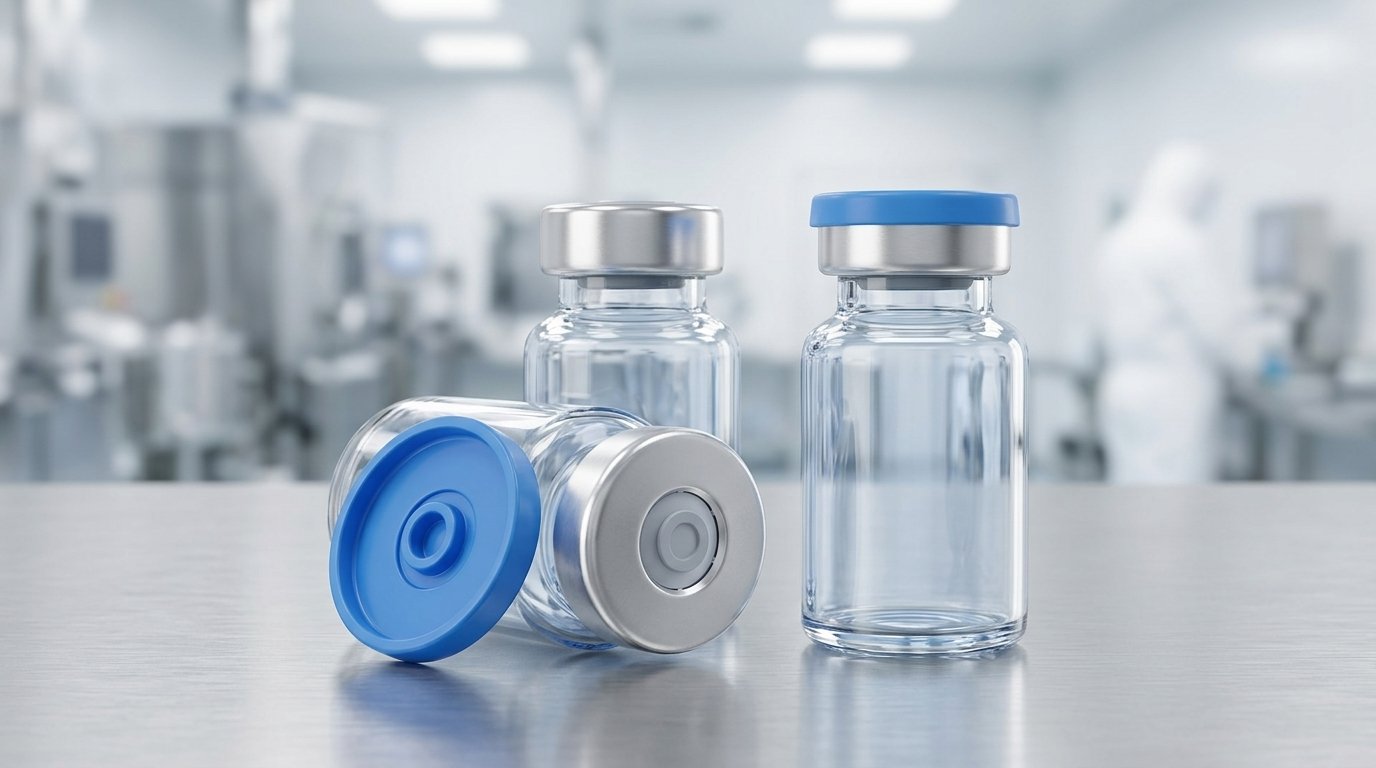
Biologics raise the stakes on the closure: the molecules are sensitive to extractables and leachables, the fills are high in value, and the sterile barrier has to hold demonstrable container closure integrity across a long shelf life, often under cold storage. For a biologic, the seal is not a commodity component; it is part of the container-closure system that protects a product worth far more than the packaging around it.
This page is for biologics formulators, packaging engineers and sourcing managers selecting a vial closure. It covers sensitivity to extractables and leachables, container closure integrity, the high-value-fill argument for closure quality, the Autofits seals that fit, and the standards involved.
Key takeaways
- Biologics are sensitive to extractables and leachables, so the material specification of the closure system matters as much as its mechanics.
- The fill is high in value, which raises the cost of any container closure integrity failure or batch loss; closure quality is a risk-reduction decision.
- Container closure integrity (CCI) must be demonstrable across the shelf life and storage range, evaluated against USP <1207> and within the aseptic expectations of EU GMP Annex 1.
- The FlipTop® Optima flip-off seal in 13 mm and 20 mm is the default; the Pull-Ring suits presentations where the whole seal must be removed.
- Autofits closures carry documented material compliance: AA8011 aluminium, epoxy lacquer to 21 CFR 175.300, polypropylene to 21 CFR 177.1520, heavy metals at a maximum 100 ppm total, and BSE/TSE-free status.
- Production runs under ISO 15378:2017 GMP with a Drug Master File (DMF 18100).
What biologic packaging needs from the closure
A biologic vial is a sterile container-closure system in the same form as any injectable: glass vial, rubber stopper and an aluminium-plastic seal crimped under the neck flange. What sets biologics apart is the consequence profile. The product is sensitive and expensive, so the closure is evaluated less as a part and more as a contributor to product quality and risk.
Three requirements dominate. First, material compatibility, because proteins and other large molecules can interact with substances that migrate from packaging contact materials. Second, container closure integrity over time, because a biologic shelf life is long and often spans refrigerated or frozen storage, and a slow leak that would be tolerable on a short-dated product is not. Third, closure quality and consistency, because the value tied up in each filled vial makes a defect or a failed crimp expensive in a way it is not for a low-cost generic.
Sensitivity to extractables and leachables
Extractables are substances that can be drawn out of a packaging material under exaggerated conditions; leachables are what actually migrates into the product under real storage conditions. For biologics, both are a primary concern, because trace migrants can affect a sensitive molecule or its stability. The closure contributes to this picture through its contact and near-contact materials.
Autofits aluminium-plastic seals are specified with this in mind, with documented material compliance for each component:
- Aluminium: alloy AA8011, conforming to EN 15088:2005, with EN 10204 3.1 certification, REACH and RoHS compliant.
- Lacquer: epoxy lacquer coating conforming to 21 CFR 175.300; double-lacquered for the Ready-to-Use form.
- Polypropylene button/disc: conforming to IS 10910 / IS 10909 and FDA 21 CFR 177.1520 (olefin polymers), with EC 1895/2005 compliance; BADGE, NOGE and BFDGE are not used.
- Heavy metals: chrome-VI, cadmium, mercury and lead at a maximum 100 ppm total (EN 602, EC 94/62).
- BSE/TSE-free: per EMEA/410/01 rev. 3.
A documented material specification is the starting point; product-specific extractables and leachables studies remain the formulator’s responsibility, but a closure with a known, controlled composition makes that work tractable.
Container closure integrity and the high-value fill
The seal forms the sterile barrier by crimping the aluminium shell under the neck flange to compress the stopper against the glass. For a biologic, that barrier has to hold not just at release but across the whole shelf life and storage range, because the product is sterile and a breach is a patient-safety event, and because the fill is too valuable to lose to a slow leak.
This is where closure quality earns its place. A consistent crimp depends on tight dimensional control of the seal, which Autofits holds to the engineering drawings, and on consistent component geometry, which comes from in-house polypropylene moulding on Toyo machines and 100% high-speed camera inspection of every seal. Components are washed on an automated line to control particulates and assembled in an ISO Class 8 cleanroom. For aseptic biologic lines, seals are supplied Ready-to-Use, gamma or ETO sterilized and double-bagged. Container closure integrity for the finished system should be demonstrated against USP <1207>.
Two neighbouring bodies of work are worth reading alongside this page. Extractables and leachables are a study-design problem before they are a materials problem, and extractables and leachables testing for vial closures sets out how to scope one. Shelf-life claims under refrigerated or frozen storage rest on the stability programme, so ICH Q1A(R2) and Q1B is the reference for how long the closure has to hold and under what conditions. Many biologics are presented dry rather than in solution, which moves the specification onto the ground covered by lyophilised vial seals, and the hazardous end of the same category is covered on oncology vial closures. At the far end of the value scale sit cell and gene therapy closures, where a batch can be one patient’s only dose and the vial goes to vapour-phase liquid nitrogen. Small-volume biologic fills usually land on a 13 mm neck, and the 13 mm seal range lists what is available in that size.
Which Autofits seals fit biologics
For most biologic vials, the FlipTop® Optima flip-off seal is the default:
- 20 mm Optima is the highest-volume injectable size and suits most biologic vials. Total height 9.02 to 9.91 mm, six tapered bridges, maximum opening force 35 N.
- 13 mm Optima suits smaller-volume, higher-potency biologic fills. Total height 7.62 to 8.38 mm, six tapered bridges, maximum opening force 30 N.
- The Button design adds intrinsic tamper evidence, useful for high-value product.
Where a presentation requires the whole seal to be removed rather than a flip-off button, the FlipTop® Pull-Ring is the fit: the polypropylene disc is detached, then the aluminium ring is pulled and opened anticlockwise so the whole seal comes off. The Pull-Ring is made in 20 mm (bridge) and 32 mm (flower).
All forms are supplied Regular, Ready-to-Use (gamma or ETO sterilized, double-bagged) or Ready-to-Sterilize. Shelf life is 3.5 years before capping for non-irradiated seals and 2 years before capping for RTU. Browse by neck size from the 20 mm index, or see the products page.
Relevant standards
- USP <1207>: package integrity evaluation for sterile products, the reference for demonstrating container closure integrity across the shelf life and cold storage.
- EU GMP Annex 1: manufacture of sterile medicinal products, which sets the aseptic-processing and CCI expectations a biologic fill must meet.
- ISO 15378: GMP requirements for primary packaging materials; Autofits seals are produced under ISO 15378:2017, with a Drug Master File (DMF 18100).
- ISO 8362-6: the design standard for aluminium-plastics combination caps that the Optima and Pull-Ring follow. Vial necks follow ISO 8362-1.
FAQ
Why are extractables and leachables a bigger concern for biologics?
Biologics are large, sensitive molecules whose stability can be affected by trace substances that migrate from packaging contact materials. A closure with a known, documented material composition, such as the Autofits aluminium-plastic seal with its specified AA8011 aluminium, 21 CFR-compliant lacquer and polypropylene, makes product-specific extractables and leachables work tractable. Those studies remain the formulator’s responsibility.
What container closure integrity standard applies to a biologic vial?
Container closure integrity for sterile products is evaluated against USP <1207>, and the aseptic-processing and CCI expectations for sterile manufacture are set by EU GMP Annex 1. For a biologic, integrity has to hold across the full shelf life and storage range, not just at release.
Which seal is the default for biologics?
The FlipTop® Optima flip-off seal in 13 mm or 20 mm is the default for most biologic vials. Where the whole seal must be removed rather than a flip-off button, the Pull-Ring is the fit: the disc is detached and the aluminium ring is pulled and opened anticlockwise so the whole seal comes off.
Why does closure quality matter more for a high-value fill?
The cost of a container closure integrity failure scales with the value in the vial. A slow leak or a failed crimp that might be tolerable on a low-cost generic is expensive for a biologic, in lost product and in patient-safety terms. Consistent crimping from tight dimensional control, in-house moulding and 100% camera inspection is a risk-reduction measure for high-value fills. Where the biologic ships as a syringe rather than a vial, or as a vial-and-syringe kit, the packaging problem moves outward, and secondary packaging for prefilled syringes covers it.
Are the materials documented for compliance?
Yes. The aluminium is AA8011 conforming to EN 15088:2005, the lacquer conforms to 21 CFR 175.300, the polypropylene conforms to 21 CFR 177.1520, heavy metals are held to a maximum 100 ppm total, and components are BSE/TSE-free per EMEA/410/01 rev. 3. Production runs under ISO 15378:2017 with a Drug Master File (DMF 18100).
Can biologic seals be supplied sterile for aseptic filling?
Yes. The seals are available Ready-to-Use, gamma or ETO sterilized and supplied double-bagged for aseptic areas, as well as Ready-to-Sterilize for your own step and Regular (non-sterile). RTU seals are assembled in an ISO Class 8 cleanroom and washed to control particulates.
Related reading
- Vial sealing applications hub
- Vaccine vial seals and closures
- FlipTop® Optima flip-off seals
- FlipTop Pull-Ring seals
- USP <1207>: package integrity for sterile products
- EU GMP Annex 1: sterile manufacture
- ISO 15378: GMP for primary packaging
Sources
- Autofits FlipTop Seals dossier and engineering drawings (working/spec-sheets/)
- ISO: ISO 8362-6:2010, Injection containers and accessories, Part 6: Caps made of aluminium-plastics combinations for injection vials (https://www.iso.org/standard/45641.html)
- ISO: ISO 15378:2017, Primary packaging materials for medicinal products, GMP requirements (https://www.iso.org/standard/70729.html)
- USP-NF: General Chapter <1207>, Package Integrity Evaluation, Sterile Products (https://www.usp.org/)
- EudraLex Volume 4, EU GMP Annex 1, Manufacture of Sterile Medicinal Products (https://health.ec.europa.eu/)
*Last updated: 2026-06-27. This page is general technical information, not regulatory or compliance advice; confirm current standard editions and your own specification with Autofits and the issuing bodies.*
