
Secondary Packaging for Syringes
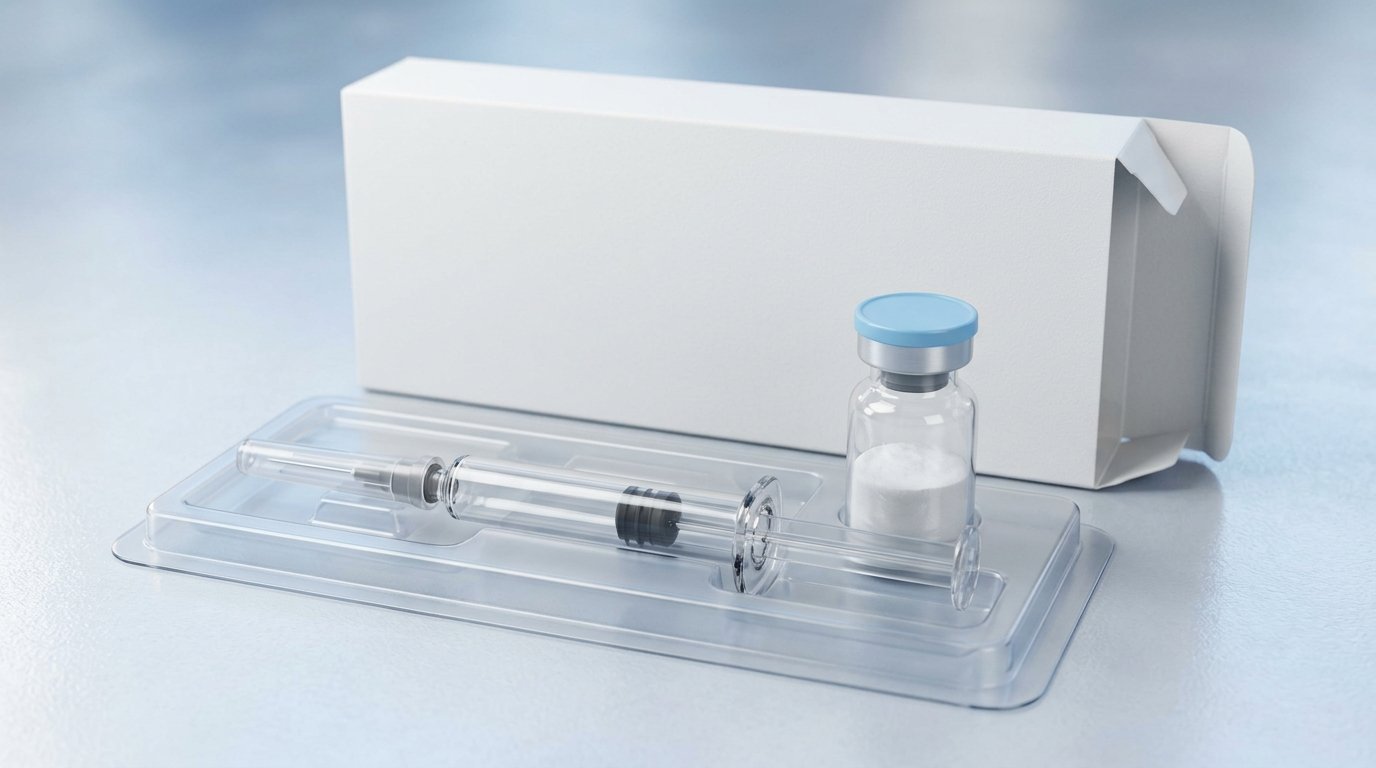
Secondary packaging for a prefilled syringe is everything outside the fluid path: the nest and tub the barrels arrive in, the moulded tray, the carton, the label and leaflet, the plunger rod and backstop, the needle-safety device or autoinjector, and the anti-tampering and serialisation features the carton has to carry. Autofits does not manufacture syringe components or cartons; where it fits a prefilled-syringe programme is the vial that travels with the syringe in a kit or a reconstitution pack.
This page sets out what secondary packaging means for a prefilled syringe, the standards and market-specific serialisation rules that apply to it, and the point at which a vial closure becomes part of a syringe-based presentation. It is written for packaging engineers scoping a combination or kit presentation.
Key takeaways
- Primary packaging for a prefilled syringe is the barrel, plunger stopper, tip cap or needle shield; secondary packaging is the layer around it, and tertiary is the shipper.
- Nest and tub is the standard supply format for ready-to-fill barrels: a moulded polymer nest inside a tub, sealed with a breathable lid and sterilised.
- The ISO 11040 series covers prefilled syringes, including glass barrels for ready-to-fill sterilised subassembled syringes and test methods for finished prefilled syringes.
- Serialisation and anti-tampering rules sit on the secondary pack and differ by market: the EU, the US and India each set their own requirements.
- Autofits does not make syringe components, nests, tubs, cartons or autoinjectors. Its role in a PFS programme is the accompanying vial: a lyophilised drug vial reconstituted by a diluent syringe, or a diluent vial paired with a drug syringe.
- Where a vial is in the kit, the same FlipTop® Optima closures apply, with colour used to separate the vial from the syringe component at the point of use.
What counts as secondary packaging for a prefilled syringe
Primary packaging is whatever contacts the drug product; for a prefilled syringe that is the glass or polymer barrel, the plunger stopper, and the tip cap or rigid needle shield. Everything else is secondary or tertiary. The distinction is defined generally on the primary packaging glossary page and it matters because the regulatory obligations attach differently to each layer.
The secondary layer for a prefilled syringe usually includes several items that a vial presentation does not have. A plunger rod and backstop are assembled onto the barrel after filling, so they arrive as secondary components even though the user handles them as part of the device. A needle-safety device or passive safety guard may be added for sharps protection. An autoinjector or on-body injector may enclose the syringe entirely, in which case the syringe is a component inside a device. Around all of that sit the moulded tray or blister, the carton, the label and the patient information leaflet.
The upstream format is worth understanding because it shapes the whole line. Ready-to-fill barrels are supplied in a nest and tub: a moulded polymer nest holds the barrels in a fixed array, the nest sits in a tub, and the tub is sealed with a breathable lid and sterilised before shipping. The filler opens the tub in a clean area and fills the barrels in the nest without handling them individually. The ISO 11040 series covers prefilled syringes across several parts, including glass barrels for injectables and sterilised subassembled syringes ready for filling, and requirements and test methods for finished prefilled syringes.
Anti-tampering and serialisation, by market
The features that make a secondary carton compliant are set nationally, so a presentation sold into three markets can need three different carton specifications. This is one of the places where assuming a single global rule causes a re-artwork cycle late in a project.
In the European Union, the Falsified Medicines Directive delegated regulation, Regulation (EU) 2016/161, requires most prescription medicines to carry two safety features on the outer packaging: a unique identifier encoded in a two-dimensional barcode, and an anti-tampering device that shows whether the pack has been opened. In the United States, the Drug Supply Chain Security Act administered by the FDA sets product-identifier and traceability requirements through the supply chain. In India, barcode or QR-code requirements carrying identification data have been notified for a specified list of drug formulation brands under the Drugs Rules, with details published by CDSCO; the Indian regulatory picture for medicines is summarised on the CDSCO guidelines page. Confirm what applies to your product and market rather than carrying one market’s artwork across.
There is a conceptual link back to primary closures here that is worth naming. An anti-tampering device on a carton and the tamper evidence built into a crimped vial closure do the same job at different layers: they make an interference visible to whoever handles the pack next. A carton ATD tells a pharmacist the box has been opened; a flipped flip-off button tells a nurse the vial has been entered. The primary-level version is covered on the tamper-evident vial closures page. Neither substitutes for the other, and a kit that contains a vial needs both.
Cold chain and transport for syringe presentations
Most prefilled-syringe products are biologics stored at 2 °C to 8 °C, so the secondary pack is also a thermal and mechanical protection system, and any vial travelling with the syringe shares that duty. The carton and tray have to hold the syringe against shock and against plunger movement during transport, and the whole pack has to survive the temperature excursions that a distribution route can impose.
For the vial component of a kit, the closure considerations are the ones on the cold-chain vial closure page: residual seal force has to hold across the storage range, and freeze excursions are the condition that most often exposes a marginal crimp. Where the drug in the kit is a freeze-dried powder rather than a solution, the lyophilised products page covers the closure sequence, and where it is a biologic, the biologics page covers the material and integrity requirements.
Where a vial closure fits a prefilled-syringe programme
Autofits manufactures aluminium and aluminium-plastic vial seals and pilfer-proof caps. It does not make syringe barrels, plunger stoppers, tip caps, nests, tubs, cartons, trays or autoinjectors. Saying that plainly is more useful to a packaging engineer than a vague claim of adjacency.
Three configurations put an Autofits closure inside a syringe-based presentation.
Reconstitution kits. A lyophilised drug in a vial is packed with a prefilled syringe of diluent. The user injects the diluent into the vial, reconstitutes, and draws the dose back. The vial in that kit needs a flip-off closure that holds container closure integrity over the shelf life of the dry cake and exposes a clean central injection point for the diluent needle.
Diluent vials paired with a drug syringe. The reverse arrangement, where the syringe carries the active and a vial supplies the diluent or flush. The closure requirements here are the ones on the IV diluent page, and the applications hub indexes the remaining drug categories.
Multi-component kits and trays. Where a tray holds a syringe alongside one or more vials, closure colour becomes a functional part of the pack design. Giving the drug vial and the diluent vial visibly different disc colours reduces selection error inside the tray; the colour range and the guidance on the seal colour coding page apply.
The relevant closures are the small sizes. The FlipTop® Optima flip-off in 13 mm has an inner aluminium diameter of 13.36 mm minimum, six taper bridges and a maximum opening force of 30 N; the 20 mm has an inner aluminium diameter of 20.22 mm minimum, six taper bridges and 35 N. Both are available Regular, Ready-to-Use (gamma or ethylene-oxide sterilised, double-bagged for aseptic areas) or Ready-to-Sterilize. For bottled components packed in a kit rather than vialled ones, pilfer-proof (ROPP) caps are the equivalent closure.
Frequently asked questions
What is secondary packaging for a prefilled syringe?
Secondary packaging is everything outside the drug contact path. For a prefilled syringe that means the plunger rod and backstop, any needle-safety device or autoinjector, the moulded tray or blister, the carton, the label and the leaflet. The primary packaging is the barrel, the plunger stopper and the tip cap or rigid needle shield, because those are the parts the drug touches.
What is a nest and tub?
Nest and tub is the standard supply format for ready-to-fill syringe barrels. A moulded polymer nest holds the barrels in a fixed array, the nest sits inside a tub, and the tub is sealed with a breathable lid and sterilised before shipping. The filler opens the tub in a clean area and fills the barrels while they stay in the nest, which avoids handling each barrel individually.
Which standards cover prefilled syringes?
The ISO 11040 series covers prefilled syringes across several parts, including glass barrels for injectables and sterilised subassembled syringes ready for filling, and requirements and test methods for finished prefilled syringes. Serialisation and anti-tampering requirements on the secondary pack come from national law rather than from ISO, and differ between the EU, the US and India.
Does Autofits make prefilled syringe components?
No. Autofits manufactures aluminium and aluminium-plastic vial seals and aluminium pilfer-proof caps. It does not make syringe barrels, plunger stoppers, tip caps, nests, tubs, cartons, trays or autoinjectors. Its role in a prefilled-syringe programme is the vial that travels with the syringe, typically a lyophilised drug vial or a diluent vial in a reconstitution kit.
What closure does the vial in a reconstitution kit need?
A flip-off closure that holds container closure integrity across the shelf life of the contents and presents a clean central injection point for the diluent needle. In practice that is a FlipTop Optima flip-off seal in 13 mm or 20 mm, supplied Ready-to-Use for an aseptic fill or Ready-to-Sterilize where the vial is terminally sterilised. Colour is worth using to distinguish the drug vial from the diluent component inside the tray.
How do carton anti-tampering devices relate to vial tamper evidence?
They operate at different layers on the same principle: making an interference visible to whoever handles the pack next. In the EU, Regulation (EU) 2016/161 requires an anti-tampering device on the outer packaging of most prescription medicines, which tells a pharmacist the carton has been opened. A crimped flip-off closure on a vial inside the carton tells a nurse the vial itself has been entered. A kit containing a vial needs both.
Related reading
- Vial sealing applications hub
- Lyophilised products vial seals
- IV diluent and saline vial seals
- Emergency drug vial seals
- Primary packaging: definition
- Tamper-evident vial closures
- Vial closures for cold-chain drugs
Sources
- Autofits FlipTop Seals dossier and engineering drawings (working/spec-sheets/)
- ISO: ISO 11040 series, Prefilled syringes (https://www.iso.org/)
- EUR-Lex: Commission Delegated Regulation (EU) 2016/161 supplementing Directive 2001/83/EC, safety features on the packaging of medicinal products for human use (https://eur-lex.europa.eu/)
- US FDA: Drug Supply Chain Security Act (https://www.fda.gov/)
- CDSCO: notifications on barcoding and track and trace for drug formulations (https://cdsco.gov.in/)
- ISO: ISO 15378:2017, Primary packaging materials for medicinal products, GMP requirements (https://www.iso.org/standard/70729.html)
*Last updated: 2026-07-31. This page is general technical information, not regulatory or compliance advice; serialisation and anti-tampering requirements differ by market, so confirm current standard editions and the applicable national rules with the issuing bodies and with the Autofits technical team.*
