
Pharmaceutical Vial Seal Colours and Colour Coding
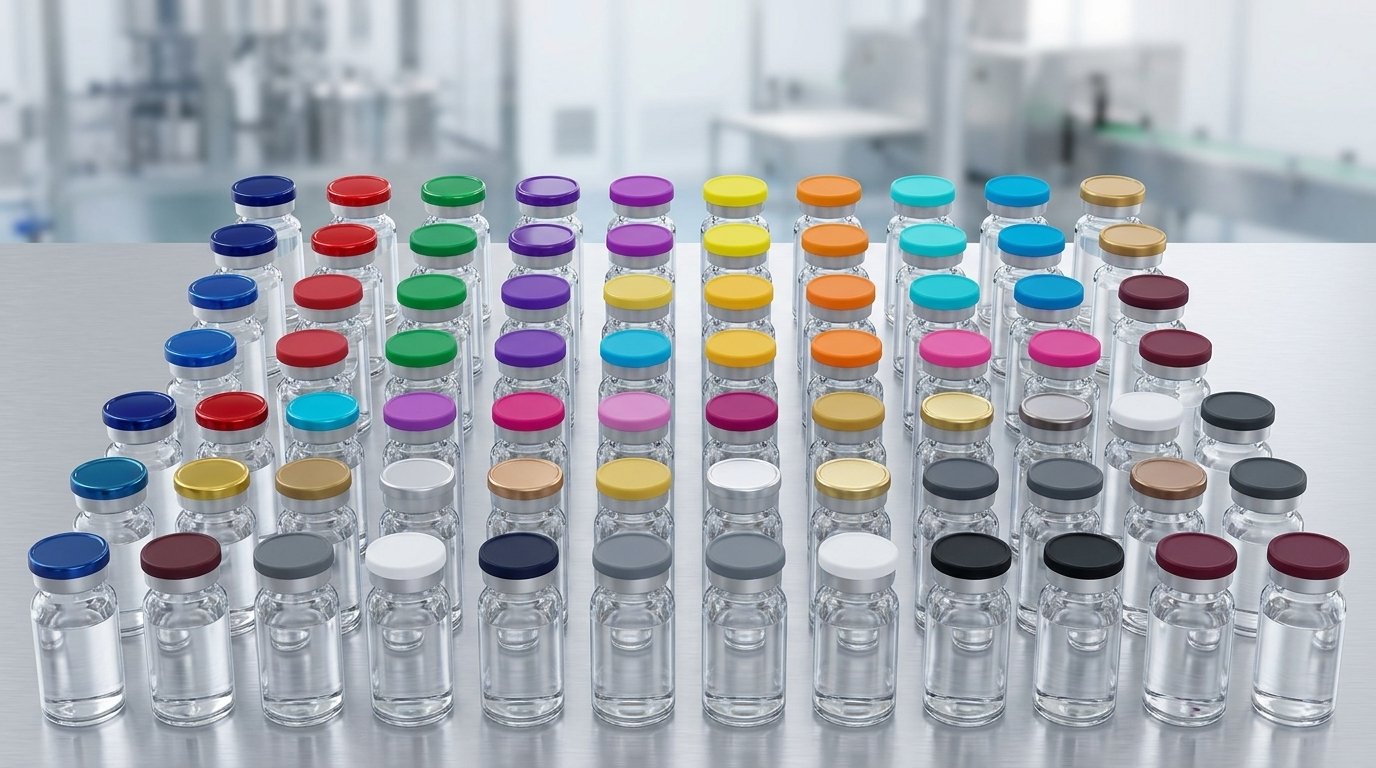
Autofits supplies pharmaceutical vial seals in a wide range of colours, in matte or glossy finish, customised to requirement, across every product line from 13 mm flip-off seals to 38 mm pilfer-proof caps, with printing on both the aluminium and the polypropylene disc, and embossing or debossing. Seal colour is a practical tool for telling products and strengths apart and for reducing line errors. There is no single global mandatory colour standard, so the colour scheme is set by the manufacturer, a regional convention or the customer, and some markets reserve a specific colour by rule.
This page lets you browse colour by product line, shows which part of each seal carries the colour, sets out the colour-coding convention as it affects an order, and explains how to specify colour alongside size and design.
Key takeaways
- Vial seal colour is used for product differentiation, strength coding, line clarity, error reduction and branding.
- There is no single global mandatory colour standard for vial seals; colour coding is set by the manufacturer, a regional convention or the customer.
- Every Autofits line is available in a wide range of colours, matte or glossy, customised to requirement: FlipTop Optima, Pull Ring and Tear-Down, all-aluminium tear-off and tear-down, and aluminium pilfer-proof (ROPP) caps.
- On aluminium-plastic seals colour can sit on the polypropylene disc, the aluminium, or both; on all-aluminium seals and ROPP caps it comes from pigmented epoxy lacquer.
- Seals can be printed and embossed or debossed, which carries point-of-use instructions and supports authentication.
- Some colours are reserved by rule in some markets: in the US, a black cap and ferrule is used only for concentrated potassium chloride.
- Custom colours are typically ordered from 100,000 pieces, with a lead time of typically 4 to 6 weeks including artwork approval, both confirmed with the quotation.
Browse colour by product line
Every product line takes colour, but the part of the seal that carries it and the finishes available differ by construction.
| Product line | Sizes | Where the colour sits | Finishes and marking |
|---|---|---|---|
| FlipTop Optima flip-off (Bridge, Button, Flower) | 13, 20, 28, 32, 34 mm | Polypropylene disc or button, and optionally the aluminium | Glossy, matte, embossed or printed |
| FlipTop Pull Ring | 20, 32 mm | Polypropylene disc, and optionally the aluminium | Matte or glossy; print and emboss confirmed per design |
| FlipTop Tear-Down | 13, 20, 32 mm | Polypropylene disc riveted to the aluminium, and optionally the aluminium | Matte or glossy; print and emboss confirmed per design |
| All-aluminium tear-off | 13, 20, 32 mm | Pigmented lacquer on the aluminium | Matte or glossy; print and emboss confirmed per design |
| All-aluminium tear-down | 20 mm | Pigmented lacquer on the aluminium | Matte or glossy; print and emboss confirmed per design |
| Aluminium pilfer-proof (ROPP) caps | 22, 25, 28, 35, 38 mm | Pigmented lacquer on the aluminium shell | Plain, printed or chamfered |
Choosing between lines by colour. The aluminium-plastic lines give the largest coloured area a user sees, because the disc sits on top of the vial and is visible across a tray before the label is read. That makes FlipTop Optima the usual line where colour does identification work on injectables. All-aluminium seals carry colour in the lacquer only, which suits a single house colour or a subtle distinction rather than a strength ladder. ROPP caps carry colour around the whole shell, which works for oral liquid bottles on a shelf.
Two colour surfaces on one seal. On an aluminium-plastic seal the disc and the aluminium can be specified separately, so a range can hold one aluminium colour across a product family and change only the disc colour per strength, or use both surfaces to build more distinct combinations than disc colour alone gives. Specify both on the order, even when the aluminium is left plain.
Why colour matters on vial seals
On a filling line and at the point of use, the seal colour is the fastest visual cue for telling one product or strength from another. A vial seal is small and the label carries most of the detail, but the colour of the cap is visible across a tray, a fridge shelf or an anaesthetic trolley before anyone reads the text. The main reasons to use it:
- Product differentiation: distinguishing different drugs, presentations or pack types at a glance.
- Strength and concentration coding: giving each strength of the same drug its own colour to reduce selection errors.
- Line clarity: helping operators confirm that the right seal is running on the right product during changeovers.
- Error reduction: supporting the human checks that prevent the wrong vial being picked where look-alike strengths sit side by side, such as emergency drug trays, anaesthetic trolleys and diagnostic reagent panels.
- Branding: carrying a house colour or a product family identity across a range and across neck sizes, as on veterinary ranges.
There is no single global colour standard
Vial seal colours are not fixed worldwide. There is no single global mandatory colour standard that assigns a specific drug or strength to a specific colour everywhere. Instead, colour coding is set at one of three levels: by the manufacturer as an internal convention across its own portfolio; by a regional rule or professional convention where one exists for a drug class; or by the customer specifying a colour for a particular product. Because the convention is not universal, the colour scheme is agreed per product and per market rather than assumed. When you specify a seal, treat the colour as part of the artwork, defined by your own standard or your market’s convention, and confirmed on the order.
The colour-coding convention, as it affects your order
For a seal order, the convention comes down to four checks: who owns the scheme, whether the market reserves a colour, what the top of the seal may carry, and whether the scheme has to travel across markets. The reasoning behind each, and the limits of relying on colour at all, is set out in seal colour coding in pharma.
| Check | What it means for the specification |
|---|---|
| Who owns the colour scheme | The marketing-authorisation holder sets it; Autofits reproduces the specified colour and does not assign meanings to colours |
| Does the market reserve a colour | In the US, a black cap overseal and black ferrule are used only for Potassium Chloride for Injection Concentrate, so black is not specified for any other product sold there |
| What the top surface may carry | In the US, the top of the ferrule and cap overseal is kept for cautionary statements, such as the warning required on neuromuscular blocking agents; print other text elsewhere or leave the top blank |
| Does the scheme travel | A colour that means something in one market or hospital system may mean nothing in another, so an export range documents its scheme per market |
Vial seal colour coding is also not the blood-collection tube colour code. The coloured stoppers on blood tubes identify the additive inside a laboratory sample tube, which is a separate convention with nothing to say about injectable vial seals.
Colour, finish and marking capability
Colour is produced by pigmenting the epoxy lacquer that coats the aluminium and by the colour of the moulded polypropylene disc, so the colour is part of the component rather than a separate add-on.
What can be coloured and marked:
- Colour range: a wide range of colours, customised to requirement, matched against a physical sample or a colour reference you supply.
- Finish: matte or glossy, specified per order.
- Lacquer coloration: the epoxy lacquer, which conforms to 21 CFR 175.300, is pigmented to achieve the aluminium colour.
- Printing: on both the aluminium seal and the polypropylene disc.
- Embossing and debossing: raised or recessed marking, using Autofits’ own embossing and debossing process.
Printing and embossing on the seal and the disc do more than carry a colour. They can hold point-of-use instructions (for example, a short directive on the disc that the user sees when handling the vial), and they support authentication and counterfeit deterrence by carrying marks that are harder to copy than a printed label alone. For US-market vials, keep in mind that the top surface is reserved for cautionary statements (see the table above).
Matching a specific shade
To match a shade, send a physical sample or a colour reference with the seal size, design, finish and any artwork, and the colour options for your order are confirmed against it. The steps, what the reference should be and how approval works are set out on the vial seal colour chart resource.
Custom colour, print or emboss is typically ordered from 100,000 pieces, against typically 50,000 pieces per size and colour for standard designs. Lead time for a custom colour or print is typically 4 to 6 weeks, including artwork approval, and both figures are confirmed with the quotation. Send the request through the contact page.
How colour fits with size and design
Colour is one axis of a seal specification; size and design are the others. Once the colour and finish are agreed, the rest of the specification follows the same per-order pattern:
- By size: choose the neck finish from the by-size hub, 13 mm to 34 mm for vial seals.
- By design: choose the closure family and opening action from the product lines in the table above.
- By colour and marking: specify the disc colour, the aluminium colour, the finish, printing and embossing, confirmed against your reference.
All three are set together on the order so the seal matches the vial neck, the opening action and the colour scheme for the product.
Frequently asked questions
What colours do Autofits vial seals come in?
Autofits seals are available in a wide range of colours, in matte or glossy finish, customised to requirement, across the FlipTop Optima, Pull Ring and Tear-Down lines, the all-aluminium tear-off and tear-down seals, and aluminium pilfer-proof caps. Rather than a fixed swatch list, colours are matched against a customer sample or reference and confirmed per order.
Is there a standard colour code for vial seals?
No. There is no single global mandatory colour standard that assigns a specific drug or strength to a specific seal colour everywhere. Colour coding is set by the manufacturer as an internal convention, by a regional rule or convention where one exists, or by the customer for a particular product. In the US, for example, a black cap and ferrule is reserved for concentrated potassium chloride.
Why are vial seals colour coded?
Colour coding helps differentiate products and strengths at a glance, gives line operators a quick check during changeovers, reduces the risk of selecting the wrong vial in a clinical setting, and carries brand or product-family identity. The seal colour is often the fastest visual cue before anyone reads the label.
Is vial seal colour coding the same as blood tube colour coding?
No. Blood collection tubes use stopper colours to identify the additive in a laboratory sample tube. Injectable vial seal colours follow the drug manufacturer’s own scheme or a regional convention, and a blood tube colour carries no meaning on a medicine vial.
Can you print or emboss on the seal?
Yes. Autofits prints on both the aluminium seal and the polypropylene disc, and can emboss or deboss. Marking can carry point-of-use instructions, support authentication and act as a counterfeit deterrent, alongside the seal colour.
Can you match a specific brand colour?
Yes. Send a physical sample or a colour reference and the colour is matched against it, in matte or glossy finish. The epoxy lacquer is pigmented to achieve the aluminium colour, and exact colour options are confirmed per order.
Where do I choose the colour when ordering?
Colour, finish, printing and embossing are specified per order, alongside the seal size and design. Choose the size from the by-size hub and the design from the product lines, then specify the disc and aluminium colours and any marking against your reference.
Related reading
- Seal colour coding in pharma: what the convention is and is not
- Vial seal colour chart
- FlipTop Optima flip-off seals
- FlipTop aluminium-plastic seals
- Aluminium pilfer-proof (ROPP) caps
- Vial seals by size, 13 mm to 34 mm
Sources
- U.S. FDA: Safety Considerations for Container Labels and Carton Labeling Design to Minimize Medication Errors, Guidance for Industry, May 2022 (https://www.fda.gov/media/158522/download)
- USP-NF: General Chapter <7>, Labeling, section on Ferrules and Cap Overseals (https://www.uspnf.com/)
- ISO: ISO 8362-6:2010, Injection containers and accessories, Part 6: Caps made of aluminium-plastics combinations for injection vials (https://www.iso.org/standard/52806.html)
- Autofits FlipTop Seals dossier and engineering drawings
*Last updated: 2026-09-15. This page is general technical information, not regulatory or compliance advice; confirm colour-coding and labelling requirements for your product and market with the applicable authority.*
