
Cell and Gene Therapy Vial Seals and Closures
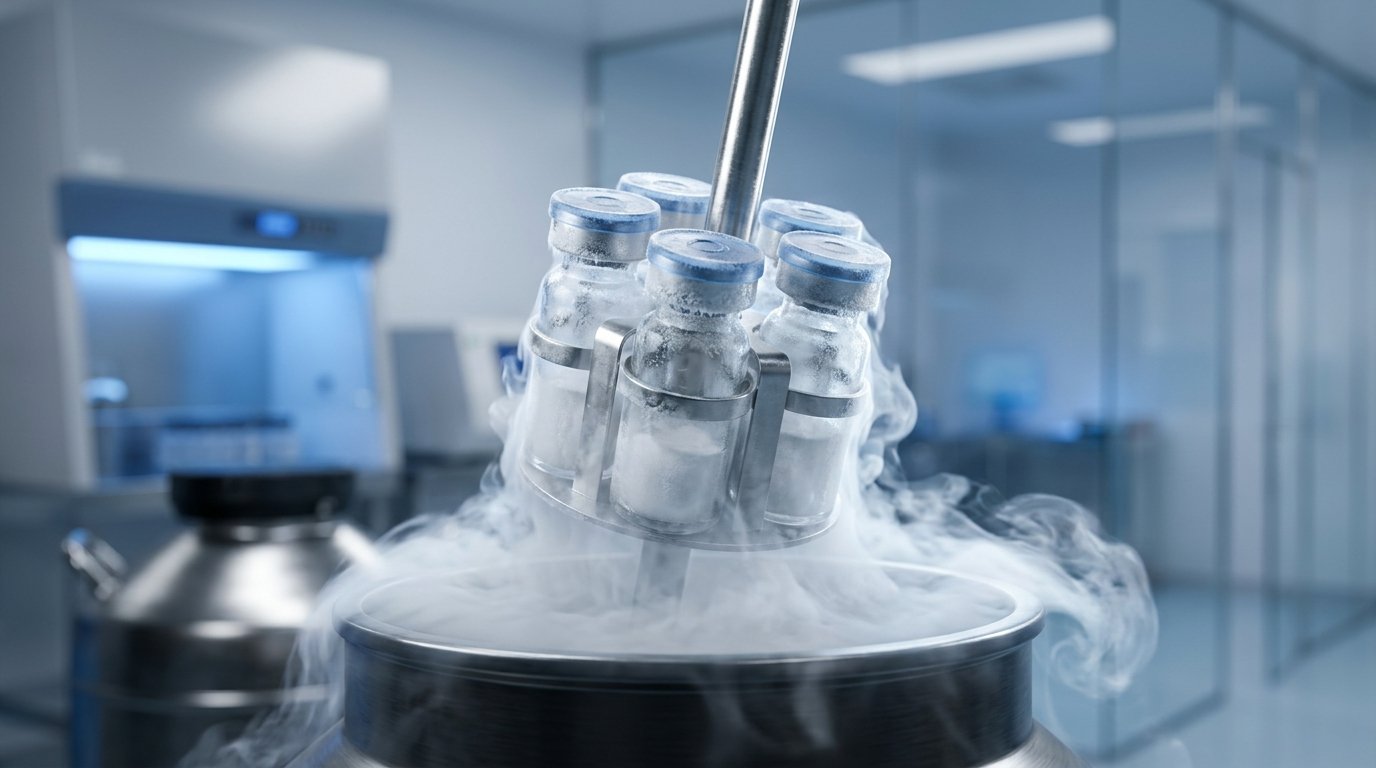
A cell therapy vial seal has to hold container closure integrity at temperatures far below anything a conventional injectable sees, because cell products are stored in vapour-phase liquid nitrogen at or below -150 °C and viral-vector gene therapies are typically held between -60 °C and -80 °C. At those temperatures the elastomeric stopper is no longer elastic, so the residual seal force delivered by the aluminium crimp becomes the thing keeping the container closed.
This page is for advanced-therapy process development, packaging and quality teams choosing a closure for a cryopreserved product. It covers the storage conditions, what cryogenic temperature does to a container-closure system, the aseptic small-batch reality of these fills, the Autofits closures that fit, and the qualification work that stays with the product owner.
Key takeaways
- Storage is the defining constraint. Cryopreserved cell products are held in vapour-phase liquid nitrogen at or below -150 °C; viral-vector and plasmid-based products commonly sit at -60 °C to -80 °C.
- The elastomer stops being a rubber. Butyl and halobutyl stoppers have glass-transition temperatures in the region of -60 °C, below which they behave as rigid glassy solids and cannot deform to take up gaps.
- Materials contract unequally. Aluminium’s coefficient of thermal expansion is roughly seven times that of Type I borosilicate glass, so the crimp geometry at storage temperature is not the geometry at capping.
- Vials are not the only format. Cryobags dominate autologous cell suspensions; vials are used for allogeneic doses, viral vectors, plasmids and small-volume high-value fills.
- These products cannot be terminally sterilised, so aseptic processing runs end to end and pre-sterilised Ready-to-Use closures reduce bioburden and particle load in the fill suite.
- Cryogenic performance is a product-owner qualification. Autofits publishes dimensional and material data to support it; it does not publish a cryogenic closure qualification, and no supplier’s data replaces testing at your own condition.
What cell and gene therapy products demand of a container
Advanced therapy products are living cells, viral vectors or nucleic acids, preserved by freezing rather than by drying or by preservatives, so the container-closure system spends its shelf life at cryogenic or deep-frozen temperature. That single fact reorders every closure priority.
Autologous cell therapies, where a patient’s own cells are engineered and returned, are typically cryopreserved in a dimethyl sulfoxide-containing medium and held in vapour-phase liquid nitrogen, and allogeneic cell products follow the same route. Adeno-associated virus and lentiviral vector products, and the plasmid and messenger RNA intermediates behind them, are more commonly held at -60 °C to -80 °C. The regulatory frameworks reflect the specialised handling: the European Union publishes dedicated good manufacturing practice for advanced therapy medicinal products as Part IV of EudraLex Volume 4, the US FDA has issued chemistry, manufacturing and control guidance for human gene therapy investigational applications, and India’s National Guidelines for Gene Therapy Product Development and Clinical Trials are published by the Indian Council of Medical Research with the Department of Biotechnology. Confirm the applicable route before fixing a specification.
The commercial shape is unusual too. A batch may be a handful of vials, and for an autologous therapy the batch is one patient’s only dose, so a closure failure is not a yield problem but a treatment failure. That inverts the cost logic of a commodity fill like an IV diluent: here the closure is chosen for consistency and documentation support, and unit price is close to irrelevant. Across the rest of the applications hub that trade-off usually runs the other way.
What cryogenic temperature does to a closure
Cooling a sealed vial to -150 °C changes the mechanics of the seal, because the three materials in the system contract at different rates and the one that was supposed to be compliant stops being compliant.
The elastomer goes first. Butyl and halobutyl formulations, the standard materials for injectable stoppers, have glass-transition temperatures in the region of -60 °C, with the exact value depending on the compound. Below that point the stopper is a rigid glassy solid rather than a rubber. It can no longer flow into the microscopic irregularities of the glass sealing surface or respond to small dimensional changes elsewhere in the assembly. The material differences are set out on the butyl versus EPDM stopper page and the butyl rubber stopper glossary entry.
Then the geometry moves. Aluminium’s coefficient of thermal expansion is roughly seven times that of Type I borosilicate glass, so over a temperature drop of more than 170 K the aluminium skirt shrinks appreciably more than the glass neck it is crimped around. Whether that raises or lowers compression on the stopper depends on the specific geometry, which is why it has to be measured rather than reasoned. What holds generally is that the residual seal force at storage temperature is not the force measured at capping, and the crimp now carries the load the elastomer used to share.
Thermal cycling adds the third effect. A vial pulled from storage, thawed and in some workflows briefly returned, crosses the elastomer’s transition each time. Consistency across cycles depends on dimensional consistency in the seal, because a crimp formed on an out-of-tolerance skirt has less margin to give away.
One practical point often gets missed: the closure is normally opened after a controlled thaw, not while frozen. The cryogenic duty is a storage and transport duty, so opening force and button ergonomics are specified for the thawed condition. What has to survive the cold is the seal, not the mechanism.
Aseptic processing and the sterile closure
Living cells cannot be terminally sterilised, so an advanced therapy fill is aseptic end to end and every component entering the grade A area has to arrive sterile and clean. That makes the closure’s form of supply a process decision rather than a convenience.
Ready-to-Use seals are assembled and washed in an ISO Class 8 cleanroom, double-lacquered, gamma or ethylene-oxide sterilised and double-bagged for entry into aseptic areas, with a 2-year shelf life before capping. For a small-batch advanced therapy suite that removes an in-house washing and sterilisation step, along with the validation and operator interventions attached to it, which is the direction EU GMP Annex 1 pushes contamination control strategy. Particle control matters here because fill volumes are small and visual inspection of a cell suspension is harder than inspection of a clear solution. The mechanics of aseptic sealing are covered on the sterile vial sealing page.
Annex 1 also expects the capping step to be controlled and sealed containers inspected, since a defective seal is an integrity risk rather than a cosmetic one.
Which Autofits seals fit cell and gene therapy vials
Advanced therapy vials sit at the small end of the range, so the 13 mm and 20 mm FlipTop® Optima flip-off seals are the relevant options, supplied Ready-to-Use for aseptic fills.
- FlipTop® Optima flip-off, 13 mm: the common size for small cryopreserved fills. Inner aluminium diameter 13.36 mm minimum, inner aluminium height 6.15 to 6.40 mm, total seal height 7.62 to 8.38 mm, aluminium thickness 0.16 to 0.20 mm, six taper bridges, maximum opening force 30 N.
- FlipTop® Optima flip-off, 20 mm: for larger vector and allogeneic presentations. Inner aluminium diameter 20.22 mm minimum, inner aluminium height 7.37 to 7.62 mm, total seal height 9.02 to 9.91 mm, six taper bridges, maximum opening force 35 N.
- Button-type Optima: carries intrinsic tamper evidence through a 12-stem flower formed under the button disc, useful where chain-of-custody records for an autologous dose need a visible physical state to match.
Material declarations supporting a qualification file cover AA8011 aluminium alloy, an epoxy lacquer conforming to 21 CFR 175.300, a polypropylene disc conforming to 21 CFR 177.1520 and IS 10910 / IS 10909, heavy metals limited to 100 ppm total for chrome-VI, cadmium, mercury and lead, and a BSE/TSE-free declaration under EMEA/410/01 rev.3. Disc colour helps separate product from control or diluent within a cryo box.
What Autofits does not claim, and what you need to qualify
Autofits does not publish a cryogenic qualification for its seals. The closure system for an advanced therapy has to be qualified by the product owner at the actual storage condition, cycle count and orientation. Stating that plainly is more useful than a reassurance that would not survive an audit.
The supplier can contribute the data that makes the qualification tractable: dimensional drawings with tolerances, material declarations, batch consistency records, AQL evidence and the ISO 15378:2017 quality system behind them. The product owner generates the container closure integrity data, at the storage temperature and after the intended number of thermal cycles. USP <1207> sets out the deterministic and probabilistic method families and the lifecycle approach, and the practical choices are compared on the container closure integrity testing page. Test at the condition, not at ambient after warming, because a system that leaks at -150 °C can seal perfectly well by the time it reaches the bench.
Frequently asked questions
What is a cell therapy vial seal?
A cell therapy vial seal is the aluminium-plastic closure crimped over the stopper of a cryopreserved cell or gene therapy vial. Its defining requirement is holding container closure integrity at cryogenic storage temperature, where the elastomeric stopper has passed below its glass-transition point and the residual seal force from the aluminium crimp is what keeps the stopper compressed against the glass.
Can standard flip-off seals be used at liquid nitrogen temperatures?
The construction is used on deep-frozen product, but suitability at any given cryogenic condition is a qualification question, not a catalogue question. The elastomer stiffens below roughly -60 °C, and aluminium contracts around seven times as much as borosilicate glass over the same temperature drop, so the compression at storage temperature differs from the compression at capping. Qualify the whole container-closure system at your actual storage temperature and thermal-cycle count.
Why is the stopper the limiting component at cryogenic temperature?
Butyl and halobutyl elastomers have glass-transition temperatures in the region of -60 °C. Below that they behave as rigid glassy solids rather than as rubbers, so they cannot deform into the microscopic irregularities of the glass sealing surface or absorb small dimensional changes in the assembly. The crimped aluminium seal then carries the load that the elastomer’s compliance used to share, which is why the crimp quality and the seal’s dimensional consistency matter more here than in a room-temperature application.
Do cell and gene therapy products always use vials?
No. Autologous cell suspensions are frequently cryopreserved in bags rather than vials, because bags suit larger volumes and controlled-rate freezing. Vials are used for allogeneic doses, viral-vector products, plasmid and messenger RNA intermediates, and small-volume high-value fills. The closure discussion on this page applies to the vialled presentations.
Should closures for advanced therapies be supplied sterile?
Usually yes. Living cells cannot be terminally sterilised, so the fill is aseptic throughout and every component entering the grade A area must arrive sterile. Ready-to-Use seals are assembled and washed in an ISO Class 8 cleanroom, gamma or ethylene-oxide sterilised and double-bagged, which removes an in-house washing and sterilisation step and the interventions that go with it.
What data does Autofits provide to support a cryogenic qualification?
Dimensional drawings with tolerances, material declarations covering the AA8011 aluminium alloy, epoxy lacquer and polypropylene disc, heavy-metal limits, a BSE/TSE-free declaration, AQL and inspection evidence, and the ISO 15378:2017 quality system documentation. The container closure integrity testing at cryogenic temperature remains the product owner’s exercise, run against USP <1207> method families at the actual storage condition.
Related reading
- Vial sealing applications hub
- Biologics vial seals and closures
- Lyophilised products vial seals
- Vial closures for cold-chain drugs
- Container closure integrity testing
- Butyl versus EPDM stoppers
- FlipTop® Optima flip-off seals
Sources
- Autofits FlipTop Seals dossier and engineering drawings (working/spec-sheets/)
- EudraLex Volume 4, Part IV: GMP for Advanced Therapy Medicinal Products (https://health.ec.europa.eu/)
- US FDA: Chemistry, Manufacturing, and Control (CMC) Information for Human Gene Therapy Investigational New Drug Applications (https://www.fda.gov/)
- Indian Council of Medical Research and Department of Biotechnology: National Guidelines for Gene Therapy Product Development and Clinical Trials (https://www.icmr.gov.in/)
- EudraLex Volume 4, EU GMP Annex 1, Manufacture of Sterile Medicinal Products (https://health.ec.europa.eu/)
- USP-NF: General Chapter <1207>, Package Integrity Evaluation, Sterile Products (https://www.usp.org/)
- ISO: ISO 15378:2017, Primary packaging materials for medicinal products, GMP requirements (https://www.iso.org/standard/70729.html)
- Standard engineering reference data for the coefficients of thermal expansion of aluminium alloy and Type I borosilicate glass
*Last updated: 2026-07-31. This page is general technical information, not regulatory or compliance advice. Cryogenic container closure integrity must be qualified by the product owner at the actual storage condition; confirm current standard editions and your own specification with Autofits and the issuing bodies.*
