
Butyl vs EPDM Stopper: Barrier, Reseal and Chemical Compatibility
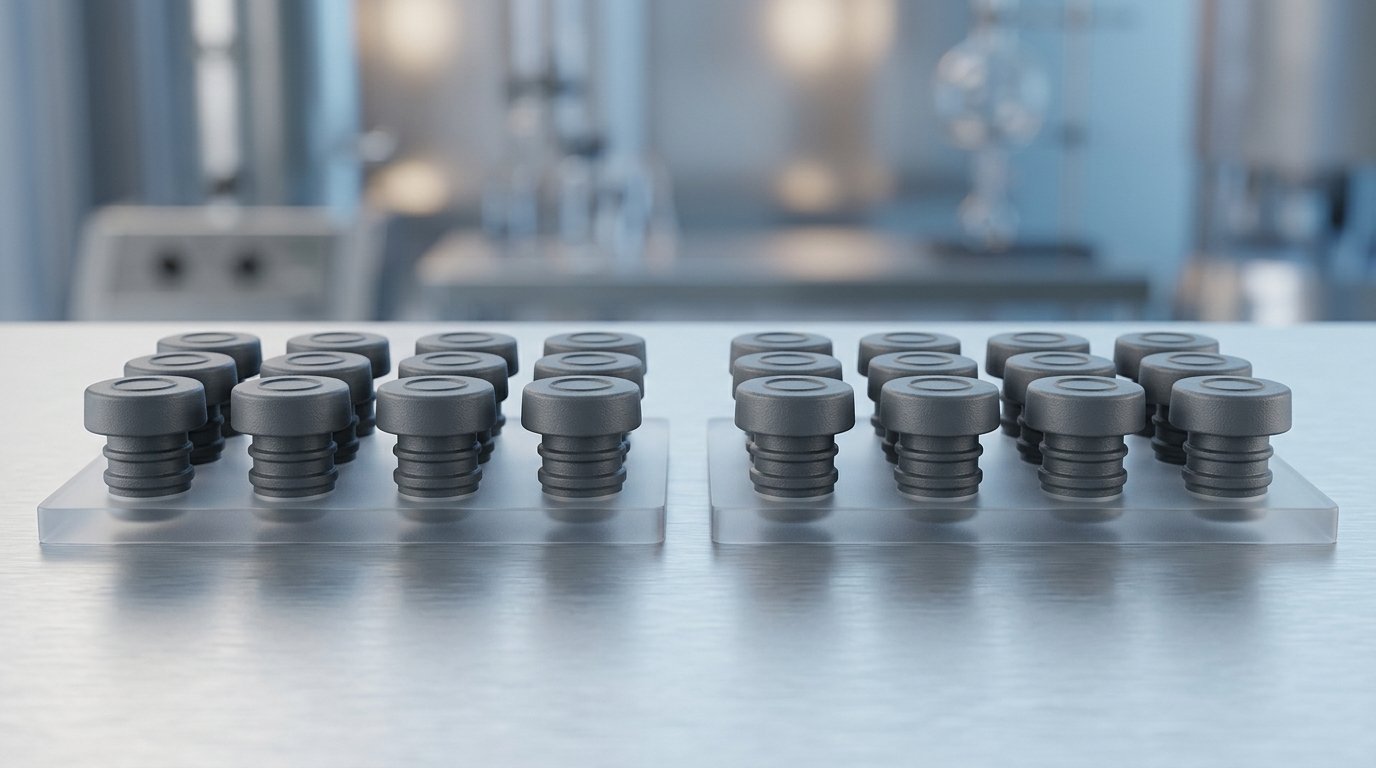
Butyl (and halobutyl) rubber is the standard elastomer for injectable vial stoppers because it has a very low permeability to moisture and gases, while EPDM offers excellent heat, ozone, and chemical resistance but a weaker moisture and gas barrier, so butyl dominates parenteral closures and EPDM is chosen where chemical or thermal resistance is the priority. Both are elastomers that can seal, be pierced, and reseal, so both can function as a closure; the deciding property for a vial stopper is the barrier, and that is where butyl leads. EPDM’s strengths lie elsewhere, in resistance to heat, ozone, and certain polar chemicals, which makes it a specialist choice rather than the mainstream parenteral stopper material. Neither choice changes the seal size: a 20 mm stopper of either compound takes a 20 mm aluminium seal.
This page compares butyl and EPDM elastomers for vial stoppers on moisture and gas barrier, resealing, and chemical compatibility, explains where each fits, and sets out what each one means for the aluminium seal crimped over it.
Key takeaways
- Butyl (and halobutyl) rubber is the standard for injectable vial stoppers, chosen for very low moisture and gas permeability.
- EPDM (ethylene propylene diene monomer) offers strong heat, ozone, and polar-chemical resistance but a weaker moisture and gas barrier than butyl.
- Barrier is the deciding property for a parenteral stopper, so butyl dominates; EPDM is used more where chemical or thermal resistance matters most.
- Both reseal: each is elastic enough to close a needle track, but butyl’s barrier keeps oxygen and moisture out of the drug over shelf life.
- Chemical compatibility differs by formulation; the stopper compound is always qualified against the specific drug product, not assumed from the family.
- A butyl rubber stopper is an elastomeric closure qualified under USP <381> for material and USP <382> for function; the aluminium seal crimps over whichever stopper is chosen.
- Seal size does not change with compound: the match stays one to one at 13, 20, 28, 32 and 34 mm. What can change is the seated stopper height and the residual force the crimp leaves behind.
What is the difference between butyl and EPDM stoppers?
The core difference is barrier versus resistance: butyl rubber has one of the lowest gas and moisture permeabilities of any common elastomer, which protects the drug, while EPDM is prized for heat, ozone, and polar-chemical resistance but lets more gas and moisture through than butyl. Both are synthetic elastomers, and both can be moulded into a stopper that seats in a vial, is pierced by a needle, and reseals. The choice between them comes down to which property the application most needs.
For a sterile injectable, the closure has to protect an oxygen- or moisture-sensitive drug across a long shelf life, so the low permeability of butyl is decisive. For an application dominated by heat cycling, ozone exposure, or contact with certain polar chemicals, EPDM’s resistance profile can be the better fit. Because a vial stopper is a primary drug-contact component, the specific compound is always qualified against the formulation regardless of the family. The comparison below breaks the choice into the properties that matter.
Moisture and gas barrier
Butyl rubber is the benchmark for low permeability: its tight molecular structure strongly resists the passage of oxygen and water vapour, which is exactly what a drug closure needs to protect sensitive and freeze-dried products through shelf life. This is the single biggest reason butyl became the standard for parenteral stoppers, replacing natural rubber, which is more permeable.
EPDM has a good all-round property set but a weaker moisture and gas barrier than butyl. It lets more oxygen and water vapour through, which is a disadvantage precisely where a vial stopper has to perform: keeping air and moisture away from the drug. For products that degrade on exposure to oxygen or that must stay dry, the barrier gap makes butyl the safer default and pushes EPDM toward applications where the barrier is less critical than its other properties.
Resealing and elasticity
Both butyl and EPDM are elastic enough to be pierced by a needle and recover to close the puncture, so both can reseal, but butyl’s combination of resealing and low permeability is what makes it suited to multiple-entry injectable vials. Self-sealing is a functional property evaluated under USP <382>, and a stopper of either family must be qualified for it against the vial and seal.
The practical point is that resealing alone does not decide the material, because both families can do it. What tips the choice for injectable vials is that butyl reseals and holds a strong barrier, so a multi-dose vial under its serum vial seal stays protected between entries. EPDM can reseal too, but without butyl’s barrier the container is less able to keep gases and moisture out over the in-use and shelf life, so its resealing advantage does not offset the barrier gap for most parenteral uses.
Chemical compatibility, heat and ozone
EPDM’s strengths are resistance to heat, ozone, weathering, and many polar chemicals, whereas butyl also has good chemical resistance and is the more proven parenteral contact material; in both cases compatibility with the specific drug is confirmed by testing, not assumed. This is where EPDM earns its place: applications with aggressive thermal cycling, ozone exposure, or contact with certain polar substances can favour EPDM’s resistance.
For pharmaceutical vial stoppers specifically, though, chemical compatibility is always established for the exact formulation through extractables and leachables work and functional qualification. Neither family is universally “compatible”: a butyl or halobutyl compound is matched to the drug, sometimes with a fluoropolymer-coated drug-contact surface to further reduce extractables. EPDM’s resistance profile is real, but it does not by itself qualify a stopper for a given drug; that always requires product-specific testing. Because butyl combines a strong barrier with a long track record in parenterals, it remains the default, with EPDM reserved for cases where its particular resistances are the governing need.
Butyl vs EPDM: the comparison
For injectable vial stoppers, butyl wins on the property that matters most (barrier), while EPDM leads on heat and ozone resistance; the right material is set by the application and confirmed by testing.
| Property | Butyl / halobutyl | EPDM |
|---|---|---|
| Moisture and gas barrier | Very low permeability (strong barrier) | Weaker barrier than butyl |
| Resealing after puncture | Yes | Yes |
| Heat and ozone resistance | Good | Excellent |
| Polar-chemical resistance | Good | Excellent |
| Parenteral track record | The standard for injectable stoppers | Specialist / less common for primary closures |
| Typical use for vial stoppers | Mainstream injectable and freeze-dried products | Where heat, ozone, or specific chemical resistance dominates |
| Aluminium seal required | Same nominal size as the neck | Same nominal size as the neck |
The table shows why butyl is the default for injectable stoppers: the barrier requirement outweighs EPDM’s resistance strengths for most drug products. EPDM is not inferior in general, it is optimised for different conditions. On the last row, the two families are identical: the seal is specified against the neck finish, not against the rubber.
Which is used for vial stoppers
Butyl and halobutyl rubber are used for the large majority of injectable vial stoppers, because low permeability is the governing requirement for protecting a parenteral drug, while EPDM appears where its heat, ozone, or chemical resistance is more important than the barrier. In practice, when a specification calls for a rubber stopper on an injectable vial, it is almost always a butyl or halobutyl compound.
That is why butyl is the reference case for parenteral closures, and why EPDM is discussed as an alternative for specific conditions rather than a like-for-like substitute. Whichever elastomer is selected, it is qualified as a material under USP <381> and functionally under USP <382>, and it is only one part of the container closure system: the stopper still has to be held in the vial by a crimped seal. The wider material field, including bromobutyl, chlorobutyl and silicone, is surveyed in vial closure rubber types.
Which aluminium seal suits each stopper
The seal is selected against the vial neck finish, not against the elastomer, so a butyl stopper and an EPDM stopper of the same nominal size take the same seal. Autofits supplies matching seals across 13, 20, 28, 32 and 34 mm, and the pairing is one to one: a 13 mm stopper on a 13 mm ISO 8362-1 neck takes a 13 mm seal, and so on up the range.
| Stopper and neck size | Inner Ø aluminium seal (D1) | Outer Ø plastic disc (D2) | Inner aluminium height | Total seal height | Bridges | Max opening force | Size page |
|---|---|---|---|---|---|---|---|
| 13 mm | 13.36 mm (min) | 14.99 mm (max) | 6.15–6.40 mm | 7.62–8.38 mm | 6 taper | 30 N | 13 mm seals |
| 20 mm | 20.22 mm (min) | 23.14 mm (max) | 7.37–7.62 mm | 9.02–9.91 mm | 6 taper | 35 N | 20 mm seals |
| 28 mm | 27.60–28.20 mm | 30.10–31.10 mm | 8.70–9.30 mm | 11.06–12.06 mm | 8 | 35 N | 28 mm seals |
| 32 mm | 32.10–32.90 mm | 35.50–36.50 mm | Available on request | 14.30–15.50 mm | 12 taper | 65 N | 32 mm seals |
| 34 mm | 33.60–34.00 mm | 35.50–36.50 mm | Available on request | 15.00–16.00 mm | 8 taper | Available on request | 34 mm seals |
Where the two families do diverge is in the seal format that suits the presentation. A terminally steam-sterilised product running an EPDM stopper for its autoclave behaviour is often a large-volume or veterinary presentation, which points at the 32 and 34 mm end of the FlipTop Optima range or at an all-aluminium tear-off seal where no plastic disc is wanted in the cycle. A halobutyl stopper on a routine vaccine or small-molecule fill is almost always 13 or 20 mm flip-off. Oral presentations on either compound are candidates for a pull-ring or tear-down seal, where the whole seal detaches rather than a button lifting.
What crimping a harder or softer elastomer means for the seal
Compound hardness changes what the crimp achieves at a fixed machine setting, so a stopper change is a reason to re-verify capping even when the nominal dimensions have not moved. The crimp rolls the aluminium skirt under the vial neck flange and leaves the stopper under a residual compressive load. How much load survives depends on the rubber, not on the aluminium.
A harder compound resists deformation, so at a given capping-head setting it compresses less and sits taller when seated. Two consequences follow. The seal’s inner aluminium height, which runs from 6.15–6.40 mm at 13 mm to 8.70–9.30 mm at 28 mm, has to accommodate that seated height, or the skirt lands high on the neck and the crimp is shallow. And the contact stress between rubber and glass can end up lower than intended, because the harder compound has not been pushed as far into the sealing surfaces.
A softer compound is the mirror image. It compresses further at the same setting, which usually gives a generous initial seal, but soft compounds tend to relax more over time. Compression set, the fraction of deformation a rubber does not recover after a sustained load, is the property that governs this: a compound with high compression set keeps deforming under the crimp and gives back load across shelf life, so a package that passed at capping can drift. That drift is invisible on a dimensional check and shows up only in integrity testing.
Crimp force itself is a machine parameter on the customer’s capping head, established during capping qualification rather than supplied as a seal attribute. What Autofits controls is the dimensional envelope the crimp works within: aluminium thickness of 0.16–0.20 mm at 13 and 20 mm, 0.17–0.23 mm at 28 mm, 0.21–0.25 mm at 32 mm and 0.20–0.25 mm at 34 mm, held under 100% high-speed camera inspection.
The result is verified rather than assumed. Container closure integrity testing on the assembled package is what confirms the pairing works, and USP <1207> sets out the deterministic and probabilistic method families used for it. Material-side requirements stay with USP <381>, which is also where fragmentation testing sits. The full mechanical treatment is in pairing the rubber stopper and aluminium seal, and the capping parameters in vial crimping explained.
Forms of supply, shelf life and packing
Whichever elastomer the filler has qualified, the Autofits seal that goes over it is available in three forms. Regular is the standard non-sterile presentation. Ready-to-Use is sterilized by gamma irradiation or by ETO, washed to control particles, assembled in an ISO Class 8 cleanroom and supplied double-bagged for transfer into an aseptic area. Ready-to-Sterilize is supplied clean and bagged for the customer’s own cycle. Tyvek bagging is available in place of the standard bag.
Shelf life is 3.5 years before capping for non-irradiated seals, plus a further 5 years after capping, and 2 years before capping for Ready-to-Use. Standard packing per box is 15,000 at 13 mm (5,000 in each of three bags), 6,000 at 20 mm (2,000 × 2), 3,000 at 28 mm (1,500 × 2) and 1,400 at 32 mm (700 × 2), in a 420 × 270 × 320 mm shipper. Packing at 34 mm is available on request.
To request a seal against a stopper you have already qualified, send the nominal neck finish, the stopper reference, the seal family and top design, and the form of supply through the contact page. Samples and drawings are available on request, as are minimum order quantities and lead times.
Where the aluminium seal fits at Autofits
Autofits manufactures the aluminium and aluminium-plastic seals that crimp over the rubber stopper, whether that stopper is a butyl, halobutyl, or (in specialist cases) EPDM compound; it does not manufacture the stopper itself. The seal’s job is the same regardless of the elastomer chosen: the aluminium skirt crimps under the vial neck flange, compressing the stopper against the glass to maintain container closure integrity, and an aluminium-plastic flip-off seal adds tamper-evident opening. The FlipTop Optima flip-off seals and the rest of the range are matched to the vial and to whichever stopper the filler has qualified. The stopper choice (butyl versus EPDM) is a drug-contact material decision made by the drug manufacturer; the Autofits seal is the metal component that secures it. Autofits produces these seals under an ISO 15378:2017 quality system in a 75,000 sq ft Nashik facility with an ISO Class 8 cleanroom and 100% high-speed camera inspection.
Stopper compound is chosen against the product rather than in the abstract. Moisture ingress is the deciding factor for lyophilised vial presentations, where a hygroscopic cake will not forgive a slow gain in residual moisture. Reseal across many punctures is what matters on insulin and hormone vials. On biologic fills the extractables and leachables profile of the compound usually outranks both, and the USP <382> functional testing regime became official on 1 December 2025, with a further Revision Bulletin official 1 February 2026.
Frequently asked questions
What is the difference between butyl and EPDM stoppers?
Butyl (and halobutyl) rubber has a very low permeability to moisture and gases, which protects the drug, and it is the standard elastomer for injectable vial stoppers. EPDM has excellent heat, ozone, and polar-chemical resistance but a weaker moisture and gas barrier, so it is used more where chemical or thermal resistance matters most than as a general parenteral closure. Both can seal, be pierced, and reseal.
Why is butyl rubber preferred for vial stoppers?
Butyl rubber is preferred because its tight molecular structure gives it one of the lowest gas and moisture permeabilities of common elastomers, protecting oxygen- and moisture-sensitive drugs and freeze-dried products across their shelf life. It also reseals well after needle puncture. For a parenteral closure, that barrier is the governing property, and butyl (and its halobutyl grades) provides it, which is why it replaced natural rubber for most injectable stoppers.
Can EPDM be used for injectable vial stoppers?
EPDM can be used, but it is a specialist rather than a default choice for injectable stoppers, because its moisture and gas barrier is weaker than butyl’s. It is favoured where heat, ozone, or specific polar-chemical resistance is the dominant requirement. As with any stopper, an EPDM compound must be qualified against the specific drug product through material, functional, and extractables and leachables testing before use.
Does EPDM or butyl reseal better after a needle puncture?
Both butyl and EPDM are elastic enough to reseal after a needle is withdrawn, so resealing alone does not separate them. The difference for a vial stopper is that butyl combines resealing with a strong moisture and gas barrier, so a multi-dose vial stays protected between entries. That combination, not resealing by itself, is why butyl is the standard for multiple-entry injectable vials.
Does the stopper material change the aluminium seal?
No. The aluminium or aluminium-plastic seal crimps over whichever rubber stopper is used, butyl, halobutyl, or EPDM, and its job is the same: compress the stopper against the vial neck to maintain container closure integrity and provide tamper-evident opening. The stopper material is a drug-contact decision; the seal is selected to match the vial size and stopper dimensions rather than the elastomer family. A 20 mm stopper of any compound takes a 20 mm seal.
Does a harder or softer stopper compound change the crimp?
Yes, at a fixed capping setting it does. A harder compound compresses less, sits taller when seated, and can leave lower contact stress against the glass. A softer compound compresses further but tends to have higher compression set, so it gives back load over shelf life. Neither changes the nominal seal size, but both are reasons to re-verify the capping setup and re-confirm container closure integrity after a stopper change.
Related reading
- FlipTop Optima aluminium-plastic seals, 13 to 34 mm
- Vial seals by nominal size
- Pairing the rubber stopper and aluminium seal
- Vial closure rubber types: the material-by-material guide
- Rubber stopper vs elastomer: terminology explained
- USP <381>: elastomeric components in injectable packaging
Sources
- USP-NF: General Chapter <381>, Elastomeric Components in Injectable Pharmaceutical Product Packaging/Delivery Systems (https://www.usp.org/)
- USP-NF: General Chapter <382>, Elastomeric Component Functional Suitability in Parenteral Product Packaging/Delivery Systems (https://www.usp.org/)
- USP-NF: General Chapter <1207>, Package Integrity Evaluation, Sterile Products (https://www.usp.org/)
- ISO: ISO 8362-1, Injection containers and accessories, Part 1: Injection vials made of glass tubing (https://www.iso.org/)
- ISO: ISO 8362-2, Injection containers and accessories, Part 2: Closures for injection vials (https://www.iso.org/)
- European Directorate for the Quality of Medicines (EDQM): European Pharmacopoeia, Rubber closures for containers for aqueous parenteral preparations (https://www.edqm.eu/)
- Autofits FlipTop Seals dossier and engineering drawings (working/spec-sheets/)
*Last updated: 2026-08-18. This article is general technical information, not regulatory or compliance advice; confirm current standard editions, material grades, and product-specific compatibility with the issuing bodies and your supplier.*
