
Chlorobutyl vs Bromobutyl Stopper: How to Choose a Halobutyl Compound
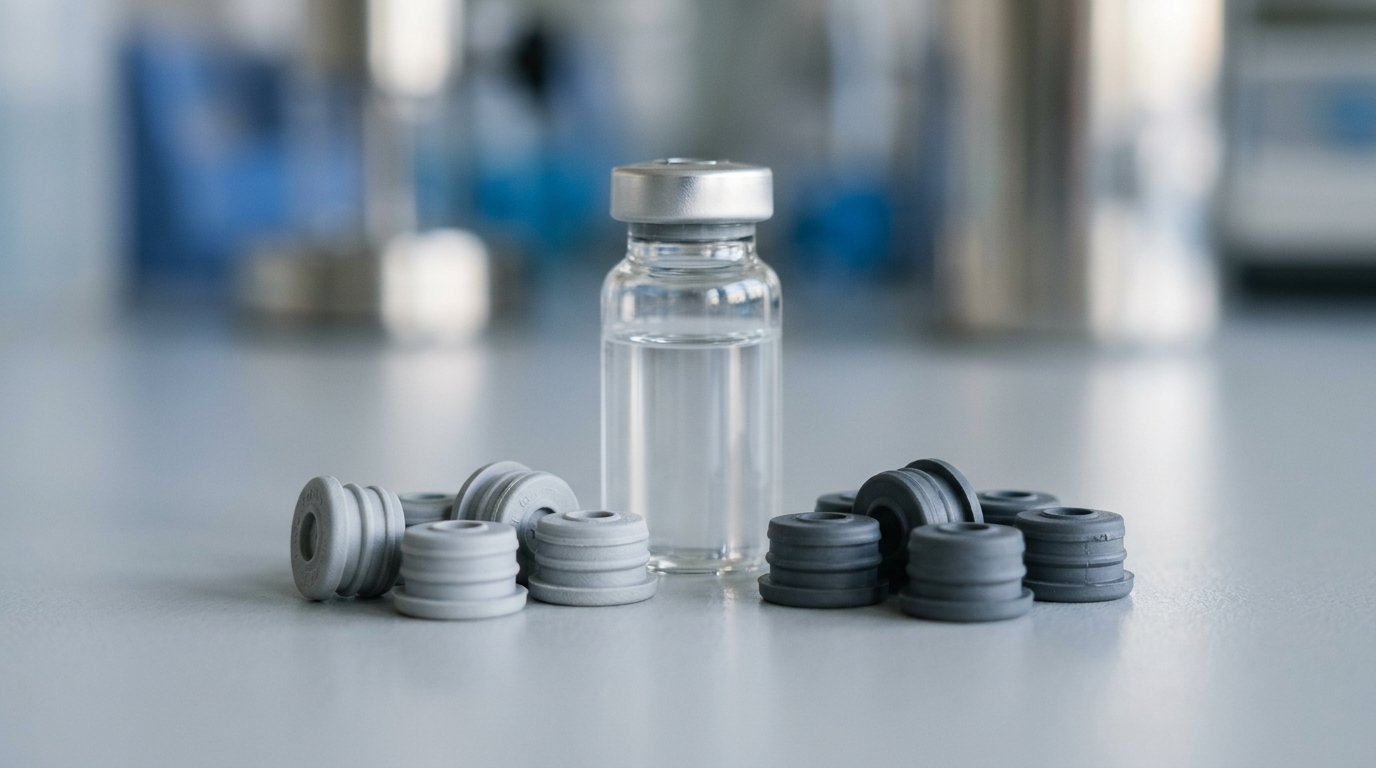
Chlorobutyl and bromobutyl are the two halobutyl rubbers used for most injectable vial stoppers, and on barrier properties they are close to interchangeable: both give very low oxygen and water vapour permeability. The real differences are in compounding. The halogen changes how the rubber cures, the cure system changes what can extract into the drug, and the extractables profile of the finished compound, not the polymer name, is what decides the choice for a given product. Either polymer can meet USP <381> and Ph. Eur. 3.2.9 when it is properly compounded.
Key takeaways
- Both are halogenated butyl rubber: a copolymer of isobutylene with a small amount of isoprene, with chlorine or bromine added.
- Barrier is comparable. West Pharmaceutical Services, a stopper manufacturer, states that the two are comparable in oxygen and water permeability.
- The difference that matters is the extractables profile, which follows the cure system, fillers and stabilisers in the compound.
- Compendial tests apply to the closure, not the polymer: USP <381> for physicochemical properties and biological reactivity, USP <382> for functional suitability, Ph. Eur. 3.2.9 in Europe.
- Specify the compound reference, not “bromobutyl”. Two compounds on the same base polymer can behave very differently.
- The seal does not change. A 20 mm stopper takes a 20 mm seal whichever halobutyl it is made from.
Chlorobutyl vs bromobutyl at a glance
| Property | Chlorobutyl (CIIR) | Bromobutyl (BIIR) |
|---|---|---|
| Base polymer | Isobutylene-isoprene copolymer, chlorinated | Isobutylene-isoprene copolymer, brominated |
| Oxygen and water vapour permeability | Very low | Very low, comparable to chlorobutyl |
| Halogen reactivity | Lower | Higher; the carbon-bromine bond is weaker |
| Cure behaviour | Slower, more stable in processing | Faster, with a wider choice of cure systems |
| Extractables | Set by the compound’s cure system, fillers and additives | Set by the compound’s cure system, fillers and additives |
| Compendial requirements | USP <381>, USP <382>, Ph. Eur. 3.2.9 | USP <381>, USP <382>, Ph. Eur. 3.2.9 |
| Typical uses | Serum, lyophilisation and infusion stoppers | Serum, lyophilisation and infusion stoppers |
| Seal pairing | Same nominal size as the neck | Same nominal size as the neck |
What the two rubbers have in common
Both start from butyl rubber, and both keep the property that made butyl the parenteral default: a very low rate of gas and moisture transmission. Butyl is made from isobutylene with a small proportion of isoprene, which leaves a mostly saturated polymer backbone. Halogenation adds a small amount of chlorine or bromine at the isoprene sites, giving reactive points for vulcanisation without changing that backbone.
West’s technical blog on the two formulations sets out the shared case: halobutyl rubbers typically have lower extractables than other rubbers and resist permeation by water and oxygen, and chlorobutyl and bromobutyl are comparable on permeability. ARLANXEO, a halobutyl polymer producer, lists low permeability, polymer purity, clean cure systems and good ageing as the reasons its chlorobutyl and bromobutyl grades are used for vial stoppers.
For a product with a nitrogen headspace, a vacuum or a moisture-sensitive powder, that means the base polymer is rarely the deciding factor. Retention is shown on the finished vial, stopper and seal over the shelf life.
Where they differ
The differences are chemical and they surface in the compound: how it cures, what it needs added, and therefore what can leach.
Cure chemistry. The carbon-bromine bond is weaker than the carbon-chlorine bond, so bromobutyl is the more reactive of the two. It cures faster and accepts a wider range of cure systems, which gives the compounder more freedom to choose low-residue curatives. Chlorobutyl is less reactive, which makes it steadier in processing and storage but narrows the cure options.
Extractables profile. Because the curatives, stabilisers and processing aids differ between compounds, the substances that can extract differ too. West’s position is that the primary difference between the two will be found in the extractables profile, not in barrier.
Compound over polymer. A finished stopper is the base polymer plus mineral filler, a cure system, pigment and processing aids. That is why two bromobutyl stoppers can differ from each other more than a given bromobutyl differs from a given chlorobutyl, and why the supplier’s compound reference is what goes under change control.
What the compendia require of either
Pharmacopoeial tests are written for the elastomeric closure, whatever its polymer, so a chlorobutyl and a bromobutyl stopper meet the same chapters.
- USP <381>, Elastomeric Components in Injectable Pharmaceutical Product Packaging/Delivery Systems, covers biological reactivity and physicochemical properties of the elastomer, including extractable elements. See USP <381>.
- USP <382> covers functional suitability of the elastomeric component in the packaging system, such as penetrability and self-sealing. See USP <382>.
- Ph. Eur. 3.2.9, Rubber closures for containers for aqueous parenteral preparations, for powders and for freeze-dried powders, applies in Europe and markets that follow it. See Ph. Eur. 3.2.9.
- ISO 8362-2 sets dimensions for closures for injection vials, and ISO 8362-5 for freeze-drying closures.
Meeting a compendial chapter shows the closure is suitable in general. It does not replace a product-specific extractables and leachables study, which is where the chlorobutyl or bromobutyl decision is actually tested. The study design is covered in extractables and leachables.
Choosing by product
Start from the product’s sensitivities, shortlist compounds on either polymer that address them, and let product-specific data decide. The table lists what drives the choice for common presentations.
| Product | What decides the compound | Ask the stopper supplier for |
|---|---|---|
| Aqueous small-molecule injection | Extractables against the formulation’s pH and solvents | Compendial compliance for the compound and an extractables profile |
| Oxygen-sensitive or nitrogen-flushed product | Headspace retention on the assembled vial | Permeation data for the compound and a closure integrity study on your vial |
| Lyophilised powder | Moisture the stopper holds and releases into the cake | Freeze-drying stopper design to ISO 8362-5 and moisture data for the compound |
| Protein or biologic | Adsorption and leachables that can affect the molecule | Extractables profile and whether a coated option exists |
| Multi-dose vial | Resealing after repeated needle entry | USP <382> functional data for the number of punctures you need |
| Frozen or cold-chain product | Stopper recovery at low temperature | Integrity data at your storage temperature |
Where a product already has a qualified stopper, the existing compound usually stays: changing it is a packaging change that brings its own regulatory work, whichever polymer the new compound uses.
How this works in practice at Autofits
Autofits does not make stoppers. It makes the aluminium and aluminium-plastic seal that crimps over one, and the seal is chosen from the stopper and vial, not from the rubber. Three stopper details decide the seal. The nominal size sets the seal size, across the 13, 20, 28, 32 and 34 mm FlipTop seal range. The flange thickness and hardness of the compound set how far the skirt has to reach and compress: the 13 mm FlipTop Optima has a total height of 7.62 to 8.38 mm and the 20 mm of 9.02 to 9.91 mm, so the stopper drawing is checked against the seal drawing before a capping trial. And a freeze-dried presentation seats the stopper in the dryer, so the seal is crimped after unloading. The term itself is defined under elastomeric closure. Send the stopper and vial drawings with a seal enquiry through contact.
Frequently asked questions
Is bromobutyl better than chlorobutyl for vial stoppers?
Not as a rule. Both give very low oxygen and moisture permeability, and stopper makers describe the two as comparable on barrier. Bromobutyl cures faster and allows more cure systems; chlorobutyl is steadier in processing. The better choice for a product is the compound whose extractables profile and functional data suit that formulation.
Can a chlorobutyl stopper be replaced with a bromobutyl one?
It can, but it is a change of closure compound, not a like-for-like swap. The new stopper needs compendial compliance, extractables and leachables data against the product, functional testing and integrity data on the vial, and the change has to be handled under the product’s regulatory change procedures.
Which halobutyl stopper holds a nitrogen headspace or vacuum better?
Neither has a decisive advantage, because both have very low gas permeability. Headspace or vacuum retention depends on the compound, the stopper design, the crimp and the vial, so it is demonstrated on the assembled container over the shelf life. EU GMP Annex 1 expects containers sealed under vacuum to be tested for maintenance of vacuum.
Is a grey rubber stopper always bromobutyl?
No. Stopper colour comes from the filler and pigment in the compound, and both chlorobutyl and bromobutyl stoppers are commonly grey. The polymer is identified from the supplier’s specification and certificate for the compound, not from its appearance.
Do chlorobutyl and bromobutyl stoppers need different aluminium seals?
No. The seal is chosen by the nominal size of the vial neck and stopper, not by the rubber. A 13 mm stopper takes a 13 mm seal and a 20 mm stopper a 20 mm seal. What can change between compounds is stopper hardness and compression, so capping settings are confirmed in trials.
Related reading
Sources
- West Pharmaceutical Services: Bromobutyl versus chlorobutyl rubber formulations, general aspects (https://www.westpharma.com/blog/2019/june/bromobutyl-versus-chlorobutyl-rubber-formulations)
- ARLANXEO: X_Butyl butyl, chlorobutyl and bromobutyl rubber (https://www.arlanxeo.com/en/brands/x-butyl)
- USP: General Chapter <381> Elastomeric Components in Injectable Pharmaceutical Product Packaging/Delivery Systems (https://doi.usp.org/USPNF/USPNF_M99140_60201_01.html)
- USP: General Chapter <382> Elastomeric Component Functional Suitability in Parenteral Product Packaging/Delivery Systems (https://doi.usp.org/USPNF/USPNF_M11355_03_01.html)
- EDQM: European Pharmacopoeia, chapter 3.2.9 (https://www.edqm.eu/en/european-pharmacopoeia)
- ISO: ISO 8362-2, Closures for injection vials (https://www.iso.org/standard/87251.html)
- European Commission: EU GMP Guidelines, Annex 1, Manufacture of Sterile Medicinal Products, section 8.24 (https://health.ec.europa.eu/medicinal-products/eudralex/eudralex-volume-4_en)
*Last updated: 2026-09-15. This page is general technical information, not regulatory advice. Stopper compounds are specified with the stopper supplier; confirm compendial editions and product-specific data with your quality and regulatory teams.*
