
Vial Seal Materials FAQs: Aluminium, Lacquer, Polypropylene and Stoppers
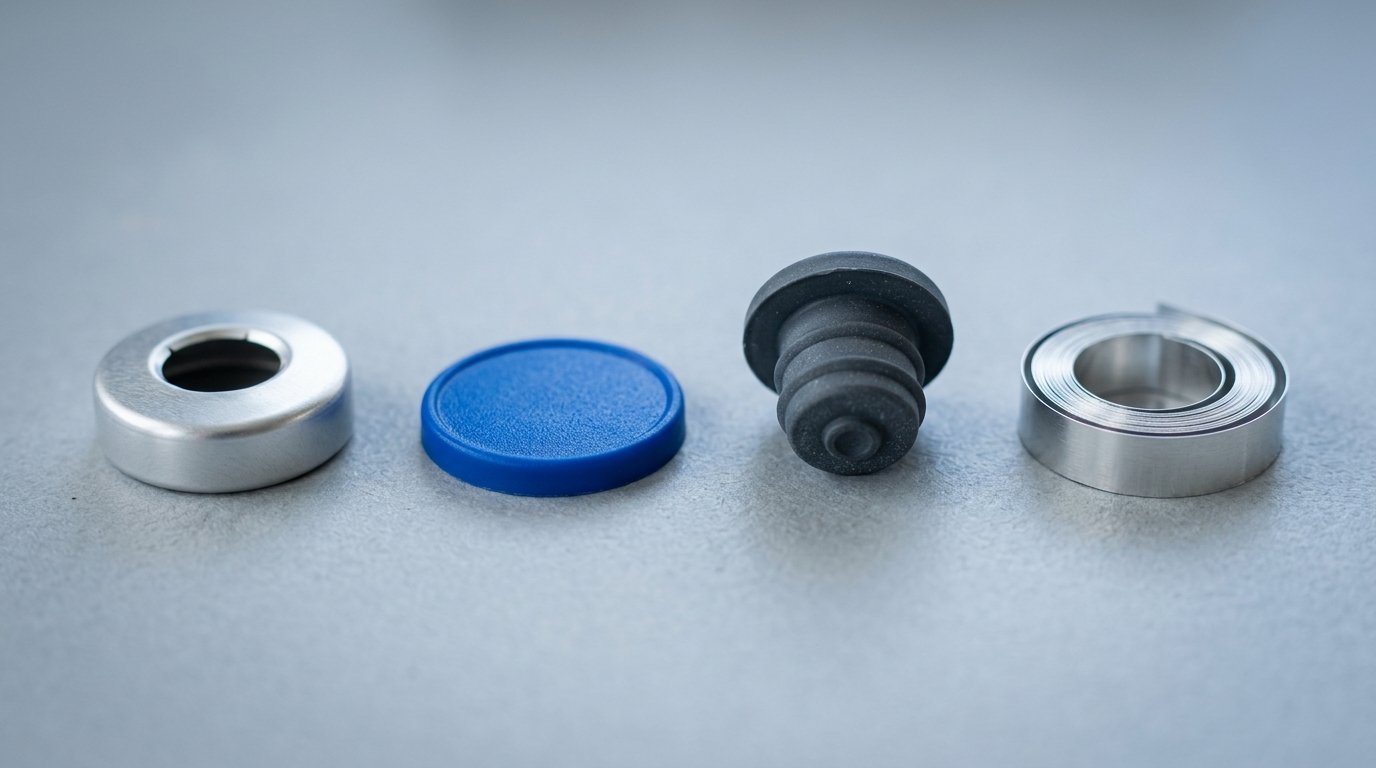
An Autofits aluminium-plastic vial seal is made of three declared materials: AA8011 aluminium alloy, an epoxy lacquer conforming to 21 CFR 175.300, and a polypropylene disc conforming to 21 CFR 177.1520. Heavy metals across the materials are held to 100 ppm total, and the components are declared BSE/TSE-free. Under the seal sits the elastomeric stopper, which is the part in contact with the drug; Autofits does not make stoppers, but the stopper questions are answered here because the seal has to suit the stopper. The questions below cover what each material is, what it complies with, and where it matters.
Aluminium shell
The aluminium does the structural work of the closure. Alloy choices across the industry are compared in aluminium grades for vial caps.
What aluminium alloy are Autofits vial seals made from?
Autofits seals are made from aluminium alloy AA8011. The material conforms to EN 15088:2005, is supplied with EN 10204 3.1 inspection certification, is tested to BS EN 485-2:2008, and is REACH and RoHS compliant. Aluminium thickness is set by size, from 0.16 to 0.20 mm on the 13 and 20 mm FlipTop Optima up to 0.21 to 0.25 mm on the 32 mm.
Are flip-off seals made of stainless steel?
No. Autofits flip-off, tear-off, tear-down and pull-ring seals are aluminium, in alloy AA8011, and the aluminium-plastic designs add a polypropylene disc. Aluminium is used because the skirt has to be rolled under the vial crown during capping, which needs a thin, ductile metal.
Why is aluminium used to crimp a vial closure?
A crimped seal has to deform once, cleanly, and then hold. Thin aluminium can be drawn into a cup, rolled under the crown of a glass vial without cracking, and keep that shape so the stopper stays compressed for the shelf life of the product. It also takes lacquer and pigment well and is light. The same property lets the tear-off and tear-down designs be opened by hand.
What lacquer is used on aluminium seals?
Autofits seals carry an epoxy lacquer conforming to 21 CFR 175.300, the US regulation for resinous and polymeric coatings. The lacquer can be pigmented to colour the aluminium. Ready-to-Use seals are double-lacquered and washed to control particles before they are assembled in the cleanroom and sterilised.
Does the seal lacquer come into contact with the drug?
Not in a correctly closed vial. The stopper sits between the product and the seal, and the aluminium only holds the stopper flange against the crown. The lacquer still matters for cleanliness, because flakes or particles from a seal can reach the stopper surface on the filling line, which is why the material declarations and the washing and inspection steps apply to the seal as well.
Plastic disc and finishes
The disc is the part the user touches. How the aluminium and plastic parts come together is described in the aluminium-plastic seal manufacturing process.
What plastic is a flip-off disc made from?
The disc is polypropylene. At Autofits it conforms to IS 10910 and IS 10909, to FDA 21 CFR 177.1520 for olefin polymers, and to EC 1895/2005. Discs and buttons are injection moulded in-house on Japanese Toyo machines, which keeps the disc geometry, and so the opening behaviour, consistent from batch to batch.
How is an aluminium-plastic seal made?
The aluminium shell is formed from AA8011 and coated with epoxy lacquer, and the polypropylene disc is injection moulded separately. The two parts are assembled, washed on a fully automated line, and every seal passes 100% high-speed camera inspection before packing. Seals for Ready-to-Use supply are assembled in an ISO Class 8 cleanroom and then sterilised by gamma irradiation or ethylene oxide.
What gives a seal its colour?
On an aluminium-plastic seal, colour comes mainly from pigment in the polypropylene disc, and the aluminium can be coloured as well through a pigmented epoxy lacquer. Autofits offers a wide range of colours, matte or glossy, customised to requirement. Colours are matched to a physical sample or reference supplied by the buyer, since the finish affects how a shade reads.
What is a grain, matte or glossy finish on a flip-top seal?
These describe the surface of the plastic disc. Glossy is a smooth, reflective surface; matte is non-reflective; and grain is a name some suppliers use for a textured surface. Autofits offers glossy, matte, embossed and printed finishes. Because suppliers name textures differently, the surface is best agreed from a sample rather than from the name alone.
Material compliance
The declarations below come from the Autofits seals dossier. The certification set is on the quality page.
What heavy-metal limits apply to the seal materials?
The sum of chromium VI, cadmium, mercury and lead in the seal materials is held to a maximum of 100 ppm, declared against EN 602 and the European packaging directive 94/62/EC. That is a limit on the packaging material, not a result for any drug product; elemental impurities in the finished medicine are assessed separately by the drug manufacturer.
Are the seal materials REACH and RoHS compliant?
Yes. The AA8011 aluminium used for Autofits seals is declared REACH and RoHS compliant, and the material conforms to EN 15088:2005 with EN 10204 3.1 certification. REACH is the European Union regulation on chemicals, and RoHS restricts hazardous substances in electrical and electronic equipment, so both are general material declarations that sit alongside the pharmaceutical ones.
What does EC 1895/2005 mean on a seal declaration?
Regulation (EC) No 1895/2005 restricts certain epoxy derivatives in materials intended to contact food: BADGE, BFDGE and NOGE. The Autofits declaration states conformity to EC 1895/2005 and that BADGE, NOGE and BFDGE are not used.
Is there natural rubber latex in Autofits seals or caps?
The vial seals are made of aluminium, epoxy lacquer and polypropylene, none of which is natural rubber latex. Autofits does not make stoppers; the chlorobutyl and bromobutyl compounds commonly used for injectable stoppers are synthetic rubbers, so confirm the latex position with your stopper supplier. Latex does appear as one of three liner options for pilfer-proof ROPP caps, alongside EPE and PVC, so where latex has to be excluded, specify an EPE or PVC liner.
Stoppers
The stopper is the drug-contact part of a vial closure and is sourced from a stopper manufacturer; Autofits makes the seal that holds it. The term is defined under elastomeric closure, and the two main compounds are compared in chlorobutyl vs bromobutyl stoppers.
What is the seal material on an insulin vial?
An insulin vial is typically closed like other multi-dose injectable vials: an elastomeric stopper held in the neck by a crimped aluminium seal, with a plastic flip-off button that exposes the centre of the stopper for repeated needle entry. The seal itself is aluminium and polypropylene; the stopper compound is chosen by the drug manufacturer for resealing after puncture and compatibility with the formulation.
What rubber are vial stoppers made from?
Many injectable vial stoppers are made from halobutyl rubber, either chlorobutyl or bromobutyl, because both have very low gas and moisture permeability. Other elastomers exist for special cases. A finished stopper is a compound of the base rubber with filler, a cure system and pigment, which is why stoppers are specified by compound reference. Autofits does not make stoppers; its seals are matched to the stopper and vial neck by nominal size.
What is the difference between butyl and chlorobutyl rubber?
Butyl rubber is a copolymer of isobutylene with a small amount of isoprene. Chlorobutyl is butyl rubber with chlorine added at the isoprene sites, which gives it reactive points for vulcanisation. Both keep butyl’s very low permeability, but the halogenated grade can be cured with lower levels of curatives and a wider choice of cure systems, which is one reason halobutyl compounds are widely used for parenteral stoppers.
What are Type I and Type II rubber closures?
They are two classes in the pharmacopoeias. Ph. Eur. 3.2.9 describes Type I closures as those meeting the strictest requirements, to be preferred, and Type II closures as those whose mechanical properties suit special uses, such as multiple piercing, but which cannot meet requirements as severe because of their chemical composition. Check how the current USP <381> text classifies closures before quoting a type in a specification.
Why are rubber stoppers siliconised or coated?
Silicone oil is applied to many stoppers so they flow through hoppers and feeders and seat in the vial without sticking. Coated stoppers go further, carrying a fluoropolymer film or spray coating that separates the rubber from the drug, which stopper makers describe as reducing extractables and the need for added silicone oil. Both are properties of the stopper and are set in its specification.
What kind of stopper is used for freeze-dried products?
Freeze-dried products use lyophilisation stoppers, which have vents or slots so they can sit partly inserted while water vapour leaves the vial, and are then pushed fully home inside the freeze dryer. Their dimensions are covered by ISO 8362-5. The compound is also checked for the moisture it holds and can release into the dried product. The aluminium seal is crimped after the vials leave the dryer.
Pilfer-proof cap materials
ROPP caps close threaded bottles and seal on a liner rather than a stopper. Liner options are compared on ROPP cap liners.
What are ROPP cap liners made of?
Autofits pilfer-proof caps are available with EPE, latex or PVC liners. The liner is the part that seals against the top of the bottle neck, while the aluminium shell, in AA8011 with an epoxy lacquer, holds it under compression. EPE is the usual starting point for aqueous oral liquids, and the final choice is confirmed with a compatibility and leak study on the filled bottle.
Related reading
Sources
- Autofits FlipTop seals dossier, for alloy, lacquer, polypropylene, heavy-metal and BSE/TSE declarations
- eCFR: 21 CFR 175.300, Resinous and polymeric coatings (https://www.ecfr.gov/current/title-21/chapter-I/subchapter-B/part-175/subpart-C/section-175.300)
- eCFR: 21 CFR 177.1520, Olefin polymers (https://www.ecfr.gov/current/title-21/chapter-I/subchapter-B/part-177/subpart-B/section-177.1520)
- EUR-Lex: Commission Regulation (EC) No 1895/2005 on the restriction of use of certain epoxy derivatives (https://eur-lex.europa.eu/eli/reg/2005/1895/oj)
- EDQM: European Pharmacopoeia, chapter 3.2.9, Rubber closures for containers for aqueous parenteral preparations, for powders and for freeze-dried powders (https://www.edqm.eu/en/european-pharmacopoeia)
- USP: General Chapter <381> Elastomeric Components in Injectable Pharmaceutical Product Packaging/Delivery Systems (https://doi.usp.org/USPNF/USPNF_M99140_60201_01.html)
- ISO: ISO 8362-5, Freeze drying closures for injection vials (https://www.iso.org/standard/65448.html)
*Last updated: 2026-09-15. Material data is from the Autofits FlipTop seals dossier. Autofits does not make stoppers; this page gives no test results for any stopper compound.*
