
Aluminium Grades Used in Vial Caps: Alloys, Tempers, and What They Change
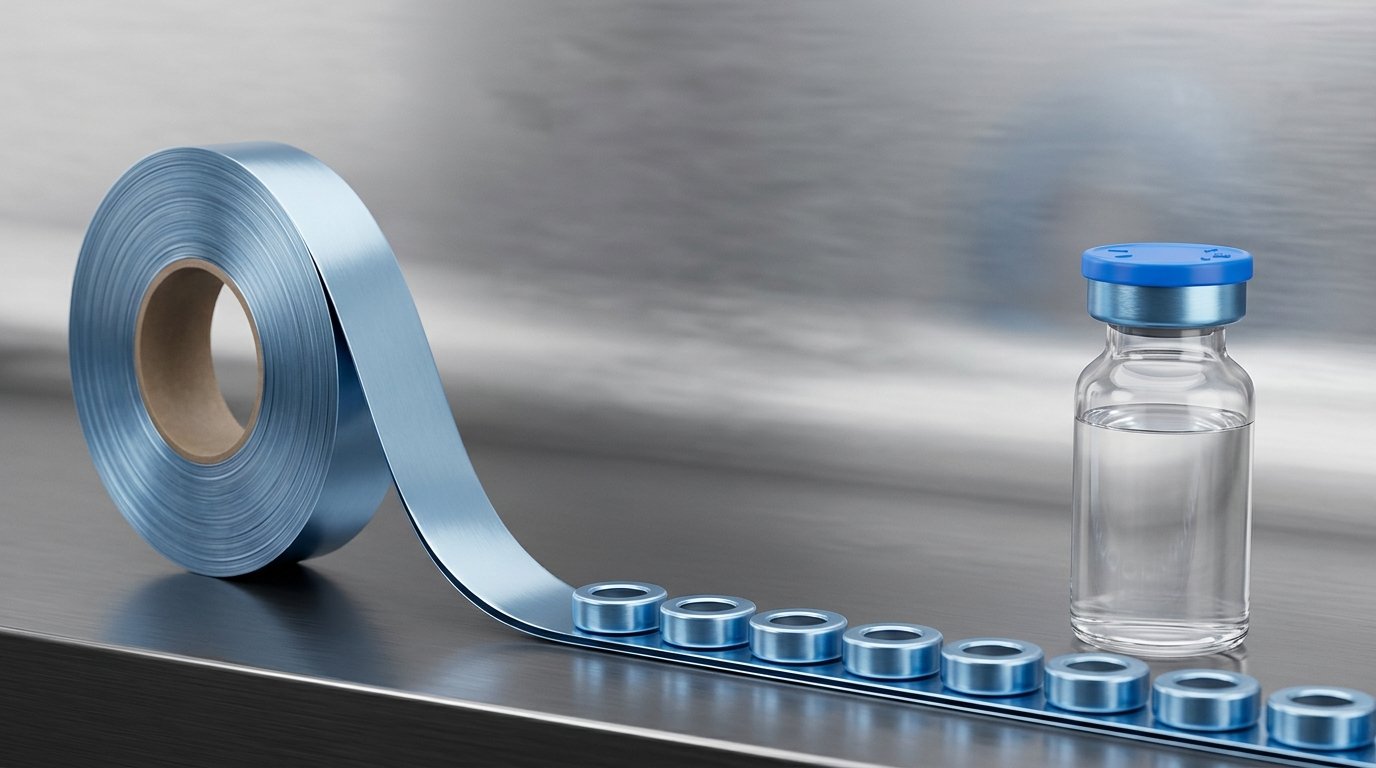
Vial caps and seals are drawn from thin rolled aluminium in a small set of grades: the commercially pure 1xxx alloys (1050, 1060, 1070), the aluminium-iron-silicon alloy 8011, and, for some closure work, the manganese alloys 3105 and 3003. The grade sets the metal’s chemistry, the temper sets how hard it has been worked, and the strip gauge sets how much metal there is. Those three choices together decide how cleanly the shell draws, how the skirt behaves under a crimping head, and whether a score line tears the way it is meant to.
This guide covers how the grades are designated, which alloy families are used for vial seals and pilfer-proof caps, what the temper suffix means, and what each choice changes on a real closure.
Key takeaways
- Closure aluminium is specified as three things together: alloy, temper, and gauge. Naming only the alloy does not describe the material.
- The dominant families are 1xxx commercially pure (1050, 1060, 1070) and 8011, an aluminium-iron-silicon alloy valued for deep drawing; 3105 and 3003 appear in some cap and closure work.
- The 1xxx numbering encodes purity: 1050 is 99.50% minimum aluminium, 1060 is 99.60%, 1070 is 99.70%.
- Temper letters follow a defined system: O is annealed and softest, H1x is strain-hardened only, H2x is strain-hardened then partially annealed, and the second digit gives the degree (4 is half hard, 8 is full hard).
- Cap stock is thin: EN 541 covers rolled products for cans, closures and lids from 0.150 mm to 0.500 mm, and vial seal strip usually sits in the lower part of that band.
- The aluminium arrives lacquered and often printed before forming, and the coating has to survive drawing and crimping without cracking or shedding particles.
How aluminium grades are named
Wrought aluminium is identified by a four-digit alloy number plus a temper suffix, for example 8011-H14 or 1050-O. The four-digit numbering originates with the Aluminum Association’s registration system and is carried into Europe by EN 573-3, whose composition limits are aligned with the registered international designations. European drawings often show the same alloy with an EN AW prefix, for example EN AW-8011.
The first digit identifies the family by principal alloying element:
| Series | Principal alloying element | Relevance to closures |
|---|---|---|
| 1xxx | None (commercially pure aluminium, 99.00% and above) | Very ductile, excellent formability, used for soft-drawn seals and foil |
| 3xxx | Manganese | Higher strength than 1xxx with good formability, used in some cap stock |
| 8xxx | Other elements (in cap stock, iron and silicon) | 8011 is the workhorse cap alloy for its draw behaviour and low earing |
In the 1xxx series the last two digits carry real information: they give the minimum aluminium content past 99%. So 1050 is 99.50% aluminium minimum, 1060 is 99.60%, and 1070 is 99.70%. In the other series they are identifiers with no arithmetic meaning.
Alloy 8011 is an aluminium-iron-silicon composition, typically holding iron in the region of 0.6% to 1.0% and silicon around 0.5% to 0.9%. Those elements form fine intermetallic particles that refine the grain structure, giving 8011 its mix of drawability and dimensional stability in a thin drawn part.
What the temper changes
The temper suffix records how the strip was worked and heat-treated after rolling, and it is the biggest single control on how a cap forms and crimps. The designation system, set out in EN 515 in Europe and ANSI H35.1 in North America, works like this:
| Temper | What it means | Behaviour in a cap |
|---|---|---|
| O | Annealed, the softest condition | Draws deepest with least cracking, lowest springback, softest crimp |
| H1x | Strain-hardened only | Stiffer as the second digit rises, holds shape better, tolerates less draw |
| H2x | Strain-hardened, then partially annealed | Recovers some ductility at a given strength, common for formed closures |
| H3x | Strain-hardened, then stabilised by low-temperature heating | Used where ageing of the strip would otherwise shift properties |
The second digit is the degree of hardening: 2 is quarter hard, 4 is half hard, 6 is three-quarter hard, 8 is full hard. So 8011-H14 is 8011 strain-hardened only to half hard, while 8011-H24 is the same alloy strain-hardened and then partially annealed back to half hard. The two reach similar strength by different routes and do not form identically.
Vial seal shells are deep-drawn parts, so they are cut from the softer end of the range, commonly O through the half-hard tempers depending on skirt height and design. Pilfer-proof caps are formed as a plain shell and then threaded onto the container by rollers during application, so they are usually specified around half hard: soft enough to take the thread form, stiff enough that the shell and the pilfer band hold their geometry until the cap is opened.
Gauge: how much metal there is
Closure stock is thin strip, not sheet, and the gauge is specified to a tight band because it drives both draw behaviour and crimp force. EN 541, the European specification for rolled aluminium products for cans, closures and lids, covers thicknesses from 0.150 mm to 0.500 mm. Cap and vial seal stock generally sits in the lower half of that range, around 0.18 mm to 0.25 mm for common designs, with the exact figure set by diameter, skirt height, and the crimp the customer’s line applies.
Gauge is a trade-off. Thinner metal draws more easily and crimps with less force, but leaves less margin before a score line tears prematurely. Thicker metal is more robust and needs more crimp force, which pushes the capping head harder. Because the crimp is what holds the stopper compressed, as described in vial crimping explained, a gauge change is never only a cost decision; it changes the capping recipe.
Two other rolled-strip properties are specified alongside gauge for drawn closures:
- Earing. Rolling gives the strip directional properties, so a drawn cup can come out with wavy peaks (ears) around its rim rather than a flat edge. Closure stock is bought against a low maximum earing value, often around 2%, because ears become uneven skirt height on the finished shell.
- Mechanical properties per temper. Tensile strength and elongation are agreed per temper on the supply specification and confirmed on the certificate for each coil. Half-hard 8011 closure sheet, for instance, is commonly quoted in the region of 130 to 155 MPa tensile strength.
Coating, lacquer and print
Cap aluminium is almost never used bare: it is lacquered on both faces and often printed before it is formed. Coating goes onto flat strip and is cured there, then the metal is stamped and drawn, so the film has to survive the draw and the later crimp without cracking or flaking. A loose coating fragment is a particulate contamination risk on an injectable line, which is why that matters more here than in general packaging.
Colour and print are also applied on flat strip, which is why registration stays consistent across a lot. The aluminium-plastic seal manufacturing process walks through the full sequence from coil to packed seal. One consequence is that alloy and coating choices are coupled: a harder temper springs back more after forming, and a coating formulated for a soft-drawn shell can craze at the same radius on a harder one, so changing the metal triggers a re-check of the coating system.
What the grade choice changes in the finished cap
Grade, temper and gauge show up on the customer’s line as four measurable behaviours.
- Draw quality. How deeply the shell forms without thinning, tearing or earing. This is where 8011 earns its position: the fine intermetallic structure supports deep drawing at a low earing rate.
- Crimp behaviour and springback. The skirt has to fold under the vial neck flange and stay folded. A softer temper folds at lower force and springs back less; a harder temper resists the roll and can leave the crimp slightly open, which is a container closure integrity risk. Consistency matters as much as the absolute value, because a capping station is set once for a lot.
- Tear and score behaviour. On a tear-off seal, the metal itself is the opening feature. The score has to break under hand force along its intended line without the tab shearing off or the tear running into the skirt. That window is set by temper and gauge as much as by score depth.
- Surface and corrosion behaviour. The 1xxx alloys have the best corrosion resistance of the families used here, and manganese or iron additions trade a little of that for strength. The lacquer carries most of the corrosion duty in practice, but the substrate sets how the surface reacts where the coating is scratched.
It is worth being precise about drug contact. In a correctly assembled vial the aluminium seal contacts the outside of the rubber stopper and the outer surface of the glass neck; the drug touches the glass and the inner face of the stopper. The seal is still primary packaging and still inside the scope of a container closure system assessment, but it is not normally a direct product-contact surface.
Where the grade is specified and controlled
The alloy and temper are fixed in the purchase specification for the coil, evidenced on the mill certificate, and re-verified at goods-in. Several documents sit around that:
- EN 573-3 for chemical composition and EN 515 for temper designation, with ANSI H35.1 as the North American equivalent.
- EN 541 for rolled products intended for cans, closures and lids, covering tolerances and delivery conditions in the 0.150 mm to 0.500 mm band. ASTM B209 applies where a customer works to American sheet specifications, and in India wrought aluminium sheet and strip is covered by IS 737.
- ISO 8362-3, which specifies the forms, dimensions and requirements of plain aluminium caps for injection vials, with ISO 8362-6 covering aluminium-plastics combination caps. These standardise the cap rather than the alloy, but they set the geometry the chosen metal has to hold.
- ISO 15378:2017, which applies GMP principles to primary packaging manufacture and is where each incoming coil lot has to remain traceable to each finished seal lot. That chain is set out in vial seal batch traceability.
Elemental impurities deserve a note. Aluminium itself is not among the elements listed in ICH Q3D, but several elements that can appear in an alloy or coating system, copper and chromium among them, are within its scope, so a packaging risk assessment reads the alloy specification rather than assuming the metal is out of scope.
How this works in practice at Autofits
Autofits forms its aluminium shells from lacquered, printed strip bought against a fixed material specification, with each incoming coil lot verified before it is released to the presses. The range covers FlipTop aluminium-plastic seals, tear-off and tear-down aluminium seals, and aluminium pilfer-proof (ROPP) caps, set out on the products page, across sizes from 13 mm to 34 mm (see the size index). Because a temper or gauge change alters how a seal crimps on a customer’s capping station, material specifications are held constant for a qualified product rather than substituted lot to lot. Production runs in a 75,000 sq ft Nashik facility with an ISO Class 8 cleanroom, under an ISO 15378:2017 quality system alongside ISO 9001:2015 and ISO 14001:2015 certification and a Drug Master File.
Frequently asked questions
What grade of aluminium is used for vial caps?
Vial caps and seals are made from thin rolled aluminium, most often the commercially pure 1xxx alloys (1050, 1060, 1070) or the aluminium-iron-silicon alloy 8011. Alloys 3105 and 3003 are also used in some cap and closure work. Alloy 8011 is widely chosen for drawn closures because it deep-draws well at a low earing rate, which keeps the formed skirt even.
What does the temper on aluminium cap stock mean?
The temper suffix records how the strip was worked. O is annealed and softest. H1x means strain-hardened only, H2x means strain-hardened then partially annealed, and H3x means strain-hardened then stabilised. The second digit gives the degree: 2 is quarter hard, 4 is half hard, 6 is three-quarter hard, 8 is full hard. So 8011-H14 is half-hard 8011 that has been strain-hardened without a subsequent anneal.
How thick is the aluminium in a vial seal?
Vial seal and cap stock is thin strip. EN 541, the European specification for rolled aluminium products for cans, closures and lids, covers 0.150 mm to 0.500 mm, and vial seal stock generally sits in the lower part of that band, around 0.18 mm to 0.25 mm for common designs. The exact gauge is set by the seal diameter, the skirt height, and the crimp the customer’s capping line applies.
Does the aluminium in a vial seal touch the drug?
Not in a correctly assembled vial. The seal crimps over the outside of the rubber stopper and the outer surface of the glass neck, so the drug is in contact with the glass and the inner face of the stopper. The seal is still primary packaging and still part of the container closure system assessment, but it is not normally a direct product-contact surface.
Which standards define aluminium grades for pharmaceutical caps?
Composition is defined by EN 573-3 and the equivalent Aluminum Association registrations, temper by EN 515 or ANSI H35.1, and rolled closure stock by EN 541. ASTM B209 applies to American sheet specifications and IS 737 to wrought sheet and strip in India. The caps themselves are dimensioned by ISO 8362-3 and ISO 8362-6.
Why does changing the aluminium grade affect the capping line?
Because grade, temper and gauge together set how much force it takes to roll the skirt under the vial flange and how much the metal springs back afterwards. A harder or thicker material can leave a slightly open crimp at the previous setting, which is an integrity risk, so a material change is treated as a change to the capping recipe and re-qualified.
Related reading
- How aluminium-plastic vial seals are manufactured
- Vial crimping explained
- ISO 8362-3: aluminium caps for injection vials
- Vial seal batch traceability
- Browse Autofits seals by size
Sources
- CEN: EN 573-3, Aluminium and aluminium alloys, Chemical composition and form of wrought products, Part 3 (https://standards.iteh.ai/catalog/standards/cen/22ea55a3-ad41-4b4e-a3de-c580d0eadd23/en-573-3-2019)
- BSI: BS EN 541, Aluminium and aluminium alloys, Rolled products for cans, closures and lids, Specifications (https://knowledge.bsigroup.com/products/aluminium-and-aluminium-alloys-rolled-products-for-cans-closures-and-lids-specifications)
- The Aluminum Association: Industry standards, including the alloy and temper designation systems (https://www.aluminum.org/industry-standards)
- ISO: ISO 8362-3:2001, Injection containers and accessories, Part 3: Aluminium caps for injection vials (https://www.iso.org/standard/33804.html)
- ISO: ISO 15378:2017, Primary packaging materials for medicinal products (https://www.iso.org/standard/70729.html)
- ICH: Q3D Elemental Impurities (https://www.ich.org/page/quality-guidelines)
*Last updated: 2026-07-31. This article is general technical information, not engineering or compliance advice; confirm current standard editions and material specifications with the issuing bodies and your supplier.*
