
ROPP Cap Liners: EPE, Latex and PVC Wads
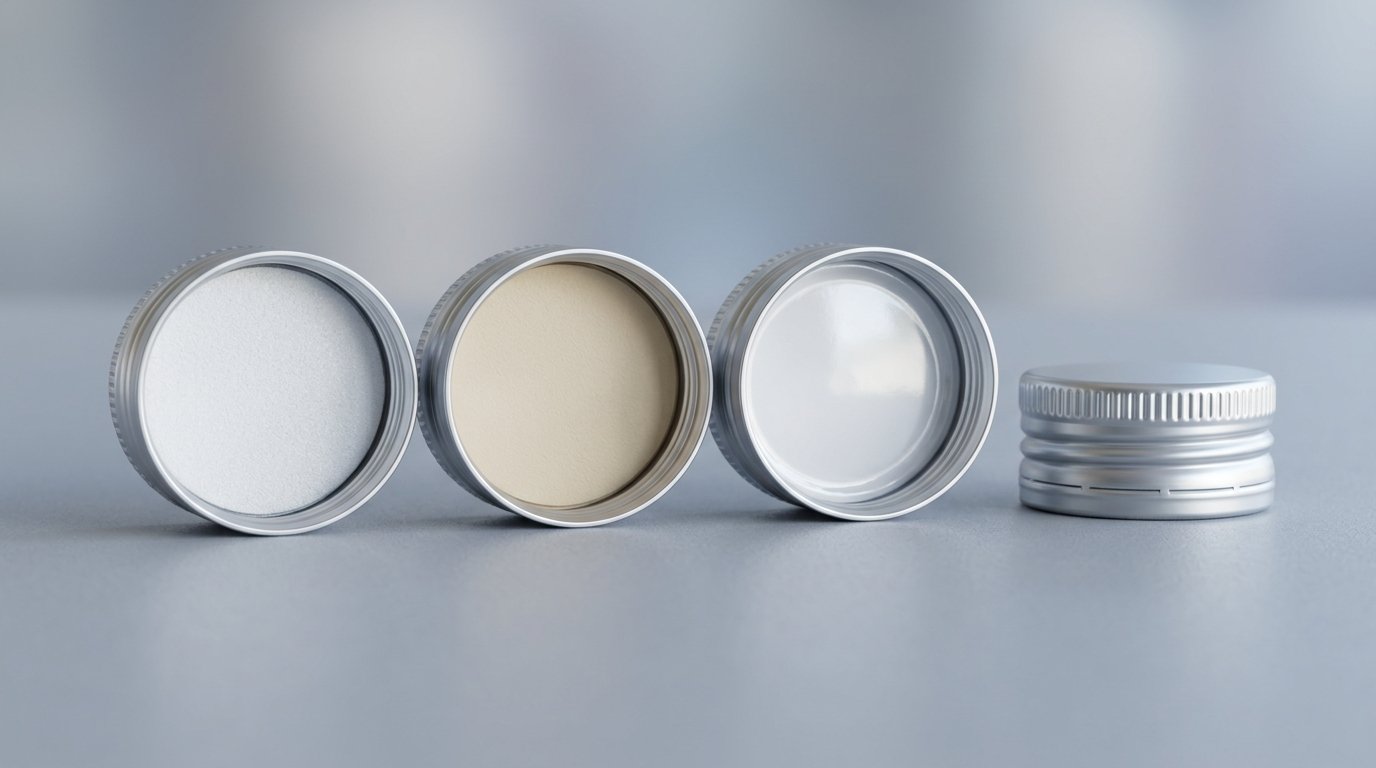
The liner, or wad, is the disc inside a pilfer-proof cap that actually forms the seal against the bottle’s sealing surface. Autofits supplies aluminium ROPP caps with EPE, latex or PVC liners, selected per application and cost. The aluminium shell holds the closure on and carries the tamper evidence; the liner is what stops the product getting out and moisture getting in. Liner choice follows the product and the container, not the cap size.
This page explains what a liner does mechanically, the three liner types offered, how to choose between them, and what a formulation or QA team should qualify before committing to one.
Key takeaways
- The liner does the sealing. The rolled aluminium threads supply the closing force; the liner is the compliant layer that conforms to the bottle’s sealing surface and closes the leak path.
- Autofits offers EPE, latex and PVC liners across the pilfer-proof cap range.
- EPE is a one-piece expanded polyethylene foam wad: a polyethylene contact face, resilient, and the general-purpose choice for aqueous oral liquids.
- Latex-faced liners use a rubber latex coating on a backing and are a long-established option in oral liquid packing.
- PVC-faced liners give a different chemical resistance and sealing character where a polyethylene face is not the right contact material.
- Liner selection is a product-contact decision, so it belongs in the same review as extractables and leachables and the plastic-materials framework of USP <661>.
- The liner is not the tamper-evidence feature. That is the pilfer band on the aluminium shell.
What the liner does
A ROPP cap seals in two stages, and the liner is the second one. During capping, thread rollers form the aluminium into the bottle’s thread profile while top load presses the cap down onto the finish. That downward load compresses the liner against the bottle’s sealing surface, which on a screw-neck bottle is the flat land at the top of the neck. The liner deforms into the microscopic irregularities of that land and closes the leak path.
Once the rollers withdraw, the formed threads hold the compression. The liner stays under load for the life of the closure, recovering slightly if the cap is unscrewed and re-tightened. Three liner properties therefore matter:
- Compressibility, so the liner conforms to the sealing land at a realistic application torque.
- Compression set and recovery, so the seal holds after months on a shelf and re-seals when the consumer closes the bottle again.
- Chemical compatibility with the product, because the liner face is a product-contact surface, in direct or headspace contact for the whole shelf life.
The aluminium shell contributes none of this. It holds the closure on, provides the printable outer surface, and carries the tamper-evident band. A cap with the right shell and the wrong liner will still leak.
The three liner types
Autofits offers EPE, latex and PVC liners on pilfer-proof caps, selected per application and cost.
EPE (expanded polyethylene) foam
An EPE liner is a one-piece disc of closed-cell polyethylene foam. Because it is a single homogeneous material, both faces are polyethylene, so the product-contact surface is a well-characterised polyolefin. It is compressible, recovers well, and is the general-purpose choice for aqueous oral liquids and syrups.
The single-material construction also simplifies the regulatory conversation. There is no adhesive layer, no board backing and no facing film to characterise separately, so the plastic-materials assessment under the USP <661> framework covers one polymer rather than a laminate.
Latex-faced
A latex-faced liner carries a rubber latex coating on a backing, giving a compliant sealing face with good conformity to the bottle land. It is a long-established construction in oral liquid packing and remains in use where the fill and the closing process suit it.
Two selection points are worth raising early with the regulatory group. The contact face is a rubber compound rather than a thermoplastic, so its extractables profile is characterised differently from a polyolefin. And where the finished product’s labelling has to address natural rubber content, the liner choice is part of that assessment rather than an afterthought.
PVC-faced
A PVC-faced liner presents a polyvinyl chloride sealing surface. It is chosen where a polyethylene face is not the right contact material for the formulation, or where the sealing character of a PVC face suits the container and the closing process better.
As with any plasticised polymer in product contact, the migration profile is the thing to establish. That is standard extractables and leachables work, run against the actual formulation and the actual shelf-life conditions rather than against a generic dataset.
Side by side
| EPE | Latex-faced | PVC-faced | |
|---|---|---|---|
| Construction | One-piece expanded polyethylene foam | Rubber latex coating on a backing | PVC sealing face |
| Product-contact material | Polyethylene | Rubber compound | PVC |
| Typical use | General-purpose aqueous oral liquids | Established option in oral liquid packing | Where a polyolefin face is not suitable |
| Regulatory characterisation | Single polymer | Rubber compound plus backing | Plasticised polymer, migration focus |
| Reseal after opening | Good recovery | Good conformity | Depends on construction |
Availability of a given liner in a given size and finish is confirmed per order.
Which product types need which liner
Liner choice starts from the product type, and each type has one property that decides it. The table gives the usual starting point; the compatibility and leak study on the filled pack makes the final call.
| Product type | Usual starting point | The property that decides it |
|---|---|---|
| Aqueous syrups and oral suspensions | EPE | Leak and removal torque on the filled pack, and product on the sealing land after filling |
| Dry syrups and powders for reconstitution | EPE | Moisture ingress before reconstitution, and recovery on repeated reclosing after it |
| Flavoured liquids and those with essential oils | Decided by study | Whether the liner face absorbs flavour components, which polyolefin faces can do |
| Diagnostic and research reagents | Decided by study | Chemical resistance to solvents or reactive components in the reagent |
| Products where natural rubber content has to be declared | Check the latex liner’s composition, or use EPE or PVC | The labelling position on natural rubber |
| Formulations a polyethylene face does not suit | PVC-faced or latex-faced | Migration from the alternative face, established by extractables and leachables work |
How to choose a liner
Choose on product compatibility first, then on sealing performance, then on cost. The sequence matters, because a liner that fails compatibility cannot be rescued by good sealing.
- Characterise the product. Aqueous or solvent based, pH, surfactants, flavour and colour systems, and whether the formulation contains anything that will attack or absorb into a polymer face. Volatile components make the barrier requirement stricter.
- Set the barrier requirement. Moisture ingress and egress over the labelled shelf life, and headspace oxygen if the formulation is sensitive. Container performance testing under the USP framework covers moisture permeation of the packaged system, and the liner is part of that system.
- Check the sealing surface. Glass and plastic bottle lands behave differently, and a moulded plastic land can carry parting-line witness marks that need a more compliant liner.
- Confirm the closing process. Application torque, top load and line speed determine how much the liner is compressed and how consistently.
- Run the compatibility study. Extractables and leachables against the actual formulation, plus stability on the real pack. The general framework is on the extractables and leachables page.
- Then compare cost. Liner cost differences are small per unit and large per million, which is why they are worth deciding last rather than first.
What to qualify before you commit
The liner is a product-contact component, so it is qualified with the pack, not on its own. A workable qualification package usually includes:
- Leak and torque data on the filled, capped container, at the application torque the line will actually run.
- Removal torque after conditioning, to confirm the pack opens within an acceptable range for the intended user.
- Moisture permeation on the packaged system over the shelf life.
- Extractables and leachables, with a toxicological assessment of anything found above the reporting threshold.
- Stability on the final pack, covering the label claim and any accelerated conditions required.
- Supplier documentation: material compliance statements, heavy-metal position, and the BSE/TSE position covered on the BSE/TSE compliance page.
How this works in practice at Autofits
Autofits supplies pilfer-proof caps with EPE, latex or PVC liners across the 22 to 38 mm size range, in plain, printed and chamfered finishes, and describes the choice between them as one made per application and cost. The liner sits inside an AA8011 aluminium shell with an epoxy lacquer to 21 CFR 175.300, so the product-contact surfaces a qualification has to cover are the liner face and, where the product reaches it, the lacquer.
Caps are produced at the 75,000 sq ft Nashik facility under ISO 9001:2015, ISO 14001:2015 and ISO 15378:2017 with a Drug Master File (DMF 18100) and CFDA registration, with online high-speed camera inspection. What ISO 15378 requires of a primary packaging supplier is explained on the ISO 15378 page, and the certificates are listed on the quality page. Standard samples, typically 200 to 500 pieces per size, are the practical way to start a liner compatibility and leak study.
To specify, send the product, the bottle neck finish and the intended liner, and the matching cap drawing and the material declarations for that liner are supplied with the quotation.
Frequently asked questions
What is a ROPP cap liner?
The liner, also called a wad, is the disc inside a pilfer-proof cap that forms the actual seal against the bottle’s sealing surface. When the cap is applied, top load compresses the liner against the flat land at the top of the bottle neck and the rolled aluminium threads hold that compression. The aluminium shell holds the closure on and carries the tamper-evident band; the liner is what closes the leak path.
Which liners does Autofits offer on pilfer-proof caps?
Autofits offers EPE, latex and PVC liners, selected per application and cost. EPE is a one-piece expanded polyethylene foam wad with a polyethylene contact face. Latex-faced liners use a rubber latex coating on a backing. PVC-faced liners present a polyvinyl chloride sealing surface. Availability in a given size and finish is confirmed per order.
Which liner is best for oral liquids?
EPE is the general-purpose choice for aqueous oral liquids and syrups, because it is a single polyolefin material with a well-characterised contact surface, it compresses and recovers well, and it needs no separate characterisation of an adhesive or backing layer. Formulations with solvents, high surfactant content or volatile components may need a different face, which is why the choice is confirmed with a compatibility study rather than by category.
Is the liner what makes a pilfer-proof cap tamper evident?
No. Tamper evidence comes from the pilfer band at the base of the aluminium shell, which is joined to the cap body by thin bridges and is locked under the bottle’s retaining bead during capping. The bridges shear the first time the cap is unscrewed, and the band cannot be reattached. The liner has no role in tamper evidence; it seals the container.
Do I need extractables and leachables data on the liner?
If the liner is in direct or headspace contact with the product, which it is in a ROPP closure, then yes, it forms part of the container closure system that has to be assessed. The study is run against the actual formulation and the actual shelf-life conditions, not against a generic dataset for the polymer. The general framework is covered on the extractables and leachables page.
Can the liner be changed without changing the cap?
The shell and the liner are specified together on the drawing, so a liner change is a specification change to the closure even though the aluminium is unchanged. It is normally handled as a change control on the customer’s side too, because the liner is a product-contact material and the compatibility and stability data were generated on the original construction.
Related reading
- Pilfer-proof (ROPP) aluminium caps: the full range
- 22 mm, 25 mm, 28 mm, 35 mm and 38 mm ROPP caps
- ROPP cap finishes: plain, printed and chamfered
- Applying ROPP caps: roll-on capping and torque
- Extractables and leachables for pharmaceutical packaging
- USP <661>: plastic packaging systems
- Pilfer-proof cap: definition
Sources
- Autofits pilfer-proof (ROPP) cap range and product dossier (working/spec-sheets/)
- USP: USP-NF General Chapters <661.1> Plastic Materials of Construction and <661.2> Plastic Packaging Systems for Pharmaceutical Use (https://www.usp.org/)
- USP: USP-NF General Chapter <671>, Containers, Performance Testing (https://www.usp.org/)
- eCFR: 21 CFR 175.300, Resinous and polymeric coatings (https://www.ecfr.gov/current/title-21/chapter-I/subchapter-B/part-175/subpart-C/section-175.300)
- ISO: ISO 15378:2017, Primary packaging materials for medicinal products, GMP requirements (https://www.iso.org/standard/70729.html)
*Last updated: 2026-09-15. This page is general technical and product information, not regulatory or compliance advice; confirm current standard editions and your own specification with Autofits and the issuing bodies.*
