
Vial Seal Packaging and Shipping Specifications
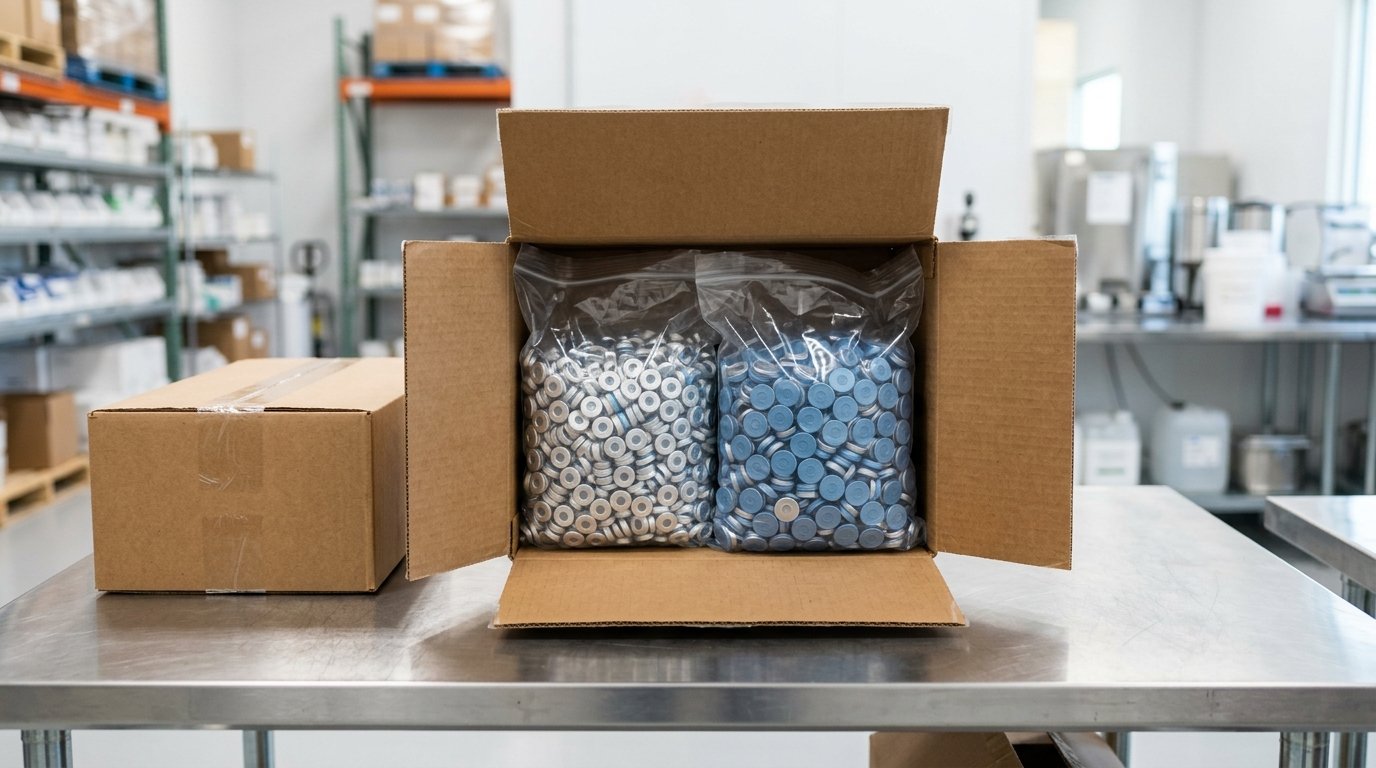
Autofits FlipTop vial seals ship in a standard box of 420 × 270 × 320 mm, holding 15,000 seals at 13 mm, 6,000 at 20 mm, 3,000 at 28 mm and 1,400 at 32 mm, packed in inner bags. Tyvek bagging is available, and seals for aseptic areas are double-bagged. Ready-to-Use seals are sterilised by gamma irradiation or ETO before packing. This page sets out the box, the bags, the counts and the figures a buyer needs to plan storage, freight and entry into a clean area.
Key takeaways
- One box size across the seal range: 420 × 270 × 320 mm, a volume of about 0.036 m³.
- Seals per box: 15,000 (13 mm), 6,000 (20 mm), 3,000 (28 mm) and 1,400 (32 mm). The 34 mm count is confirmed with the quotation.
- Bags per box: three bags of 5,000 at 13 mm, two bags of 1,500 at 28 mm and two bags of 700 at 32 mm.
- Double-bagging for seals going into aseptic areas, so the outer bag can be removed before transfer.
- Tyvek bagging is available where a breathable sterile barrier is specified.
- ROPP caps ship in cartons of typically about 4,000 to 12,000 caps depending on size.
Standard box and bag configuration
Every vial seal size uses the same outer box; the bag count and pieces per bag change with the seal diameter.
| Seal size | Seals per box | Bags per box | Seals per bag | Box dimensions |
|---|---|---|---|---|
| 13 mm | 15,000 | 3 | 5,000 | 420 × 270 × 320 mm |
| 20 mm | 6,000 | Confirmed with the quotation | Confirmed with the quotation | 420 × 270 × 320 mm |
| 28 mm | 3,000 | 2 | 1,500 | 420 × 270 × 320 mm |
| 32 mm | 1,400 | 2 | 700 | 420 × 270 × 320 mm |
| 34 mm | Confirmed with the quotation | Confirmed with the quotation | Confirmed with the quotation | 420 × 270 × 320 mm |
These are the standard counts for the FlipTop aluminium-plastic lines by size. Counts for the all-aluminium tear-off and tear-down seals, and the bag split for 20 mm seals, are confirmed with the quotation.
Freight and storage planning figures
These figures are straight arithmetic on the box size and counts above, for estimating warehouse space and shipment volume.
| Seal size | Boxes per 100,000 seals | Seals per cubic metre of boxes | Boxes per cubic metre |
|---|---|---|---|
| 13 mm | 6.7 | About 413,000 | About 27.6 |
| 20 mm | 16.7 | About 165,000 | About 27.6 |
| 28 mm | 33.3 | About 82,700 | About 27.6 |
| 32 mm | 71.4 | About 38,600 | About 27.6 |
Gross weight per box and the pallet pattern depend on seal size, design and bagging, and are confirmed with the quotation. Use the table for a first estimate and the shipping documents for the actual consignment.
Packaging by delivery form
The delivery form decides how the seals are cleaned, whether they are sterilised, and how many barriers they carry into your plant.
| Delivery form | Processing before packing | Bagging | Shelf life before capping |
|---|---|---|---|
| Regular | Standard production and 100% camera inspection | Standard bags in the box; Tyvek on request | 3.5 years (non-irradiated), plus 5 years after capping |
| Ready-to-Sterilize (RTS) | Prepared for the customer’s own sterilisation step | Confirmed with the specification; Tyvek available | Confirmed with the specification |
| Ready-to-Use (RTU) | Double-lacquered aluminium, washed to control particles, assembled in an ISO Class 8 cleanroom, sterilised by gamma irradiation or ETO | Double-bagged for aseptic areas | 2 years |
The sterilisation method has to suit the downstream process and the materials. How gamma and ETO cycles are validated is covered under sterilisation validation, and what happens to RTU seals once they reach the capping station is described in sterile vial sealing.
Why double-bagging matters for aseptic areas
A double-bagged seal lets the outer bag, which has been handled through transport and the warehouse, be removed before the inner bag enters the cleaner zone. In a typical transfer the outer bag is opened and discarded at the airlock or pass-through, and the inner bag is wiped or decontaminated according to the site’s procedure before it goes further. The seals themselves are not exposed until they reach the point of use.
The expectations for moving components into the areas around an aseptic filling line are set by the manufacturer’s contamination control strategy under EU GMP Annex 1. The supplier’s part is to deliver seals in a bag configuration that the site’s transfer procedure can work with, which is why the bagging is stated at the time of ordering rather than assumed.
ROPP cap cartons
Pilfer-proof caps ship in cartons whose count depends on cap size, shell height and liner. Counts below are typical, and the carton size, bagging and count for an order are confirmed with the quotation.
| Cap size | Typical caps per carton |
|---|---|
| 22 mm | About 12,000 |
| 25 mm | About 10,000 |
| 28 mm | About 7,500 |
| 35 mm | About 5,000 |
| 38 mm | About 4,000 |
Checks on receipt
A receiving check on seals is quick, and most of it can be done before a bag is opened.
- Box condition. No crush damage, tears or signs of moisture.
- Bag integrity. Inner bags sealed; on double-bagged RTU stock, both layers intact.
- Identity. Part description, size, colour and batch on the box match the order and the documents.
- Count. Boxes and bags received against the delivery documents.
- Shelf life. The date on the box checked against the shelf life before capping: 2 years for Ready-to-Use seals, 3.5 years for non-irradiated seals.
A dimensional spot check of D1 and total height against the drawing is the natural next step; the values for each line are on the technical datasheets page. Batch records that link a box back to production are described in seal batch traceability.
Storing seals after receipt
Seals keep their shelf life only if they are stored the way the product dossier describes. Epoxy lacquer and polypropylene can age faster in poor conditions, so:
- keep boxes closed, at room temperature, out of sunlight and protected from dust;
- do not stack loads that compress the boxes, because compression deforms seals;
- keep seals away from solvents and their vapours;
- avoid wet or humid storage and any condition that causes condensation, in a ventilated warehouse;
- keep storage time short and use stock first-in, first-out.
What to send with a packaging enquiry
- Seal line, size and quantity
- Delivery form: Regular, RTS, or RTU by gamma or ETO
- Bagging: standard, Tyvek or double-bagged
- Any site rule on box material or labelling for your warehouse or clean area
- Destination country and the Incoterm you want quoted
- Whether you need a pallet pattern or gross weights before ordering
Contact Autofits. Order quantities and lead times, including the typical 1 to 2 weeks that RTU supply adds, are on the MOQ and lead times page.
Frequently asked questions
How many flip-off seals are in a box?
A standard Autofits box holds 15,000 seals at 13 mm, 6,000 at 20 mm, 3,000 at 28 mm and 1,400 at 32 mm. The 13 mm seals are packed in three bags of 5,000, the 28 mm in two bags of 1,500 and the 32 mm in two bags of 700. The count for 34 mm seals is confirmed with the quotation.
What size is the shipping box for vial seals?
The standard box is 420 × 270 × 320 mm for every vial seal size, which is a volume of about 0.036 cubic metres. Only the number of seals and bags inside it changes with the seal size.
Are vial seals available in Tyvek bags?
Yes. Tyvek bagging is available on request. Tyvek is a breathable material often chosen where a sterilisation cycle has to reach the contents through the bag. State the bagging you need when you ask for a quotation.
What does double-bagged mean for Ready-to-Use seals?
Ready-to-Use seals are packed in two bags so the outer bag, which has been through transport and storage, can be removed at the entry to a clean area, leaving a clean inner bag to carry the seals further. This matches how components are usually transferred towards an aseptic filling line.
What is the gross weight of a box of seals?
Gross weight depends on the seal size, the design, the disc and the bagging, so it is confirmed with the quotation rather than published as one figure.
Related reading
- Technical datasheets by product line
- MOQ and lead times
- Sterile vial sealing
- EU GMP Annex 1 and vial closures
- Pilfer-proof (ROPP) caps
Sources
- Autofits FlipTop Seals dossier (packing, delivery forms, sterilisation, shelf life)
- European Commission: EudraLex Volume 4, EU GMP guidelines, Annex 1 Manufacture of Sterile Medicinal Products (https://health.ec.europa.eu/medicinal-products/eudralex/eudralex-volume-4_en)
- ISO: ISO 11137-1, Sterilization of health care products, Radiation (https://www.iso.org/standard/81721.html)
- ISO: ISO 11135, Sterilization of health-care products, Ethylene oxide (https://www.iso.org/standard/56137.html)
*Last updated: 2026-09-15. Box dimensions and seal counts are from the Autofits FlipTop Seals dossier; planning figures are calculated from them. ROPP carton counts are typical. Gross weights and pallet patterns are confirmed with the quotation.*
