
Vial Seal Technical Datasheets: Specifications for Every Autofits Product Line
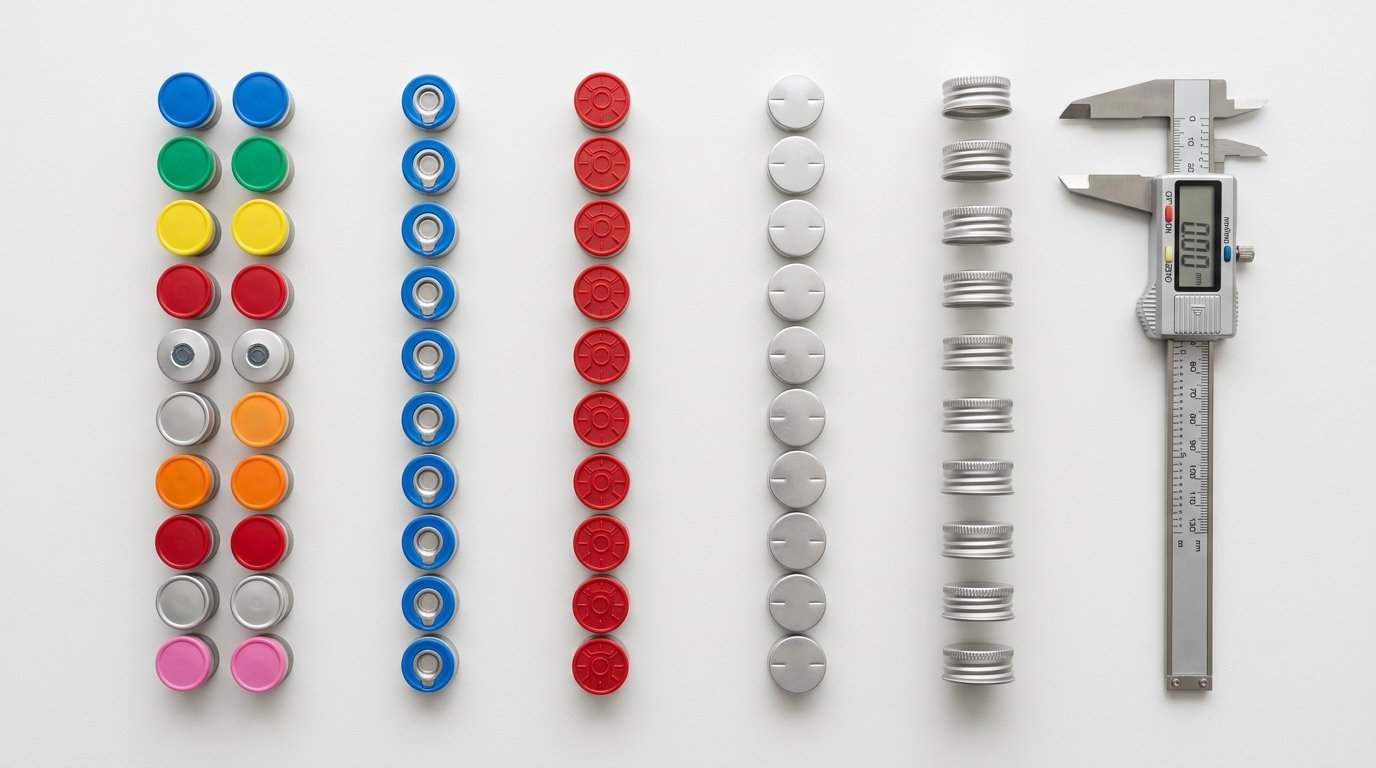
This page holds the technical datasheet for each Autofits product line: dimensions, materials, maximum opening force, standard packing, delivery forms, shelf life and the standards each line follows. Every seal figure comes from the Autofits engineering drawings and the FlipTop seals dossier. The common specification shared by all seal lines is set out once, then each line has its own datasheet with the values that differ. Pilfer-proof (ROPP) cap values are typical and are confirmed with the quotation.
Key takeaways
- Six datasheets: FlipTop Optima, FlipTop Pull Ring, FlipTop Tear-Down, all-aluminium Tear-off, all-aluminium Tear-down, and aluminium pilfer-proof (ROPP) caps.
- Aluminium: AA8011 to EN 15088:2005, EN 10204 3.1 certified, tested to BS EN 485-2:2008, REACH and RoHS compliant.
- Plastic discs: polypropylene to FDA 21 CFR 177.1520 and EC 1895/2005, with BADGE, NOGE and BFDGE not used.
- Maximum opening force: 30 N at 13 mm, 35 N at 20 and 28 mm, 65 N at 32 mm.
- Shelf life: 3.5 years before capping and 5 years after capping for non-irradiated seals; 2 years before capping for Ready-to-Use seals.
- Standard box: 420 × 270 × 320 mm, holding 15,000 seals at 13 mm down to 1,400 at 32 mm.
Common specification for all vial seal lines
Every vial seal line shares one material set, one quality system and one set of delivery forms; only dimensions, opening force and packing change between lines.
| Field | Specification |
|---|---|
| Aluminium | Alloy AA8011, conforming to EN 15088:2005, EN 10204 3.1 certification, tested to BS EN 485-2:2008 |
| Aluminium coating | Epoxy lacquer conforming to 21 CFR 175.300, may be pigmented for colour |
| Plastic disc (aluminium-plastic lines) | Polypropylene to IS 10910 and IS 10909, FDA 21 CFR 177.1520 (olefin polymers) and EC 1895/2005; BADGE, NOGE and BFDGE not used |
| Heavy metals | Chromium VI, cadmium, mercury and lead, maximum 100 ppm total (EN 602, EC 94/62) |
| Animal origin | BSE/TSE-free to EMEA/410/01 rev. 3 |
| Chemical regulations | REACH and RoHS compliant |
| Delivery forms | Regular; Ready-to-Sterilize (RTS); Ready-to-Use (RTU), sterilised by gamma irradiation or ETO |
| RTU processing | Double-lacquered aluminium, washed to control particles, assembled in an ISO Class 8 cleanroom, then sterilised |
| Bagging | Tyvek bagging available; double-bagged for aseptic areas |
| Shelf life, non-irradiated | 3.5 years before capping, plus 5 years after capping |
| Shelf life, RTU | 2 years before capping |
| Storage | Closed containers at room temperature, away from sunlight, dust, solvents and condensation; not compressed; first-in, first-out |
| Inspection | 100% high-speed camera inspection |
| AQL | Critical nil; major not more than 2.5%; minor not more than 4%; tailorable |
| Quality system | ISO 9001:2015, ISO 14001:2015, ISO 15378:2017; Drug Master File (DMF 18100); CFDA registration |
| Standard box | 420 × 270 × 320 mm |
Maximum opening force and pack counts by size come from the FlipTop seals dossier, which covers the aluminium-plastic lines. For the all-aluminium lines both are given on request.
Datasheet: FlipTop Optima flip-off seal
The FlipTop Optima is an aluminium-plastic flip-off seal: the user flips the polypropylene disc off to expose the stopper, while the aluminium skirt stays crimped.
| Field | Value |
|---|---|
| Construction | Aluminium shell with polypropylene flip-off disc |
| Designs | Bridge (with or without groove), Button, Flower |
| Finishes | Glossy, matte, embossed, printed |
| Sizes | 13, 20, 28, 32, 34 mm |
| Standards | ISO 15378:2017, ISO 8362-6 |
| Tamper evidence | Button design carries intrinsic tamper evidence, with a 12-stem flower under the button disc |
| Size | D1 inner aluminium (mm) | Total height (mm) | Aluminium thickness (mm) | Bridges | Max opening force | Standard packing per box |
|---|---|---|---|---|---|---|
| 13 mm | 13.36 min | 7.62 to 8.38 | 0.16 to 0.20 | 6 taper | 30 N | 15,000 (5,000 × 3 bags) |
| 20 mm | 20.22 min | 9.02 to 9.91 | 0.16 to 0.20 | 6 taper | 35 N | 6,000 (bag split confirmed with the quotation) |
| 28 mm | 27.60 to 28.20 | 11.06 to 12.06 | 0.17 to 0.23 | 8 | 35 N | 3,000 (1,500 × 2 bags) |
| 32 mm | 32.10 to 32.90 | 14.30 to 15.50 | 0.21 to 0.25 | 12 taper | 65 N | 1,400 (700 × 2 bags) |
| 34 mm | 33.60 to 34.00 | 15.00 to 16.00 | 0.20 to 0.25 | 8 taper | On request | On request |
Disc diameters and heights for every size are in the seal sizing guide. Product page: FlipTop Optima.
Datasheet: FlipTop Pull Ring seal
On a pull-ring seal the whole seal comes away once the polypropylene disc is detached: the user pulls the aluminium ring and opens it anticlockwise.
| Field | 20 mm | 32 mm |
|---|---|---|
| Construction | Aluminium shell, PP disc, bridge design | Aluminium shell, PP disc, flower design |
| D1 inner aluminium | 20.00 to 20.60 mm | 32.15 to 32.40 mm |
| D2 outer disc | 22.00 to 23.00 mm | 36.20 to 36.60 mm |
| Total or assembled height | 9.00 to 10.00 mm | 14.30 to 15.30 mm |
| Aluminium thickness | 0.18 to 0.22 mm | 0.20 to 0.26 mm |
| Bridges or fins | 6 taper bridges | 8 fins |
| Max opening force | 35 N | 65 N |
| Standard packing per box | 6,000 (bag split confirmed with the quotation) | 1,400 (700 × 2 bags) |
| Marking | Often marked “For Oral Use Only” or “Flip Top & Tear” | Often marked “For Oral Use Only” or “Flip Top & Tear” |
| Standards | ISO 15378:2017, ISO 8362-6 | ISO 15378:2017, ISO 8362-6 |
Product page: FlipTop Pull Ring.
Datasheet: FlipTop Tear-Down seal
The FlipTop Tear-Down has a polypropylene disc riveted to the aluminium; the disc is opened, then pulled and turned anticlockwise so the whole seal comes off. It is used mainly for oral vaccinations.
| Field | 13 mm | 20 mm | 32 mm (flower) |
|---|---|---|---|
| D1 inner aluminium | 13.30 to 13.50 mm | 20.00 to 20.60 mm | 32.40 to 33.15 mm |
| D2 disc | 14.80 to 15.40 mm | 22.00 to 23.00 mm | 35.70 to 36.70 mm |
| Total height | 6.80 to 8.30 mm | 8.80 to 9.80 mm (assembled) | 14.30 to 15.30 mm |
| Aluminium thickness | 0.18 to 0.22 mm | On request | 0.20 to 0.26 mm |
| Bridges or fins | Bridge design | Bridge design | 8 fins |
| Max opening force | 30 N | 35 N | 65 N |
| Standard packing per box | 15,000 (5,000 × 3 bags) | 6,000 (bag split confirmed with the quotation) | 1,400 (700 × 2 bags) |
| Standards | ISO 15378:2017, ISO 8362-6 | ISO 15378:2017, ISO 8362-6 | ISO 15378:2017, ISO 8362-6 |
Product page: FlipTop Tear-Down.
Datasheet: all-aluminium Tear-off seal
A tear-off seal is one piece of lacquered aluminium with no plastic; the perforated centre is torn away to expose the stopper.
| Field | 13 mm | 20 mm | 32 mm |
|---|---|---|---|
| D1 inner aluminium | 13.20 to 13.60 mm | 20.00 to 20.60 mm | 32.40 to 32.60 mm |
| Perforation diameter | On request | 9.70 to 10.50 mm | 17.80 to 18.20 mm |
| Total height | 6.90 to 7.70 mm | 7.40 to 8.00 mm | 13.00 to 13.60 mm |
| Aluminium thickness | On request | 0.16 to 0.20 mm | On request |
| Bridges | 2 | 2 | On request |
| Max opening force | On request | On request | On request |
| Standard packing per box | Confirmed with the quotation | Confirmed with the quotation | Confirmed with the quotation |
| Standards | ISO 15378:2017, ISO 8362-3 | ISO 15378:2017, ISO 8362-3 | ISO 15378:2017, ISO 8362-3 |
Product page: Tear-off seals.
Datasheet: all-aluminium Tear-down seal
The all-aluminium tear-down seal removes completely by tearing its perforated section down, with no plastic disc.
| Field | 20 mm |
|---|---|
| D1 inner aluminium | 20.50 to 20.70 mm |
| Perforation diameter | 12.90 to 13.20 mm |
| Total height | 7.50 to 8.50 mm |
| Aluminium thickness | 0.18 to 0.22 mm |
| Bridges | 2 taper |
| Other sizes | Confirmed on enquiry |
| Standards | ISO 15378:2017, ISO 8362-3 |
Product page: Tear-down seals.
Datasheet: aluminium pilfer-proof (ROPP) caps
ROPP caps are threadless aluminium shells roll-formed onto a bottle’s screw neck, with a pilfer band that breaks on first opening. Values are typical and confirmed with the quotation.
| Field | Value |
|---|---|
| Sizes | 22, 25, 28, 35, 38 mm |
| Aluminium | AA8011; typically 0.20 to 0.22 mm at 22 and 25 mm, 0.21 to 0.23 mm at 28 mm, 0.22 to 0.24 mm at 35 mm, 0.23 to 0.25 mm at 38 mm |
| Coating | Epoxy lacquer to 21 CFR 175.300 |
| Liners | EPE, latex or PVC |
| Finishes | Plain, printed or chamfered |
| Typical shell height | 15 to 18 mm (22 mm) up to 18 to 24 mm (35 and 38 mm) |
| Typical carton | About 12,000 (22 mm), 10,000 (25 mm), 7,500 (28 mm), 5,000 (35 mm), 4,000 (38 mm) |
Product page: pilfer-proof caps.
How to use these datasheets
Use a datasheet as the starting point for your purchase specification, then fix the controlled drawing for the exact part before a first order.
- Incoming inspection. D1 and total height are the two dimensions most worth checking on receipt, because they decide whether the seal clears the neck and covers the stopper flange.
- Capping trials. Opening force and aluminium thickness affect how the seal crimps and how it opens at point of use. Run trials with production vials and stoppers.
- Stability and shelf life. Plan use of RTU stock within its 2 years before capping; non-irradiated seals allow 3.5 years before capping.
- Supplier file. The material conformances in the common specification are the ones a qualification file usually records. Certificate numbers are on the quality certificates page, and box and bag details on the packaging and shipping specs page.
Piece weight is not part of these datasheets because it differs by design, disc and gauge. It is confirmed with the quotation.
What to send for a controlled datasheet
Send the line, size and design you are specifying, and a drawing and specification for that exact part come back with the quotation.
- Product line, design and size
- Vial and stopper drawings
- Colour, finish and any print or emboss
- Delivery form: Regular, RTS, or RTU by gamma or ETO
- Bagging: standard, Tyvek or double-bagged
- Annual volume and destination country
Contact Autofits with the list above.
Frequently asked questions
What is the weight of a 20 mm flip-off seal?
Piece weight is not a fixed datasheet figure, because it depends on the design, the polypropylene disc and the aluminium thickness, which is 0.16 to 0.20 mm on a 20 mm FlipTop Optima. The weight for the exact part is confirmed with the quotation.
What is the shelf life of an aluminium vial seal?
Non-irradiated Autofits seals have a shelf life of 3.5 years before capping and 5 years after capping. Ready-to-Use seals, which are sterilised by gamma irradiation or ETO, have a shelf life of 2 years before capping.
Which material standards does the aluminium meet?
The aluminium is alloy AA8011, conforming to EN 15088:2005, supplied with EN 10204 3.1 certification and tested to BS EN 485-2:2008. It is REACH and RoHS compliant, and the epoxy lacquer coating conforms to 21 CFR 175.300.
Why are some 34 mm and all-aluminium values given on request?
They are not part of the published specification for the range. The opening force and pack count for the 34 mm seal, and the opening force and pack count for the all-aluminium seals, are given with the quotation for the specific part rather than shown as an estimate.
Can a datasheet be used as a purchase specification?
It is a starting point. A purchase specification should reference the controlled drawing for the exact part, the delivery form, the bagging and the AQL agreed with the supplier. The standard AQL is critical nil, major not more than 2.5% and minor not more than 4%, and it can be tailored.
Related reading
- Vial seal sizing guide
- Packaging and shipping specifications
- Quality certificates and registrations
- FlipTop Optima flip-off seals
- Pilfer-proof (ROPP) caps
Sources
- Autofits engineering drawings and FlipTop Seals dossier
- eCFR: 21 CFR 175.300, Resinous and polymeric coatings (https://www.ecfr.gov/current/title-21/chapter-I/subchapter-B/part-175/subpart-C/section-175.300)
- eCFR: 21 CFR 177.1520, Olefin polymers (https://www.ecfr.gov/current/title-21/chapter-I/subchapter-B/part-177/subpart-B/section-177.1520)
- EMA: Note for guidance on minimising the risk of transmitting animal spongiform encephalopathy agents via human and veterinary medicinal products, EMA/410/01 rev. 3 (https://www.ema.europa.eu/en/minimising-risk-transmitting-animal-spongiform-encephalopathy-agents-human-veterinary-medicinal-products-scientific-guideline)
- ISO: ISO 8362-6:2010, Caps made of aluminium-plastics combinations for injection vials (https://www.iso.org/standard/52806.html)
- ISO: ISO 15378:2017, Primary packaging materials for medicinal products (https://www.iso.org/standard/70729.html)
*Last updated: 2026-09-15. Seal values are transcribed from Autofits engineering drawings and the FlipTop Seals dossier; ROPP cap values are typical. The controlled drawing for the part you order is confirmed with the quotation.*
