
Vial Seal Sizing Guide: Dimensions for Every Seal from 13 to 34 mm
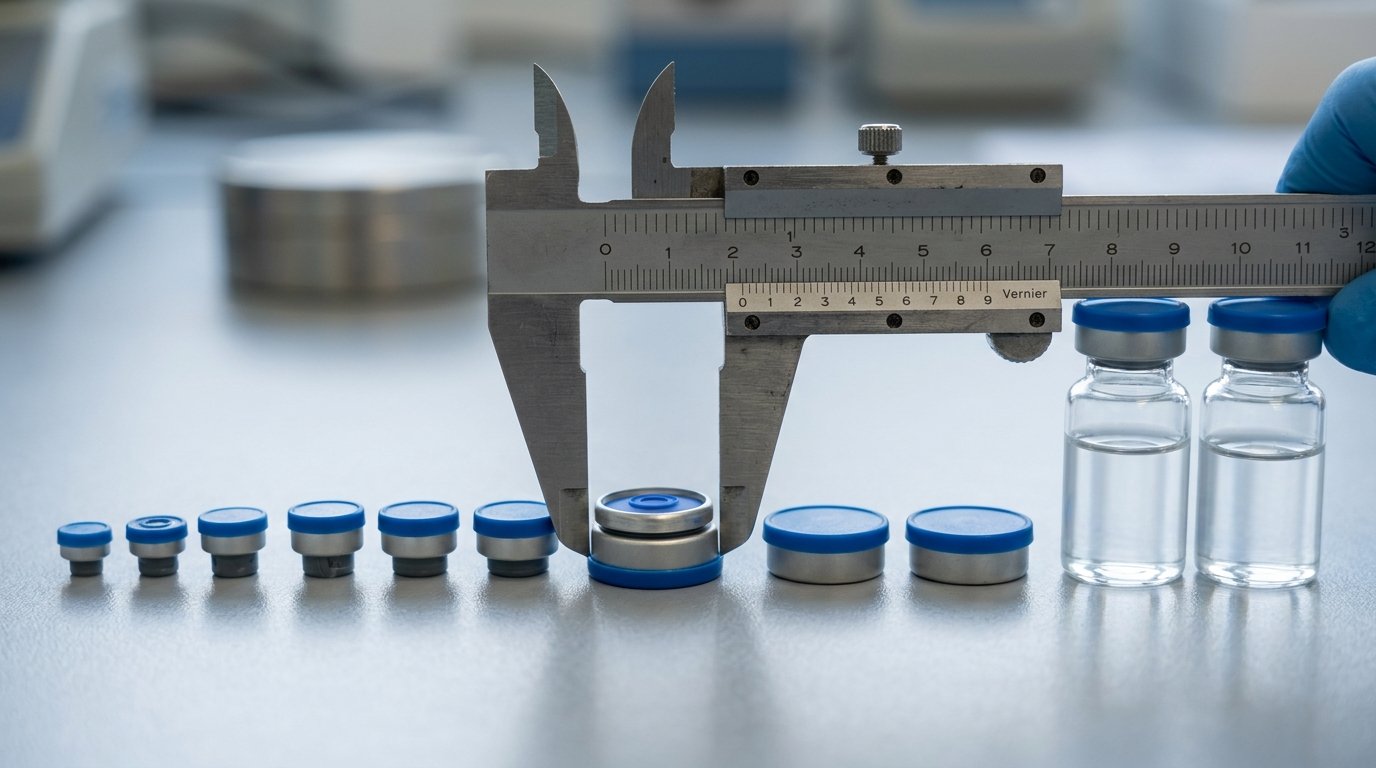
A vial seal is sized by the nominal outside diameter of the vial neck it closes, so a 20 mm seal fits a 20 mm neck finish whatever the fill volume of the vial. Autofits makes crimped vial seals in 13, 20, 28, 32 and 34 mm. This guide gives the drawing dimensions for each size and product line: inner aluminium diameter (D1), outer disc or perforation diameter (D2), heights, aluminium thickness and bridge count, with the neck standard behind each. Values are transcribed from the Autofits engineering drawings; a value not published for a size is marked “on request”.
Key takeaways
- Five seal sizes: 13, 20, 28, 32 and 34 mm. The size is the neck finish, not the vial capacity.
- D1 is the inside diameter of the aluminium skirt. On a 20 mm FlipTop Optima it is 20.22 mm minimum, just over the neck it fits.
- Aluminium thickness runs from 0.16 to 0.20 mm on 13 and 20 mm Optima seals up to 0.21 to 0.25 mm on the 32 mm.
- Bridge count varies by size: 6 on 13 and 20 mm Optima, 8 on 28 and 34 mm, 12 on 32 mm.
- Maximum opening force is 30 N at 13 mm, 35 N at 20 and 28 mm, and 65 N at 32 mm.
- Glass vial necks follow ISO 8362-1 (tubing) and ISO 8362-4 (moulded); aluminium-plastic caps follow ISO 8362-6 and all-aluminium caps ISO 8362-3.
- Pilfer-proof (ROPP) caps are a separate family sized to bottle necks: 22, 25, 28, 35 and 38 mm.
How to read seal size against vial neck
Match the seal to the neck finish on the vial drawing, then check that the skirt height covers the stopper flange and the neck bead together. The seal diameter is fixed by the neck. The height has to suit the stack it crimps over: the flange of the rubber stopper sitting on top of the glass bead. A seal that is too short leaves too little skirt to roll under the bead; one that is too tall leaves loose aluminium after crimping.
| Seal size | Neck it closes | Typical container | Autofits lines in this size | Cap standard |
|---|---|---|---|---|
| 13 mm | 13 mm neck finish | Small tubular glass injection and lyophilisation vials | FlipTop Optima, FlipTop Tear-Down, Tear-off | ISO 8362-6 (alu-plastic), ISO 8362-3 (all-aluminium) |
| 20 mm | 20 mm neck finish | The most common injection vial neck, tubular or moulded | FlipTop Optima, FlipTop Pull Ring, FlipTop Tear-Down, Tear-off, Tear-down | ISO 8362-6, ISO 8362-3 |
| 28 mm | 28 mm neck finish | Larger-neck injectable and lyophilised vials | FlipTop Optima | ISO 8362-6 |
| 32 mm | 32 mm neck finish | Large-neck vials for high fill or reconstitution | FlipTop Optima, FlipTop Pull Ring, FlipTop Tear-Down, Tear-off | ISO 8362-6, ISO 8362-3 |
| 34 mm | 34 mm neck finish | The largest necks in the range | FlipTop Optima | ISO 8362-6 |
Container types are typical practice, not a limit. Two vials of very different capacity often share one neck, which is why a 2 ml and a 10 ml vial can take the same 20 mm seal. The broader decision is explained in how to choose a vial cap size, and the seals are grouped by size on the vial seals by size pages.
FlipTop Optima dimensions (aluminium-plastic flip-off)
The FlipTop Optima is the only line made in all five sizes, so its table doubles as the reference chart for the range. All values in mm.
| Size | D1, inner aluminium | D2, outer disc | Disc height | Inner aluminium height | Total seal height | Aluminium thickness | Bridges |
|---|---|---|---|---|---|---|---|
| 13 mm | 13.36 min | 14.99 max | 2.90 to 3.30 | 6.15 to 6.40 | 7.62 to 8.38 | 0.16 to 0.20 | 6 taper |
| 20 mm | 20.22 min | 23.14 max | 3.20 to 3.60 | 7.37 to 7.62 | 9.02 to 9.91 | 0.16 to 0.20 | 6 taper |
| 28 mm | 27.60 to 28.20 | 30.10 to 31.10 | On request | 8.70 to 9.30 | 11.06 to 12.06 | 0.17 to 0.23 | 8 |
| 32 mm | 32.10 to 32.90 | 35.50 to 36.50 | On request | On request | 14.30 to 15.50 | 0.21 to 0.25 | 12 taper |
| 34 mm | 33.60 to 34.00 | 35.50 to 36.50 | On request | On request | 15.00 to 16.00 | 0.20 to 0.25 | 8 taper |
FlipTop Pull Ring and FlipTop Tear-Down dimensions
Both lines remove the whole seal after opening; at 20 mm the Pull Ring is drawn from thicker aluminium than the Optima, 0.18 to 0.22 mm against 0.16 to 0.20 mm. All values in mm.
| Line and size | D1, inner aluminium | D2, disc | Disc height | Inner aluminium height | Total or assembled height | Aluminium thickness | Bridges or fins |
|---|---|---|---|---|---|---|---|
| Pull Ring 20 mm | 20.00 to 20.60 | 22.00 to 23.00 | 3.00 to 4.00 | 7.00 to 7.60 | 9.00 to 10.00 | 0.18 to 0.22 | 6 taper bridges |
| Pull Ring 32 mm (flower) | 32.15 to 32.40 | 36.20 to 36.60 | On request | 13.20 to 13.60 | 14.30 to 15.30 | 0.20 to 0.26 | 8 fins |
| Tear-Down 13 mm | 13.30 to 13.50 | 14.80 to 15.40 | 3.70 to 4.10 | 6.00 to 6.40 | 6.80 to 8.30 | 0.18 to 0.22 | Bridge design |
| Tear-Down 20 mm | 20.00 to 20.60 | 22.00 to 23.00 | 3.00 to 4.00 | 7.20 to 7.80 | 8.80 to 9.80 | On request | Bridge design |
| Tear-Down 32 mm (flower) | 32.40 to 33.15 | 35.70 to 36.70 | On request | 13.20 to 13.60 | 14.30 to 15.30 | 0.20 to 0.26 | 8 fins |
All-aluminium tear-off and tear-down dimensions
All-aluminium seals have no plastic disc, so D2 is the diameter of the perforated centre that tears away rather than a disc. All values in mm.
| Line and size | D1, inner aluminium | D2, perforation | Total height | Aluminium thickness | Bridges |
|---|---|---|---|---|---|
| Tear-off 13 mm | 13.20 to 13.60 | On request | 6.90 to 7.70 | On request | 2 |
| Tear-off 20 mm | 20.00 to 20.60 | 9.70 to 10.50 | 7.40 to 8.00 | 0.16 to 0.20 | 2 |
| Tear-off 32 mm | 32.40 to 32.60 | 17.80 to 18.20 | 13.00 to 13.60 | On request | On request |
| Tear-down 20 mm | 20.50 to 20.70 | 12.90 to 13.20 | 7.50 to 8.50 | 0.18 to 0.22 | 2 taper |
Opening force by size
Opening force depends on seal size and on the number of bridges that have to break. The figures below are maximums from the FlipTop seals dossier.
| Seal size | Maximum opening force |
|---|---|
| 13 mm | 30 N |
| 20 mm | 35 N |
| 28 mm | 35 N |
| 32 mm | 65 N |
| 34 mm | On request |
Pilfer-proof (ROPP) cap sizes
ROPP caps close threaded bottles, not stoppered vials, so their sizes follow the bottle’s screw-neck finish. The values below are typical; the controlled drawing for a specific bottle is confirmed with the quotation.
| Cap size | Typical container | Typical shell height | Typical aluminium thickness |
|---|---|---|---|
| 22 mm | 10 ml to 60 ml bottles | 15 to 18 mm | 0.20 to 0.22 mm |
| 25 mm | 30 ml to 125 ml bottles | 16 to 18 mm | 0.20 to 0.22 mm |
| 28 mm | 100 ml to 500 ml bottles | 18 mm, taller for longer necks | 0.21 to 0.23 mm |
| 35 mm | 150 ml to 500 ml wider-neck bottles | 18 to 24 mm | 0.22 to 0.24 mm |
| 38 mm | 200 ml to 1 litre wide-mouth bottles | 18 to 24 mm | 0.23 to 0.25 mm |
The caps and their liners are on the pilfer-proof caps page.
How to use this guide
Start from the vial drawing, pick the size from the neck, then check three numbers against the vial and stopper: D1, total height and aluminium thickness.
- Read the neck outside diameter and bead height from the vial supplier’s drawing. Tubular glass vials are dimensioned under ISO 8362-1 and moulded glass vials under ISO 8362-4.
- Add the stopper flange thickness from the stopper drawing. The seal’s inner height has to cover the flange and the bead with enough skirt left to roll under.
- Choose the line from how the vial is opened: flip-off, pull ring, tear-down or tear-off. The dimensional rules for aluminium-plastic caps are in ISO 8362-6; for all-aluminium caps, ISO 8362-3.
- Check the crimp on your own capper with production vials and stoppers before fixing the specification. Dimensions confirm fit on paper; a capping trial confirms it on the line.
Piece weight is not a catalogue value. It varies with the design, the disc and the aluminium thickness, and is confirmed with the quotation for the part you order. The full specification for each line, including materials and shelf life, is on the technical datasheets page.
What to send with a sizing enquiry
Send the drawings, not a description, and the matching seal drawing comes back with the quotation.
- Vial drawing, or the vial supplier and part number, with neck diameter and bead height
- Stopper drawing, with flange diameter and thickness
- Seal line and design you have in mind, if any
- Capping machine type and speed
- Whether you need samples for a capping trial
Contact Autofits with the above and the engineering team will confirm the seal size and drawing.
Frequently asked questions
Are 5 ml, 10 ml and 30 ml vial caps the same size?
Often, yes. A vial seal is sized by the neck finish, not by the vial’s capacity, and vials of quite different volumes are commonly made with the same 20 mm neck. A 5 ml vial could also have a 13 mm neck. Read the neck diameter from the vial drawing rather than choosing the seal from the fill volume.
How do I measure a vial neck to choose a seal?
Measure the outside diameter of the neck bead, the rolled lip at the top of the vial, with a caliper, and compare it with the nominal sizes of 13, 20, 28, 32 and 34 mm. Then take the bead height and the stopper flange thickness, because together they set how tall the seal skirt must be. The vial drawing is more reliable than a measured sample.
What is the difference between D1 and D2 on a seal drawing?
D1 is the inside diameter of the aluminium skirt, the dimension that has to clear the vial neck and stopper. D2 is the outside diameter of the plastic disc on an aluminium-plastic seal, or the diameter of the perforated centre on an all-aluminium tear-off or tear-down seal.
How much does a 20 mm flip-off seal weigh?
Piece weight is not published as a fixed figure because it depends on the design, the disc and the aluminium thickness, which on a 20 mm FlipTop Optima runs from 0.16 to 0.20 mm. The weight for the exact part you order is confirmed with the quotation. A standard box holds 6,000 20 mm FlipTop seals.
Which standard sets vial seal dimensions?
ISO 8362-6 covers caps made of aluminium-plastics combinations for injection vials, which includes flip-off seals, and ISO 8362-3 covers all-aluminium caps. Both are written to fit the glass vials of ISO 8362-1 and ISO 8362-4. Autofits aluminium-plastic seals follow ISO 8362-6, and its all-aluminium seals relate to ISO 8362-3.
Related reading
- Vial seals by size, 13 mm to 34 mm
- How to choose a vial cap size
- Technical datasheets for every seal line
- ISO 8362-6: aluminium-plastic caps
- ISO 8362-1: tubular glass injection vials
Sources
- Autofits engineering drawings and FlipTop Seals dossier
- ISO: ISO 8362-1:2018, Injection containers and accessories, Part 1: Injection vials made of glass tubing (https://www.iso.org/standard/74398.html)
- ISO: ISO 8362-3:2001, Injection containers and accessories, Part 3: Aluminium caps for injection vials (https://www.iso.org/standard/33804.html)
- ISO: ISO 8362-4:2011, Injection containers and accessories, Part 4: Injection vials made of moulded glass (https://www.iso.org/standard/57745.html)
- ISO: ISO 8362-6:2010, Injection containers and accessories, Part 6: Caps made of aluminium-plastics combinations for injection vials (https://www.iso.org/standard/52806.html)
*Last updated: 2026-09-15. Dimensions are transcribed from Autofits engineering drawings; the controlled drawing for the part you order is confirmed with the quotation. ROPP cap values are typical. This page is technical product information, not regulatory advice.*
