
Container Closure System (CCS): What It Is and Why It Matters
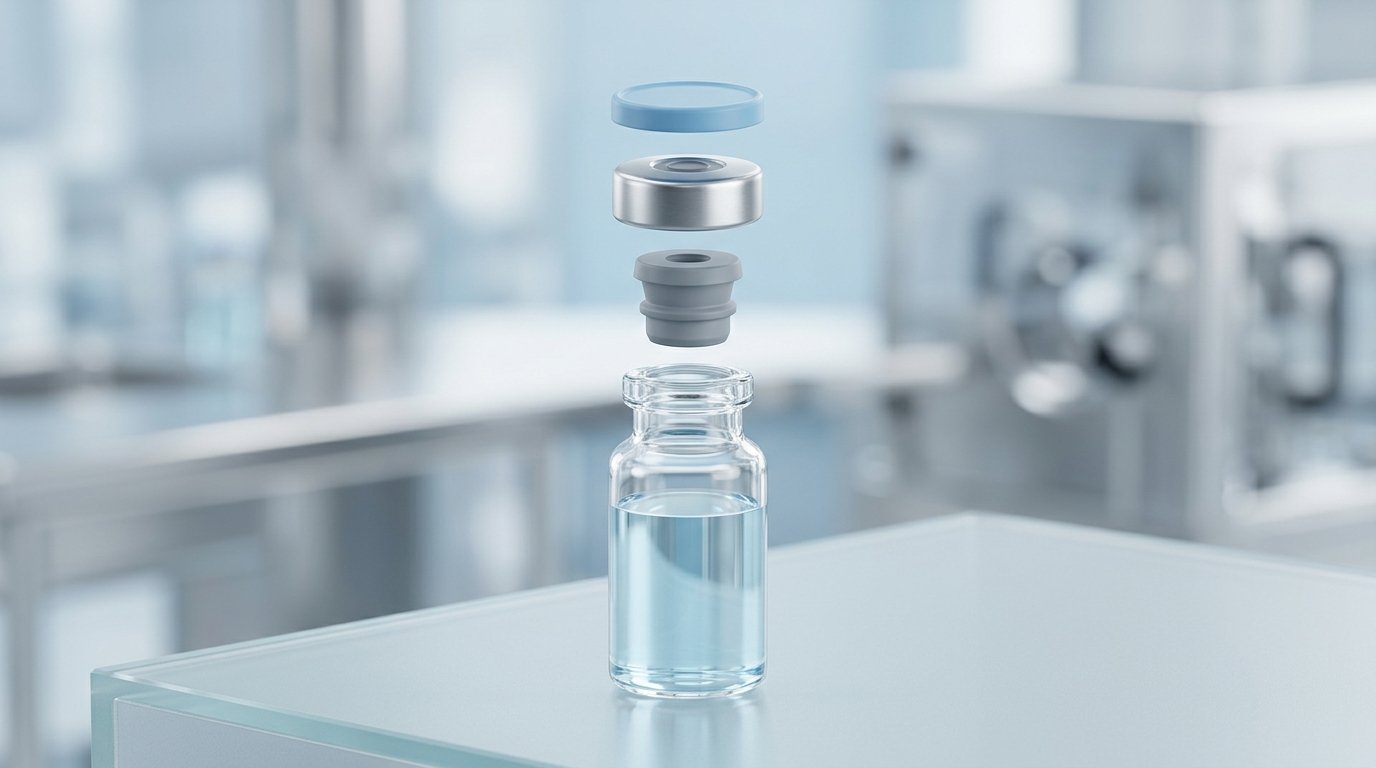
A container closure system (CCS) is the sum of the packaging components that together contain and protect a drug product. For an injectable, the CCS is the vial (the container) plus the closure that seals it: the rubber stopper and the aluminium or aluminium-plastic seal crimped over it. These parts are not evaluated in isolation. They are qualified as one system, because it is the assembled whole, not any single piece, that keeps the medicine sterile, stable, and protected from the moment it is filled until it reaches the patient.
This glossary entry explains what a container closure system is, which components make it up, how it maintains sterility, and how regulators frame it.
Key takeaways
- A container closure system is the complete set of packaging components that contain and protect a drug product: the container plus the closure.
- For an injectable vial, the CCS is the glass vial + rubber (elastomeric) stopper + aluminium or aluminium-plastic seal.
- The system is qualified as a whole, not part by part, because protection depends on how the components fit and seal together.
- A CCS must maintain container closure integrity (CCI), an unbroken sterile barrier, for the product’s entire shelf life.
- Regulators frame the CCS as central to product quality: the FDA’s container closure systems guidance and EU GMP Annex 1 both treat closure integrity as part of sterility assurance.
- The aluminium seal completes the system by holding the stopper in compression so the sterile barrier is maintained and so any tampering is visible.
What is a container closure system?
A container closure system is every packaging component that comes together to contain a specific drug product and keep it protected through storage and use. The term is defined in the FDA’s guidance on container closure systems for packaging human drugs and biologics, which describes a container closure system as the sum of packaging components that together contain and protect the dosage form.
The word “system” is deliberate. A vial on its own is just an empty container. A stopper on its own seals nothing. A seal on its own holds nothing in place. Only when the vial, stopper, and seal are assembled and crimped do they form a barrier that excludes microbes, moisture, oxygen, and contaminants. Because the protection is a property of the assembly, the components are selected, tested, and approved as a matched set.
A container closure system is a subset of primary packaging, the materials in direct contact with the medicine. Where “primary packaging” describes the contact materials individually, “container closure system” describes how those materials work together as a functioning protective unit.
What components make up a vial container closure system?
For an injectable vial, the container closure system has three core components: the container, the elastomeric closure, and the seal that secures it. Each has a defined job, and the system only works when all three are correct and correctly assembled.
| Component | Role in the system |
|---|---|
| Container (glass or polymer vial) | Holds the drug product and forms the primary barrier wall. |
| Elastomeric closure (rubber stopper) | Seats in the vial neck to seal the contents and allows needle penetration for dosing; resealing on withdrawal. |
| Aluminium or aluminium-plastic seal | Crimps over the stopper and vial neck to hold the stopper in compression, lock the seal, and provide tamper evidence. |
The stopper and the seal are distinct but interdependent. The stopper provides the sealing surface; the aluminium seal provides the force that keeps that surface compressed against the glass. A correctly applied seal is what converts a loosely seated stopper into a secure, integral closure. This is why an aluminium flip-off seal is not a cosmetic finish but a structural part of the closure system. The assembly as a whole is described under vial closure, and which closure format suits which product is worked through in the drug-type application guides.
How does a container closure system protect the drug?
A container closure system protects the drug by maintaining container closure integrity (CCI), an intact barrier that keeps the sterile contents in and contaminants out for the entire shelf life. For sterile and injectable products, this is the single most important function of the packaging.
Maintaining integrity depends on the components staying matched under real conditions: the stopper compressed at the right load, the seal crimped to the correct dimensions, and the materials remaining stable through sterilization, transport, temperature swings, and storage. A defect in any one part, a cracked vial, a misseated stopper, or a loose or damaged seal, can break the barrier and put sterility at risk.
Because integrity cannot be confirmed by visual inspection alone, manufacturers verify it with container closure integrity testing. The methods and lifecycle approach are described in USP General Chapter <1207>, which covers package integrity evaluation for sterile products and the deterministic and probabilistic leak-test methods used to demonstrate that a closure system holds.
How regulators frame the container closure system
Regulators treat the container closure system as a defined element of product quality, not as generic packaging. A drug application must describe and justify the CCS, and the closure components must be shown to be suitable for the product.
- FDA: The container closure systems guidance sets out what information is needed to demonstrate that a packaging system protects, is compatible with, and is safe for the drug product.
- USP: The elastomeric closure that forms part of the system is governed by USP <381> (elastomeric closures for injections) and its USP <382> functional-suitability tests, while integrity sits under USP <1207>.
- EU GMP Annex 1: The 2022 revision of Annex 1 treats the integrity of the sealed container as part of sterility assurance and sets expectations for the capping and sealing of vials and for inspecting sealed units.
The common thread across all three is that the closure system is qualified as a unit and held responsible for keeping the product sterile and stable. EU GMP Annex 1 states the sterility half of that, and ICH Q1A(R2) the stability half, since shelf life is demonstrated in the actual pack.
How this works in practice at Autofits
Autofits manufactures the seal that completes the injectable container closure system: aluminium-plastic FlipTop® flip-off seals, tear-off and tear-down aluminium seals, and aluminium pilfer-proof caps in 13, 20, and 32 mm sizes. The seal’s job in the system is to crimp over the stopper and vial neck so the stopper stays compressed and the sterile barrier holds, while the flip-top button gives tamper evidence. These seals are produced under an ISO 15378:2017 quality system, alongside ISO 9001:2015 and ISO 14001:2015 certification and a Drug Master File (DMF), in a 75,000 sq ft Nashik facility with an ISO Class 8 cleanroom and high-speed visual inspection. That dimensional consistency and inspection discipline is what lets the seal reliably do its part in the closure system. The full range of vial sealing products and the complete certification set are on the quality page.
Frequently asked questions
What is a container closure system?
A container closure system is the complete set of packaging components that together contain and protect a drug product. For an injectable, it is the vial (container) plus the closure that seals it: the rubber stopper and the aluminium or aluminium-plastic seal. The components are qualified as one system because protection depends on how they fit and seal together.
What is the difference between a container closure system and primary packaging?
Primary packaging refers to the materials in direct contact with the medicine, described individually (vial, stopper, seal, ampoule). A container closure system describes how those contact materials work together as one functioning protective unit. The CCS is the assembled system; primary packaging is the set of contact materials it is built from.
What are the components of a vial container closure system?
A vial container closure system has three core parts: the container (a glass or polymer vial), the elastomeric closure (a rubber stopper that seals the contents and allows needle access), and the aluminium or aluminium-plastic seal that crimps over the stopper to hold it in compression and provide tamper evidence.
How does the aluminium seal fit into the container closure system?
The aluminium seal completes the system by crimping over the stopper and vial neck. It holds the stopper compressed against the glass so the sterile barrier is maintained, locks the closure in place, and makes any tampering visible. The stopper provides the sealing surface; the seal provides the force that keeps it sealed.
Why is the container closure system qualified as a whole rather than part by part?
Because protection is a property of the assembly, not of any single component. A vial, stopper, or seal alone seals nothing. Only the matched, correctly assembled set maintains container closure integrity. Regulators therefore require the system to be described and justified as a unit, with the components shown to be suitable together.
Related reading
- What “primary packaging” means
- How a flip-off seal works and where it is used
- USP <1207> and container closure integrity
- Container closure integrity testing (CCIT) methods
- USP <382>: functional suitability of elastomeric closures
Sources
- FDA: Container Closure Systems for Packaging Human Drugs and Biologics, guidance for industry (https://www.fda.gov/regulatory-information/search-fda-guidance-documents/container-closure-systems-packaging-human-drugs-and-biologics)
- USP-NF: United States Pharmacopeia (USP <381>, <382>, <1207>) (https://www.usp.org/)
- European Commission: EudraLex Volume 4, EU GMP Annex 1, Manufacture of Sterile Medicinal Products (https://health.ec.europa.eu/medicinal-products/eudralex/eudralex-volume-4_en)
*Last updated: 2026-06-10. This article is general regulatory information, not legal or compliance advice; confirm current standard editions and guidance with the issuing bodies.*
