
Flip-Off Seal: What It Is and How It Works on Injectable Vials
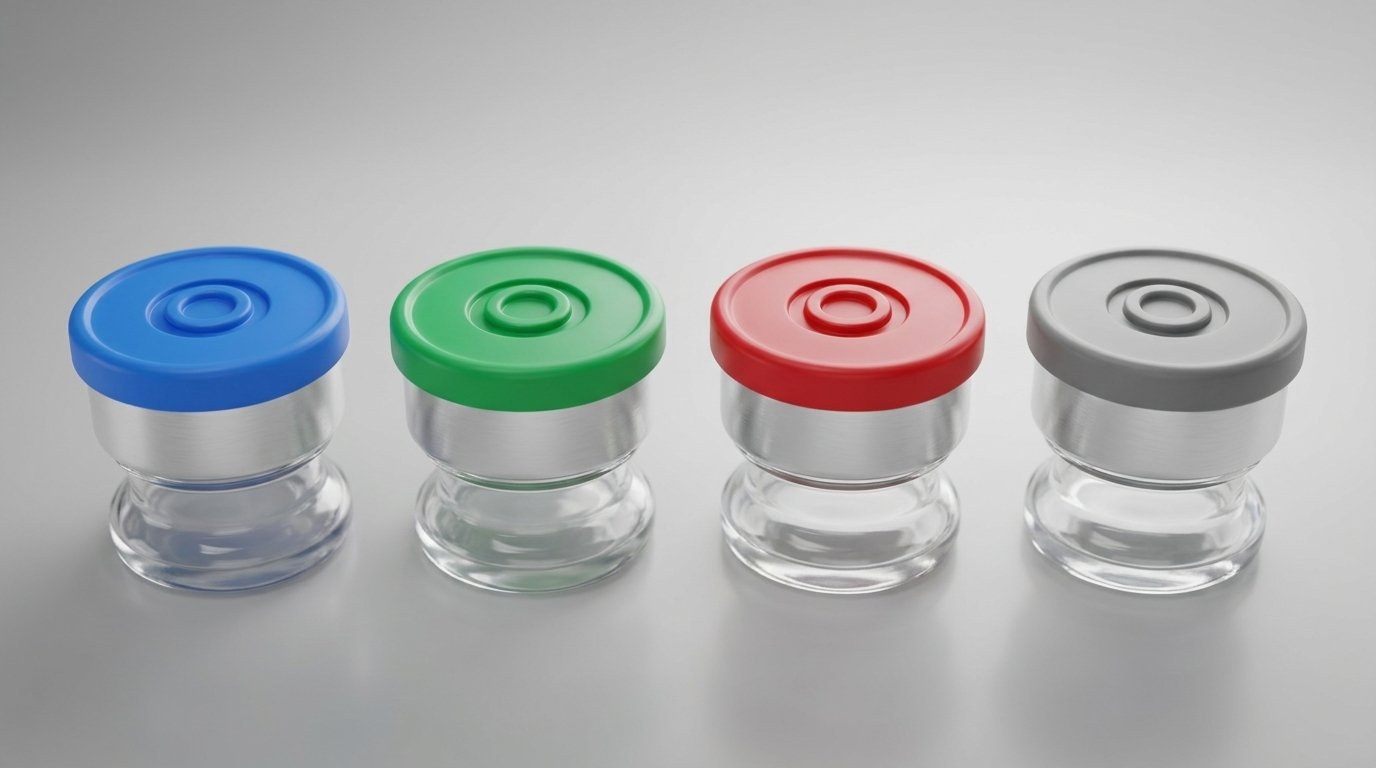
A flip-off seal is an aluminium-plastic combination closure for injectable vials: a coloured plastic flip-top button sits on top of an aluminium shell that is crimped over the rubber stopper and the neck of the vial. To access the medicine, you flip the plastic button off the centre, which exposes the stopper for needle entry while the crimped aluminium skirt stays in place to hold the closure system together. The plastic button also provides tamper evidence, because once it is flipped off it cannot be reseated to look untouched.
This page defines what a flip-off seal is, explains its parts and how it works, and covers where it is used, the common sizes, and how it compares with other vial seal types.
Key takeaways
- A flip-off seal combines an aluminium shell (crimped over the stopper) with a plastic flip-top button that covers the centre of the stopper.
- You open it by flipping off the plastic button only; the aluminium crimp stays on the vial to maintain the seal around the stopper.
- It is used mainly on injectable vials (vaccines, parenteral medicines, veterinary injectables) where a sterile rubber stopper must be kept covered until use.
- The flipped-off button gives single-use tamper evidence: it cannot be put back to look intact.
- Common pharmaceutical sizes are 13 mm, 20 mm, and 32 mm, matching standard vial neck diameters.
- It belongs to the wider family of aluminium-plastic seals and differs from tear-off seals, where the whole aluminium top is removed.
What is a flip-off seal?
A flip-off seal is a two-part vial closure made of an aluminium shell and a moulded plastic top, used to secure a rubber stopper onto an injectable vial. It is also written “flip-off cap,” “flip-top seal,” or “flip-off vial seal,” and on injectable vials “flip-up” describes the same closure. The aluminium shell is mechanically crimped (rolled under the vial neck) so that it clamps the stopper firmly against the glass, which is what maintains container closure integrity. The plastic button on top covers the central area of the stopper that the needle will eventually pass through.
The seal does not contact the medicine directly in the way the stopper and glass do. Its job is to hold the stopper in place, keep the injection site covered and clean until the moment of use, and provide a visible tamper-evident feature. Because it is part of the packaging system that protects a sterile product, it is treated as a primary packaging component and is manufactured under pharmaceutical quality controls such as ISO 15378.
What are the parts of a flip-off seal?
A flip-off seal has three working elements: the aluminium shell, the crimped skirt, and the plastic flip-top button. Each does a distinct job.
| Part | Material | Function |
|---|---|---|
| Plastic flip-top button | Moulded plastic (matte or glossy) | Covers the centre of the stopper; flips off to expose the injection site; carries colour, print, or embossing |
| Aluminium shell | Aluminium | Forms the body of the seal that sits over the stopper and vial neck |
| Crimped skirt | Aluminium (the lower edge of the shell) | Rolled under the vial neck to clamp the stopper and hold the closure system together |
The plastic top is where customisation happens. The disc can be supplied in matte or glossy finishes and in effectively unlimited colours to a customer’s specification, and it can be printed or embossed. The metal part can also be coloured and printed. Colour coding this way helps fill-finish and clinical teams tell products and strengths apart.
How does a flip-off seal work?
In use, you press or lift the edge of the plastic button and flip it off the top of the seal, which exposes the central part of the rubber stopper; the aluminium crimp stays clamped on the vial. The exposed stopper is then wiped with an alcohol swab and the needle is inserted straight through it. A more detailed walkthrough is on the guide to opening a vial with a metal cap, and the mechanics are covered in how flip-off caps work.
Two design points make this work. First, the aluminium skirt is crimped during capping on the fill-finish line, so the clamping force on the stopper is set at manufacture and is not disturbed when the plastic button is removed. Second, the plastic button is held by a tear or scoreline feature that breaks when flipped, so it detaches cleanly but cannot be reattached. That irreversibility is what makes the flipped button a tamper-evident signal.
Where are flip-off seals used?
Flip-off seals are used primarily on injectable (parenteral) vials, where a sterile rubber stopper has to stay covered and protected until the moment of dosing. Typical applications include vaccines, injectable medicines such as cytotoxic and oncology products, intravitreal and other ophthalmic injectables, and veterinary injectables. The format suits any product filled into a stoppered glass vial that is then capped on a fill-finish line.
The flip-off design is preferred for injectables because it keeps the needle-entry area covered and clean before use while keeping the stopper firmly seated for the life of the product. For oral medicines and some other formats, different closures such as tear-down or pull-ring seals are more common. The application guides work through the closure requirements drug type by drug type.
What sizes do flip-off seals come in?
Flip-off seals are made to match standard vial neck diameters, most commonly 13 mm, 20 mm, and 32 mm. The 13 mm and 20 mm sizes cover the majority of small-volume injectable and vaccine vials, while 32 mm is used for larger-neck vials. The correct size is dictated by the vial and stopper, since the seal has to crimp accurately over that specific neck and stopper combination to hold integrity.
How a flip-off seal differs from other vial seals
A flip-off seal removes only its plastic button on opening, while the aluminium stays crimped on the vial; other seal types differ in how much of the closure comes off and how. A tear-off seal has no plastic button: the whole aluminium top is pulled away. Tear-down and pull-ring seals are opened by tearing a perforated section or pulling a ring, and are more often used on oral-medicine containers. The choice depends on the product, the dosing workflow, and the level of tamper evidence required. A side-by-side view is on the flip-off vs tear-off comparison.
Flip-off seals at Autofits
Autofits manufactures aluminium-plastic FlipTop® flip-off seals (including the FlipTop Optima flip-off seals) in 13 mm, 20 mm, and 32 mm sizes for injectable vials. The plastic discs are available in matte or glossy finishes, in custom colours, and can be printed or embossed, while the metal can also be coloured and printed for product differentiation. These sit alongside the wider range of vial sealing products made on the same lines. Production runs in a 75,000 sq ft Nashik (Maharashtra) facility with an ISO Class 8 cleanroom and high-speed visual inspection, under an ISO 15378:2017 quality system alongside ISO 9001:2015 and ISO 14001:2015 certification and a Drug Master File (DMF). The full set of certifications is on the quality page.
Frequently asked questions
What is a flip-off seal on a vial?
A flip-off seal is an aluminium-plastic closure on an injectable vial. It has a coloured plastic button on top of an aluminium shell that is crimped over the rubber stopper and the vial neck. You flip the plastic button off to expose the stopper for the needle, while the crimped aluminium stays on the vial to keep the closure sealed.
How do you open a flip-off seal?
Lift or press the edge of the plastic flip-top button and flip it off the centre of the seal. This exposes the rubber stopper underneath. Wipe the stopper with an alcohol swab and insert the needle through it. You do not remove the aluminium part: it stays crimped on the vial to maintain the seal.
Why does the aluminium part stay on after you flip the cap?
The aluminium shell is crimped onto the vial during capping to clamp the rubber stopper against the glass, which is what keeps the container sealed. Only the plastic button is meant to come off. Leaving the crimped aluminium in place preserves container closure integrity and keeps the stopper firmly seated while the vial is in use.
Is a flip-off seal tamper-evident?
Yes. Once the plastic button is flipped off, it cannot be reseated to look untouched, so a missing or detached button is a visible sign that the vial has been opened. This single-use tamper evidence is one of the main reasons flip-off seals are used on injectable products.
What sizes do flip-off seals come in?
Flip-off seals are made to match standard vial neck diameters. The most common pharmaceutical sizes are 13 mm, 20 mm, and 32 mm. The right size is set by the vial and stopper, because the aluminium shell has to crimp accurately over that specific neck to hold the seal.
What is the difference between a flip-off seal and a tear-off seal?
A flip-off seal removes only its plastic button when opened, and the aluminium shell stays crimped on the vial. A tear-off seal has no plastic button: the entire aluminium top is pulled away to expose the stopper. Flip-off seals are common on injectable vials; tear-off and tear-down seals are used where the whole top needs to come off.
Sources
- ISO: ISO 15378:2017, Primary packaging materials for medicinal products (https://www.iso.org/standard/70729.html)
- ISO: ISO 8362, Injection containers and accessories (closures, caps, and aluminium caps for injection vials) (https://www.iso.org/search.html?q=ISO%208362)
- U.S. Pharmacopeia: USP General Chapter <381> Elastomeric Closures for Injections (https://www.usp.org/)
*Last updated: 2026-06-10. This article is general technical information about pharmaceutical packaging, not regulatory or compliance advice; confirm current standard editions and product specifications with the relevant body and your supplier.*
