
Flip-Off vs Tear-Off Seals: How Vial Closures Differ
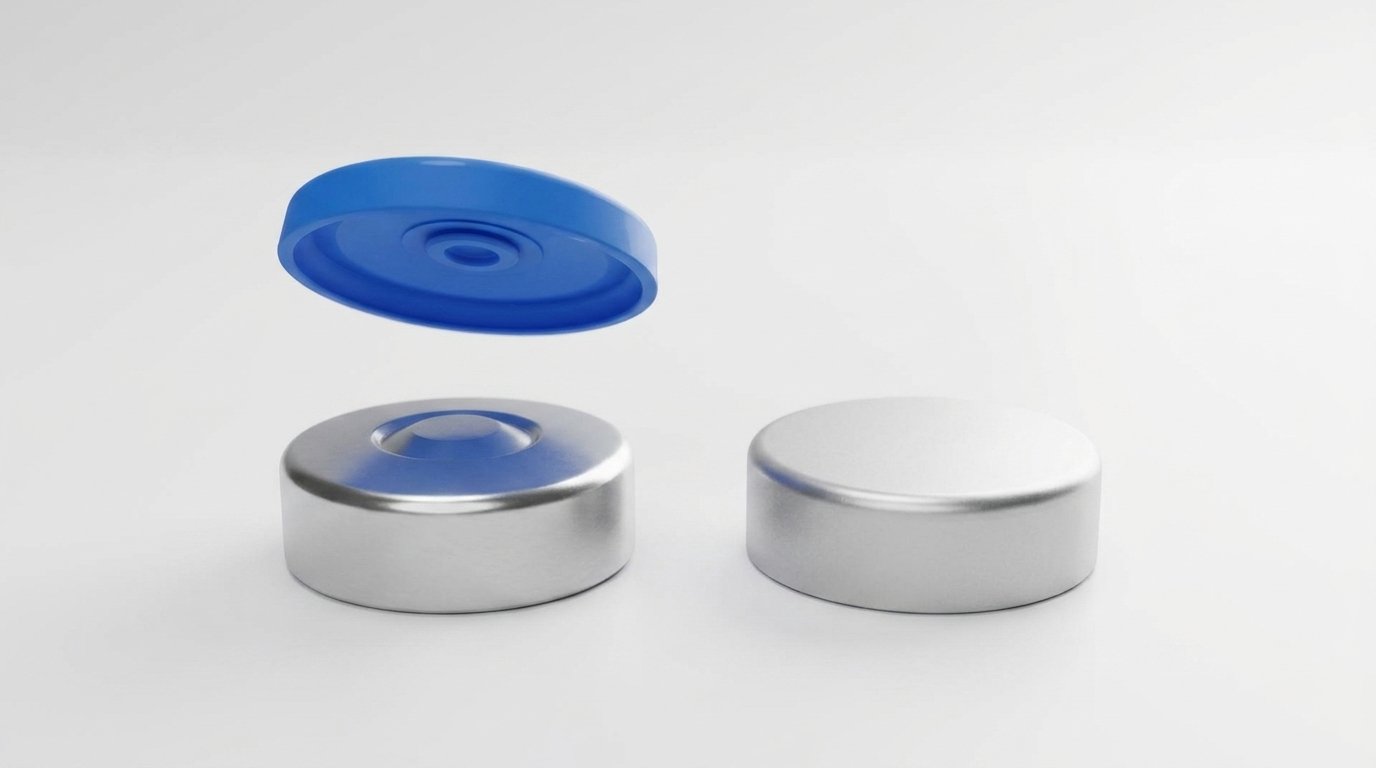
The core difference is what stays on the vial after opening. A flip-off seal leaves its aluminium skirt crimped on the vial and only the plastic button flips up, exposing the centre of the rubber stopper for needle access. A tear-off seal removes the entire aluminium top in one motion, taking the seal off the vial completely. Both are tamper-evident aluminium closures for injectable and other pharmaceutical vials; they differ mainly in how they open and how much of the seal remains in place afterward.
This page compares the two side by side: opening mechanism, tamper evidence, typical applications, and the opening experience.
Key takeaways
- Flip-off seal: a combination aluminium-plastic seal where a plastic flip button sits over a crimped aluminium shell. Flip the button up, the centre tears at a scoreline, and the aluminium skirt stays crimped on the vial.
- Tear-off seal: an all-aluminium seal (no plastic button) where a pull tab or ring removes the whole metal top, leaving the stopper fully exposed.
- Both are tamper-evident: once opened, neither can be returned to its original sealed state without obvious signs.
- Flip-off is the dominant closure for injectable vials because it exposes only the stopper centre while the crimp keeps the stopper secured for container closure integrity.
- Tear-off gives full-top removal and is used where complete access to the stopper or vial mouth is wanted.
- Common vial seal sizes for both styles are 13 mm, 20 mm, and 32 mm.
What is a flip-off seal?
A flip-off seal is an aluminium-plastic combination seal: an aluminium shell crimped over the vial’s rubber stopper, topped with a moulded plastic button that flips up to reveal the stopper. When you lift the plastic button, a scoreline lets the centre detach while the aluminium skirt stays crimped around the vial neck. That retained crimp continues to hold the stopper in place, which is why flip-off seals are the standard closure on injectable vials. For how the mechanism works in detail, see how flip-off caps work and the flip-off seal definition.
The crimped aluminium skirt is the part that delivers container closure integrity: it compresses the elastomeric stopper against the glass to maintain the sterile barrier. The plastic button is the user-facing opening feature and the surface most often used for colour coding, printing, or embossing.
What is a tear-off seal?
A tear-off seal is an all-aluminium seal with no plastic button, opened by pulling a tab or ring that removes the entire metal top from the vial. Instead of flipping a button and leaving the skirt behind, the user tears the whole aluminium cap away, fully exposing the stopper and, depending on design, the vial mouth. See the tear-off seal definition for more.
Because the full top comes off, tear-off seals are chosen where complete removal is preferred over partial access. They are a simpler construction than the combination seal, using aluminium alone rather than an aluminium-plus-plastic assembly.
Flip-off vs tear-off: side-by-side comparison
The table below summarises the practical differences. Both are tamper-evident aluminium pharmaceutical seals; the contrast is in construction and how they open.
| Attribute | Flip-off seal | Tear-off seal |
|---|---|---|
| Construction | Aluminium shell + moulded plastic flip button (combination seal) | All-aluminium, no plastic button |
| Opening mechanism | Flip the plastic button up; centre detaches at a scoreline | Pull a tab or ring; the whole aluminium top is torn off |
| What remains on the vial | Aluminium skirt stays crimped around the vial neck | Nothing; the seal is removed entirely |
| Stopper access | Centre of the stopper exposed for needle entry | Full stopper (and mouth area) exposed |
| Tamper evidence | Flipped/detached button cannot be reset without visible signs | Torn-away top cannot be restored |
| Customisation surface | Plastic button: printable, embossable, wide colour range; metal also printable | Aluminium top: printable and colourable |
| Typical applications | Injectable vials (vaccines, parenteral medicines) | Vials where full-top removal is preferred |
| Opening experience | Tool-free button flip; designed for quick clinical access | Tab/ring pull that lifts the whole metal top |
Tamper evidence: how each shows opening
Both seals are tamper evident vial seals: once opened, neither returns to its original sealed appearance. On a flip-off seal, the plastic button is either flipped up or its centre is detached at the scoreline, both of which are immediately visible; the crimped skirt also shows whether the original factory crimp has been disturbed. On a tear-off seal, the entire aluminium top is gone after opening, so an opened vial is unmistakable.
For injectable products, tamper evidence works together with container closure integrity: the seal both signals tampering and, in the flip-off case, keeps the stopper crimped to preserve the sterile barrier until the moment of use.
Which seal fits which application?
Flip-off seals suit injectable vials where the stopper must stay secured during access, while tear-off seals suit cases where the whole top is meant to come off. Flip-off is the common choice for vaccines and other parenteral medicines: the needle goes through the exposed stopper centre while the crimp holds everything in place, and the plastic button supports colour coding across product lines. Tear-off seals are used where full removal of the metal top is the intended opening action.
Selection usually comes down to the dosing/access workflow, the degree of stopper access required, tamper-evidence preference, and any colour-coding or branding needs on the closure. For a broader material-level view, compare all-aluminium versus aluminium-plastic seals, and for the purchase specification itself, aluminium-plastic seal vs plain aluminium seal sets the two spec sheets against each other.
How this works in practice at Autofits
Autofits manufactures both styles: FlipTop Optima flip-off seals (with the Pull Ring and Tear Down sub-ranges) and Tear Off aluminium seals, in 13 mm, 20 mm, and 32 mm. The plastic disc is available in matte or glossy finish and can be printed and embossed, with the metal part colourable and printable as well, which supports product colour coding across a customer’s range. Production runs in a 75,000 sq ft Nashik (Maharashtra) facility with an ISO Class 8 cleanroom and high-speed visual inspection, under an ISO 15378:2017 quality system alongside ISO 9001:2015, ISO 14001:2015, and a Drug Master File. You can review the full set of certifications on the quality page.
In practice the split falls along the drug product. Sterile injectables accessed by needle stay with the flip-off, which covers multidose vaccine vial seals and biologic fills. Tear-off holds its ground where the whole top comes away and there is no needle in the workflow, which is the case on research and lab reagent vials and across much of the diagnostics and IVD reagent range.
Frequently asked questions
What is the difference between a flip-off and a tear-off seal?
A flip-off seal has a plastic button that flips up while the aluminium skirt stays crimped on the vial, exposing only the centre of the stopper. A tear-off seal is all aluminium with no button, and a pull tab or ring removes the entire metal top from the vial. The key distinction is that a flip-off seal stays partly on the vial after opening, while a tear-off seal comes off completely.
Are flip-off and tear-off seals both tamper-evident?
Yes. Both are tamper-evident aluminium pharmaceutical seals. A flip-off seal shows tampering through its flipped or detached plastic button and the condition of the crimped skirt, and a tear-off seal cannot be restored once its top has been torn away. Neither can be returned to its original sealed state without visible evidence.
Why are flip-off seals used on injectable vials?
Flip-off seals keep the aluminium skirt crimped on the vial so the rubber stopper stays compressed against the glass, which maintains container closure integrity and the sterile barrier. The plastic button exposes only the stopper centre for needle access while the crimp holds everything secure, and the button surface allows colour coding across product lines.
Can a tear-off seal be resealed after opening?
No. Removing the aluminium top of a tear-off seal is permanent. Once the metal top is torn away, the seal cannot be reapplied, which is what makes the opening tamper-evident. A new sealing operation would require a fresh seal applied on a capping line.
What sizes do flip-off and tear-off vial seals come in?
Common pharmaceutical vial seal sizes are 13 mm, 20 mm, and 32 mm, and both flip-off and tear-off styles are made across these diameters. The right size matches the vial neck finish. Not every product is offered in every size, so confirm availability for the specific style and diameter you need.
Related reading
- Flip-off seal: definition and how it works
- Tear-off seal: definition
- How flip-off caps work
- Aluminium vs plastic seals compared
- FlipTop Optima seals: full specification
- Tear Off aluminium seals
Sources
- ISO: ISO 15378:2017, Primary packaging materials for medicinal products (https://www.iso.org/standard/70729.html)
- USP: USP <1207> Package Integrity Evaluation, Sterile Products (https://www.usp.org)
- EMA: EU GMP Annex 1, Manufacture of Sterile Medicinal Products (https://www.ema.europa.eu/en/human-regulatory-overview/research-development/compliance-research-development/good-manufacturing-practice)
*Last updated: 2026-06-10. This article is general technical information about pharmaceutical vial closures, not regulatory or compliance advice; confirm current standard editions and product specifications with the relevant body and your supplier.*
