
Aluminium-Plastic Seal vs Plain Aluminium Seal: How to Specify Each
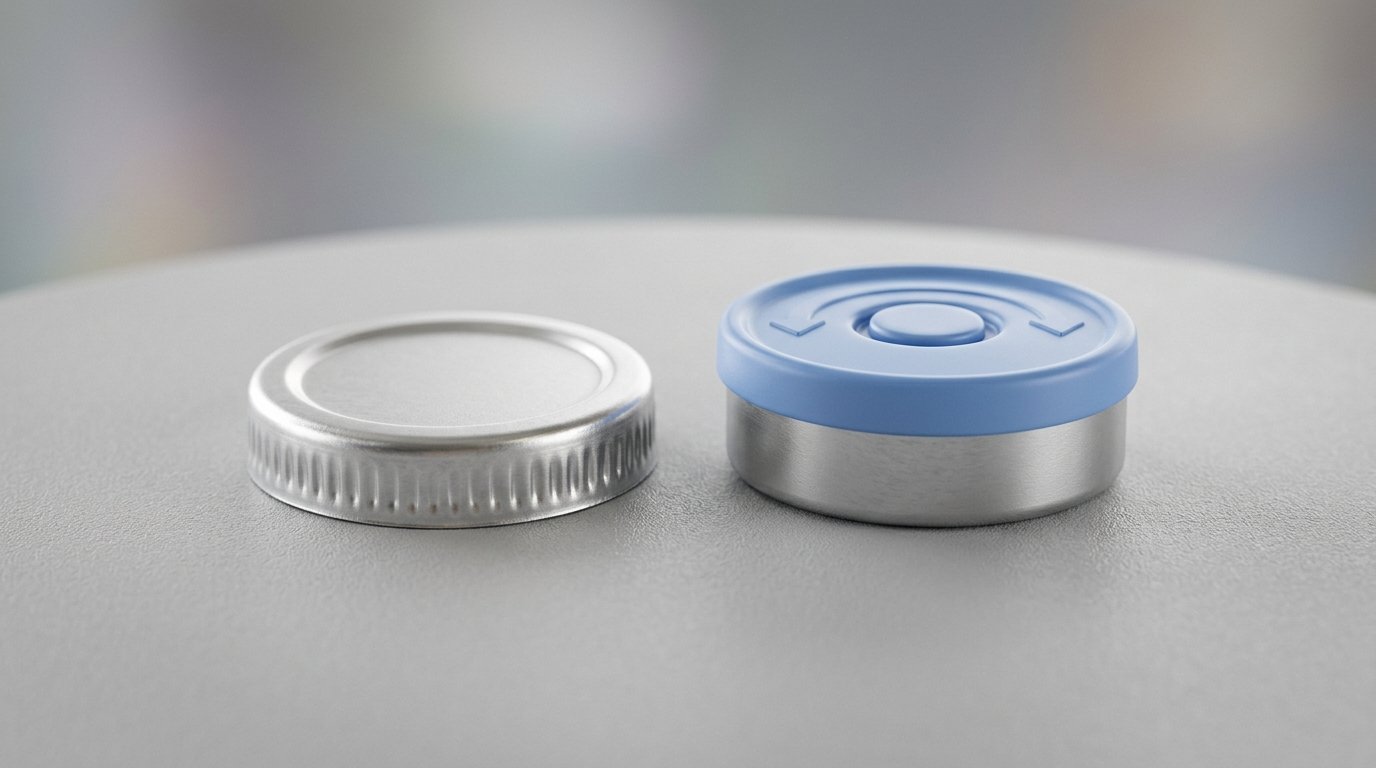
These are two separate product categories with separate standards, not two grades of the same part. A plain aluminium seal is a single drawn aluminium shell, covered by ISO 8362-3, opened by tearing the metal. An aluminium-plastic seal adds an injection-moulded plastic top to that shell and is covered by ISO 8362-6, or ISO 8362-7 where the plastic does not overlap the metal. The crimp that holds the sterile barrier is identical; everything above the crimp, and therefore most of the specification sheet, is different.
This page is written for the person filling in a purchase specification or an RFQ. It walks the spec sheet line by line: which standard applies, what materials appear on the bill of materials, which dimensions are controlled, what opening force means for each type, and what has to be agreed before a first order. If you are still deciding which type to use at all, the broader trade-off is set out in aluminium vs aluminium-plastic seals. The rest of the closure comparison guides cover the format decisions that sit alongside this one, including tear-off versus tear-down.
Key takeaways
- Different standards. Plain aluminium caps sit under ISO 8362-3; aluminium-plastics combination caps sit under ISO 8362-6 and ISO 8362-7.
- Different bill of materials. One part is aluminium plus lacquer. The other adds a moulded polypropylene component, which brings its own material compliance file.
- Different controlled dimensions. A plain aluminium seal is specified with a perforation diameter and a tear path; a combination cap is specified with a disc outer diameter, a disc height, and a bridge count.
- Opening force means different things. On a combination cap it is the force to shear the button bridges. On a tear-off or tear-down cap it is the force to start and run the tear in the metal.
- Colour and print differ in scope. Both can be lacquered in colour and printed on the metal; only the combination cap gives a moulded plastic surface for embossing and a wide colour palette.
- Both are supplied Regular, Ready-to-Sterilize or Ready-to-Use, so the supply form is a separate decision from the construction.
Which standard governs which part
Getting the standard reference right is the single most useful thing a specification can do, because it fixes the dimensional and performance framework before any supplier-specific detail is discussed. ISO 8362-3 covers aluminium caps for injection vials: a one-piece metal closure. ISO 8362-6 covers caps made of aluminium-plastics combinations, the combi seals in which a plastic top sits over the aluminium shell, as on a flip-off seal. ISO 8362-7 covers the same combination construction in the form where the plastic part does not overlap the aluminium.
Whichever part applies, the vial neck the seal has to fit is defined separately, by ISO 8362-1 for tubing vials or ISO 8362-4 for moulded glass, and the rubber stopper by ISO 8362-2. A specification that names the seal standard, the vial standard, and the stopper standard leaves very little room for a mismatch at the capping station, because the three parts have to be treated as one interface rather than three separate purchases.
The spec sheet, line by line
The table sets the two constructions side by side using the fields that actually appear on a drawing and a purchase specification.
| Specification field | Plain aluminium seal | Aluminium-plastic seal |
|---|---|---|
| Governing standard | ISO 8362-3 | ISO 8362-6, or ISO 8362-7 without overlap |
| Construction | One drawn aluminium shell | Aluminium shell plus moulded plastic top |
| Metal | Aluminium alloy, lacquered both sides | Aluminium alloy, lacquered both sides |
| Plastic | None | Polypropylene disc or button, with its own food-contact file |
| Controlled diameters | Inner diameter of the aluminium, perforation diameter | Inner diameter of the aluminium, outer diameter of the disc |
| Controlled heights | Total seal height, aluminium thickness | Total seal height, disc height, inner aluminium height, aluminium thickness |
| Opening feature | Perforation or score line with tear bridges | Plastic disc held by shearing bridges |
| Opening force meaning | Force to start and run the metal tear | Force to shear the bridges holding the disc |
| Colour options | Lacquer colour on the metal | Lacquer colour on the metal plus a moulded disc colour |
| Decoration | Printing on the metal | Printing, embossing and debossing on the plastic, printing on the metal |
| Inspection points | Metal geometry, lacquer coverage, perforation | Metal geometry, lacquer coverage, disc geometry, disc-to-shell assembly |
| Typical applications | Products preferring an all-metal closure or full stopper access | Injectables and vaccines needing partial stopper access and colour coding |
| Supply forms | Regular, Ready-to-Sterilize, Ready-to-Use | Regular, Ready-to-Sterilize, Ready-to-Use |
What the extra plastic component adds to qualification
Adding a moulded plastic top does not change the sealing mechanism, but it does add a second material to qualify, a second moulding process to control, and a second set of inspection criteria. On the material side, the polypropylene needs its own food-contact and extractables position alongside the lacquer on the metal. That work belongs to the same framework as the metal side: material declarations, heavy-metal limits, and an extractables and leachables assessment appropriate to the dosage form.
On the process side, the disc has to be moulded to a consistent geometry and then assembled to the shell without introducing particulate. That is why combination caps are typically washed on an automated line and camera-inspected for both metal and plastic features, while a plain aluminium cap only presents metal features to the camera. The manufacturing sequence for the combination part is described in how aluminium-plastic seals are made.
Line behaviour and why the choice shows up at the capping station
Both types crimp the same way, so the crimping head settings are driven by the vial and stopper rather than by the presence of plastic; what changes is how forgiving the part is when it is fed and how it presents to inspection. The disc edge geometry on a combination cap affects how cleanly seals slide down a chute and orient in a capping bowl, and the disc face is what a top-down camera sees. A plain aluminium cap has fewer features to catch, but its perforation has to be intact and correctly positioned, because a damaged tear path shows up as a customer complaint rather than as a line stoppage.
Dimensional consistency matters more than construction for throughput. Geometry that drifts within tolerance still shows up as rejects at the capping station, whichever construction is running, which is why the drawing tolerances and the inspection regime deserve more attention in an RFQ than the choice between metal and metal-plus-plastic.
What to put in the RFQ
State the standard, the neck size, the construction, the finish and colour, the decoration, the supply form, and the AQL, then ask for the drawing. A quotation against a nickname is not comparable between suppliers; a quotation against those seven items is.
For a plain aluminium seal, ask specifically for the perforation diameter and the bridge count, because those set the tear behaviour. For an aluminium-plastic seal, ask for the disc outer diameter, the disc height, the bridge count, and the maximum opening force, because those set the opening feel. In both cases ask for the alloy, the lacquer specification, the heavy-metal position, and whether the supplier can hold your AQL across the lot sizes you order.
How this works in practice at Autofits
Autofits makes both categories in the same plant. The all-aluminium range covers tear-off seals and tear-down seals, drawn from AA8011 aluminium with a double-side silver epoxy lacquer as standard and no plastic component; the 20 mm tear-off is drawn to an inner diameter of 20.00 to 20.60 mm with a perforation diameter of 9.70 to 10.50 mm, two bridges, and a maximum opening force of 35 N. The aluminium-plastic range is the FlipTop family, led by the FlipTop Optima, an AA8011 shell with epoxy lacquer and a polypropylene button moulded in-house, in 13, 20, 28, 32 and 34 mm with Bridge, Button and Flower tops. Both are washed on an automated line, assembled or bagged in an ISO Class 8 cleanroom, and given 100% high-speed camera inspection, under ISO 9001:2015, ISO 14001:2015 and ISO 15378:2017 with Drug Master File 18100. Certificates are on the quality page.
Frequently asked questions
Is an aluminium-plastic seal better than a plain aluminium seal?
Neither is better in general; they answer different requirements. A plain aluminium seal suits products that want an all-metal closure, full access to the stopper after opening, or no plastic in the closure system. An aluminium-plastic seal suits injectables that need partial stopper access through a flip-open button, plus a moulded surface for colour coding, printing and embossing. The crimped aluminium skirt that holds the sterile barrier is common to both.
Do the two types use different standards?
Yes. Plain aluminium caps for injection vials are covered by ISO 8362-3. Aluminium-plastics combination caps are covered by ISO 8362-6, and by ISO 8362-7 where the plastic part does not overlap the aluminium. Quoting the correct part number in a specification removes most of the ambiguity between suppliers.
Does the plastic top affect container closure integrity?
No. Integrity comes from the aluminium skirt crimped under the vial neck flange, which compresses the rubber stopper against the glass. The plastic top is the user-facing opening feature and the decoration surface; it sits above the sealing interface and does not form part of it. Integrity is verified by container closure integrity testing on the finished, capped vial.
Can both types be supplied ready to use?
Yes. Both plain aluminium and aluminium-plastic seals are commonly supplied in three forms: Regular for customers who wash and sterilize in-house, Ready-to-Sterilize after a validated wash, and Ready-to-Use after a validated wash and sterilization, double-bagged for entry into an aseptic area. The supply form is specified separately from the construction.
Which dimensions should I confirm before a first order?
For both types, confirm the inner diameter of the aluminium against your vial neck finish, the total seal height, and the aluminium thickness. For a plain aluminium seal, also confirm the perforation diameter and bridge count. For an aluminium-plastic seal, also confirm the disc outer diameter, disc height, bridge count and maximum opening force. Ask for the controlled drawing rather than a catalogue extract.
Related reading
- Aluminium vs aluminium-plastic seals: integrity, tamper evidence and cost
- ISO 8362-3: aluminium caps for injection vials
- ISO 8362-6: aluminium-plastics combination caps
- Aluminium-plastic seal: definition
- Tear-off aluminium seals
- FlipTop Optima flip-off seals
Sources
- ISO: ISO 8362-3:2001, Injection containers and accessories, Part 3: Aluminium caps for injection vials (https://www.iso.org/standard/33804.html)
- ISO: ISO 8362-6:2010, Injection containers and accessories, Part 6: Caps made of aluminium-plastics combinations for injection vials (https://www.iso.org/standard/52806.html)
- ISO: ISO 8362-7:2006, Injection containers and accessories, Part 7: Injection caps made of aluminium-plastics combinations without overlapping plastics part (https://www.iso.org/standard/43551.html)
- ISO: ISO 15378:2017, Primary packaging materials for medicinal products (https://www.iso.org/standard/70729.html)
- USP: USP General Chapter <1207> Package Integrity Evaluation, Sterile Products (https://www.usp.org)
*Last updated: 2026-07-31. This article is general technical information about pharmaceutical vial closures, not regulatory or compliance advice; confirm current standard editions and controlled drawings with the relevant body and your supplier.*
