
Tear-Off vs Tear-Down Seal: What Is the Difference?
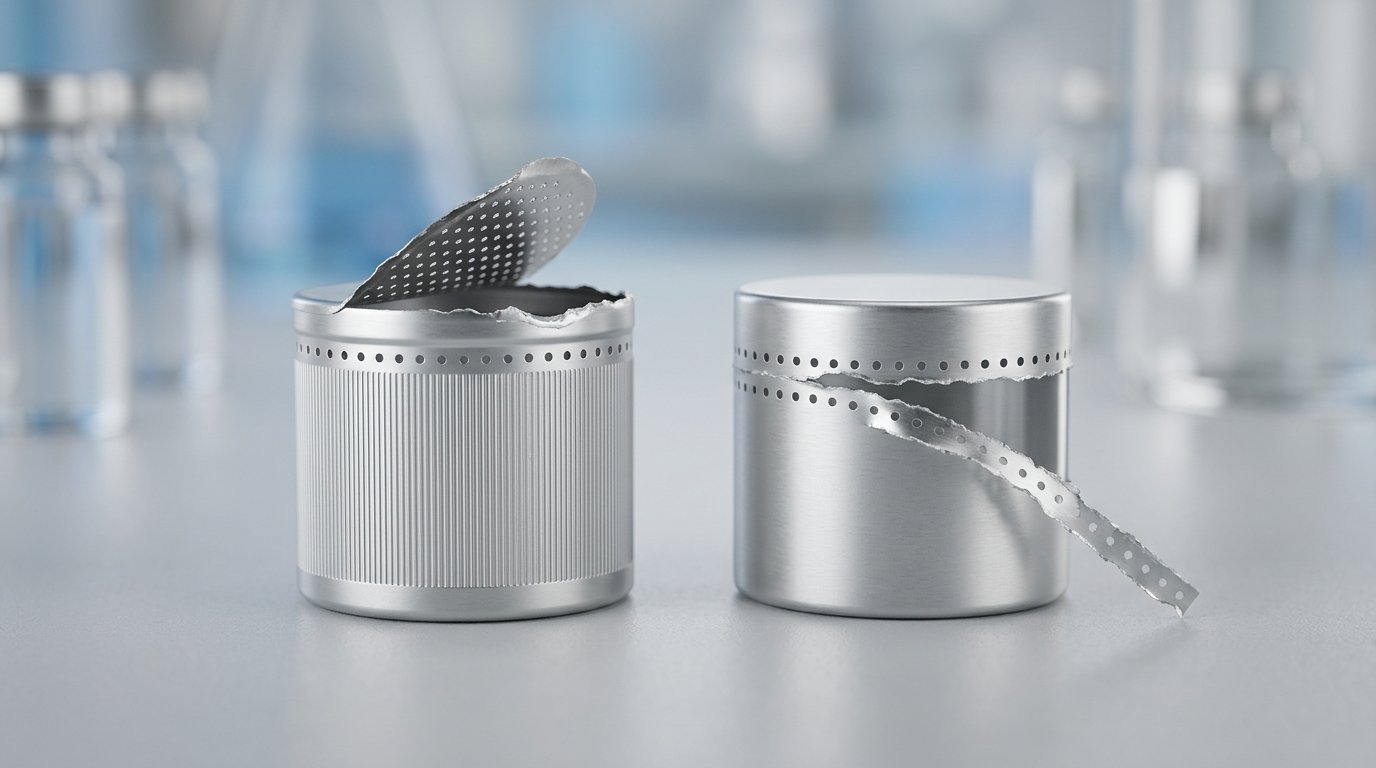
Both are all-aluminium vial seals with no plastic top, and both are opened by tearing the metal along a perforation, but the tear runs in a different direction and leaves a different result. A tear-off seal tears across the top: the perforated upper section lifts away, the crimped skirt stays on the neck, and the stopper is exposed. A tear-down seal tears downward: a perforated band is pulled down and around, the bridges break, and the whole closure releases from the neck so it can be lifted off. One removes the lid. The other releases the seal.
This page sets the two mechanisms side by side, gives the controlled dimensions that distinguish them, and explains where each is chosen. It also clears up a naming collision that catches buyers out: an all-aluminium tear-down seal is a different product from an aluminium-plastic tear-down seal.
Key takeaways
- Both are one-piece aluminium closures covered by ISO 8362-3, with no polypropylene disc anywhere on the part.
- Tear-off removes the top. The perforated upper face comes away and the crimped skirt remains on the vial neck.
- Tear-down releases the seal. A perforated band is torn downward, the bridges break, and the entire closure lifts off, fully exposing the stopper.
- Perforation diameter is the tell. On the 20 mm Autofits parts the tear-off perforation is 9.70 to 10.50 mm; the tear-down perforation is 12.90 to 13.20 mm.
- Both give irreversible tamper evidence, because torn aluminium cannot be reformed or reseated.
- Watch the naming. The FlipTop Tear-Down is an aluminium-plastic closure opened by twisting anticlockwise, not the all-aluminium tear-down described here.
How each one opens
The sealing action is identical; only the opening action differs. In both cases the seal is drawn from a single piece of AA8011 aluminium, and during capping the skirt rolls under the vial neck flange and compresses the rubber stopper against the glass. That crimp, together with the stopper, is what holds the closure. Nothing about the opening feature contributes to the seal.
On a tear-off seal, the metal across the upper face is perforated. The user lifts the tear tab and pulls the perforated section completely away, so the metal covering the stopper is removed while the skirt stays crimped in place. The result is a vial with an exposed stopper and a metal ring still on the neck.
On a tear-down seal, the perforation defines a band that runs down the side of the cap. The user starts the tear at the perforation and pulls the metal down and around. On the 20 mm part, two taper bridges break as the band separates, and once they go the seal is released and the whole closure lifts off the neck. The result is a vial with the stopper fully accessible and no metal remaining. The wider background is in what is a tear-off seal.
Side-by-side comparison
The table uses controlled drawing figures for the 20 mm size, which is the size for which both parts have full published dimensions.
| Attribute | Tear-off seal | Tear-down seal |
|---|---|---|
| Construction | One-piece AA8011 aluminium, no plastic | One-piece AA8011 aluminium, no plastic |
| Governing standard | ISO 8362-3 | ISO 8362-3 |
| Tear direction | Across the top face | Down the side of the cap |
| What is removed | The perforated upper section | The perforated band, then the whole seal |
| What stays on the vial | The crimped aluminium skirt | Nothing |
| Stopper access after opening | Stopper exposed through the opened top | Stopper fully exposed, neck clear |
| 20 mm inner diameter (D1) | 20.00 to 20.60 mm | 20.50 to 20.70 mm |
| 20 mm perforation diameter | 9.70 to 10.50 mm | 12.90 to 13.20 mm |
| 20 mm total height | 7.40 to 8.00 mm | 7.50 to 8.50 mm |
| 20 mm aluminium thickness | 0.16 to 0.20 mm | 0.18 to 0.22 mm |
| Bridges (20 mm) | 2 | 2 taper bridges |
| Sizes with full drawing data | 13, 20 and 32 mm | 20 mm, other sizes on request |
| Standard finish | Double-side silver epoxy lacquer | Double-side silver epoxy lacquer |
| Tamper evidence | Torn top cannot be reformed | Torn band cannot be reformed |
| Supply forms | Regular, Ready-to-Sterilize, Ready-to-Use | Regular, Ready-to-Sterilize, Ready-to-Use |
The two perforation diameters are the clearest technical separation. A tear-off perforation is sized to open a window over the stopper, so it is smaller than the neck. A tear-down perforation runs at close to full neck diameter because the band has to release the whole cap.
Which one to specify
Choose tear-off when the vial should keep its crimped skirt after opening, and tear-down when the whole closure needs to come away. That is the practical decision, and it follows from what happens to the vial after it is opened.
A tear-off leaves the skirt in place, which keeps the stopper mechanically retained even after the top is gone. That suits presentations where the stopper should stay seated while the contents are withdrawn or transferred. A tear-down clears the neck entirely, which suits presentations where the stopper is meant to be lifted out, or where the contents are poured or reconstituted in a way that needs the mouth unobstructed. Oral formats commonly use this pattern.
If the requirement is a small central opening rather than full removal, neither is the right family, and an aluminium-plastic flip-off cap is. That comparison is in flip-off vs tear-off seals. All six opening styles, plain, tear-off, tear-down, pull-ring, flip-off and pilfer-proof, are laid out together in aluminium cap finish types.
The naming collision worth knowing about
Tear-down describes an opening action, not a construction, so the same word appears on two different products. The all-aluminium tear-down seal covered on this page is a single drawn metal shell with no plastic. The FlipTop Tear-Down is an aluminium-plastic closure with a moulded polypropylene disc, opened by twisting anticlockwise so the seal tears down and comes off. They open to a similar end state but they are different parts, made from different bills of material, against different standards. Aluminium-plastic seal vs plain aluminium seal takes that split apart at specification level, which is where the naming collision usually costs someone an order.
A related pairing is the pull-ring, where an aluminium ring is pulled and turned anticlockwise to remove the whole seal. Pull-ring and tear-down are both full-removal closures used on oral presentations; the pull-ring is the more complex construction and the harder one to reproduce, which matters where copy resistance is a consideration. They are compared in pull ring vs tear down. When ordering, name the construction as well as the action: all-aluminium tear-down to ISO 8362-3, or aluminium-plastic tear-down.
How this works in practice at Autofits
Autofits makes both parts on the same site. The tear-off seal is supplied in 13 mm, 20 mm and 32 mm neck finishes, with a defined perforation diameter on the 20 mm and 32 mm for clean tear initiation, a maximum opening force of 35 N on the 20 mm, and standard packing of 6,000 per box in two bags of 2,000. The 20 mm all-aluminium tear-down seal has full drawing data, with other sizes available on request against a stated vial neck finish. Both are drawn from AA8011 aluminium conforming to EN 15088:2005 with EN 10204 3.1 certification, finished in double-side silver epoxy lacquer conforming to 21 CFR 175.300, and can be pigmented for colour identification. Heavy metals are controlled to a maximum 100 ppm total for chromium VI, cadmium, mercury and lead. Both pass automated washing and 100% high-speed camera inspection, with ready-to-use lots bagged in an ISO Class 8 cleanroom, under ISO 9001:2015, ISO 14001:2015 and ISO 15378:2017 with Drug Master File 18100. Certificates are on the quality page.
Application decides this one more often than preference does. All-aluminium tear-off is the cost-led choice on research and lab reagent vials and parts of the diagnostics and IVD reagent range, where no plastic button is wanted. Tear-down belongs where the whole seal has to come away cleanly for an oral or poured presentation, which is the pattern described on the vaccines and veterinary pages.
Frequently asked questions
What is the difference between a tear-off and a tear-down seal?
Both are all-aluminium vial seals opened by tearing a perforation in the metal, but the tear runs differently. A tear-off seal has a perforation across the top, so the upper section lifts away and the crimped skirt stays on the vial neck. A tear-down seal has a perforation that runs down the side, so pulling the band down breaks the bridges and releases the entire closure from the neck.
Do either of them contain plastic?
No. Both the tear-off and the all-aluminium tear-down seal are drawn from a single piece of aluminium alloy with an epoxy lacquer coating, and neither has a polypropylene disc or button. A closure with a moulded plastic top belongs to the aluminium-plastics combination family under ISO 8362-6 instead.
Is a tear-down seal the same as a FlipTop Tear-Down?
No. The all-aluminium tear-down seal is a single metal shell with no plastic component. The FlipTop Tear-Down is an aluminium-plastic closure with a polypropylene disc, opened by twisting anticlockwise. They reach a similar end state, with the seal removed from the vial, but they are separate products with different materials, drawings and standards references.
Which gives better tamper evidence?
Both give irreversible tamper evidence, because torn aluminium cannot be reformed or reseated. The difference is what an inspector sees. A tear-off shows a missing or torn top with the skirt still crimped. A tear-down shows either an intact seal or no seal at all, since opening removes the whole closure. Neither can be restored to its factory-sealed appearance.
Which sizes are available?
Autofits publishes full drawing dimensions for tear-off seals in 13 mm, 20 mm and 32 mm neck finishes, and for the all-aluminium tear-down seal in 20 mm, with other tear-down sizes available on request against a stated vial neck finish. The seal size must match the vial neck, which follows ISO 8362-1 for tubing vials.
Related reading
- Tear-off seal: definition
- Tear-down seal: definition
- Tear-off aluminium seals
- Tear-down aluminium seals
- Pull ring vs tear down seals
- ISO 8362-3: aluminium caps for injection vials
Sources
- ISO: ISO 8362-3:2001, Injection containers and accessories, Part 3: Aluminium caps for injection vials (https://www.iso.org/standard/33804.html)
- ISO: ISO 8362-1:2018, Injection containers and accessories, Part 1: Injection vials made of glass tubing (https://www.iso.org/standard/74398.html)
- ISO: ISO 8362-6:2010, Injection containers and accessories, Part 6: Caps made of aluminium-plastics combinations for injection vials (https://www.iso.org/standard/52806.html)
- ISO: ISO 15378:2017, Primary packaging materials for medicinal products (https://www.iso.org/standard/70729.html)
- US FDA: 21 CFR 175.300, Resinous and polymeric coatings (https://www.ecfr.gov/current/title-21/chapter-I/subchapter-B/part-175)
*Last updated: 2026-07-31. This article is general technical information about pharmaceutical vial closures, not regulatory or compliance advice; confirm current standard editions and controlled drawings with the relevant body and your supplier.*
