
Research and Lab Reagent Vial Seals and Closures
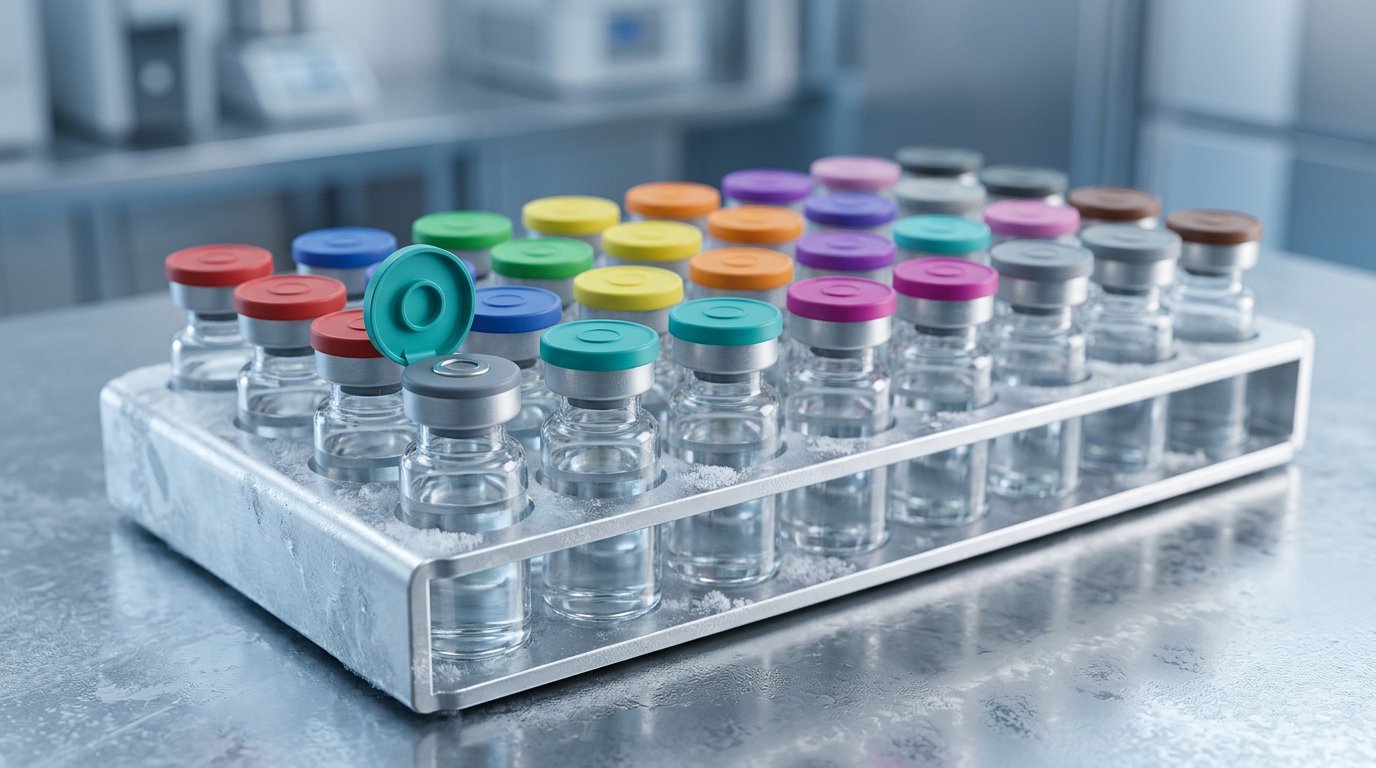
A research vial seal is the aluminium or aluminium-plastic closure on a laboratory reagent vial that is labelled for research use rather than for patient use, so it is chosen for freezer storage, repeated freeze-thaw handling, small fill volumes and fast visual identification rather than for parenteral compliance. Research reagents sit outside the injectable regulatory pathway, which moves the decision away from pharmacopoeial closure chapters and towards practical bench behaviour.
This page is for reagent manufacturers, kit assemblers and laboratory-supply packaging teams selecting a closure for research-use-only material. It covers the regulatory position, the storage and handling duty a research reagent puts on a closure, identification, the Autofits seals that fit, and where an injectable-grade specification is still worth taking.
Key takeaways
- A research vial seal closes a reagent labelled for research use only (RUO); the closure is specified for storage duty and identification, not for parenteral release testing.
- RUO products are handled differently by market: the US requires a specific RUO labelling statement, and the EU excludes research-only products with no medical purpose from its in vitro diagnostic regulation.
- Freezer storage at -20 °C and -80 °C, plus repeated freeze-thaw cycling, is the dominant physical duty; the crimp has to hold residual seal force through it.
- Fill volumes are small. The 13 mm neck covers most aliquoted reagents, with 20 mm for bulk buffers and media.
- Identification matters more than in most applications, because a rack can hold dozens of visually identical vials; the plastic disc can be coloured, printed and embossed.
- Where a reagent feeds a cell-culture or downstream-manufacturing workflow, the same closures can be specified to ISO 8362-6 under ISO 15378 GMP and supplied sterile.
Where research reagents sit in the regulatory picture
Research reagents are not medicines and are not diagnostic devices, so pharmacopoeial injectable requirements are not automatically in scope and the closure specification is a technical decision rather than a compliance one. The rules that do apply are labelling rules, and they differ by market.
In the United States, in vitro diagnostic products in the research phase of development are required to carry the statement “For Research Use Only. Not for use in diagnostic procedures.”, and the US FDA has published guidance on the distribution of products labelled research use only or investigational use only. In the European Union, Regulation (EU) 2017/746 on in vitro diagnostic medical devices excludes products intended solely for research purposes with no medical objective from its scope, so a research reagent and a CE-marked IVD are not held to the same requirements. In India, a reagent supplied for laboratory research is outside the scope of the medical-device and drug provisions administered by CDSCO unless it is placed on the market for a diagnostic or therapeutic purpose. Confirm the classification for the markets you ship to before you fix the specification, because the moment a reagent is intended for a diagnostic claim it moves onto the IVD pathway and the requirements change.
What that freedom means in practice is that a research reagent closure is specified against the workflow. The relevant questions are how cold the vial gets, how often it is opened, how it is told apart from its neighbours, and whether the reagent eventually touches a regulated process downstream.
Cold storage and freeze-thaw duty
Most research reagents live in a freezer, so the closure spends its working life below zero and is cycled through thaw and refreeze whenever the vial is used. Enzymes, antibodies, primers, nucleotides and protein standards are commonly held at -20 °C, and long-term stocks of sensitive material at -80 °C. That is a harsher thermal duty than a room-temperature pharmaceutical vial and a different one from the 2 °C to 8 °C range covered on the cold-chain closure page.
Three things follow for the closure. Materials contract at different rates, so the aluminium shell, the glass neck and the elastomeric stopper do not shrink by the same amount as the vial cools, and the residual seal force the crimp applies changes with temperature. The stopper stiffens as it approaches its glass-transition temperature and stops behaving like a rubber, so it can no longer deform to take up small gaps; the crimp has to carry that load instead. And each thaw cycle draws the vial back through the same movement in reverse, so consistency across many cycles matters more than performance at any single temperature.
A crimped aluminium closure suits this because the crimp is permanent and mechanical. It does not rely on a thread staying tight or on friction that can relax, which is the argument set out on the crimp versus screw closure comparison. Dimensional consistency across the batch is what makes it reliable: if the inner aluminium diameter and skirt height vary, the crimp force varies with them, and a batch that seals well at room temperature can behave unevenly at -80 °C. Deep-cryogenic storage below -150 °C is a further step again, and it is the routine condition for cell and gene therapy vials held in vapour-phase liquid nitrogen, and the same crimp-consistency argument carries more weight the higher the value of the fill, which is the case set out on vial closures for biologics. The elastomer under the seal moves too, and vial closure rubber types compared covers how the different formulations behave as they cool.
Identification on a crowded bench
A reagent rack holds many vials of the same size and shape, so the closure is often the fastest way to tell them apart, and colour coding on the plastic disc does most of that work. A kit with eight components, a compound library plate feeding from stock vials, or a freezer box of twenty aliquots all present the same problem: the label is on the side of the vial and the vial is stored upright, so what the user sees first is the top of the closure.
The plastic disc on an aluminium-plastic seal can be produced in a wide range of colours, matte or glossy, customised to requirement, and it can be printed and embossed. The aluminium can also be printed. That gives a reagent programme a workable visual scheme without depending on the side label being turned to face the user. The general principles are set out on the seal colour coding page. One caution carries over from clinical practice: colour is an aid to finding the right vial, not a substitute for reading the label, because no colour convention is shared across suppliers.
Which Autofits seals fit research reagent vials
- FlipTop® Optima flip-off, 13 mm: the default for aliquoted reagents. Inner aluminium diameter 13.36 mm minimum, disc height 2.90 to 3.30 mm, total seal height 7.62 to 8.38 mm, aluminium thickness 0.16 to 0.20 mm, six taper bridges, maximum opening force 30 N. Standard packing is 15,000 per box.
- FlipTop® Optima flip-off, 20 mm: for bulk buffers, media and larger stock vials. Inner aluminium diameter 20.22 mm minimum, total seal height 9.02 to 9.91 mm, six taper bridges, maximum opening force 35 N, 6,000 per box.
- Tear-off seals in all-aluminium, 13, 20 and 32 mm: the simplest option where the whole top comes off and no plastic button is wanted. The 20 mm version has an inner aluminium diameter of 20.00 to 20.60 mm and a perforation diameter of 9.70 to 10.50 mm.
- FlipTop® Tear-Down, 13, 20 and 32 mm: full seal removal by twisting anticlockwise, for reagents that are poured or decanted rather than drawn through the stopper.
All of these are supplied Regular, Ready-to-Use (gamma or ethylene-oxide sterilised, double-bagged) or Ready-to-Sterilize. Non-irradiated seals carry a 3.5-year shelf life before capping and Ready-to-Use seals carry 2 years. Sizes across the range are listed on the by-size index, and colour options on the colour range page.
When to take an injectable-grade specification anyway
Specify the closure to injectable standards when the reagent feeds a process that is itself regulated, or when particle and extractables control affects the assay. Cell-culture media, buffers used in downstream bioprocessing, and reference materials that enter a GMP workflow all inherit requirements from the process they serve rather than from their own RUO label.
In those cases the same seals are made to ISO 8362-6 for aluminium-plastics combination caps, with vial necks to ISO 8362-1, and produced under ISO 15378:2017 GMP for primary packaging materials. Material declarations cover AA8011 aluminium alloy, an epoxy lacquer conforming to 21 CFR 175.300, and a polypropylene disc conforming to 21 CFR 177.1520, with total chrome-VI, cadmium, mercury and lead limited to 100 ppm and a BSE/TSE-free declaration. Where leachables into a sensitive assay are a concern, the framework on the extractables and leachables page applies in the same way it does to a drug product, and the Ready-to-Use form is washed and assembled in an ISO Class 8 cleanroom to control particles.
Frequently asked questions
What is a research vial seal?
A research vial seal is the aluminium or aluminium-plastic closure on a laboratory reagent vial labelled for research use rather than patient use. Because the reagent is not a medicine or a diagnostic device, the closure is specified for storage duty, freeze-thaw handling and visual identification rather than against pharmacopoeial injectable chapters, though it can be built to injectable standards where the workflow calls for it.
How is a research reagent closure different from an IVD reagent closure?
The regulatory position differs. A research-use-only product is excluded from the in vitro diagnostic pathway in the EU and carries a specific research-use statement in the US, while an IVD reagent is regulated as a diagnostic device with its own conformity requirements. In practice the physical closure can be identical; the difference is what documentation and change control you need behind it. The IVD side is covered on the diagnostics page.
Do flip-off seals hold up at -80 °C?
A crimped aluminium closure is a mechanical seal, so it does not relax the way a threaded cap can, and it is widely used on frozen product. What changes with temperature is the residual seal force, because the aluminium, the glass and the elastomeric stopper contract at different rates and the stopper stiffens as it cools. Dimensional consistency across the batch is what keeps that predictable, and the closure system should be qualified at your own storage temperature and cycle count.
What size seal do laboratory reagent vials use?
Most aliquoted reagents use a 13 mm neck, and bulk buffers, media and stock solutions move up to 20 mm. Autofits makes the FlipTop Optima flip-off seal in 13, 20, 28, 32 and 34 mm, so a whole reagent portfolio can be sealed from one supplier and one specification family.
Can research reagent seals be colour coded and printed?
Yes. The polypropylene disc is available in a wide range of colours, matte or glossy, customised to requirement, and it can be printed and embossed; the aluminium can be printed as well. That supports a visual scheme across a reagent kit or a freezer box. Colour should be treated as a finding aid rather than as identification, since no colour convention is shared across suppliers.
Can these seals be supplied sterile?
Yes. Any of the seals can be supplied Ready-to-Use, gamma or ethylene-oxide sterilised, assembled and washed in an ISO Class 8 cleanroom and double-bagged for entry into a clean area, or Ready-to-Sterilize for sterilisation in your own process. Ready-to-Use seals carry a 2-year shelf life before capping.
Related reading
- Vial sealing applications hub
- Diagnostic and IVD reagent vial seals
- Vial closures for biologics
- FlipTop® Optima flip-off seals
- Tear-off seals
- Seal colour coding in pharma
- ISO 15378: GMP for primary packaging
Sources
- Autofits FlipTop Seals dossier and engineering drawings (working/spec-sheets/)
- US FDA: Guidance on Distribution of In Vitro Diagnostic Products Labeled for Research Use Only or Investigational Use Only (https://www.fda.gov/)
- EUR-Lex: Regulation (EU) 2017/746 on in vitro diagnostic medical devices (https://eur-lex.europa.eu/)
- ISO: ISO 8362-6:2010, Injection containers and accessories, Part 6: Caps made of aluminium-plastics combinations for injection vials (https://www.iso.org/standard/45641.html)
- ISO: ISO 15378:2017, Primary packaging materials for medicinal products, GMP requirements (https://www.iso.org/standard/70729.html)
*Last updated: 2026-07-31. This page is general technical information, not regulatory or compliance advice; confirm current standard editions, the classification of your product in each market, and your own specification with Autofits and the issuing bodies.*
