
Crimp vs Screw Vial Closure: Which Seals Better?
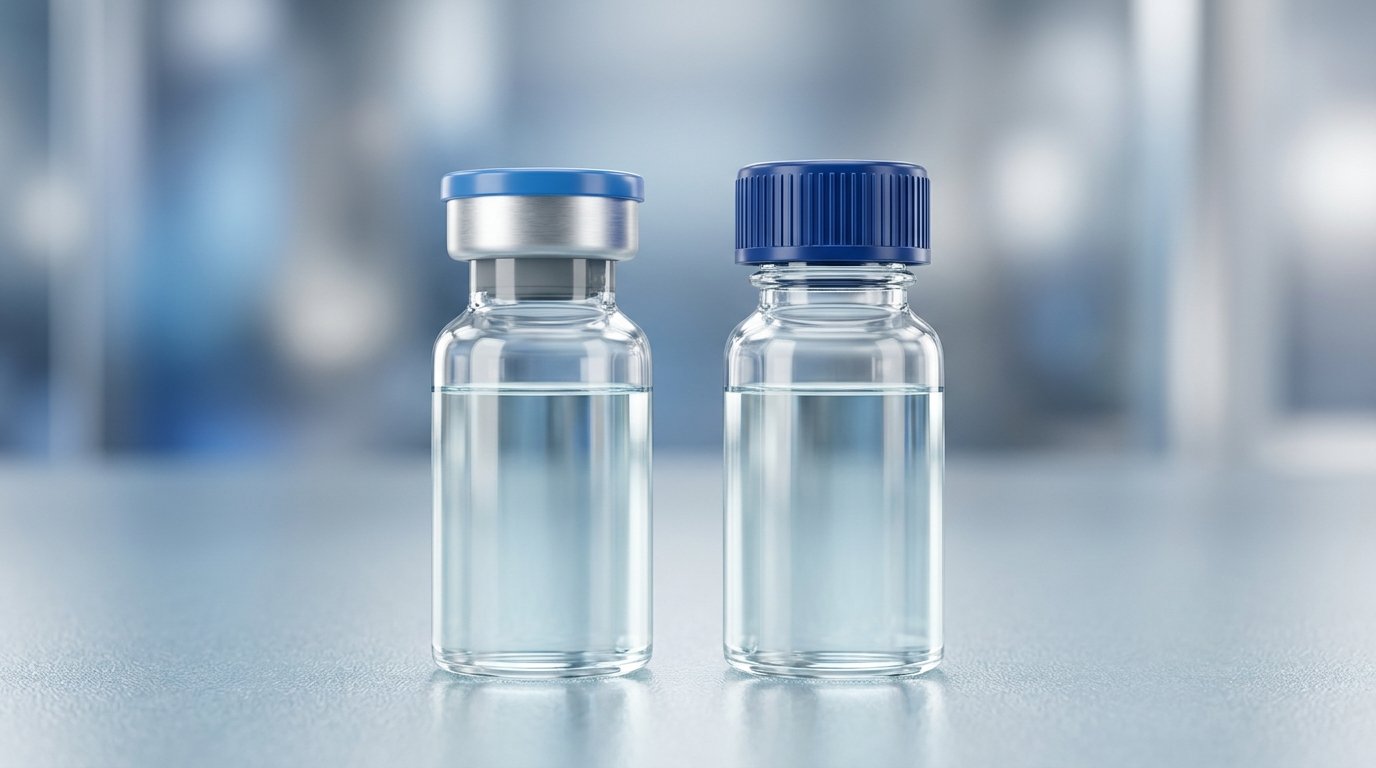
A crimp closure seals a vial by crimping an aluminium seal over a rubber stopper, while a screw closure seals it with a threaded cap. For sterile injectables the crimp closure is the standard, because it locks the stopper under permanent compression and provides clear tamper evidence, whereas screw closures suit reclosable applications where repeated opening matters more than a permanent sterile seal. Both can hold a sound seal for their intended use; the difference is that a crimp is a one-time, locked closure and a screw cap is removable and reclosable.
This guide compares crimp and screw vial closures, explains how each works, and outlines which is used where.
Key takeaways
- A crimp closure crimps an aluminium (or aluminium-plastic) seal over a rubber stopper, locking it under compression; it is not reclosable.
- A screw closure uses a threaded cap that screws on and off, so it is removable and reclosable.
- Injectables use crimp closures because they give a permanent, tamper-evident sterile seal with a piercable, resealing stopper.
- Screw closures suit reclosable containers (many oral liquids, reagents, samples) where repeated access matters.
- The crimp seal’s integrity comes from the stopper compressed by the crimp; a screw seal’s comes from the cap liner against the neck.
- A pilfer-proof (ROPP) cap is a screw closure with a tamper band, bridging the two for bottles. See pilfer-proof cap.
How a crimp closure works
A crimp closure seals a vial by rolling the lower edge of an aluminium seal under the vial neck flange, compressing a rubber stopper against the glass. The stopper forms the resealable barrier; the crimped aluminium is the clamp that holds it under load permanently. Once crimped, the seal cannot be lifted off by hand, which is why crimp closures are single-access.
This construction does two things a screw cap cannot. First, it incorporates a piercable, self-sealing rubber stopper, so a needle can be inserted to withdraw or deliver the drug and the stopper reseals afterwards. Second, it provides built-in tamper evidence: a flip-off button that snaps off, or a torn aluminium top, that cannot be restored. The mechanics are covered in vial crimping explained and how flip-off caps work.
How a screw closure works
A screw closure seals a container with a threaded cap that tightens onto matching threads on the neck, pressing a liner or the cap face against the neck to form the seal. It is removable and reclosable: the cap screws off to open and back on to reclose, which suits products accessed more than once.
A screw cap does not, by itself, incorporate a piercable resealing stopper or a permanent crimp. It seals by thread tension and a liner, and it can be re-opened freely unless a tamper-evident feature is added. That is where a pilfer-proof (roll-on pilfer-proof) cap comes in: it is an aluminium screw cap with a tear-off band that breaks on first opening, adding tamper evidence to a reclosable screw closure. Screw closures are common on bottles rather than injectable vials.
Crimp vs screw: the comparison
The core trade-off is permanence and sterility (crimp) versus reclosability (screw). Each is matched to its use.
| Aspect | Crimp closure | Screw closure |
|---|---|---|
| How it seals | Aluminium crimped over a rubber stopper | Threaded cap with a liner |
| Reclosable | No (single-access) | Yes |
| Needle access | Yes, through the stopper | Not by design |
| Tamper evidence | Built in (flip button or torn metal) | Needs a feature (for example a pilfer band) |
| Typical container | Injectable vials | Bottles and jars |
| Typical contents | Sterile injectables, vaccines | Oral liquids, reagents, samples |
Neither is universally “better.” For a sterile injectable that must stay sealed and be pierced by a needle, the crimp closure is the right choice. For a product opened and reclosed repeatedly, a screw closure is more practical.
Which is used where
Crimp closures are the standard for sterile injectable vials, while screw closures are used for reclosable bottles and containers, including with a pilfer-proof band for tamper evidence. The use cases rarely overlap because the requirements differ.
- Crimp: vaccines and injectable medicines in glass vials, where a permanent, tamper-evident sterile seal and needle access through a stopper are essential.
- Screw: oral liquids and syrups, reagents, and sample containers, where the container is opened more than once. An aluminium pilfer-proof (ROPP) cap adds tamper evidence to a screw closure on bottles.
So the question “which seals better” is really “which fits the product”: a crimp seal is better for a single-access sterile injectable, a screw seal is better for a reclosable container.
How this works in practice at Autofits
Autofits manufactures both kinds of closure. Its crimp closures for injectable vials include FlipTop Optima flip-off seals, tear-off and tear-down aluminium seals, and FlipTop Pull Ring seals, all crimped over a rubber stopper. Its screw-type closures are the aluminium pilfer-proof (ROPP) caps for threaded bottles, which add a tear-off tamper band. The full range is on the products page. Production runs under an ISO 15378:2017 quality system, alongside ISO 9001:2015 and ISO 14001:2015 certification and a Drug Master File, in a 75,000 sq ft Nashik facility with an ISO Class 8 cleanroom and high-speed visual inspection. The full certification set is on the quality page.
The crimp-versus-screw question is settled by the product in most cases. Anything filled aseptically and held to container closure integrity across shelf life takes the crimp, which covers lyophilised vial seals and biologic fills. Screw closures survive mainly on the laboratory bench and on non-parenteral bottles, which is the territory covered on research and lab reagent closures.
Frequently asked questions
What is the difference between a crimp and a screw vial closure?
A crimp closure seals a vial by crimping an aluminium seal over a rubber stopper, locking it under compression; it is single-access and not reclosable. A screw closure uses a threaded cap that screws on and off, so it is reclosable. Injectables use crimp closures for a permanent, tamper-evident sterile seal with needle access; screw closures suit reclosable bottles.
Why do injectable vials use crimp closures instead of screw caps?
Injectable vials use crimp closures because the design locks a rubber stopper under permanent compression, giving a sterile seal that a needle can pierce and that reseals afterwards, plus built-in tamper evidence. A screw cap is removable and does not, by itself, incorporate a piercable resealing stopper or a permanent seal, so it is unsuitable for a single-access sterile injectable.
Which seals better, crimp or screw?
It depends on the use. For a sterile injectable that must stay sealed, be pierced by a needle, and show tamper evidence, a crimp closure seals better. For a container opened and reclosed repeatedly, a screw closure is more practical. They are matched to different requirements rather than one being universally superior.
Is a pilfer-proof cap a crimp or a screw closure?
A pilfer-proof (ROPP) cap is a screw closure: it threads onto a bottle neck and is reclosable. What it adds is a tear-off tamper band that breaks on first opening, giving the tamper evidence a plain screw cap lacks. It is used on bottles, not crimped over a stopper like an injectable vial seal.
Are crimp closures reclosable?
No. A crimp closure is single-access: once the aluminium is crimped under the vial neck flange, it cannot be lifted off and reseated by hand. The flip-off button or torn metal top gives one-time tamper evidence. For reclosable use, a screw closure is the appropriate design.
Related reading
- Vial crimping explained
- How flip-off caps work
- Pilfer-proof cap: definition
- What is a pilfer-proof cap?
- FlipTop Optima crimped flip-off seals
Sources
- ISO: ISO 8362-3:2001, Injection containers and accessories, Part 3: Aluminium caps for injection vials (https://www.iso.org/standard/33804.html)
- USP-NF: General Chapter <1207>, Package Integrity Evaluation, Sterile Products (https://www.usp.org/)
*Last updated: 2026-06-18. This article is general technical information, not regulatory or compliance advice; confirm current standard editions and requirements with the issuing bodies.*
