
Aluminium Cap Finish Types: Opening Styles and Surface Finishes Explained
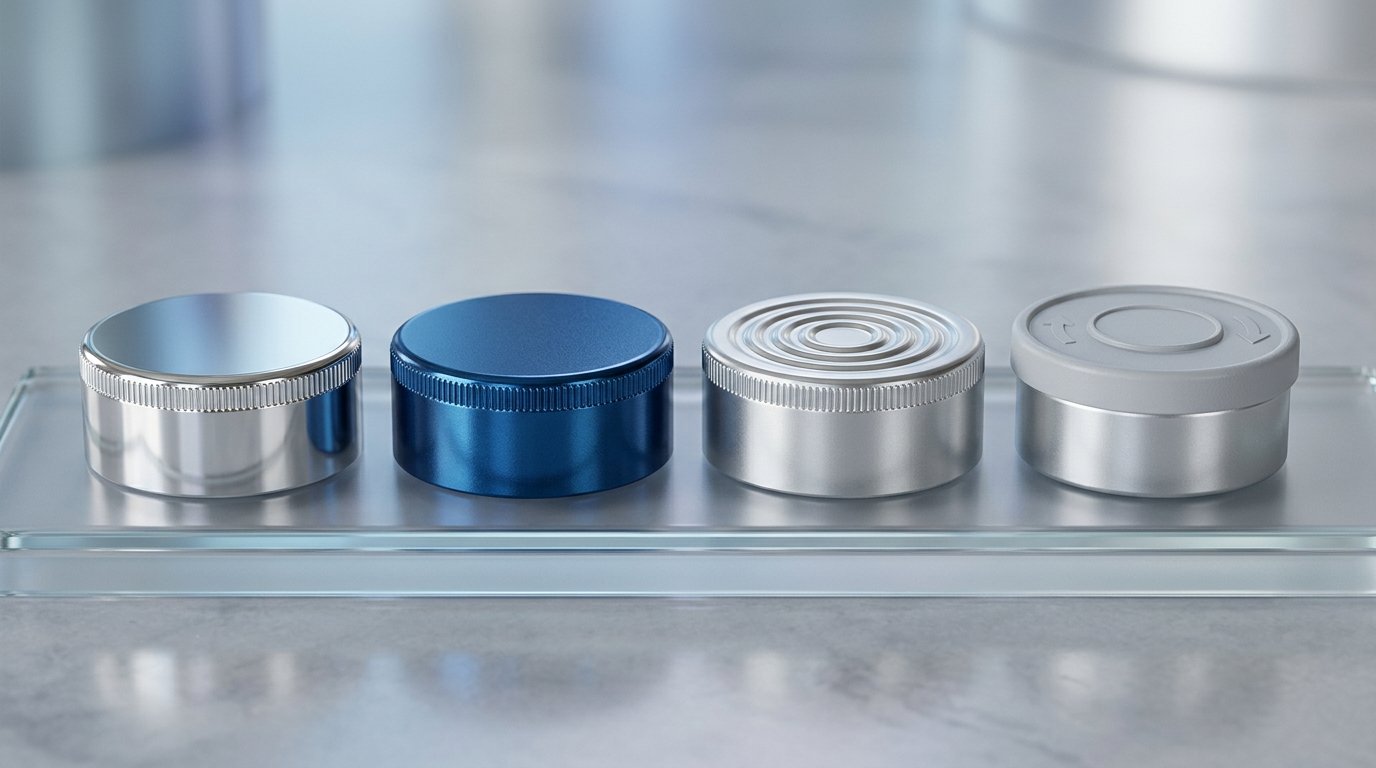
“Finish” describes two different things on an aluminium vial cap, and buyers routinely mean one while suppliers hear the other. The opening finish is what the top of the cap does: plain, tear-off, tear-down, pull-ring, flip-off, or pilfer-proof. The surface finish is what is applied to the metal and plastic: lacquer, colour, print, embossing, and a matte or glossy face. A third sense, the container finish, refers to the vial neck the cap has to fit rather than to the cap at all.
Separating the three makes specification faster, because each is decided by different people for different reasons. This guide covers every opening style, every surface treatment, the neck geometry that constrains both, and the standards involved.
Key takeaways
- Opening finish is a functional choice driven by the product and the user; surface finish is a cosmetic and identification choice; container finish is fixed by the vial.
- The six opening finishes in common use are plain, tear-off, tear-down, pull-ring, flip-off, and pilfer-proof (ROPP).
- Only the pilfer-proof cap threads onto the container; the other five crimp over a flanged neck.
- Surface options include mill-bright aluminium, clear or tinted lacquer, colour, offset printing, embossing, and a matte or glossy plastic face.
- No legal colour code exists for pharmaceutical vial caps: colour is a house convention, not a standard.
- Dimensions sit in ISO 8362-3 (plain aluminium caps) and ISO 8362-6 and 8362-7 (aluminium-plastics combinations); general requirements and test methods sit in ISO 8872:2022.
- Surface finish is applied before forming, which is why decoration is a run-quantity decision rather than a last-minute one.
Three things “finish” can mean
Separating the three senses is the fastest way to write an unambiguous specification. Each is decided at a different point, by a different constraint.
| Sense | What it describes | Decided by |
|---|---|---|
| Opening finish | How the closure opens and what remains on the vial | Product, dose format, and end user |
| Surface finish | Lacquer, colour, print, emboss, matte or gloss | Brand, identification scheme, and market |
| Container finish | The vial neck the cap must fit | The vial, per ISO 8362-1 or ISO 8362-4 |
Opening finishes: the six aluminium cap types
All six start as a soft-temper aluminium shell; they differ in what happens to that shell when the user opens it, and in what is left behind. A closure is tamper evident because opening it destroys something that cannot be restored.
| Opening finish | Construction | How it opens | What stays on the vial |
|---|---|---|---|
| Plain (smooth) | All aluminium, no feature on top | Needs a decapping tool | Nothing, once removed |
| Tear-off | Scored aluminium top with a pull tab | The whole top tears away | The crimped skirt |
| Tear-down | Aluminium with a perforated vertical section | The section tears downward | Little or nothing |
| Pull-ring | Aluminium with a formed ring | The ring tears the top away | The crimped skirt |
| Flip-off | Aluminium shell plus a moulded plastic button | The button flips up | The skirt and outer plastic |
| Pilfer-proof (ROPP) | Plain shell, threaded on application | Unscrews; the band separates | The severed band |
Plain (smooth) aluminium caps
A plain cap is an unbroken aluminium shell crimped over the stopper with no opening feature. It gives the maximum barrier and the most secure crimp, and it is the reference form in ISO 8362-3. The trade-off is access: without a scoreline or button it has to be cut or levered off with a decapper, so plain caps suit laboratory containers.
Tear-off caps
A tear-off cap adds a circular scoreline and a raised tab or ring to the top of the aluminium. Pulling the tab tears the metal along the scoreline and lifts the entire top away, exposing the stopper in one action and leaving the crimped skirt in place. Tamper evidence is unambiguous: the removed disc cannot be put back. See tear-off seal.
Tear-down caps
A tear-down cap is opened by tearing a perforated vertical strip downward, which unzips the cap and releases it from the neck. It is simpler and lower-cost than a pull-ring, and common on oral-medicine bottles. See tear-down seal.
Pull-ring caps
A pull-ring cap uses a formed metal ring rather than a flat tab. The ring is harder to form and to reproduce than a printed tab or a perforation, which is part of its appeal where counterfeit resistance matters, and it grips better on a larger-diameter closure.
Flip-off (aluminium-plastic combination) caps
A flip-off cap is a combination construction: an aluminium shell crimped over the stopper, with a moulded plastic top carrying a button that flips away to expose the septum while the crimp stays untouched. It dominates injectable vials because it gives single-action access without disturbing the seal that holds container closure integrity. See flip-off seal and aluminium-plastic seal; the two ISO parts that specify it, 8362-6 and 8362-7, differ in whether the plastic overlaps the aluminium edge.
Pilfer-proof (ROPP) caps
The pilfer-proof or roll-on pilfer-proof cap is the outlier. It arrives as a plain aluminium shell and is formed onto the container during capping, with threads and a pilfer band rolled into the metal against the container’s own thread profile. Opening unscrews the cap and severs the bridges holding the band, which stays on the neck as evidence. Because it needs a threaded neck it cannot go on a flanged injection vial, which is why it appears on bottles for oral liquids. See pilfer-proof cap.
Surface finishes on the metal
Surface finish is applied to flat aluminium strip before the shell is formed, so decoration is decided at the coil stage rather than at assembly, which is why lead time and minimum quantity change with the finish chosen.
Mill or bright aluminium. Uncoated aluminium with its natural finish: the plainest and least expensive option, and the one that shows handling marks most readily.
Clear and tinted lacquer. A lacquer coat protects the metal, improves formability during stamping, and can carry a tint. A gold-toned lacquer is a long-standing pharmaceutical convention, still specified on plain and tear-off caps.
Colour. Colour is applied as a pigmented coating across the strip, almost always as an identification device: differentiating strengths within a product family, separating a diluent from an active, or matching a corporate palette. There is no legal or pharmacopoeial colour code for vial caps, so a scheme is only as reliable as the house convention behind it.
Printing. Offset or litho printing on the strip carries text and graphics: product family, strength, warnings, a brand mark. It sits on the metal surface, so it is unavailable where forming stretches the metal most severely.
Embossing. Embossing raises or recesses a pattern in the metal during forming, giving a tactile mark that cannot be washed or scuffed off. It is useful as an anti-counterfeit feature and for identification by touch.
What can and cannot be varied within these options is covered in custom vial seal manufacturing.
Surface finish on the plastic
On combination caps, the plastic top is a second decorative surface with its own finish choices, and it carries most of the visual identity because it is what the user sees and touches. The disc or button is moulded in colour rather than coated, so the colour goes all the way through and cannot scratch off.
The plastic face is specified matte or glossy. Matte is less reflective, making printed or embossed detail easier to read under bright clinical lighting; glossy reads as a more finished surface. The plastic can also be printed or embossed, and because it is moulded rather than formed from sheet, it accepts detail the aluminium cannot hold.
The container finish the cap has to fit
Everything above is constrained by the vial neck, which the cap does not get to influence. Injection vials are made from glass tubing to ISO 8362-1 or from moulded glass to ISO 8362-4, and both fix the neck diameters and flange profiles. Caps are specified against those same neck sizes, which is what lets a vial, a stopper, and a seal from three suppliers assemble correctly.
So the diameter is chosen first, from the standard family the vial belongs to, and the opening and surface finishes are chosen within it. The neck geometry, including the blowback profile that helps retain the stopper, is covered in vial neck types under ISO 8362. A cap specified without reference to its neck is the most common source of a failed first article.
The standards that govern aluminium cap finishes
Dimensional requirements are split by construction across three parts of ISO 8362; general requirements and test methods sit in a single separate standard.
| Standard | Scope |
|---|---|
| ISO 8362-3:2001 | Aluminium caps for injection vials (plain, all-metal) |
| ISO 8362-6:2010 | Caps made of aluminium-plastics combinations for injection vials |
| ISO 8362-7:2006 | Combination caps without an overlapping plastics part |
| ISO 8872:2022 | Aluminium and aluminium/plastic caps: general requirements and test methods |
| ISO 15378:2017 | The GMP-aligned quality system under which such caps are made |
ISO 8872 is the one most often missed. Its third edition, published in 2022, brought all-aluminium and aluminium-plastic caps into a single standard for general requirements and test methods, superseding the separate treatment combination caps previously had under ISO 10985. Cite it when a specification needs a test method rather than a dimension.
Choosing a finish
Work down the three senses in order: fix the container finish, choose the opening finish from the product’s access requirement, then choose the surface finish for identification and brand.
| If the product is | Usual opening finish | Because |
|---|---|---|
| An injectable accessed by needle | Flip-off | Exposes the septum without disturbing the crimp |
| An injectable where the whole stopper must be exposed | Tear-off | Removes the entire top in one action |
| An oral liquid in a threaded bottle | Pilfer-proof (ROPP) | Resealable, with a tamper band |
| An oral medicine needing a low-cost seal | Tear-down | Simplest construction that still shows tampering |
| A product where counterfeiting is a concern | Pull-ring, embossed | Harder to reproduce than a printed tab |
| A laboratory or bulk container | Plain aluminium | Maximum barrier; opened with a decapper |
What finish does not change
No finish alters the seal itself. Container closure integrity comes from the crimp holding the stopper compressed against the glass, and every one of these constructions crimps the same aluminium skirt under the same neck flange. So “which finish seals best” has a short answer: they seal identically, and the choice is made on access, tamper evidence, and identification. The metal under the finish is a separate specification again, covered in aluminium grades used in vial caps, and which opening finish suits a given drug product is worked through across the applications hub.
How this works in practice at Autofits
Autofits produces most of the finishes described above: FlipTop aluminium-plastic seals in Optima, Pull Ring, and Tear Down variants, tear-off and tear-down aluminium seals, and aluminium pilfer-proof (ROPP) caps, listed on the products page. The plastic disc is available matte or glossy and can be printed or embossed, and the metal is colourable and printable, with decoration applied at the coil stage before forming. Production runs under an ISO 15378:2017 quality system alongside ISO 9001:2015 and ISO 14001:2015 certification and a Drug Master File, in a 75,000 sq ft Nashik facility with an ISO Class 8 cleanroom and high-speed visual inspection.
Frequently asked questions
What are the different types of aluminium cap finish?
There are two answers, because “finish” carries two meanings. The opening finish is the type of cap: plain (smooth), tear-off, tear-down, pull-ring, flip-off, and pilfer-proof (ROPP). The surface finish is the treatment applied to the material: mill-bright aluminium, clear or tinted lacquer, colour, offset printing, embossing, and a matte or glossy plastic face on combination caps.
What is the difference between a tear-off and a flip-off cap?
A tear-off cap has a scored aluminium top removed entirely by a pull tab, exposing the whole stopper and leaving the crimped skirt behind. A flip-off cap has a moulded plastic button that flips up to expose only the central septum, with the aluminium skirt and surrounding plastic staying in place. Both are tamper evident; the flip-off is the standard for injectable vials because it exposes the septum without disturbing the crimp.
Is there a standard colour code for pharmaceutical vial caps?
No. There is no legal or pharmacopoeial colour code. Colours are house conventions set by individual manufacturers, most often to differentiate strengths within a product family or to separate an active from a diluent. Because the same colour can mean different things across companies, cap colour should not be the sole means of identifying a product.
Which ISO standards apply to aluminium vial caps?
Dimensional requirements are in ISO 8362-3:2001 for plain aluminium caps, ISO 8362-6:2010 for aluminium-plastics combination caps, and ISO 8362-7:2006 for combination caps whose plastic does not overlap the aluminium. General requirements and test methods for both families are in ISO 8872:2022. The necks they fit are in ISO 8362-1:2018 and ISO 8362-4:2011.
Can an aluminium cap be printed and embossed at the same time?
Yes. Printing is applied to the flat strip before forming and embossing is created during forming, so the two are compatible and often combined. The constraint is placement: printed detail cannot sit where forming stretches the metal most severely, and embossed detail needs enough flat area to register cleanly.
Does the cap finish affect the seal or shelf life?
No. Sealing comes from the crimp compressing the rubber stopper against the glass, and every crimped aluminium finish uses the same mechanism, so tear-off, flip-off, pull-ring, tear-down, and plain caps on the same vial deliver the same closure integrity.
Related reading
- Flip-off seal: definition
- Tear-off seal: definition
- Pilfer-proof cap: definition
- Custom vial seal manufacturing
Sources
- ISO: ISO 8362-3:2001, Aluminium caps for injection vials (https://www.iso.org/standard/33804.html)
- ISO: ISO 8362-6:2010, Caps made of aluminium-plastics combinations for injection vials (https://www.iso.org/standard/52806.html)
- ISO: ISO 8362-7:2006, Injection caps made of aluminium-plastics combinations without overlapping plastics part (https://www.iso.org/standard/43551.html)
- ISO: ISO 8872:2022, Aluminium caps and aluminium/plastic caps for infusion bottles and injection vials, General requirements and test methods (https://www.iso.org/standard/82226.html)
- ISO: ISO 8362-1:2018, Injection vials made of glass tubing (https://www.iso.org/standard/74398.html)
- ISO: ISO 15378:2017, Primary packaging materials for medicinal products (https://www.iso.org/standard/70729.html)
*Last updated: 2026-07-31. This article is general technical information, not regulatory or compliance advice; confirm current standard editions and requirements with the issuing bodies.*
