
Tear-Down Seal: What It Is and How It Works on Pharma Containers
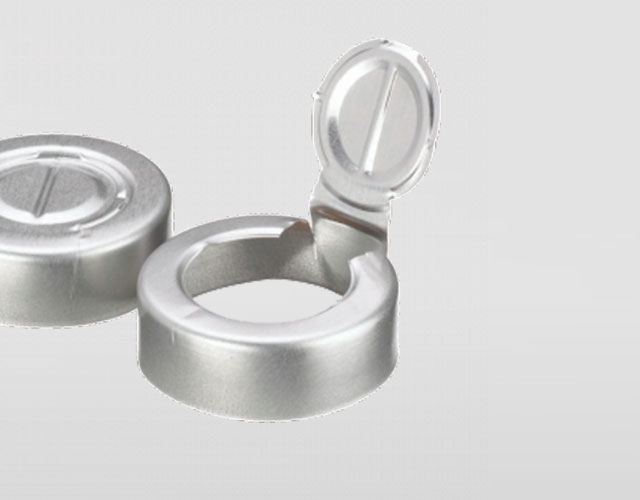
A tear-down seal is an aluminium pharmaceutical seal that is opened by tearing down a perforated section of the cap to release the closure underneath. It is a tamper-evident closure used mainly for oral medicines, where the user breaks the perforation and peels the aluminium downward to open the container. Within the family of aluminium seals, the tear-down seal is the simpler, lower-cost counterpart to the pull-ring seal: it relies on a scored tear line rather than a moulded pull ring, which makes it easier and cheaper to produce while still providing visible tamper evidence.
This page defines the tear-down seal, explains how it opens, and shows how it differs from tear-off and pull-ring seals.
Key takeaways
- A tear-down seal is an aluminium closure opened by tearing along a perforated section that runs down the side of the seal.
- It is used mainly for oral medicines, not injectable vials, and provides clear tamper evidence once the perforation is broken.
- It is the simpler, lower-cost alternative to the pull-ring seal, which uses a moulded ring and is harder to duplicate.
- It differs from a tear-off seal (where the whole top is pulled off by a tab) and from a pull-ring seal (opened by lifting a ring).
- All three (tear-down, pull-ring, tear-off) are tamper-evident aluminium seals; the choice depends on application, opening experience, and cost.
- Autofits manufactures Tear Down aluminium seals as part of its FlipTop® range.
What is a tear-down seal?
A tear-down seal is a tamper-evident aluminium seal with a weakened, perforated tear line that lets the user open the container by tearing the aluminium downward. The seal is applied over the container’s mouth and crimped or secured in place. To open it, the user starts the tear at the perforation and pulls the aluminium down and away, which breaks the seal and exposes the contents.
The defining feature is the perforation, a line of partial cuts or scores pressed into the aluminium. Until that line is broken, the seal is intact and the container is visibly unopened. Once it is torn, the seal cannot be reclosed to its original state, which is what makes it tamper-evident. Tamper-evident packaging, broadly, is packaging that shows visible evidence if a container has been opened or interfered with, an expectation set out for many medicines by regulators such as the U.S. Food and Drug Administration.
Because the tear-down mechanism uses a simple scored line rather than an additional moulded component, the seal is straightforward to manufacture, which keeps it among the lower-cost options for tamper-evident aluminium closures. Like any closure in direct contact with the dose, it is primary packaging and is qualified as such.
Where tear-down seals are used
Tear-down seals are used mainly for oral medicines rather than injectable vials. Oral products are accessed by the patient or caregiver directly, so the closure has to be easy to open by hand without a tool while still showing whether the pack has been tampered with. The tear-down format suits that use: the perforation gives a clear opening path, and the broken aluminium makes prior opening obvious.
This positions the tear-down seal differently from a flip-off seal, which is designed for injectable vials accessed by needle. A flip-off seal keeps an aluminium crimp on the vial to hold the rubber stopper in place for container closure integrity, and only a small plastic button flips away. A tear-down seal, by contrast, is meant to be opened fully by the end user for an oral dose form.
How a tear-down seal differs from tear-off and pull-ring seals
A tear-down seal opens by tearing a perforated section downward, a tear-off seal opens by pulling the whole top off with a tab, and a pull-ring seal opens by lifting a moulded ring. All three are aluminium, all three are tamper-evident, but the opening mechanism and the typical application differ.
| Seal type | How it opens | Relative complexity and cost | Typical use |
|---|---|---|---|
| Tear-down seal | Tear a perforated section downward by hand | Simpler, lower cost | Oral medicines |
| Tear-off seal | Pull a tab or ring to remove the whole aluminium top | Moderate | Containers where the full top is removed |
| Pull-ring seal | Lift and pull a moulded ring to break the seal | More complex, harder to duplicate, more premium | Oral medicines, including premium and counterfeit-sensitive products |
The pull-ring and tear-down seals are the closest pair: both are used for oral medicines, and the practical trade-off between them is complexity versus cost. The pull-ring seal uses a moulded ring that is harder to copy, which adds counterfeit resistance but also cost, while the tear-down seal favours simplicity and economy. A tear-off seal is distinct again: instead of tearing a section downward, the user removes the entire aluminium top, which is why it is usually contrasted with the partial-opening flip-off design. For the injectable side of the comparison, see tear-off versus tear-down seals.
How this works in practice at Autofits
Autofits manufactures Tear Down aluminium seals as one of the sub-ranges within its FlipTop® product family, alongside Optima and Pull Ring seals, plus separate Tear Off aluminium seals and aluminium pilfer-proof (ROPP) caps across the wider product range. The aluminium-plastic version of the same opening action, with a polypropylene disc riveted to the shell, is the FlipTop® Tear-Down seal. The seals are produced in a 75,000 sq ft Nashik (Maharashtra) facility that includes an ISO Class 8 cleanroom, with high-speed visual inspection on the lines and an output of roughly 2.4 billion seals per year. Manufacturing runs under an ISO 15378:2017 quality system (the GMP-aligned standard for primary packaging materials) alongside ISO 9001:2015 and ISO 14001:2015 certification and a Drug Master File (DMF). Autofits is also one of the few manufacturers of pull-ring seals in India, the more complex counterpart to the tear-down format. You can review the full set of certifications on the quality page.
Frequently asked questions
What is a tear-down seal?
A tear-down seal is a tamper-evident aluminium seal opened by tearing along a perforated section of the cap. It is used mainly for oral medicines and is opened by hand without a tool. Once the perforation is broken, the seal cannot be restored to its original state, which is what makes prior opening visible.
What is the difference between a tear-down seal and a pull-ring seal?
Both are aluminium tamper-evident seals used for oral medicines, but they open differently and sit at different cost points. A tear-down seal opens by tearing a perforated section downward and is the simpler, lower-cost option. A pull-ring seal opens by lifting a moulded ring and is more complex, harder to duplicate, and more premium.
Is a tear-down seal the same as a tear-off seal?
No. A tear-down seal is opened by tearing a perforated section downward, while a tear-off seal is opened by pulling a tab or ring to remove the whole aluminium top. They are both tamper-evident aluminium seals but use different opening mechanisms.
Are tear-down seals used for injectable vials?
Tear-down seals are used mainly for oral medicines rather than injectable vials. Injectable vials typically use a flip-off seal, which keeps an aluminium crimp on the vial to hold the rubber stopper and maintain container closure integrity while a small plastic button flips away for needle access.
Why are tear-down seals lower cost than pull-ring seals?
A tear-down seal opens along a scored, perforated line and does not require an additional moulded component, so it is simpler to manufacture. A pull-ring seal uses a moulded ring that adds material and tooling complexity and is harder to duplicate, which makes it more premium and more counterfeit-resistant but also more costly.
Related reading
- Pull-ring seal vs tear-down seal compared
- Autofits Tear Down aluminium seals
- What a tear-off seal is
- What a flip-off seal is
- ISO 15378:2017 and GMP quality for primary packaging
Sources
- U.S. Food and Drug Administration: Drugs (tamper-evident packaging requirements for medicines) (https://www.fda.gov/drugs)
- ISO: ISO 15378:2017, Primary packaging materials for medicinal products (https://www.iso.org/standard/70729.html)
*Last updated: 2026-06-10. This article is general product and regulatory information, not legal or compliance advice; confirm current standard editions and packaging requirements with the relevant authority.*
