
USP 788 Particulate Matter in Injections: What It Asks of a Vial Closure
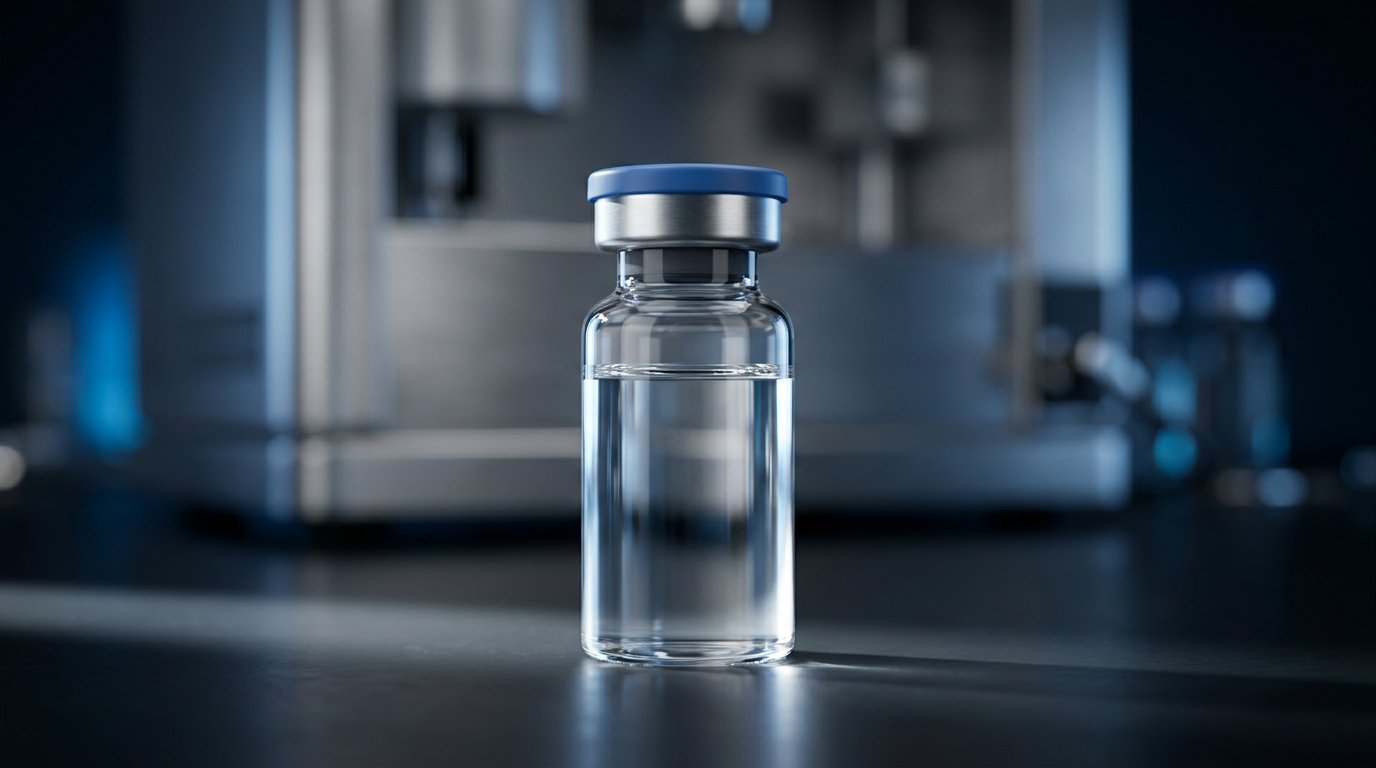
USP General Chapter <788> limits the sub-visible particles an injection may contain: by light obscuration, a small-volume injection may carry not more than 6,000 particles of 10 µm and larger and not more than 600 of 25 µm and larger per container. The test is run on the finished drug product, so a vial seal or stopper can never pass or fail it on its own. What <788> asks of a closure is that it adds as few particles as possible to that count, and that its supplier can show how: through the materials, the washing and cleanroom assembly, 100% inspection of every seal, and a delivery form that keeps the component clean until it reaches the capping station.
This page sets out what the chapter requires, how its companions <787>, <789> and <790> and the European texts relate to it, and then what it means in practice for the aluminium seal and rubber stopper on a vial: where closure particles come from, how seals are made and inspected to limit them, and what a buyer should ask a seal supplier to show.
Key takeaways
- USP <788> covers sub-visible particulate matter in injections, with Method 1 light obscuration as the default and Method 2 microscopic particle count where light obscuration cannot be used.
- Light obscuration limits: small-volume injections (100 mL or less) not more than 6,000 per container at 10 µm and 600 at 25 µm; large-volume injections not more than 25 per mL at 10 µm and 3 per mL at 25 µm.
- USP lists a Pharmacopeial Discussion Group revision of the chapter, retitled Subvisible Particulate Matter in Injections, as official from 1 August 2026; check the limits below against the official revised text before updating a specification.
- Closures are an intrinsic particle source. The stopper sheds from its surface and can fragment on needle penetration; the seal can carry particles in from manufacture and generate them at the capping station.
- No component can be certified to <788>. A closure supplier evidences its contribution instead: declared materials, automated washing, cleanroom assembly, 100% camera inspection, a stated AQL, and Ready-to-Use supply.
- For elastomeric parts, released particles are counted to ISO 8871-3, which leaves the limits to be agreed between closure maker and user.
- USP <790> governs visible particles through 100% inspection of every filled unit, and any particle a seal sheds becomes a reject there.
What USP <788> asks of a closure, requirement by requirement
The chapter sets no requirement on packaging components directly; each of its requirements reaches the closure through the drug manufacturer’s control strategy. The table traces each one to what it means for the seal and stopper, and to the evidence a closure supplier can give.
| What the drug product has to meet | What it means for the closure | What a seal or stopper supplier can evidence |
|---|---|---|
| Sub-visible counts at 10 µm and 25 µm within the <788> limits | Every particle the stopper and seal add counts against the same limit as particles from the process and formulation | Washing route, cleanroom assembly class, bagging; ISO 8871-3 released-particle data for elastomeric parts |
| Visible particles found only within acceptance criteria at 100% inspection (USP <790>) | Burrs, flakes and fibres from a closure become rejected units | 100% camera inspection of seals, AQL release plan, defect trending |
| Contamination Control Strategy covering components (EU GMP Annex 1) | Components must be qualified and their incoming state controlled | ISO 15378 quality system, declared materials, change control, certificates on request |
| Particles not generated by the process itself | A seal that is out of round or burred can shave metal at the capping head | Drawing-controlled dimensions and tolerances, camera rejection of deformed shells |
| Component entering the aseptic area without an in-house wash, where the line needs that | The seal has to arrive washed, sterile and protected | Ready-to-Use supply: washed, gamma or ETO sterilized, double-bagged |
The sections below explain the chapter first and then take the closure side in the order of that table.
What counts as particulate matter in an injection?
Particulate matter in an injection is any mobile, undissolved particle other than a gas bubble that is unintentionally present in the solution. The pharmacopoeias split it by size, because the two size ranges need different detection methods and carry different clinical arguments.
- Visible particulates are those an inspector can see under defined lighting during a manual or automated inspection. In practice the detection threshold sits in the region of 100 to 200 µm, depending on the particle, the container and the inspection conditions.
- Sub-visible particulates are those below the visual threshold, counted instrumentally. The pharmacopoeial size gates are 10 µm and 25 µm.
Industry practice, reflected in FDA’s guidance on inspection of injectable products for visible particulates, also classifies particles by where they came from:
- Inherent: arising from the formulation itself, for example protein aggregates or a suspension’s own solids.
- Intrinsic: arising from the manufacturing process or the packaging system, for example stainless steel wear, silicone oil, glass fragments, elastomer fragments or fibres from a component.
- Extrinsic: foreign to both process and product, for example environmental fibres, hair or insect parts.
Vial closures, meaning the elastomeric stopper and the aluminium or aluminium-plastic seal crimped over it, are a potential intrinsic source. That is the category the pharmaceutical manufacturer will interrogate a packaging supplier about, and the question comes back from every therapeutic area that fills into small-volume vials, from cytotoxic and oncology products to vaccines.
USP <788>: the sub-visible limits
USP General Chapter <788> is the compendial test for sub-visible particulate matter in injectable products, and it is harmonised across the USP, Ph. Eur. and JP. It provides two methods and expresses a clear preference for the first.
- Method 1, light obscuration particle count. A liquid sample passes through a sensor where each particle blocks a beam; the size and count are derived from the signal. This is the default method.
- Method 2, microscopic particle count. The sample is filtered onto a membrane and particles are counted under a microscope. It is used where light obscuration cannot be applied, for example with products that are not clear, are viscous, or contain air bubbles that the sensor would misread.
The limits differ by method and by container volume:
| Product | Method | 10 µm and larger | 25 µm and larger |
|---|---|---|---|
| Small-volume injection (100 mL or less) | 1, light obscuration | NMT 6,000 per container | NMT 600 per container |
| Large-volume injection (more than 100 mL) | 1, light obscuration | NMT 25 per mL | NMT 3 per mL |
| Small-volume injection (100 mL or less) | 2, microscopic | NMT 3,000 per container | NMT 300 per container |
| Large-volume injection (more than 100 mL) | 2, microscopic | NMT 12 per mL | NMT 2 per mL |
NMT means “not more than”. The chapter also sets out how many units to test, how to prepare the test environment so it does not contribute particles of its own, and how to handle a first-stage failure. Because USP-NF is revised on a continuous cycle, confirm the current text and limits in the current USP-NF edition before writing a specification against them.
For a small-volume vial the per-container limit is the one a closure has to be read against. A 20 mm vial holding a few millilitres is allowed 6,000 particles of 10 µm and larger in total, from every source combined, so a stopper or seal that sheds even a small fraction of that uses up margin the drug manufacturer needs for the process and the formulation.
The 2026 revision of USP <788>
USP’s harmonisation page for particulate contamination lists a revision of <788>, approved through the Pharmacopeial Discussion Group with the European and Japanese pharmacopoeias, under the new title Subvisible Particulate Matter in Injections, official from 1 August 2026. The new title makes explicit what the test always measured: particles below the visible range.
The revised text itself sits behind the USP-NF subscription, so this page does not restate what else changed. For a closure specification the working rule is simple: read the limits and methods in the table above against the official revised chapter, and update a specification or supplier questionnaire only from that text. What a seal or stopper is asked to show, its contribution to the count and the controls behind it, does not depend on the title. The USP particulate contamination harmonisation page lists the chapter and its sign-off documents.
USP <787>, <789> and <790>: the companion chapters
Three companion chapters sit around <788>: <787> for therapeutic protein injections, <789> for ophthalmic solutions, and <790> for visible particulates. Each changes what a closure’s particle contribution is weighed against.
USP <787> addresses sub-visible particulate matter in therapeutic protein injections, where smaller sample volumes and protein aggregates change the practicalities, so it is the chapter that applies to most biologic vial presentations. USP <789> addresses particulate matter in ophthalmic solutions, with its own limits, which makes particulate control a defining constraint on ophthalmic closures.
USP <790>, Visible Particulates in Injections, is the standard that makes every unit subject to inspection. It states the quality attribute in the negative: injectable products should be “essentially free from visible particulates”. That phrase is a defined term rather than a claim of absolute absence. It means the product complies when it has been through a validated inspection process, applied to 100% of the units in the lot, and the number of units found to contain visible particulates is within the acceptance criteria.
The chapter is deliberately short on method. The method sits in USP <1790>, Visual Inspection of Injections, an informational chapter covering inspection booth conditions, inspector qualification and requalification, manual versus semi-automated versus fully automated inspection, defect libraries, and the lifecycle management of the inspection programme. Read together, <790> sets the standard and <1790> explains how to reach it defensibly.
For a packaging supplier, any particle that a closure sheds, whether an aluminium sliver from a poorly formed shell, a polypropylene flake from a disc, or a fibre picked up in packing, becomes a reject at the customer’s inspection station. Rejects cost the customer yield, and a pattern of them triggers a supplier investigation.
The European position: Ph. Eur. 2.9.19, 2.9.20 and Annex 1
The European Pharmacopoeia covers the same ground through general chapters 2.9.19 for sub-visible particulate contamination and 2.9.20 for visible particulate contamination, published by the EDQM. Chapter 2.9.19 is harmonised with USP <788>, so the two methods and the numerical limits align; 2.9.20 covers the visible inspection.
On top of the pharmacopoeial tests, EU GMP Annex 1 (2022 revision) frames particulate control as part of the Contamination Control Strategy for sterile manufacture. Annex 1 expects filled and sealed containers to be inspected, expects defective units to be classified and trended, and expects the CCS to reach back into the supply chain, including the qualification and handling of primary packaging components. It binds the drug manufacturer rather than the component supplier, but it is the reason a component supplier is asked for particulate data at all. A fuller treatment is on the EU GMP Annex 1 page.
Where vial closures fit
A closure cannot pass or fail USP <788>; the drug product does. What a closure can do is contribute particles, and that contribution is controlled at the component supplier and at the customer’s washing and handling steps. Three parts of a sealed vial are relevant.
The elastomeric stopper. Rubber stoppers shed particles from their surface and can fragment when a needle pierces them. The dedicated test is ISO 8871-3, Elastomeric parts for parenterals and for devices for pharmaceutical use, Part 3: Determination of released-particle count, which specifies how to rinse a closure and count the visible and sub-visible particles released. ISO 8871-3 does not itself set limits: the standard leaves them to be agreed between the closure manufacturer and the user. Fragmentation on needle penetration is a separate test: in the current USP chapters it sits in USP <381> alongside material qualification, penetrability and self-sealing sit in USP <382>, and in Europe all three are in Ph. Eur. 3.2.9.
The glass vial. Glass contributes through delamination flakes and through chipping at the neck if the capping station is misaligned. Aluminium seal crimping is one of the mechanical operations at which glass can be stressed, which is why crimping force and head alignment are treated as validated parameters.
The aluminium or aluminium-plastic seal. The seal contributes in two ways: it can carry surface particulate from forming, punching and handling into the filling area, and it can generate particles at the capping station if the shell is out of round or burred. The production route below deals with the first, and the capping section after it with the second.
How seals are made to limit their particle contribution
Particle control on a vial seal is decided along the production route, from the aluminium coil to the sealed bag, and most of it is fixed before any inspection takes place. Each step either creates a particle risk or removes one.
- Aluminium and lacquer. Seal shells are punched and drawn from aluminium strip. Autofits uses AA8011 alloy conforming to EN 15088:2005, supplied with EN 10204-3.1 certification and tested to BS EN 485-2:2008, with an epoxy lacquer to 21 CFR 175.300. A lacquer that adheres well does not flake at the forming or crimping stage, and the alloy’s temper sets how cleanly it draws.
- Punching and forming. The cut edge is where burrs start. Tool condition and drawing-controlled dimensions (aluminium thickness of 0.16 to 0.20 mm at 13 and 20 mm) decide whether the edge is clean and the skirt round.
- Disc moulding. On a combination seal, the polypropylene disc is a second particle source through flash left on moulded parts. Autofits moulds its discs in house on Japanese Toyo injection machines, so the polymer route is controlled rather than bought in.
- Washing. A fully automated wash removes forming lubricant residue, metal fines and fibres picked up during production. Rinse quality and drying determine how much of what was removed stays removed.
- Assembly and packing in a cleanroom. Assembling and bagging in a classified environment stops recontamination between washing and the customer’s airlock. Autofits assembles in an ISO Class 8 cleanroom and double-bags seals for aseptic areas, with Tyvek bagging available where the airlock procedure calls for it.
- Sterilisation for Ready-to-Use supply. Ready-to-Use seals are washed to control particles, assembled in the cleanroom, double-lacquered, then sterilized by gamma irradiation or ETO and supplied double-bagged, so they can enter the aseptic area without an in-house wash, which removes one of the more particle-prone steps from the filler’s own process.
The general construction of these seals is described on the aluminium-plastic seal manufacturing process page.
How seals are inspected
Every Autofits seal passes 100% high-speed camera inspection before packing, and lots are released against an acceptance quality limit on top of that inspection. The two do different jobs, and the difference matters for particle defects.
- 100% camera inspection looks at every unit and rejects seals with burrs, deformed shells, missing or misaligned discs and visible surface contamination. Particle-generating defects tend to be intermittent, a worn tool that burrs one seal in many, so inspecting every unit catches what a sample would miss.
- AQL release samples each lot against critical nil, major not more than 2.5% and minor not more than 4%, tailorable where a customer’s own plan is tighter. It confirms the lot as a whole and gives a documented acceptance decision the customer can audit.
The quality-system framing for both is ISO 15378, the GMP standard for primary packaging materials, which is what a pharmaceutical customer audits a seal supplier against.
What the capping station adds
A clean seal can still generate particles on the customer’s line if its dimensions do not suit the capping head, which is why particle control continues past the supplier’s dispatch. Crimping rolls the aluminium skirt under the vial neck flange. If a shell is out of round, thicker than the head was set for, or burred at the edge, the rollers work the metal unevenly and can shave fine aluminium from it, and a misaligned head can chip the glass at the neck.
Two consequences follow for a filling line. First, capping is commonly run as a clean process outside the aseptic core, protected by a Grade A air supply, partly because it is a particle-generating step; the arrangement is set out in the vial fill-finish process guide. Second, the spread of seal dimensions inside a lot matters more than the nominal size, because the head is set once and every seal in the lot has to crimp cleanly at that setting.
Seal specifications relevant to particulate control
Dimensional consistency is the mechanical half of particulate control, because an out-of-round or over-thick shell is what makes a capping head shave metal. The table gives the controlled dimensions, the maximum opening force and the standard packing for the FlipTop Optima aluminium-plastic range, which is the format used on most small-volume injectable vials.
| Size | Total seal height (mm) | Aluminium thickness (mm) | Max opening force (N) | Standard packing per box |
|---|---|---|---|---|
| 13 mm | 7.62 to 8.38 | 0.16 to 0.20 | 30 | 15,000 (5,000 × 3 bags) |
| 20 mm | 9.02 to 9.91 | 0.16 to 0.20 | 35 | 6,000 per box |
| 28 mm | 11.06 to 12.06 | 0.17 to 0.23 | 35 | 3,000 (1,500 × 2 bags) |
| 32 mm | 14.30 to 15.50 | 0.21 to 0.25 | 65 | 1,400 (700 × 2 bags) |
| 34 mm | 15.00 to 16.00 | 0.20 to 0.25 | Available on request | Available on request |
Shipper box dimensions are 420 × 270 × 320 mm across the range. The all-aluminium tear-off and tear-down formats and the pull-ring seals share the same washing, cleanroom and inspection route, and the seal size index carries the full dimensional set including inner and outer diameters, disc height and bridge count.
What to ask a seal supplier for
No supplier can certify a component to <788>, so what a buyer should ask for instead is the evidence trail behind the supplier’s particulate contribution. A complete answer covers five areas.
Quality system and registrations. Manufacture under ISO 15378:2017, the GMP standard for primary packaging materials, is the baseline a pharmaceutical auditor expects. Autofits holds ISO 9001:2015, ISO 14001:2015 and ISO 15378:2017 certification, a Drug Master File (DMF 18100) whose reference a customer’s filing can cite, and a CFDA registration. Certificate copies are supplied on request, and the quality certificates page lists what is held.
Acceptance quality limits. Ask for the release plan and whether it sits on top of 100% inspection or replaces it; the Autofits plan is set out under inspection above.
Material declarations. Every contact material should be declared, because a particle recovered from a customer’s filter has to be identifiable. For Autofits seals: AA8011 aluminium to EN 15088:2005; epoxy lacquer to 21 CFR 175.300; polypropylene disc to IS 10910 and IS 10909, FDA 21 CFR 177.1520 for olefin polymers, and EC 1895/2005, with BADGE, NOGE and BFDGE not used. Heavy metals (chrome-VI, cadmium, mercury and lead) are held to a maximum of 100 ppm total under EN 602 and EC 94/62, and components are BSE/TSE-free to EMEA/410/01 rev. 3.
Forms of supply. Ask which forms are offered and how each is prepared. Regular seals suit customers who wash in house, Ready-to-Sterilize seals arrive cleaned and bagged for the customer’s own validated cycle, and Ready-to-Use seals are described in step 6 above.
Shelf life. Particle-controlled stock has a usable life. Non-irradiated Autofits seals carry 3.5 years before capping plus 5 years after capping; Ready-to-Use seals carry 2 years before capping. Those windows govern how far ahead stock can be built.
A certificate pack, material declarations or a sample against a specific vial format can be requested through the contact page.
How this works in practice at Autofits
Particulate control at Autofits is built into the production route rather than tested in at the end. Discs are moulded in house, components are washed on a fully automated line, seals are assembled in an ISO Class 8 cleanroom, and every seal passes 100% high-speed camera inspection before packing. Ready-to-Use seals are sterilized by gamma irradiation or ethylene oxide and supplied double-bagged for aseptic areas; Ready-to-Sterilize and Regular forms are available where the customer sterilizes or washes in house. Production sits under ISO 9001:2015, ISO 14001:2015 and ISO 15378:2017 with a Drug Master File (DMF 18100), in a 75,000 sq ft facility in Nashik, India. The certification set is on the quality page. The same material and inspection controls apply across the full seal and cap range, including aluminium pilfer-proof (ROPP) caps.
Frequently asked questions
What is USP <788>?
USP General Chapter <788> is the compendial test for sub-visible particulate matter in injectable products. It provides two methods, light obscuration particle count (Method 1) and microscopic particle count (Method 2), and sets limits at the 10 µm and 25 µm size gates. Light obscuration is the default; the microscopic method is used where the product cannot be measured reliably by light obscuration.
What are the USP <788> particulate limits?
By light obscuration, small-volume injections of 100 mL or less must contain not more than 6,000 particles of 10 µm and larger and not more than 600 particles of 25 µm and larger per container. Large-volume injections of more than 100 mL must contain not more than 25 particles per mL at 10 µm and larger and not more than 3 per mL at 25 µm and larger. The microscopic method has its own, lower numerical limits. Confirm the current values in the current USP-NF edition.
What changed in the 2026 revision of USP <788>?
USP lists the revised chapter, retitled Subvisible Particulate Matter in Injections, as official from 1 August 2026, following Pharmacopeial Discussion Group approval with the European and Japanese pharmacopoeias. The full revised text is in the USP-NF subscription, so check the limits and methods against it before changing a specification.
What is the difference between USP <787> and USP <788>?
USP <788> is the general test for sub-visible particles in injections. USP <787> is written for therapeutic protein injections, where sample volumes are smaller and protein aggregates are part of the particle population, and USP describes it as usable as an alternative to <788> for those products. A small-molecule injection is tested under <788>.
What is the difference between USP <788> and USP <790>?
USP <788> covers sub-visible particulates and is a laboratory test on a sample of units, counted instrumentally at the 10 µm and 25 µm gates. USP <790> covers visible particulates and is an inspection applied to 100% of the units in the lot, establishing that the product is essentially free from visible particulates. They are complementary: one measures what an inspector cannot see, the other governs what an inspector can.
Does a vial seal have to pass USP <788>?
No. USP <788> is a test on the finished injectable product, not on a packaging component. A seal or stopper cannot be certified to <788>. What a closure supplier can provide is evidence of the controls that limit its particulate contribution, such as washing, cleanroom assembly, 100% camera inspection and ready-to-use supply, plus released-particle data for elastomeric parts generated to ISO 8871-3.
How do aluminium seals contribute to particulate matter?
Two ways. They can carry surface particulate from forming, punching and handling into the filling area, which is why seals for aseptic filling are washed, bagged and often supplied sterilized. They can also generate particles at the capping station if the shell is out of round, dimensionally inconsistent, or left with burrs from punching, since the crimping tool then works the metal unevenly. Dimensional consistency and clean cut edges are the mechanical controls.
What particulate controls should a seal supplier be able to evidence?
At minimum: an automated washing step before assembly, assembly and bagging in a classified environment, 100% inspection rather than sample-only inspection, and a documented acceptance quality limit. Autofits meets each: automated washing, ISO Class 8 cleanroom assembly, 100% high-speed camera inspection, and release against AQL critical nil, major not more than 2.5% and minor not more than 4%.
What particulate specification should I expect from ready-to-use seals?
There is no compendial particle limit for a vial seal, so expect process evidence rather than a count: how the seals were washed, the cleanroom class they were assembled and bagged in, 100% inspection, the sterilisation method and the bagging. Autofits Ready-to-Use seals are washed to control particles, assembled in an ISO Class 8 cleanroom, sterilized by gamma irradiation or ETO and double-bagged. For rubber stoppers, released-particle counts to ISO 8871-3 are agreed between the stopper maker and the user.
What does “essentially free from visible particulates” mean?
It is the defined compliance state in USP <790>. It does not mean zero particles under any conceivable examination. It means the lot has been through a validated inspection process applied to every unit, under defined lighting and viewing conditions, and the number of units found to contain visible particulates falls within the acceptance criteria. USP <1790> describes how to design, validate and maintain that inspection programme.
Which European standards correspond to USP <788>?
Ph. Eur. 2.9.19 covers sub-visible particulate contamination and is harmonised with USP <788>, so the methods and limits align. Ph. Eur. 2.9.20 covers visible particulate contamination. Above the pharmacopoeial tests, EU GMP Annex 1 (2022 revision) places particulate control inside the Contamination Control Strategy for sterile manufacture and drives the inspection and trending expectations.
Related reading
- FlipTop Optima flip-off seals, washed and cleanroom-assembled
- Seals by vial size: 13, 20, 28, 32 and 34 mm
- The vial fill-finish process and where the seal enters it
- EU GMP Annex 1: sterile medicinal products
- USP <382>: elastomeric component functional suitability
- BSE/TSE compliance for pharmaceutical packaging
- Extractables and leachables for vial closures
- Sterile vial sealing
Sources
- USP: USP-NF General Chapter <788>, (Subvisible) Particulate Matter in Injections, and the Pharmacopeial Discussion Group harmonisation page for particulate contamination (https://www.usp.org/harmonization-standards/pdg/general-methods/particulate-contamination)
- USP: USP-NF General Chapter <787>, Subvisible Particulate Matter in Therapeutic Protein Injections, and <789>, Particulate Matter in Ophthalmic Solutions (https://www.usp.org/)
- USP: USP-NF General Chapter <790>, Visible Particulates in Injections, and <1790>, Visual Inspection of Injections (https://www.usp.org/)
- EDQM: European Pharmacopoeia general chapters 2.9.19 and 2.9.20 (https://www.edqm.eu/en/european-pharmacopoeia)
- European Commission: EudraLex Volume 4, Annex 1, Manufacture of Sterile Medicinal Products, 2022 revision (https://health.ec.europa.eu/medicinal-products/eudralex/eudralex-volume-4_en)
- FDA: Inspection of Injectable Products for Visible Particulates, Guidance for Industry (https://www.fda.gov/media/154868/download)
- ISO: ISO 8871-3:2003, Elastomeric parts for parenterals and for devices for pharmaceutical use, Part 3: Determination of released-particle count (https://www.iso.org/standard/33771.html)
- ISO: ISO 15378:2017, Primary packaging materials for medicinal products, GMP requirements (https://www.iso.org/standard/70729.html)
- Autofits Packaging Pvt. Ltd.: FlipTop Seals product dossier and engineering drawings (dimensions, opening force, packing, forms of supply, shelf life, material declarations)
*Last updated: 2026-09-15. This article is general technical information, not regulatory or compliance advice; confirm current pharmacopoeial editions, chapter numbering and limits with USP, the EDQM and the issuing bodies before applying them to a specification.*
