
Vial Sealing Applications by Drug Product Type
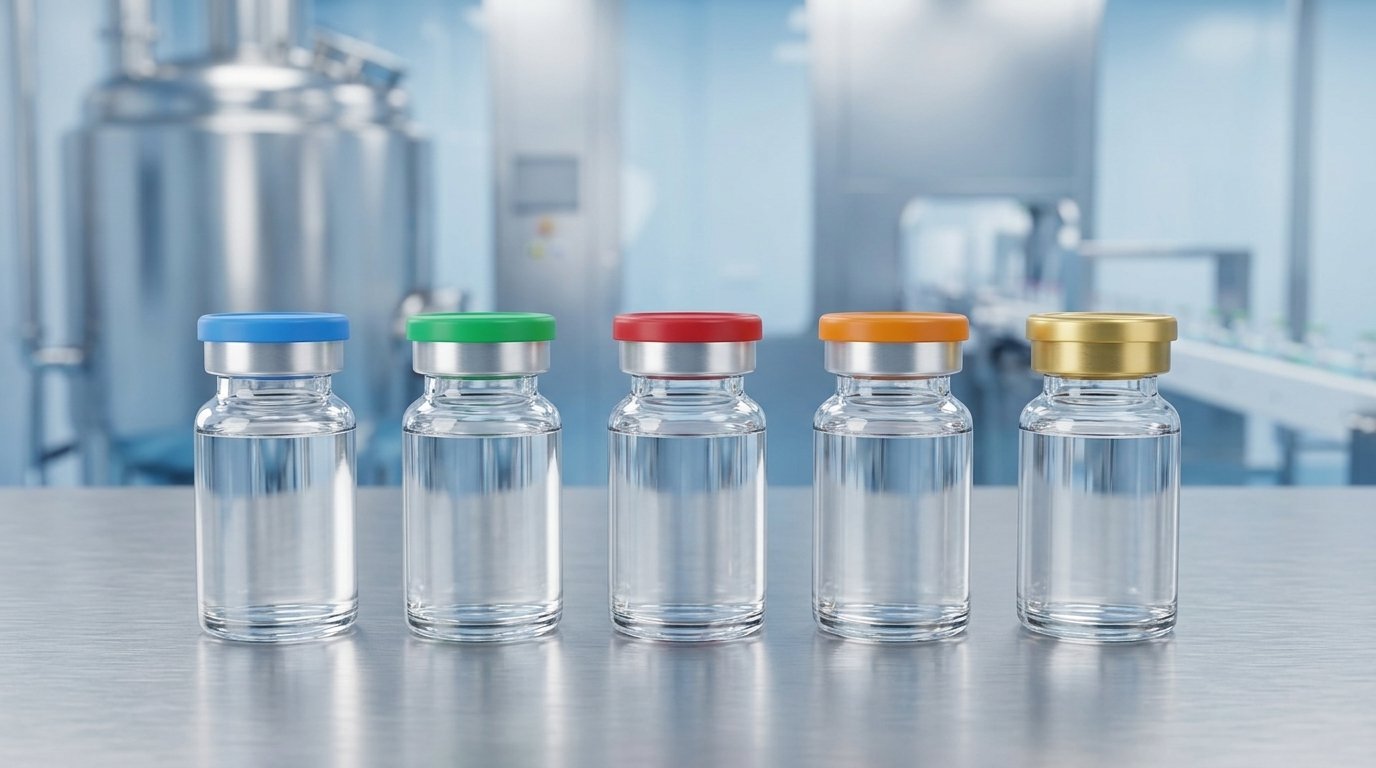
This is the index of Autofits’ 15 application pages: each drug type, what its closure has to do, and the seal design and size it needs. Most injectables take a FlipTop Optima flip-off seal in 13 or 20 mm; the exceptions are driven by the product. Oral vaccines and some veterinary products need a tear-down seal that comes off whole, large-volume contrast media needs a 32 mm pull-ring seal that exposes the whole stopper for spiking, and cryogenic cell therapies need a small seal whose crimp holds at vapour-phase liquid nitrogen temperatures.
Find your drug type in the index below and follow the link to its page. If you already know the seal you want, the product-first routes are listed further down this page.
Key takeaways
- Fifteen application pages, grouped into biologics and advanced therapies, sterile injectables in volume, specialty and high-risk fills, and diagnostics, reagents and animal health.
- The FlipTop Optima flip-off seal is the default for liquid and freeze-dried injectables, in 13 and 20 mm for most products and up to 34 mm for large multidose vials.
- Some applications need the whole seal to come off: oral vaccines and oral veterinary dosing take the FlipTop Tear-Down; contrast media and some oncology presentations take the FlipTop Pull Ring.
- Tamper evidence matters most for vaccines, oncology and emergency drugs. The Optima Button design carries it through a 12-stem flower moulded under the disc; the Pull Ring and Tear-Down show it by leaving the neck bare.
- Colour coding carries weight in anaesthetics, emergency drugs, diagnostics and research reagents, where many look-alike vials sit side by side.
- The same standards cut across every application: ISO 8362-6 for the cap, ISO 15378 for the quality system, USP <1207> for integrity and EU GMP Annex 1 for aseptic filling.
The application index
Every application page on the site, with the drug type it covers, the job the closure has to do for that product, and the seal and size it needs. Sizes are the neck finishes each page names as typical; confirm against your own vial drawing.
Biologics, vaccines and advanced therapies
High-value fills where material compliance and container closure integrity across shelf life set the specification.
| Application page | Drug type | What the closure has to do | Seal it needs | Typical sizes |
|---|---|---|---|---|
| Biologics | Monoclonal antibodies, recombinant proteins and other protein injectables | Demonstrable integrity across shelf life, low extractables contribution, compliant materials on a high-value fill | FlipTop Optima flip-off; Pull Ring where the whole seal must come off | 13 and 20 mm |
| Vaccines | Injectable multidose and single-dose vaccines; oral vaccines | Fast repeated access, tamper evidence, colour coding, a crimp that holds through the cold chain; full removal for oral doses | FlipTop Optima, Button design for tamper evidence; FlipTop Tear-Down for oral vaccines | 13 and 20 mm |
| Lyophilised products | Freeze-dried powders reconstituted before use | A clean crimp over a stopper seated in the freeze-dryer, integrity over a hygroscopic cake | FlipTop Optima, as lyophilization vial seals | 13 and 20 mm; 28, 32 and 34 mm for larger freeze-dry vials |
| Cell and gene therapy | Cryopreserved cell products and viral-vector gene therapies | Integrity at or below -150 °C in vapour-phase liquid nitrogen, or -60 °C to -80 °C, through freeze-thaw; full documentation for single-patient batches | FlipTop Optima, Button design, Ready-to-Use | 13 and 20 mm |
Sterile injectables in volume
Products where line economics, repeated access and the sterilisation route shape the choice.
| Application page | Drug type | What the closure has to do | Seal it needs | Typical sizes |
|---|---|---|---|---|
| IV diluents and saline | Sterile water, saline and diluents for reconstitution | Survive terminal sterilisation, run at high line speed, reseal on multidose use | FlipTop Optima | 13, 20, 28, 32 and 34 mm |
| Anaesthetics | Local and general anaesthetic injectables | Fast single-handed opening, colour coding for safe identification, multidose access | FlipTop Optima, Button design; FlipTop Tear-Down where the whole seal comes off | 20 mm, 13 mm for small presentations |
| Insulin and hormones | Insulin and hormone vials used over an extended in-use period | Repeated puncture, a stable crimp over weeks of use, tamper evidence | FlipTop Optima, Button design | 13 and 20 mm |
| Emergency and crash-cart drugs | Resuscitation and emergency injectables stocked on trolleys | Single-handed opening in seconds, clear colour differences between strengths, tamper evidence on stocked trays, long unattended shelf life | FlipTop Optima, Button design, colour coded; see tamper evident vial seals | 13 and 20 mm |
Specialty and high-risk fills
Applications where the closure carries a safety or handling burden on top of the sterile barrier.
| Application page | Drug type | What the closure has to do | Seal it needs | Typical sizes |
|---|---|---|---|---|
| Oncology and cytotoxic | Cytotoxic and other hazardous injectables, often reconstituted powders | Controlled opening that avoids spills and aerosols, irreversible tamper evidence, integrity after reconstitution | FlipTop Pull Ring for whole-seal removal; FlipTop Optima for a retained injection point | Pull Ring 20 and 32 mm; Optima 20 and 28 mm |
| Ophthalmic | Sterile eye preparations in small vials | Integrity on a small neck with little crimp margin, low particulate contribution, tamper evidence | FlipTop Optima, Button design | 13 mm, 20 mm for larger presentations |
| Contrast media | Iodinated CT agents and gadolinium MRI agents | Full stopper access for power-injector spiking, large fill volumes, warming before use | FlipTop Pull Ring | 32 mm |
| Prefilled syringes and kits | Syringe presentations packed with a drug or diluent vial | On the vial in the kit: integrity over shelf life and colour separation between kit components | FlipTop Optima on the vial component | 13 and 20 mm |
Diagnostics, reagents and animal health
A different regulatory pathway, but identification and handling still drive the choice.
| Application page | Drug type | What the closure has to do | Seal it needs | Typical sizes |
|---|---|---|---|---|
| Diagnostics and IVD reagents | In vitro diagnostic reagents run in parallel panels | Colour coding across many reagents, a broad size range, full removal for some reagents | FlipTop Optima; FlipTop Tear-Down or Pull Ring for full removal | 13 to 34 mm |
| Research and lab reagents | Research-use-only reagents, buffers and media | Freezer storage and freeze-thaw duty, fast identification in a rack of identical vials | FlipTop Optima, coloured, printed or embossed; all-aluminium tear-off seals | 13 mm, 20 mm for bulk buffers |
| Veterinary | Animal health injectables and oral dosing lines | Multidose access on large vials, field handling, the full neck range, full removal for oral dosing | FlipTop Optima; FlipTop Tear-Down for oral veterinary dosing; see serum vial seals | 13, 20, 28, 32 and 34 mm |
How vial-seal selection varies by application
Every injectable vial seal does the same core job, crimping an aluminium skirt under the neck flange to hold the rubber stopper against the glass; what changes between applications is the set of requirements layered on top of that barrier. Five of those requirements account for nearly every difference in the index.
| Requirement | Where it dominates | What it points to |
|---|---|---|
| Container closure integrity across shelf life | Biologics, lyophilised products, cell and gene therapy, ophthalmic | Tight dimensional tolerances, a matched stopper and neck, integrity testing to USP <1207> |
| Tamper evidence | Vaccines, oncology, emergency drugs, insulin | The Optima Button design, or a Pull Ring or Tear-Down that leaves the neck visibly bare |
| Opening action | Oral vaccines, oral veterinary dosing, contrast media, oncology | Tear-Down (twist anticlockwise) or Pull Ring (pull and open) instead of a flip-off button |
| Identification | Anaesthetics, emergency drugs, diagnostics, research reagents | Disc colour, printing or embossing, remembering that colour is not standardised across manufacturers |
| Sterility and delivery form | Aseptic fills: biologics, ophthalmic, insulin, cell and gene therapy | Ready-to-Use seals (gamma or ETO sterilized, double-bagged) or Ready-to-Sterilize |
A multidose vaccine needs a closure the user can open quickly and identify by colour, plus tamper evidence so a punctured or opened vial is obvious. A biologic is high in value and sensitive to extractables and leachables, so the priority shifts to material compliance and demonstrable container closure integrity across the shelf life. A lyophilised product is capped after freeze-drying, over a stopper pressed home inside the chamber, so machinability and a clean, consistent crimp matter most. A cytotoxic oncology fill demands a well-defined tamper-evident seal because any breach has occupational-safety consequences as well as sterility ones.
The mechanics also differ. Most applications want a flip-off button that exposes only a small injection point while the aluminium stays crimped. Some, such as oral vaccinations or products where the whole seal must come off for full access, call for a tear-down or pull-ring design instead. Cold-chain and cryogenic products add a further constraint: the closure has to keep its seal through freezing and thawing without the crimp loosening, which is covered on the cold-chain vial closure page.
Finding a seal by product rather than by drug type
If you already know the seal you want, go straight to the product pages; the application pages above are for when you know the drug and need the seal. The product-first routes are:
- By design: FlipTop Optima flip-off, FlipTop Pull Ring, FlipTop Tear-Down, all-aluminium tear-off and tear-down seals, and aluminium-plastic combi seals as a family.
- By neck size: the seals by size index lists every design available at 13, 20, 28, 32 and 34 mm; most injectables take 20 mm and small-volume fills 13 mm.
- For the whole closure system, stopper, seal and vial neck specified together: vial closures.
- For the whole sealing range on one page, every seal type, size and delivery form: pharmaceutical sealing solutions.
- For bottled oral liquids rather than vials: aluminium pilfer-proof (ROPP) caps.
If you are choosing between formats rather than by drug type, the read-outs on single-dose versus multi-dose vials and 13 mm versus 20 mm caps cover the two decisions that come up most often, and how to choose a vial cap size works through matching the seal to the vial neck finish.
A note on standards
Whatever the application, the same closure standards apply, and the application pages note only where one carries extra weight. Autofits aluminium-plastic seals are designed to ISO 8362-6, the standard for caps made of aluminium-plastics combinations for injection vials, with vial necks following ISO 8362-1; all-aluminium seals relate to ISO 8362-3. Production runs under ISO 15378:2017, the GMP standard for primary packaging materials. For the sterile barrier itself, container closure integrity is evaluated against USP <1207>, and aseptic-filling expectations, including capping and inspection, are set by EU GMP Annex 1.
Some standards sit slightly outside that common set and matter to specific fills: USP <788> particulate matter for injectables where particle limits are a defining constraint, such as oncology products, its companion USP <789> for ophthalmic solutions, and BSE and TSE compliance where animal-derived materials are in scope, which is a live question for veterinary lines.
How this works in practice at Autofits
Every application in the index is served from one range made in one facility: FlipTop Optima, Pull Ring and Tear-Down aluminium-plastic seals, all-aluminium tear-off and tear-down seals, and aluminium pilfer-proof caps, produced at a 75,000 sq ft site in Nashik, India, under ISO 9001:2015, ISO 14001:2015 and ISO 15378:2017 with a Drug Master File (DMF 18100). What changes by application is the specification: size, top design, colour and finish, and the delivery form, Regular, Ready-to-Sterilize or Ready-to-Use. Seals are assembled in an ISO Class 8 cleanroom and every one passes 100% high-speed camera inspection, released against AQL critical nil, major not more than 2.5% and minor not more than 4%. To match a seal to a product, send the drug type, the vial neck finish, the stopper, the opening action you need and the delivery form through the contact page.
Frequently asked questions
Why does the drug product affect which vial seal I choose?
The seal always forms the sterile barrier the same way, by crimping the aluminium skirt to hold the stopper against the glass. The product decides the requirements on top of that: a multidose vaccine needs fast opening and tamper evidence, a biologic needs material compliance and proven container closure integrity, a lyophilised product needs a clean crimp over a stopper seated in the freeze-dryer, and contrast media needs full stopper access for spiking.
What is the default seal for most injectable applications?
For most liquid and freeze-dried injectables the FlipTop Optima flip-off seal in 13 mm or 20 mm is the default. The user flips off the plastic disc to expose a central injection point while the aluminium stays crimped. Oral vaccines and oral veterinary products point to the FlipTop Tear-Down, and contrast media and some oncology products to the FlipTop Pull Ring, because those need the whole seal to come off.
Which seal sizes are most common?
The 20 mm neck is the highest-volume size for injectable vials, and 13 mm is common for smaller-volume products such as some vaccines, biologics, ophthalmics and research reagents. Diluents, veterinary products and large multidose vials use 28, 32 and 34 mm, and large-volume contrast media works on 32 mm. Match the seal to the vial finish and the stopper of the same nominal diameter.
Which applications need a seal that comes off completely?
Oral vaccines and oral veterinary dosing, where the dose is taken from the open vial rather than through the stopper, take the FlipTop Tear-Down, which is twisted anticlockwise to remove the whole seal. Large-volume contrast media and some oncology products take the FlipTop Pull Ring, which lifts away to expose the whole stopper for a spike or a controlled opening. Some diagnostic reagents use either.
Do all these applications use the same standards?
Yes, broadly. ISO 8362-6 governs the aluminium-plastic cap design, ISO 15378 governs the GMP quality system, and USP <1207> with EU GMP Annex 1 cover container closure integrity and aseptic expectations. Particulate limits carry extra weight for oncology injectables under USP <788> and for ophthalmic solutions under USP <789>, and BSE and TSE declarations for veterinary lines.
Where can I see seals for a specific application?
Every drug type in the index has its own page, linked from its row, setting out what the closure has to do for that product and the seal sizes that fit. For a product-first view, start from the FlipTop Optima range or the seals by size index, or send the fill and the neck finish through the contact page for a specification.
Related reading
- Vial seals for biologics
- Multidose vaccine vial seals
- FlipTop Optima flip-off seals
- Vial seals by neck size
- Lyophilization vial seals
- Single-dose vs multi-dose vial closures
- ISO 8362-6: aluminium-plastics combination caps
- ISO 15378: GMP for primary packaging
Sources
- Autofits FlipTop Seals dossier and engineering drawings
- ISO: ISO 8362-6:2010, Injection containers and accessories, Part 6: Caps made of aluminium-plastics combinations for injection vials (https://www.iso.org/standard/52806.html)
- ISO: ISO 15378:2017, Primary packaging materials for medicinal products, GMP requirements (https://www.iso.org/standard/70729.html)
- USP-NF: General Chapter <1207>, Package Integrity Evaluation, Sterile Products (https://www.usp.org/)
- USP-NF: General Chapters <788>, Particulate Matter in Injections, and <789>, Particulate Matter in Ophthalmic Solutions (https://www.usp.org/)
- European Commission: EudraLex Volume 4, EU GMP Annex 1, Manufacture of Sterile Medicinal Products (https://health.ec.europa.eu/medicinal-products/eudralex/eudralex-volume-4_en)
*Last updated: 2026-09-15. This page is general technical information, not regulatory or compliance advice; confirm current standard editions and your own specification with Autofits and the issuing bodies.*
