
Learn: How Pharmaceutical Vial Seals Work, Are Made and Are Opened
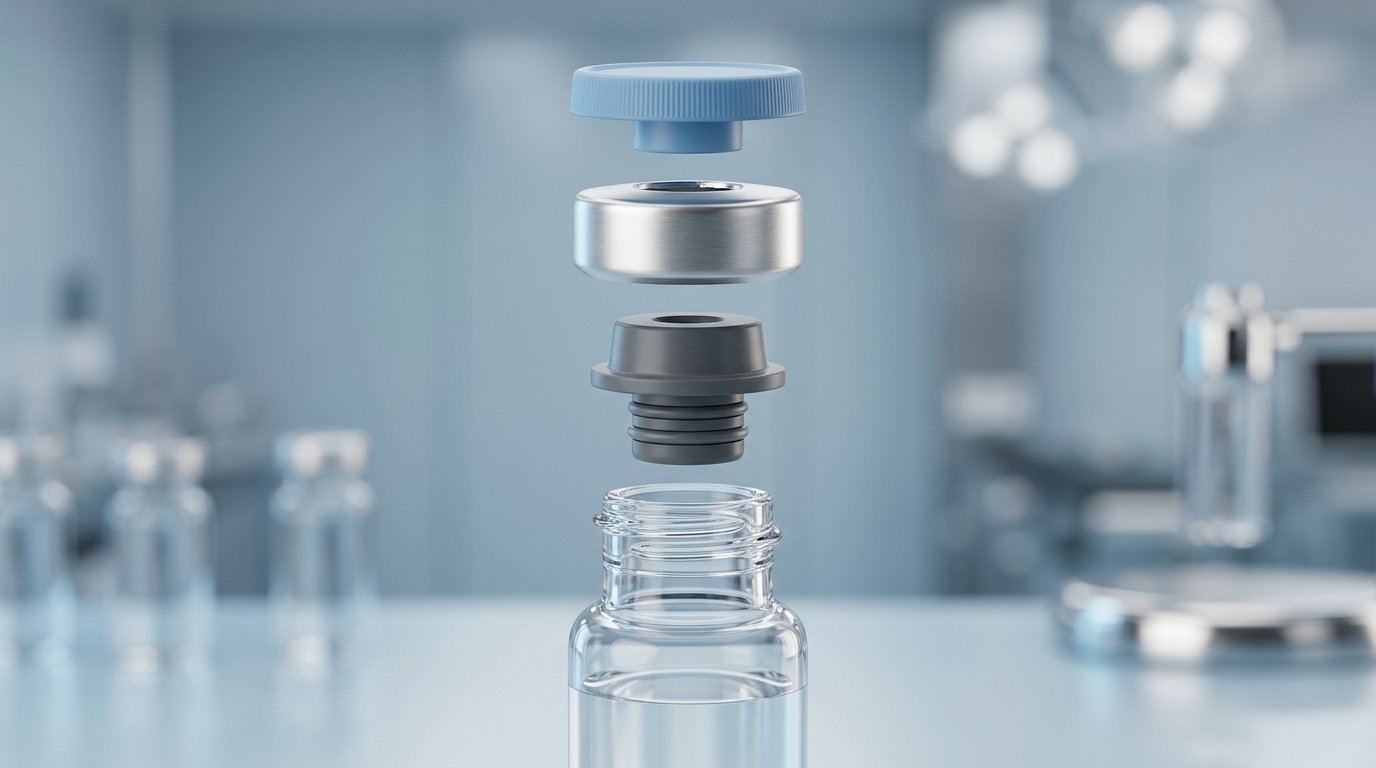
This section explains how pharmaceutical vial seals and closures work, how they are manufactured, and how to open them safely. The guides are written for packaging and fill-finish engineers, QA and regulatory teams, and the clinical and laboratory users who handle sealed vials every day. Start with how a seal is built and made, then move to the practical opening guides.
How seals work and are made
- How flip-off caps work breaks down the anatomy of a flip-off seal: the aluminium shell crimped over the stopper, the plastic flip button, and how the design delivers tamper evidence and container closure integrity.
- How aluminium-plastic seals are manufactured walks the process from aluminium coil through forming, plastic moulding, cleanroom assembly, and high-speed visual inspection.
- Aluminium grades used in vial caps covers the alloys (1050, 1060, 1070, 8011, 3105), the temper suffixes, and the strip gauge, and what each one changes in the formed seal.
- The vial sealing process explained is the step-by-step account of how a vial is filled, stoppered, and sealed on a capping line.
- Vial crimping explained covers how the aluminium skirt is crimped under the vial neck to compress the stopper and form the seal.
- Sterile vial sealing explains how injectable vials are sealed under aseptic conditions so the product stays sterile until use.
- Vial seal design and filling speed explains how closure geometry and dimensional consistency affect capping-line throughput and reject rates on a fill-finish line.
- Vial sealing machine types compares hand crimpers, bench-top semi-automatic units, automatic turret cappers, and inline rotary cappers, and the scale each one suits.
- Automated vial capping systems goes inside the machine: inline versus rotary architecture, the three crimping head families, servo capping-force control, residual seal force, and what really limits throughput.
- The vial fill-finish process, end to end walks component preparation, filtration, filling, stoppering, capping, inspection, and release, and shows where the closure system fits.
Choosing and specifying a seal
- How to choose a vial cap size shows how to match the seal size (13, 20, 28, 32, or 34 mm) to the vial neck finish and the stopper.
- Vial closure supplier selection is the buyer’s guide to qualifying a seal supplier on certifications, quality system, inspection, and documentation.
- Custom vial seal manufacturing explains what can be customised, colour, printing, finish, size, and delivery form, and within what limits.
- Aluminium cap finish types separates the three senses of “finish”: the six opening styles, the lacquer, colour, print and emboss options on the surface, and the vial neck the cap has to fit.
- Seal colour coding in pharma covers how flip-off cap colours are used for product identification and how house and customer schemes work.
- Vial neck types and sizes under ISO 8362 maps the standard vial neck finishes so the seal, stopper, and vial match.
- Pairing the rubber stopper and aluminium seal explains how the stopper and seal work together as a closure system.
- Vial closure rubber types compares butyl, bromobutyl, chlorobutyl, EPDM, silicone, and polyisoprene on barrier and temperature behaviour, and how to choose between them.
- cGMP for vial closure suppliers sets out how the GMP obligation flows down to a packaging supplier, what must be qualified, how change control works, and which documents to demand.
- Vial seal batch traceability explains what a seal lot is, the records that link an aluminium coil to a packed carton, and what ISO 15378 and 21 CFR Part 211 require on each side.
Integrity, safety, and the cold chain
- Vial closure integrity explains what closure integrity means, why the crimp matters, and how it is tested.
- Tamper-evident vial closures covers how a seal shows it has been opened, and the intrinsic tamper evidence of the Button design.
- Vial closure for cold-chain drugs explains how a mechanical aluminium crimp holds through freezing, transport, and thawing.
- E&L testing for vial closures covers how an extractables and leachables programme is scoped, which extraction conditions and analytical methods are used, what the acceptance thresholds mean, and when to re-test.
What the terms mean
- What is a flip-off seal? defines the flip-off seal and where it is used.
- What is a pilfer-proof cap? defines the ROPP aluminium cap and its tamper-evident action.
- What is a tear-off seal? defines the all-aluminium tear-off seal.
How to open a sealed vial
- How to open a vial with a metal cap is the step-by-step guide to opening a flip-off sealed vial, including why the aluminium skirt stays crimped on.
- How to remove a metal vial cap without a tool covers safe full-seal removal and when it is, and is not, necessary.
- How to open a vial cap helps you identify your seal type, flip-off, tear-off, pull-ring, tear-down, or pilfer-proof, and open each one correctly.
How Autofits fits in
Autofits manufactures aluminium-plastic FlipTop® seals, tear-off and tear-down aluminium seals, and aluminium pilfer-proof (ROPP) caps in sizes from 13 to 32 mm, under an ISO 15378:2017 quality system in a 75,000 sq ft Nashik facility with an ISO Class 8 cleanroom and high-speed visual inspection.
Explore the rest of the knowledge base: the packaging standards, the glossary of sealing terms, and the seal comparisons. If you are matching a closure to a particular drug type, the applications section covers vaccines, biologics, oncology, ophthalmic and veterinary presentations. To see the closures themselves, browse the full product range.
