
Vial Closure: Definition, Components, and How It Seals a Vial
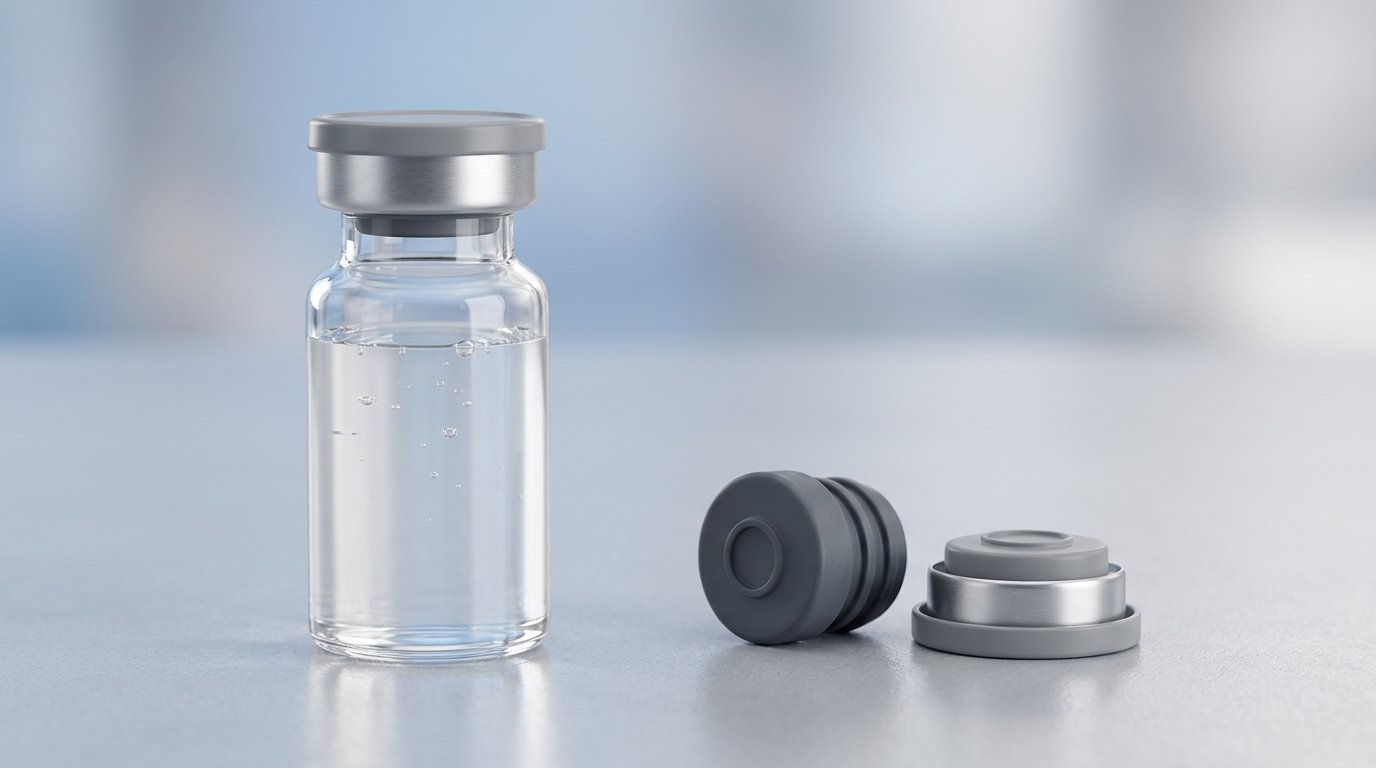
A vial closure is the assembly that seals a pharmaceutical vial: an elastomeric (rubber) stopper that sits in the vial mouth, plus an aluminium or aluminium-plastic seal crimped over it to hold the stopper in place. Together with the vial itself, the closure forms the container closure system that keeps the contents sterile and protected for the product’s shelf life. The stopper provides the resealable barrier a needle passes through; the crimped seal keeps the stopper compressed against the glass so the barrier holds.
This page defines a vial closure, lists its components, explains the common types, and describes how the closure maintains the sterile barrier.
Key takeaways
- A vial closure is the stopper-plus-seal system that closes an injectable vial; the term sometimes refers to the whole closure or just the rubber stopper, depending on context.
- The two functional parts are the elastomeric stopper (the resealing barrier) and the aluminium or aluminium-plastic seal crimped over it.
- The stopper, the seal, and the glass vial together make up the container closure system.
- The closure keeps the package sealed: the stopper presses against the glass, and the crimped seal holds that compression.
- Closure materials and functional performance are governed by standards such as USP <381>, USP <382>, and the ISO 8362 series.
- The closure type (flip-off, tear-off, tear-down, or pull-ring) describes the seal that finishes the assembly and how it is opened.
What is a vial closure?
A vial closure is the set of components that closes the open mouth of a pharmaceutical vial and maintains its seal. In its fullest sense it is the rubber stopper together with the metal or metal-plastic seal crimped over it. In casual use, “closure” sometimes means just the elastomeric stopper, because the stopper is the part that forms the resealable barrier and that pharmacopoeial chapters on closures specifically address.
The closure does two jobs at once. It has to keep the sterile contents in and contamination out for the whole shelf life, and it has to allow a needle to be inserted (and, for multiple-dose products, re-inserted) to withdraw or deliver the drug. Those two requirements, a permanent barrier and a piercable access point, are why a vial is closed with a soft rubber stopper held under a rigid crimped seal rather than a simple screw cap. How often that stopper is pierced is itself a format decision, set out in single-dose versus multi-dose vials.
The components of a vial closure
A vial closure has two functional components: the elastomeric stopper and the seal crimped over it. Each has a distinct role.
- The elastomeric stopper. A moulded rubber plug that seats in the vial mouth. It is the resealable barrier the needle pierces and the surface that reseals when the needle is withdrawn. Stoppers are commonly made from butyl rubber, chosen for its low gas and moisture permeability. The stopper is an elastomeric closure, and its material and functional requirements sit under USP <381> and USP <382>.
- The seal. A formed aluminium cap (sometimes combined with a moulded plastic top) that is crimped around the vial neck over the stopper. The crimp holds the stopper compressed against the glass so it cannot back out and the barrier stays under load. On a flip-off seal, a plastic button on top flips away to expose the injection point while the aluminium stays crimped.
The glass vial is the third element of the overall system, but the closure proper is the stopper and the seal that secure it. How the aluminium crimp clamps the stopper to the glass is described in how flip-off caps work.
Types of vial closure
Vial closures are usually named by the seal that finishes the assembly and by how that seal opens. The stopper underneath works the same way in each; the seal type determines the opening action and the tamper-evidence behaviour.
| Closure type | Seal construction | Opening action |
|---|---|---|
| Flip-off seal | Aluminium shell plus plastic flip button | Flip the plastic button; aluminium stays crimped |
| Tear-off seal | All-aluminium with a pull tab | Tear the whole aluminium top off |
| Tear-down seal | Aluminium with a tear-down section | Tear down a section to expose the stopper |
| Pull-ring seal | Aluminium-plastic with a pull ring | Pull the ring to remove the top |
These are compared in detail under flip-off versus tear-off seals and pull-ring versus tear-down seals. For freeze-dried (lyophilised) products, a special slotted stopper is used so vapour can escape during drying before the stopper is fully seated, a design covered by ISO 8362-5. The products that need it are covered under lyophilised vial closures.
How a vial closure keeps the package sealed
The seal of a vial comes from the stopper compressed against the glass, held there by the crimped aluminium. When the seal is crimped at the end of the filling line, its lower edge is rolled under the vial neck flange, pressing the stopper down so its sealing surfaces stay in contact with the glass. That compression is what maintains the sterile barrier, not the plastic button or the visible cap.
The closure’s ability to keep contents in and contamination out is called container closure integrity (CCI). Regulators treat CCI as part of sterility assurance for injectable products: EU GMP Annex 1 expects sealed vials to be inspected and capping to be controlled, the framework for evaluating package integrity is set out in USP <1207>, and the leak-test methods that confirm a vial stays sealed are covered under container closure integrity testing. A correctly applied closure is what those tests are verifying.
How this works in practice at Autofits
Autofits manufactures the aluminium and aluminium-plastic seals that complete a vial closure: FlipTop Optima flip-off seals, tear-off and tear-down aluminium seals, FlipTop Pull Ring seals, and aluminium pilfer-proof (ROPP) caps, in 13, 20, and 32 mm sizes. The full range is on the products page. The seal crimps over the rubber stopper and the vial neck, holding the stopper in compression so it can maintain its seal between needle penetrations. Production runs under an ISO 15378:2017 quality system (alongside ISO 9001:2015 and ISO 14001:2015 certification and a Drug Master File) in a 75,000 sq ft Nashik facility with an ISO Class 8 cleanroom and high-speed visual inspection on the closure lines. Dimensional consistency in the seal supports reliable crimping, which is part of how the assembled closure preserves package integrity. The full certification set is on the quality page.
Frequently asked questions
What is a vial closure?
A vial closure is the assembly that seals a pharmaceutical vial: an elastomeric (rubber) stopper that seats in the vial mouth, plus an aluminium or aluminium-plastic seal crimped over it to hold the stopper in place. The stopper forms the resealable barrier a needle passes through, and the crimped seal keeps the stopper compressed against the glass so the barrier holds. Sometimes “closure” is used to mean just the rubber stopper.
What are the parts of a vial closure?
A vial closure has two functional parts: the elastomeric stopper, which is the rubber plug that seals the vial mouth and reseals after a needle is withdrawn, and the seal, which is the formed aluminium (or aluminium-plastic) cap crimped over the stopper and around the vial neck. The glass vial is the third element of the wider container closure system.
What is the difference between a vial stopper and a vial seal?
The stopper is the rubber plug inside the vial mouth that the needle pierces and that reseals afterwards. The seal is the metal or metal-plastic cap crimped over the stopper to hold it down against the glass. The stopper forms the barrier; the seal keeps that barrier under compression and provides tamper evidence.
What standards apply to vial closures?
The elastomeric stopper’s material requirements sit under USP <381>, and its functional suitability under USP <382>. Dimensions and requirements for closures and aluminium-plastic caps are covered by the ISO 8362 series. Container closure integrity, the property the whole closure maintains, is addressed by USP <1207> and the sterile-manufacturing expectations of EU GMP Annex 1.
How does a vial closure stay sealed?
The seal stays closed because the rubber stopper is compressed against the glass vial mouth and held there by the crimped aluminium skirt rolled under the vial neck flange. That compression keeps the stopper’s sealing surfaces in contact with the glass, maintaining the sterile barrier for the product’s shelf life. Container closure integrity testing confirms there is no leak path.
Related reading
- Elastomeric closure: definition
- Container closure system: definition
- Flip-off seal: definition and how it works
- How flip-off caps work
- ISO 8362-2: closures for injection vials
- FlipTop Optima seal range
Sources
- USP-NF: General Chapters <381> Elastomeric Components in Injectable Pharmaceutical Product Packaging/Delivery Systems and <382> Elastomeric Component Functional Suitability (https://www.usp.org/)
- USP-NF: General Chapter <1207>, Package Integrity Evaluation, Sterile Products (https://www.usp.org/)
- ISO: ISO 8362-2:2024, Injection containers and accessories, Part 2: Closures for injection vials (https://www.iso.org/standard/87251.html)
- European Commission: EudraLex Volume 4, EU GMP Annex 1, Manufacture of Sterile Medicinal Products (https://health.ec.europa.eu/medicinal-products/eudralex/eudralex-volume-4_en)
*Last updated: 2026-06-18. This article is general technical information, not regulatory or compliance advice; confirm current standard editions and requirements with the issuing bodies.*
