
Combi Seals Made in India: Aluminium-Plastic Combination Caps
Autofits makes combi seals for injection vials at its plant in Nashik, India, in 13, 20, 28, 32 and 34 mm. A combi seal is an aluminium-plastic combination cap: a deep-drawn aluminium shell crimps under the vial neck flange over the rubber stopper, and a moulded polypropylene top on it gives the opening action. ISO 8362-6 is the standard for these closures and titles them caps made of aluminium-plastics combinations, which is where “combination seal” and the shop-floor short form “combi seal” come from. Autofits builds them in three designs: FlipTop® Optima flip-off, Pull-Ring and Tear-Down.

Key takeaways
- A combi seal is an aluminium-plastic combination cap: aluminium does the crimp and holds the barrier, polypropylene does the opening.
- The family standard is ISO 8362-6; ISO 8362-7 covers the variant without an overlapping plastics part.
- Autofits makes combi seals as Optima flip-off (13 to 34 mm), Pull-Ring (20 and 32 mm) and Tear-Down (13, 20 and 32 mm).
- Aluminium is AA8011 at 0.16 to 0.26 mm depending on size; the top is polypropylene moulded in-house on Japanese Toyo machines.
- Maximum opening force is 30 N at 13 mm, 35 N at 20 and 28 mm, 65 N at 32 mm, varying with the number of bridges.
- Supplied regular, ready to use or ready to sterilise, glossy, matte, embossed or printed.
The Autofits combi seal range
| Design | Plastic top | How it opens | Sizes |
|---|---|---|---|
| FlipTop® Optima | PP button disc, in bridge, button or flower design | Flip the button up to expose a central injection point; the aluminium stays crimped | 13, 20, 28, 32, 34 mm |
| FlipTop® Pull-Ring | PP disc with an aluminium pull ring | Pull the ring and open anticlockwise; the whole seal detaches once the PP disc is detached | 20 mm (bridge), 32 mm (flower) |
| FlipTop® Tear-Down | PP disc riveted to the aluminium | Open the disc, then pull and rotate it anticlockwise so the whole seal comes off | 13, 20, 32 mm |
The Optima is the general-purpose combi seal for injectables and the only design made across the full size range. Pull-Ring seals are often marked for oral use, and Tear-Down is used mainly for oral vaccines. All three are sold together as the FlipTop® flip-off seal range.
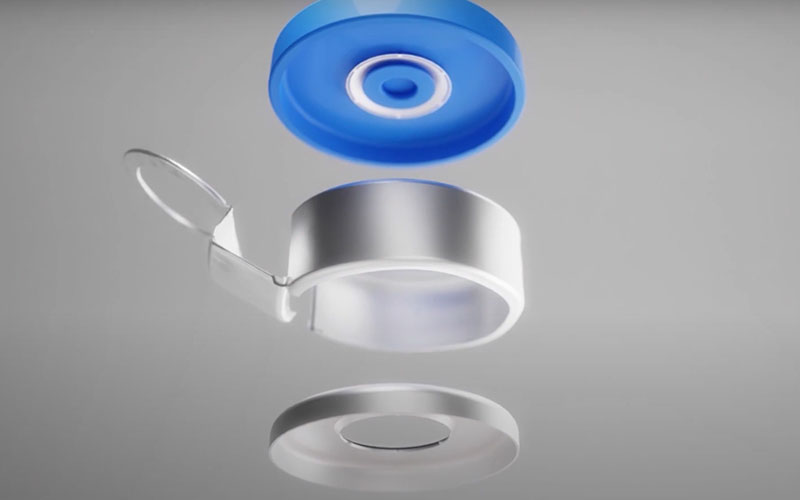
What is a combi seal?
A combi seal is a vial closure built from two materials doing different jobs: an aluminium shell crimped over the rubber stopper to hold the sterile barrier, and a moulded plastic top that gives the user a clean, controlled way to open the vial. The alternative is an all-aluminium seal, which does the crimp but has no plastic part and is opened by tearing the metal.
The aluminium half is the structural part: deep-drawn, lacquered, then rolled under the vial neck flange during capping so the stopper stays compressed against the glass for the shelf life of the product. The plastic half is the interface. Polypropylene can be moulded to a shape and a break point that aluminium cannot hold, which is what makes a flip button, a pull ring or a twist-off disc possible, and it takes pigment and print far better than lacquered metal. The trade-off between the two constructions is set out in aluminium-plastic seal versus aluminium seal.
Why the two materials are combined
The crimp and the opening action need different materials, and splitting them into two parts lets each be made for its job. A closure that has to roll under a glass flange without cracking wants a soft, ductile metal. A closure that has to snap open at a designed point, the same way across a batch, wants a mouldable polymer with a predictable break.
- Controlled access. A flip-off button exposes a small central injection point while the aluminium stays crimped, so a multi-dose vial can be entered repeatedly without loosening the closure. A tear-down or pull-ring top removes the whole closure instead.
- Colour and marking. The plastic top holds pigment, embossing and print cleanly, which is how sites tell strengths apart on the line. See the colour and marking page.
- Tamper evidence at a designed break point. The Optima button design carries intrinsic tamper evidence through a 12-stem flower moulded under the button disc.
ISO 8362-6 and where combi seals sit
ISO 8362-6 is the part of the ISO 8362 series that covers caps made of aluminium-plastics combinations for injection vials, so it is the direct standard for combi seals.
- ISO 8362-1: injection vials made of glass tubing, which sets the neck finish a combi seal has to match.
- ISO 8362-3: aluminium caps for injection vials, the all-aluminium family.
- ISO 8362-6: the combi seal family, where the plastic part overlaps the aluminium.
- ISO 8362-7: combination caps without an overlapping plastics part.
Autofits makes its combination seals to ISO 8362-6 under an ISO 15378:2017 quality system for primary packaging materials.
Specifications and sizing
From the Autofits engineering drawings. All dimensions in millimetres. Values not carried on a drawing are confirmed with the quotation.
| Design and size | Inner Ø alu (D1) | Outer Ø disc (D2) | Disc height | Total height | Alu thickness | Bridges or fins |
|---|---|---|---|---|---|---|
| Optima 13 mm | 13.36 min | 14.99 max | 2.90 to 3.30 | 7.62 to 8.38 | 0.16 to 0.20 | 6 taper |
| Optima 20 mm | 20.22 min | 23.14 max | 3.20 to 3.60 | 9.02 to 9.91 | 0.16 to 0.20 | 6 taper |
| Optima 28 mm | 27.60 to 28.20 | 30.10 to 31.10 | On drawing request | 11.06 to 12.06 | 0.17 to 0.23 | 8 |
| Optima 32 mm | 32.10 to 32.90 | 35.50 to 36.50 | On drawing request | 14.30 to 15.50 | 0.21 to 0.25 | 12 taper |
| Optima 34 mm | 33.60 to 34.00 | 35.50 to 36.50 | On drawing request | 15.00 to 16.00 | 0.20 to 0.25 | 8 taper |
| Pull-Ring 20 mm | 20.00 to 20.60 | 22.00 to 23.00 | 3.00 to 4.00 | 9.00 to 10.00 | 0.18 to 0.22 | 6 taper bridges |
| Pull-Ring 32 mm | 32.15 to 32.40 | 36.20 to 36.60 | On drawing request | 14.30 to 15.30 | 0.20 to 0.26 | 8 fins (flower) |
| Tear-Down 13 mm | 13.30 to 13.50 | 14.80 to 15.40 | 3.70 to 4.10 | 6.80 to 8.30 | 0.18 to 0.22 | Bridge |
| Tear-Down 20 mm | 20.00 to 20.60 | 22.00 to 23.00 | 3.00 to 4.00 | 8.80 to 9.80 | On drawing request | Bridge |
| Tear-Down 32 mm | 32.40 to 33.15 | 35.70 to 36.70 | On drawing request | 14.30 to 15.30 | 0.20 to 0.26 | 8 fins |
Maximum opening force is 30 N at 13 mm, 35 N at 20 and 28 mm and 65 N at 32 mm. Standard packing per 420 x 270 x 320 mm box is 15,000 at 13 mm (5,000 x 3 bags), 6,000 at 20 mm (2,000 x 2), 3,000 at 28 mm (1,500 x 2) and 1,400 at 32 mm (700 x 2). Per-size detail is on the 13 mm, 20 mm, 28 mm, 32 mm and 34 mm pages.

Materials and finishes
The aluminium is alloy AA8011 to EN 15088:2005, supplied with EN 10204 3.1 certification and tested to BS EN 485-2:2008, REACH and RoHS compliant, coated with an epoxy lacquer to 21 CFR 175.300 which may be pigmented for colour. The plastic top is polypropylene to IS 10910 and IS 10909, FDA 21 CFR 177.1520 for olefin polymers and EC 1895/2005, with BADGE, NOGE and BFDGE not used. Heavy metals (chrome-VI, cadmium, mercury, lead) are limited to 100 ppm in total to EN 602 and EC 94/62, and components are BSE/TSE-free to EMEA/410/01 rev. 3.
Finishes are glossy, matte, embossed or printed, in a wide range of colours customised to requirement; aluminium cap finish types covers what each does on the line.
Forms of supply
Combi seals ship regular (non-sterile), ready to use or ready to sterilise. Ready-to-use seals are washed and assembled in the ISO Class 8 cleanroom, double-lacquered, sterilised by gamma irradiation or ethylene oxide and double-bagged for aseptic areas. Shelf life is 3.5 years before capping for non-irradiated seals, plus 5 years after capping, and 2 years before capping for ready-to-use seals. Tyvek bagging is available. Order quantities and lead times are confirmed with the quotation.
They cover routine liquid injectables, freeze-dried products, multi-dose vaccines, biologics and oral presentations, and are the usual construction wherever colour coding or repeat entry into a multi-dose vial is part of the presentation. To specify, start from the vial neck finish, using the serum vial seals page or the FlipTop® range, then choose the design by opening action.
In practice at Autofits
Autofits Packaging Pvt. Ltd. makes its combi seals in one 75,000 sq ft plant at MIDC Malegaon, Sinnar, Nashik, Maharashtra. The polypropylene tops are moulded in-house, the seals are washed on a fully automated line, assembled in an ISO Class 8 cleanroom and 100% camera inspected. The quality system is certified to ISO 15378:2017, ISO 9001:2015 and ISO 14001:2015, with a Drug Master File (DMF 18100) and CFDA registration. Release AQL is critical nil, major 2.5% maximum, minor 4% maximum, and can be tailored. Certificate numbers are on the quality page.
Frequently asked questions
Who manufactures combi seals in India?
Autofits Packaging Pvt. Ltd. manufactures combi seals at its plant in Nashik, Maharashtra, in 13, 20, 28, 32 and 34 mm, as FlipTop® Optima flip-off, Pull-Ring and Tear-Down designs. The seals are made to ISO 8362-6 under an ISO 15378:2017 quality system, with a Drug Master File (DMF 18100).
What is a combi seal?
A combi seal is an aluminium-plastic combination cap for an injection vial: a deep-drawn aluminium shell that crimps under the vial neck flange over the rubber stopper, with a moulded polypropylene top on it. The aluminium holds the sterile barrier by keeping the stopper compressed against the glass; the plastic top provides the opening action, the tamper-evident break point and the surface for colour and printing.
Is a combi seal the same as a combination seal?
Yes. Combi seal is the shop-floor short form of the ISO 8362-6 family name, caps made of aluminium-plastics combinations for injection vials. Flip-off, pull-ring and tear-down closures are all combi seals; an all-aluminium tear-off seal is not, because it has no plastic part.
Which ISO standard covers combi seals?
ISO 8362-6, part of the ISO 8362 series on injection containers and accessories, covers caps made of aluminium-plastics combinations for injection vials. ISO 8362-7 covers the variant without an overlapping plastics part. The glass vial neck the cap has to match is defined in ISO 8362-1, and all-aluminium caps sit under ISO 8362-3.
What sizes are combi seals made in?
Autofits makes combi seals in 13, 20, 28, 32 and 34 mm. The flip-off Optima covers all five sizes; Pull-Ring is made at 20 mm as a bridge design and 32 mm as a flower design; Tear-Down covers 13, 20 and 32 mm. The size refers to the vial’s neck finish, not its fill volume, and there is no 30 mm size in the range.
Can combi seals be supplied colour coded?
Yes. Colour is applied through pigment in the polypropylene top and, where required, through pigmented epoxy lacquer on the aluminium. Finishes are glossy, matte, embossed or printed, in a wide range of colours customised to requirement. Colour matching, printing and marking are confirmed with the quotation.
Related pages
- FlipTop® flip-off seals
- FlipTop® Optima flip-off seals
- ISO 8362-6: aluminium-plastics combination caps
- ISO 8362-7: combination caps without overlapping plastics
- Aluminium-plastic seal vs aluminium seal
- Vial seal colour and marking
- Technical datasheets for every seal line
- Sterility FAQs
- Regulatory FAQs
Sources
- ISO 8362-6, Caps made of aluminium-plastics combinations for injection vials
- ISO 15378:2017, Primary packaging materials for medicinal products, GMP
- ISO 8362-7 and ISO 8362-1, Injection containers and accessories
- Autofits engineering drawings and FlipTop Seals dossier
*Last updated: 2026-11-06. This page is general technical and product information, not regulatory advice; confirm your specification with the Autofits technical team.*
