
Vial Seal Sterility FAQs: Ready-to-Use Supply, Capping and Annex 1
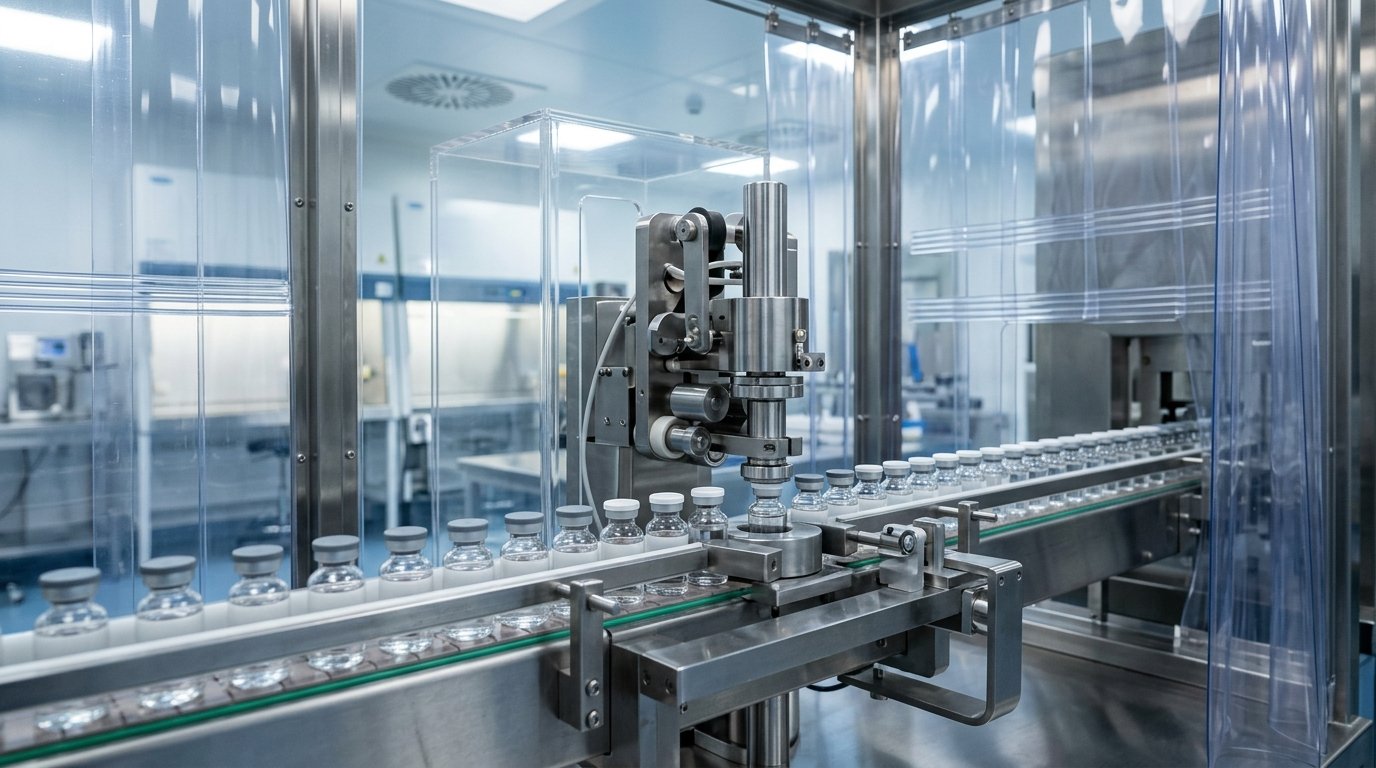
Autofits supplies vial seals in three forms: Regular, Ready-to-Sterilize (RTS) and Ready-to-Use (RTU). Ready-to-Use seals are washed, double-lacquered, assembled in an ISO Class 8 cleanroom, sterilised by gamma irradiation or ethylene oxide, and double-bagged for aseptic areas, with a shelf life of 2 years before capping. Which form a filling line needs depends on how it caps: EU GMP Annex 1 allows vial capping either as an aseptic process with sterilised caps, or as a clean process outside the aseptic area with the stoppered vials protected by a Grade A air supply until the cap is crimped. India’s revised Schedule M sets out the same two routes.
Supply forms
The forms of supply, and what each asks of the filling site, are compared on sterile vial sealing.
What delivery forms do Autofits seals come in?
Autofits seals are supplied in three forms. Regular seals are washed and inspected but not sterilised. Ready-to-Sterilize seals are prepared and packed for sterilisation by the customer in its own validated process. Ready-to-Use seals are washed, assembled in an ISO Class 8 cleanroom and sterilised by gamma irradiation or ethylene oxide, so they can go straight into an aseptic area. Tyvek bagging is available.
Who sterilises the seal in Ready-to-Use and in Ready-to-Sterilize supply?
The difference is who sterilises the seal. A Ready-to-Use seal arrives sterilised, so the customer validates only its transfer into the aseptic area. A Ready-to-Sterilize seal arrives clean and packed for sterilisation, so the customer runs and validates its own cycle before use. Ready-to-Use supply typically adds 1 to 2 weeks to the lead time for sterilisation and release, confirmed on enquiry.
Are Ready-to-Use seals sterilised by gamma irradiation or ethylene oxide?
Both are available. Gamma irradiation passes through the packed seals and leaves no chemical residue. Ethylene oxide is a gas process that needs an aeration step to remove residual gas afterwards. The choice is made with the customer, and the sterilisation method for a given order is stated with the quotation.
How are Ready-to-Use seals packed for an aseptic area?
Ready-to-Use seals are double-bagged, so the outer bag can be removed at the entry to the clean area and the inner bag carried into the aseptic zone without exposing the seals. Tyvek bagging is available where a breathable, sterilisation-compatible bag is required. The standard shipper box measures 420 × 270 × 320 mm, with the count per box set by size.
Which ISO 14644-1 cleanroom class applies to Ready-to-Use seal assembly?
They are assembled in an ISO Class 8 cleanroom. ISO 14644-1 defines cleanroom classes by airborne particle concentration, and Class 8 allows up to 3,520,000 particles of 0.5 µm and larger per cubic metre. Ready-to-Use seals use double-lacquered aluminium and are washed on a fully automated line to control particles, and every seal passes 100% high-speed camera inspection.
Shelf life
Shelf life figures below are from the Autofits seals dossier. Storage conditions for a specific order are confirmed with the quotation.
What is the shelf life of a seal before capping?
A non-irradiated Autofits seal, supplied in Regular or Ready-to-Sterilize form, has a shelf life of 3.5 years before capping. A Ready-to-Use seal, which has been sterilised, has a shelf life of 2 years before capping.
How long does a seal last after capping?
Once crimped onto a vial, a non-irradiated Autofits seal carries a shelf life of 5 years after capping, in addition to its 3.5 years before capping. The seal’s shelf life after capping is one input to the drug product’s own shelf life, which is set by the manufacturer’s stability data on the complete container closure system.
Capping under EU GMP Annex 1 and Schedule M
Annex 1 is the European Commission’s GMP guideline for manufacturing sterile medicinal products. The Autofits summary is on EU GMP Annex 1.
Do vial caps have to be sterile under EU GMP Annex 1?
Not in every case. Annex 1 says capping of aseptically filled vials can be carried out as an aseptic process using sterilised caps, or as a clean process outside the aseptic processing area. Sterilised, Ready-to-Use caps are needed for the first route. In the second, the stoppered vials should be protected by a Grade A air supply until the cap has been crimped, and the caps are handled as a clean process.
How does EU GMP Annex 1 define a Grade A air supply?
Annex 1 defines it as air passed through a filter qualified as capable of producing Grade A total particle quality air, without a requirement for continuous total particle monitoring or for meeting Grade A viable limits. It is used specifically to protect fully stoppered vials whose caps have not yet been crimped. The background environment around the Grade A air supply should meet at least Grade D.
What does Annex 1 say about particles from crimping equipment?
Annex 1 recognises that crimping equipment can generate large quantities of non-viable particles. Where it does, it expects measures such as placing the capping equipment at a physically separate station with adequate air extraction. Where capping is manual, it expects Grade A conditions, either in an isolator or in Grade A with a Grade B background. Clean, well-formed seals help, but the station design is the manufacturer’s.
What happens to vials with missing or displaced stoppers before capping?
They are rejected. Annex 1 states that where capping is a clean process with Grade A air supply protection, vials with missing or displaced stoppers should be rejected before capping, and that where people have to intervene at the capping station, technical and organisational measures should prevent direct contact with the vials. Revised Schedule M in India carries equivalent requirements.
What does India’s revised Schedule M require at capping?
Revised Schedule M states that the container closure system of an aseptically filled vial is not fully integral until the aluminium cap has been crimped, so crimping should follow stoppering as soon as possible. Capping can be aseptic with sterilised caps or a clean process outside the aseptic core with a Grade A air supply, and the crimping equipment is placed at a separate station with adequate air extraction.
Integrity after sealing
What integrity means for specifying a closure is covered in vial closure integrity, and the test methods in USP <1207>.
What checks follow sealing in sterile vial manufacturing?
After capping, filled parenteral containers are inspected individually for extraneous contamination and other defects, which revised Schedule M requires, and samples are checked for container closure integrity using validated methods under a justified sampling plan, as Annex 1 expects for containers not closed by fusion. Vacuum-sealed containers are also tested for maintenance of vacuum. Crimp appearance is checked, but it is not an integrity test.
Does Annex 1 require 100% integrity testing of crimped vials?
No. Annex 1 requires 100% integrity testing for glass ampoules, blow-fill-seal units and small containers of 100 ml or less closed by fusion. For containers closed by other means, which includes stoppered and crimped vials, it expects samples to be checked with validated methods, with the testing frequency based on knowledge of the container and closure and a scientifically justified sampling plan.
Is visual inspection an acceptable container closure integrity test?
No. Annex 1 states that visual inspection is not considered an acceptable integrity test method. Visual inspection of a crimped vial still has a place, for rejecting missing, cocked or poorly formed seals, but integrity is shown by validated physical or microbiological methods of the kind described in USP <1207>, applied to the actual vial, stopper and seal.
How are vials sealed under vacuum checked?
Annex 1 expects containers sealed under vacuum to be tested for maintenance of that vacuum after an appropriate pre-determined period, before certification and release and during shelf life. Revised Schedule M has a matching requirement. For freeze-dried products stoppered under partial vacuum, this makes the stopper and seal fit part of the release data, not just the capping step.
Does container closure integrity validation have to cover shipping?
Yes. Annex 1 says container closure integrity validation should take account of transportation and shipping conditions that could affect integrity, such as decompression or extreme temperatures. For a crimped vial, that means the integrity study includes the distribution conditions the product will actually see, not only storage on the shelf.
Sealing standards and process
The capping sequence on a filling line is described in the vial sealing process.
Which standards govern gamma and ethylene oxide sterilisation of components?
Radiation sterilisation is developed, validated and controlled under ISO 11137, and ethylene oxide sterilisation under ISO 11135. Both are written for health care products and are the reference frameworks for validating the dose or cycle, the sterility assurance level claimed and routine control. A buyer qualifying Ready-to-Use seals asks for the sterilisation method and a summary of its validation.
What is the step-by-step sealing process for a vial?
The vial is filled, and the stopper is pressed into the neck, or partly inserted and then seated inside the freeze dryer for lyophilised products. Vials with missing or displaced stoppers are rejected. A seal is fed from a hopper onto each stoppered vial, and the capping head rolls the aluminium skirt under the crown. The crimped vials are then inspected, and integrity samples are taken.
Related reading
Sources
- European Commission: EU GMP Guidelines, Annex 1, Manufacture of Sterile Medicinal Products, C(2022) 5938 final, sections 8.22 to 8.29 and glossary (https://health.ec.europa.eu/medicinal-products/eudralex/eudralex-volume-4_en)
- Ministry of Health and Family Welfare, India: G.S.R. 922(E), 28 December 2023, revised Schedule M to the Drugs Rules, 1945, via CDSCO (https://cdsco.gov.in/)
- ISO: ISO 14644-1:2015, Cleanrooms, Classification of air cleanliness by particle concentration (https://www.iso.org/standard/53394.html)
- ISO: ISO 11137-1, Sterilization of health care products, Radiation (https://www.iso.org/standard/81721.html)
- ISO: ISO 11135, Sterilization of health-care products, Ethylene oxide (https://www.iso.org/standard/56137.html)
- USP: General Chapter <1207> Package Integrity Evaluation, Sterile Products (https://www.usp.org)
- Autofits FlipTop seals dossier, for delivery forms, sterilisation, cleanroom class and shelf life
*Last updated: 2026-09-15. This page is general technical and regulatory information, not validation or compliance advice. Typical lead times are confirmed on enquiry, and requirements should be checked against the current texts of Annex 1 and Schedule M.*
