
ROPP Cap Finishes: Plain, Printed and Chamfered
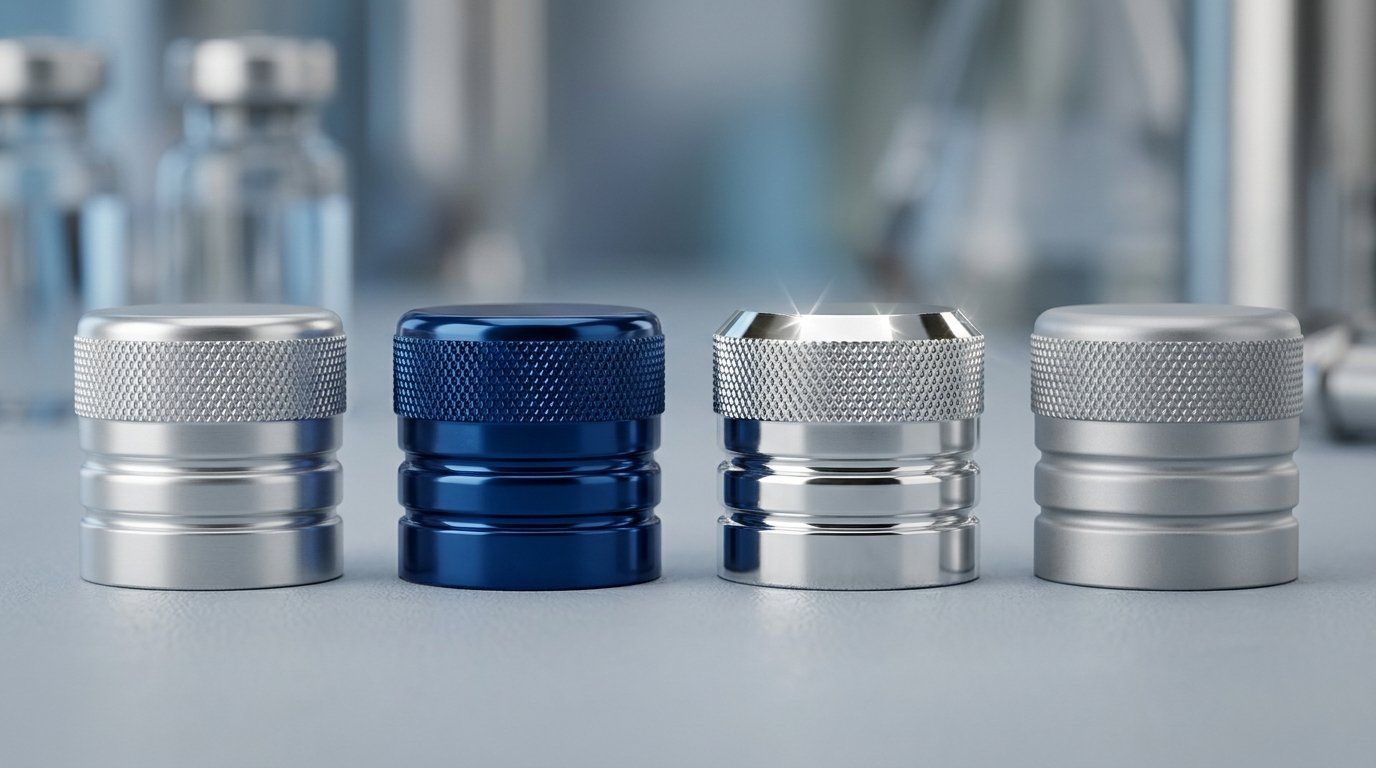
Autofits supplies aluminium pilfer-proof (ROPP) caps in three finishes: plain, printed and chamfered. Plain is the lacquered shell with no decoration; printed carries artwork applied to the outer surface; chamfered adds a bevelled profile to the cap’s top edge. Colour comes from pigmenting the epoxy lacquer, so a coloured cap is coloured all the way round rather than surface-coated with a separate ink layer. Finish is a separate decision from size and liner, and it does not change how the closure seals.
This page explains what each finish is, how colour and decoration are produced on an aluminium cap, what artwork a print job needs, and how the finish interacts with inspection and the capping line.
Key takeaways
- Three finishes are offered across the pilfer-proof cap range: plain, printed and chamfered.
- Colour is in the lacquer. The epoxy lacquer that lines and coats the shell can be pigmented, so colour is part of the coating system rather than a separate applied layer.
- Printing is applied to the outer surface of the shell before forming, which is why artwork has to account for the distortion the metal undergoes during stamping and drawing.
- Chamfered describes a bevelled profile on the cap’s top edge; exact chamfer geometry is held on the controlled drawing per size.
- Finish does not change the sealing mechanism: the liner seals and the rolled threads hold, whatever the outside looks like.
- Finish does change what has to be inspected: print registration and colour become checked attributes alongside the dimensions.
- Colour and print are a differentiation and error-prevention tool, the same logic set out for injectable closures in pharmaceutical seal colour coding.
What “finish” means on an aluminium cap
On a ROPP cap, finish refers to the treatment of the visible outer surface and the profile of the cap body, not to the bottle’s screw-neck finish. The two uses of the word sit close together in a closure specification, which is worth flagging on a drawing review: “28 mm neck finish” describes the bottle, while “printed finish” or “chamfered finish” describes the cap.
The outer surface of the cap is a lacquered aluminium sheet. It starts as coil, gets coated and, where required, printed while it is still flat, and is then stamped and drawn into the shell shape. Everything visible on the finished cap was therefore applied before the metal was formed. That sequence explains most of the practical constraints: colour is uniform because it is in the coating, and print has to be laid out with forming distortion designed in.
Plain
A plain cap is the lacquered aluminium shell with no printed decoration. It can still be coloured, because colour comes from pigmenting the epoxy lacquer rather than from printing. A plain cap in a brand colour is a common specification: it differentiates the pack on shelf and in the dispensary without the artwork approval cycle that printing requires.
Plain is the fastest route to a running product. There is no artwork, no proof, no print registration to qualify, and inspection is checking dimensions, colour and defects rather than image placement. Where a pack is being launched under time pressure, or where secondary packaging and the bottle label already carry the branding, plain does the job.
Printed
A printed cap carries artwork applied to the outer surface of the shell. It is used for brand marks, product identifiers, batch or market-specific indicators, and for anti-counterfeit features where the pack strategy calls for them.
Because printing happens on flat sheet before forming, three things need attention at artwork stage:
- Distortion allowance. Stamping and drawing stretch the metal unevenly. Artwork is laid out so that the printed result on the formed cap is correct, which means the flat artwork is not what the finished cap looks like.
- Placement relative to the knurl and pilfer band. The knurled skirt and the perforation line are functional features. Artwork is positioned so decoration does not sit across a feature where it would break up.
- Colour reference and substrate. Aluminium under a pigmented lacquer reproduces colour differently from paper or plastic. Send a physical colour reference where the match matters, not only a printed swatch or a screen value.
Print adds an inspection dimension too. Once a cap is printed, image presence, registration and print defects become attributes to check on top of the dimensional and surface checks. That is one reason printed caps carry a longer first-article approval cycle than plain.
Chamfered
A chamfered cap has a bevelled profile at the top edge of the cap rather than a square shoulder. It is a geometric option rather than a decorative one, held on the controlled drawing per size.
Chamfering changes the look and feel of the closure and the way light catches the top edge, which some pack designs want. It also changes how the cap presents itself to the capping head and to feeding equipment, so a change from square to chamfered is confirmed on the line rather than assumed. As with any profile change, the cap drawing is reissued and the capping setup is re-established; the mechanics are covered on the ROPP capping and application page.
The three finishes side by side
| Plain | Printed | Chamfered | |
|---|---|---|---|
| What it is | Lacquered shell, no artwork | Artwork on the outer surface | Bevelled top edge profile |
| Colour available | Yes, pigmented lacquer | Yes, pigmented lacquer plus print | Yes, pigmented lacquer |
| Artwork needed | No | Yes, with distortion allowance | No |
| Adds to inspection | Colour and surface defects | Image presence and registration | Profile dimension |
| Typical reason to choose | Fast to launch, branding sits on the label | Brand mark or identifier on the closure | Pack aesthetic and shoulder profile |
Finishes can be combined with any size in the 22 to 38 mm range and with any of the liner options; availability of a specific combination is confirmed per order.
Embossing and other decoration
Plain, printed and chamfered are the three finishes Autofits publishes for its pilfer-proof caps; embossing is not one of them. Embossing is offered on the plastic discs of the FlipTop vial seal range, which is a different product. If a pack design calls for a raised mark, a special knurl or another decoration on an aluminium cap, describe it in the enquiry and feasibility is confirmed with the quotation rather than assumed.
Colour, and why it matters beyond branding
Colour on a pharmaceutical closure does two jobs: it identifies the product family and it prevents selection errors. The second is the one that gets the attention of a QA group. A colour-differentiated cap gives a dispensary, a ward or a home user a fast visual check that they have the right bottle before they read the label.
The same reasoning drives colour coding on injectable vial closures, where the coloured flip button is the primary differentiator on a tray of otherwise identical vials. The practice and its limits are discussed on the seal colour coding page, and the colour options across the wider Autofits range are on the by-colour index.
Two cautions apply to colour as a control. It is a supporting cue rather than a substitute for the label, and colour conventions are not standardised across markets, so a scheme that reads clearly in one country may not carry the same meaning in another. Fix the scheme at the pack design stage with the regulatory group rather than at the ordering stage.
What to send with a finish enquiry
Finish is quoted from artwork and a colour reference, so an enquiry moves faster with both attached. For a printed or coloured cap, send:
- Size and bottle neck finish, so the correct shell is quoted.
- Colour reference, ideally a physical sample or a named colour standard rather than a screen value.
- Artwork in a print-ready vector format, with the intended placement described.
- Liner requirement, from the liner options.
- Volume per colour or artwork, since minimum quantities are counted per size and colour: typically from 50,000 pieces for a standard design and 100,000 for a custom colour or print, confirmed with the quotation.
- Any market-specific requirement that affects the decoration, for example a language or identifier that varies by destination.
Custom decoration work across the Autofits range, including the approval sequence, is described on the custom vial seal manufacturing page.
How this works in practice at Autofits
Autofits makes its pilfer-proof caps in plain, printed and chamfered finishes at its 75,000 sq ft facility in Nashik, India, where the plant produces around 250 million aluminium pilfer-proof caps a month. Colour comes from the epoxy lacquer, which conforms to 21 CFR 175.300 and may be pigmented, over AA8011 aluminium. A custom colour or print typically adds 4 to 6 weeks to an order, most of it artwork and colour approval, against a typical 2 to 3 weeks for a standard design; both are confirmed with the quotation.
In-house design and development supports custom decoration, and production runs with online high-speed camera inspection under ISO 9001:2015, ISO 14001:2015 and ISO 15378:2017, with a Drug Master File (DMF 18100) and CFDA registration. The quality standard is described on the ISO 15378 page and the full certification set is on the quality page. Standard designs are available to start from, with customisation quoted to the specific requirement.
Frequently asked questions
What finishes are pilfer-proof caps available in?
Autofits supplies aluminium pilfer-proof (ROPP) caps in three finishes: plain, printed and chamfered. Plain is the lacquered shell with no decoration, printed carries artwork on the outer surface, and chamfered adds a bevelled profile to the cap’s top edge. All three can be supplied coloured, because colour comes from pigmenting the epoxy lacquer rather than from a separate applied layer.
How are ROPP caps coloured?
Colour is achieved by pigmenting the epoxy lacquer that coats the aluminium. The coating is applied while the aluminium is still flat coil, before stamping and drawing, so the colour is part of the coating system and covers the shell uniformly. Send a physical colour reference with the enquiry, since aluminium under a pigmented lacquer reproduces colour differently from paper or plastic.
Can pilfer-proof caps be printed with our branding?
Yes. Artwork is applied to the outer surface of the shell before the metal is formed, so the layout has to allow for the distortion that stamping and drawing introduce. Supply print-ready vector artwork, the intended placement, and a physical colour reference. Printed caps carry a longer first-article approval cycle than plain ones because print registration becomes an inspected attribute.
What does a chamfered ROPP cap mean?
Chamfered describes a bevelled profile at the top edge of the cap instead of a square shoulder. It is a geometric option held on the controlled drawing for each size, chosen mainly for pack appearance. Because it changes how the cap presents to feeding and capping equipment, a change to a chamfered profile is confirmed on the line rather than assumed to be a drop-in.
Does the finish affect how well the cap seals?
No. Sealing is done by the liner compressing against the bottle’s sealing land, held under load by the aluminium threads that are rolled onto the neck during capping. Finish is a treatment of the visible outer surface and the cap profile. A profile change such as chamfering can affect how the cap feeds and how the capping head engages it, which is a line setup question rather than a sealing one.
Can colour on the cap be used to differentiate strengths?
It is widely used that way, and it helps prevent selection errors by giving a fast visual cue before the label is read. Two limits apply: colour supports the label rather than replacing it, and colour conventions differ between markets, so a scheme that reads clearly in one country may not carry the same meaning elsewhere. Fix the scheme with the regulatory group at pack design stage.
Related reading
- Pilfer-proof (ROPP) aluminium caps: the full range
- 22 mm, 25 mm, 28 mm, 35 mm and 38 mm ROPP caps
- ROPP cap liners: EPE, latex and PVC
- Applying ROPP caps: roll-on capping and torque
- Pharmaceutical seal colour coding
- Custom vial seal manufacturing
- Autofits products by colour
Sources
- Autofits pilfer-proof (ROPP) cap range and product dossier (working/spec-sheets/)
- ISO: ISO 15378:2017, Primary packaging materials for medicinal products, GMP requirements (https://www.iso.org/standard/70729.html)
- eCFR: 21 CFR 175.300, Resinous and polymeric coatings (https://www.ecfr.gov/current/title-21/chapter-I/subchapter-B/part-175/subpart-C/section-175.300)
*Last updated: 2026-09-15. This page is general technical and product information, not regulatory or compliance advice; confirm current standard editions and your own specification with Autofits and the issuing bodies.*
