
Vial Closure Rubber Types: Butyl, Halobutyl, EPDM, Silicone, and How to Choose
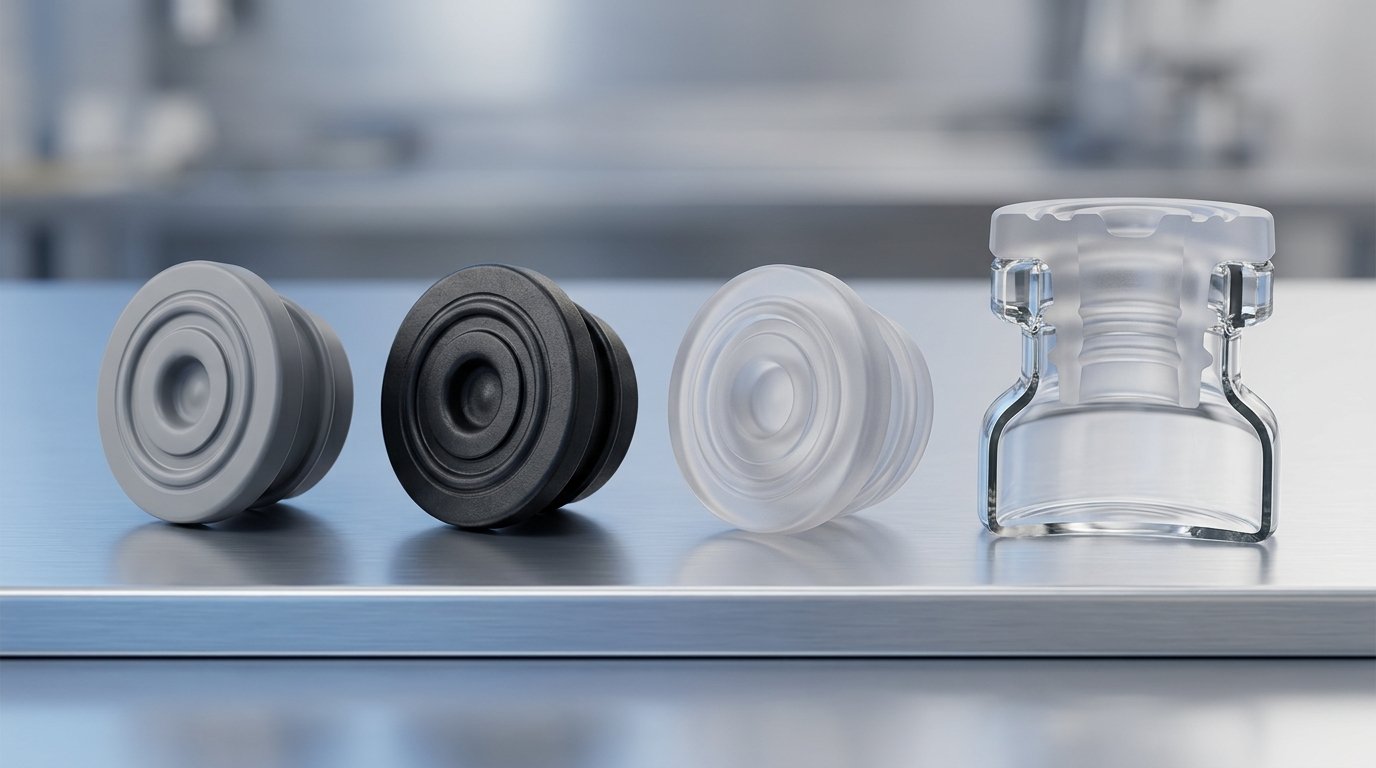
Vial closures are moulded from a small set of elastomer families, and for injectables the field narrows quickly. Bromobutyl and chlorobutyl, the two halobutyls, account for most parenteral stoppers; plain butyl is their parent polymer and still used; EPDM appears where heat and steam resistance matter more than barrier; silicone is chosen for extreme temperature range or surface inertness despite its very high gas permeability; and natural rubber and polyisoprene are largely confined to specialist components. The choice turns on barrier, reseal, temperature range, and formulation compatibility.
This is the material-by-material survey: what each family is, how it behaves, how the standards classify and test them, how to match one to a product, and which aluminium seal pairs with the result. If the question is what the words mean rather than how the materials differ, whether a rubber stopper and an elastomeric closure are the same object, that is settled in rubber stopper versus elastomer, the terminology page.
Key takeaways
- Halobutyl (bromobutyl and chlorobutyl) is the default for injectable vial stoppers: very low gas and moisture permeability plus a versatile cure chemistry.
- EPDM resists heat, steam, and ozone well but is a weaker barrier than butyl, so it is more usual in device and infusion components than in vial stoppers.
- Silicone has the widest usable temperature range and one of the highest gas permeabilities of any elastomer, making it a specialist rather than default choice.
- Natural rubber latex is not permitted under Ph. Eur. 3.2.9, although dry natural rubber may be used.
- The compound matters more than the family: two bromobutyl stoppers with different cure systems and fillers can behave and extract very differently.
- USP <382> became official on 1 December 2025, with a further Revision Bulletin official 1 February 2026 carrying the text now in force. Fragmentation testing was removed from <382> before it went official and remains in USP <381>.
- The ISO 8871 series is most often overlooked: five parts covering extractables, identification, particles, biological requirements, and function.
- No compound changes the seal size. Stopper, neck and seal share one nominal finish across 13, 20, 28, 32 and 34 mm; what the compound changes is seated height and residual crimp force.
The rubber families used for vial closures
Six families cover essentially all pharmaceutical closure applications, and they separate on two properties: permeability and temperature range.
| Family | Abbreviation | Gas and moisture barrier | Temperature behaviour | Usual parenteral role |
|---|---|---|---|---|
| Butyl | IIR | Very low | Elastic well below freezing | Parent polymer; still used for stoppers |
| Bromobutyl | BIIR | Very low | As butyl | The most common stopper base |
| Chlorobutyl | CIIR | Very low | As butyl | Widely used stopper base |
| EPDM | EPDM | Moderate; higher than butyl | Excellent heat, steam, ozone resistance | Device and infusion closures |
| Silicone | VMQ | High | Widest range; flexible when very cold | Specialist closures, plungers, tubing |
| Polyisoprene / natural rubber | IR / NR | High | Elastic, but ages less well | Plungers, needle shields |
Butyl rubber
Butyl is a copolymer of isobutylene with a small proportion of isoprene. The isobutylene backbone is densely packed with very little free volume, which gives butyl its defining property: gas and water-vapour molecules cannot diffuse through it easily. That is why butyl displaced natural rubber for injectable closures, and why a butyl-based stopper is the sensible starting point for an oxygen- or moisture-sensitive product. Its limitation is chemical: few unsaturated sites means a slow, inflexible cure and poor co-vulcanisation.
Bromobutyl and chlorobutyl
Halogenating the butyl backbone with bromine or chlorine solves that. The halogen introduces reactive sites, so the compound cures faster and with a wider choice of systems, co-vulcanises with other elastomers, and bonds better to laminate films. Barrier performance stays at butyl levels.
The two differ in processing. Bromobutyl offers the more flexible cure chemistry and better adhesion, which matters for laminated constructions; chlorobutyl is regarded as more scorch-resistant in the mould. Both are mainstream, and the choice usually follows the cure system, the drug’s compatibility profile, and existing qualification history rather than a decisive technical gap.
EPDM
EPDM is a terpolymer of ethylene, propylene, and a diene monomer. Its strengths are resistance to heat, steam, ozone, and polar fluids, and it holds up to repeated autoclaving. Its weakness here is barrier: EPDM is appreciably more permeable to oxygen and water vapour than butyl, so it protects a sensitive drug less well. It is therefore common in device seals and infusion sets and uncommon as a vial stopper. The head-to-head is in butyl vs EPDM stopper.
Silicone
Silicone rubber is a polysiloxane rather than a carbon-backbone elastomer, and that changes everything about it. It stays flexible across an exceptionally wide temperature range, well below where hydrocarbon elastomers stiffen and well above where they degrade, and it is very inert, with clean grades producing low levels of organic extractables.
Against that, silicone is one of the most gas-permeable elastomers in common use, orders of magnitude more permeable than butyl, with lower tear strength and higher cost. That puts it in niches rather than general vial stoppering: very low-temperature storage, plungers and tubing, and cases where inertness outweighs barrier.
Natural rubber and polyisoprene
Natural rubber was the original closure material and is now largely displaced: more permeable than butyl, less stable on ageing, and carrying the protein allergens associated with latex. Ph. Eur. 3.2.9 does not permit natural rubber latex in closures for aqueous parenteral preparations, although dry natural rubber may be used because the allergens are removed in processing.
Synthetic polyisoprene has the same base chemistry without the natural proteins and gives excellent elasticity and puncture recovery, which is why it appears in plungers and needle shields, but its permeability keeps it out of most vial-stopper work. Thermoplastic elastomers, moulded without vulcanisation, sit in the same category.
Why the compound matters more than the family
“Bromobutyl” names a base polymer, not a material. A finished stopper compound is the polymer plus a filler system (typically mineral, and the reason most stoppers are grey), a cure system, activators, and processing aids. Two stoppers from the same base polymer can differ substantially in hardness, compression set, penetration force, particle shedding, and extractables. So a specification written to a polymer family is not a specification: the compound reference is what has to be fixed and held under change control, and a change of compound is a change to the closure even though the family name has not moved.
Coatings and laminates
The drug-contact face of a stopper is frequently not bare rubber. Two surface treatments are widespread, and both are part of the closure specification and notifiable as changes.
Fluoropolymer films are laminated onto the drug-contact surface, and sometimes the full stopper, forming a barrier between the elastomer and the product. The film substantially cuts extractables reaching the drug and gives a harder, lower-friction surface that runs better through washing and filling equipment: a common choice for biologics.
Silicone treatment reduces friction so stoppers feed and insert reliably at line speed. Silicone is itself a particulate and interaction source, so some products specify silicone-free stoppers and rely on a laminate instead.
Matching the rubber to the product
The deciding property changes with the product, and the common error is optimising for barrier when reseal or temperature range is the constraint.
| If the product is | Deciding property | Usual direction |
|---|---|---|
| An oxygen- or moisture-sensitive small molecule | Permeability | Halobutyl, uncoated or laminated |
| A lyophilised product | Moisture vapour transmission, plus slotted geometry | Halobutyl slotted closure to ISO 8362-5 |
| A biologic or protein formulation | Extractables and particulate burden | Laminated halobutyl, often ready-to-use |
| A multiple-dose vial | Self-sealing after repeated penetration | Compound qualified against USP <382> |
| A deep-frozen product | Elasticity at the storage temperature | Cold-chain halobutyl, or silicone at the extreme |
| A terminally steam-sterilised product | Behaviour at 121 °C without added extractables | Halobutyl or EPDM, cure system chosen for it |
| A preservative-containing multi-dose product | Sorption of the preservative into the elastomer | Compound screened for preservative uptake |
Preservative sorption deserves emphasis as an often late-discovered failure mode: a preservative that partitions into the rubber loses its antimicrobial function while the assay for the active looks normal. It bites hardest on preserved multi-dose presentations such as insulin and hormone vials.
How the standards classify and test vial closure rubbers
Closure rubbers are qualified on four fronts: material chemistry, biological safety, function in use, and dimensions. No single document covers them all.
| Aspect | Reference |
|---|---|
| Physicochemical material requirements | USP <381> |
| Functional suitability | USP <382>, with guidance in USP <1382> |
| European requirements, Type I / Type II classification | Ph. Eur. 3.2.9 |
| Dimensions for injection vial closures | ISO 8362-2:2024 |
| Freeze-drying closures | ISO 8362-5:2016 |
| Extractables in aqueous autoclavates | ISO 8871-1:2003 |
| Identification and characterization | ISO 8871-2:2020 |
| Released-particle count | ISO 8871-3:2003 |
| Biological requirements and test methods | ISO 8871-4:2006 |
| Functional requirements and testing | ISO 8871-5:2025 |
Three points are worth drawing out.
USP <382> became official on 1 December 2025, and the text now in force carries a Revision Bulletin official 1 February 2026. It covers needle and spike access functional suitability: penetration force, self-sealing capacity, spike retention, and sealability. Fragmentation testing was removed from the revised chapter after concerns about the proposed particle size limits, and remains in USP <381>. The self-sealing requirement was aligned with ISO practice at 1.0 times the maximum number of scheduled penetrations. The chapter itself is summarised on the USP <382> page.
Ph. Eur. 3.2.9 classifies closures as Type I or Type II. Type I meets the stricter requirement set; Type II has mechanical properties suited to special uses, may not meet every Type I requirement, and so has to be justified. The chapter was last revised through Supplement 11.1, applicable from 1 April 2023, and is carried in the 12th Edition. It is mandatory for aqueous parenterals because binding general monographs reference it.
The ISO 8871 series is the one most often missed. Its five parts sit alongside the pharmacopoeial chapters and are frequently cited in supplier specifications.
What the rubber choice means for the aluminium seal
Changing the stopper compound can change the crimp, even when the stopper’s nominal dimensions do not move. Hardness and compression set determine how far the stopper deforms under the capping head and how much force it keeps holding, so the same settings applied to a softer or harder compound give a different residual seal force.
A harder compound compresses less and sits taller when seated, which pushes the crimp higher up the neck and can leave lower contact stress between rubber and glass than the setting was chosen for. A softer compound compresses further at the same setting, which usually looks good at capping, but soft compounds generally have a higher compression set and give load back across shelf life. Neither effect is visible on a dimensional check of the finished vial; both surface in integrity testing. A stopper change is therefore a reason to re-verify the capping setup and, where significant, to re-confirm container closure integrity against the method families in USP <1207>. The full interaction is covered in pairing the rubber stopper and aluminium seal.
What does not change with the compound is the seal size. Stopper, vial neck and seal share one nominal finish, standardised for the neck under ISO 8362-1, for the closure under ISO 8362-2, and for the aluminium-plastic cap under ISO 8362-6. A 20 mm halobutyl stopper and a 20 mm EPDM stopper take the same 20 mm seal.
Seal specifications by stopper size
Controlled dimensions for the Autofits FlipTop Optima aluminium-plastic seal at each nominal stopper and neck size, from the engineering drawings. Select against the neck finish, then verify the inner aluminium height against the seated height of the compound actually qualified.
| Stopper and neck size | Inner Ø aluminium seal (D1) | Outer Ø plastic disc (D2) | Inner aluminium height | Total seal height | Aluminium thickness | Bridges | Max opening force | Size page |
|---|---|---|---|---|---|---|---|---|
| 13 mm | 13.36 mm (min) | 14.99 mm (max) | 6.15–6.40 mm | 7.62–8.38 mm | 0.16–0.20 mm | 6 taper | 30 N | 13 mm seals |
| 20 mm | 20.22 mm (min) | 23.14 mm (max) | 7.37–7.62 mm | 9.02–9.91 mm | 0.16–0.20 mm | 6 taper | 35 N | 20 mm seals |
| 28 mm | 27.60–28.20 mm | 30.10–31.10 mm | 8.70–9.30 mm | 11.06–12.06 mm | 0.17–0.23 mm | 8 | 35 N | 28 mm seals |
| 32 mm | 32.10–32.90 mm | 35.50–36.50 mm | Available on request | 14.30–15.50 mm | 0.21–0.25 mm | 12 taper | 65 N | 32 mm seals |
| 34 mm | 33.60–34.00 mm | 35.50–36.50 mm | Available on request | 15.00–16.00 mm | 0.20–0.25 mm | 8 taper | Available on request | 34 mm seals |
The seal format follows the presentation rather than the rubber. Routine injectable and lyophilised fills take a flip-off seal from the FlipTop Optima range, where the polypropylene button lifts and the aluminium stays crimped. Oral presentations, including oral vaccination, take a pull-ring or tear-down seal, where the whole seal detaches. Where no plastic is wanted in the closure at all, for instance ahead of a terminal steam cycle, an all-aluminium tear-off seal is the alternative, available at 13, 20 and 32 mm.
Forms of supply, shelf life and packing
Autofits supplies the seal in three forms, and the choice interacts with the stopper decision on the same line. Regular is the standard non-sterile presentation for customers who wash and sterilize in house. Ready-to-Use is sterilized by gamma irradiation or by ETO, washed to control particles, assembled in an ISO Class 8 cleanroom from double-lacquered aluminium and supplied double-bagged, which is the natural counterpart to a ready-to-use laminated halobutyl stopper on an aseptic line. Ready-to-Sterilize is supplied clean and bagged for the customer’s own cycle. Tyvek bagging is available in place of the standard bag.
Shelf life is 3.5 years before capping for non-irradiated seals, plus a further 5 years after capping, and 2 years before capping for Ready-to-Use, the shorter window reflecting the sterilization dose already absorbed. Standard packing per box is 15,000 at 13 mm (5,000 in each of three bags), 6,000 at 20 mm (2,000 × 2), 3,000 at 28 mm (1,500 × 2) and 1,400 at 32 mm (700 × 2), in a 420 × 270 × 320 mm shipper. Packing at 34 mm is available on request.
To request drawings, samples or a quotation, send the nominal neck finish, the stopper compound and reference you have qualified, the seal family and top design, the finish and colour, and the form of supply through the contact page. Autofits manufactures the seal, not the stopper, so the compound decision stays with the drug manufacturer and the seal is matched to it.
How this works in practice at Autofits
Autofits manufactures the aluminium and aluminium-plastic seals that crimp over the stopper, not the stopper itself, so the compound is a customer decision Autofits designs around. The relevance is dimensional: the seal’s skirt length and diameter have to suit the seated height of whichever stopper the customer has qualified, and that height changes with compound hardness. The range covers FlipTop aluminium-plastic seals in 13, 20, 28, 32 and 34 mm, all-aluminium tear-off and tear-down seals, and aluminium pilfer-proof (ROPP) caps, on the products page, sorted by neck finish on the by-size index.
The aluminium is AA8011 alloy with an epoxy lacquer coating conforming to 21 CFR 175.300, and the polypropylene disc is to 21 CFR 177.1520, moulded in-house on Japanese Toyo injection machines. Heavy metals are held to a maximum 100 ppm total and the components are BSE/TSE-free to EMEA/410/01 rev. 3, which matters when the stopper’s own extractables profile is already under scrutiny. Every seal passes 100% high-speed camera inspection at an AQL of critical nil, major not more than 2.5% and minor not more than 4%. Production runs under an ISO 15378:2017 quality system, with ISO 9001:2015 and ISO 14001:2015 certification and a Drug Master File, in a 75,000 sq ft Nashik facility with an ISO Class 8 cleanroom.
Frequently asked questions
What rubber types are used for vial closures?
The main families are butyl, bromobutyl and chlorobutyl (the halobutyls), EPDM, silicone, and polyisoprene or dry natural rubber. Halobutyl accounts for most injectable vial stoppers because it combines very low gas and moisture permeability with a versatile cure chemistry. EPDM suits cases where steam and ozone resistance matter more than barrier, and silicone where a very wide temperature range or surface inertness is needed.
What is the difference between bromobutyl and chlorobutyl stoppers?
Both are butyl rubber with a halogen added to the backbone, and both retain butyl’s very low permeability. Bromobutyl generally offers the more flexible cure chemistry and better adhesion, which suits laminated constructions; chlorobutyl is regarded as more scorch-resistant during processing. Neither has a decisive barrier advantage, so the choice follows the cure system, the drug’s compatibility data, and existing qualification history.
Can EPDM be used for injectable vial stoppers?
EPDM can be used, but it is uncommon for injectable vials because it is a weaker moisture and gas barrier than butyl, which matters over a two-year shelf life. Its strengths, resistance to heat, steam, ozone, and polar fluids, suit device seals and infusion components. Where the drug is sensitive to oxygen or moisture, halobutyl is the standard choice.
Why is silicone rubber not the default for vial stoppers?
Because silicone is one of the most gas-permeable elastomers in common use, orders of magnitude more permeable than butyl, so it protects oxygen- and moisture-sensitive drugs poorly. It also has lower tear strength and costs more. Its advantages, a wide temperature range and high inertness, suit specific applications such as very low-temperature storage, plungers, and tubing.
Does the rubber type change which aluminium seal I need?
Not the size. Stopper, vial neck and seal share one nominal finish, so a 20 mm stopper takes a 20 mm seal whatever the compound. What the compound can change is the seated height of the stopper and the residual force left after crimping, because hardness and compression set differ. Those are reasons to re-verify the capping setup and re-confirm container closure integrity after a stopper change, not reasons to change seal size.
Which standards cover the rubber used in vial closures?
Material requirements are in USP <381> and, in Europe, Ph. Eur. 3.2.9, which also classifies closures as Type I or Type II. Functional suitability is in USP <382>, official since 1 December 2025 and revised by a Revision Bulletin official 1 February 2026, with guidance in USP <1382>. Dimensions are in ISO 8362-2:2024 and ISO 8362-5:2016. The five-part ISO 8871 series covers extractables, identification, released particles, biological requirements, and function.
Related reading
- FlipTop Optima aluminium-plastic seals, 13 to 34 mm
- Vial seals by nominal size
- Pairing the rubber stopper and aluminium seal
- Butyl vs EPDM stopper
- Rubber stopper vs elastomer: the terminology page
- Tear-off aluminium seals
Sources
- USP-NF: General Chapters <381> Elastomeric Components in Injectable Pharmaceutical Product Packaging/Delivery Systems and <382> Elastomeric Component Functional Suitability in Parenteral Product Packaging/Delivery Systems, chapter official 1 December 2025, current text by Revision Bulletin official 1 February 2026 (https://www.usp.org/)
- USP-NF: notice on General Chapters <381> and <382>, including removal of the fragmentation section from <382> (https://www.uspnf.com/notices/381-382-nitr-20250211)
- USP-NF: General Chapter <1207>, Package Integrity Evaluation, Sterile Products (https://www.usp.org/)
- EDQM: European Pharmacopoeia general chapter 3.2.9, Rubber closures for containers for aqueous parenteral preparations, for powders and for freeze-dried powders (https://www.edqm.eu/)
- ISO: ISO 8362-1, Injection vials made of glass tubing (https://www.iso.org/)
- ISO: ISO 8362-2:2024, Closures for injection vials (https://www.iso.org/standard/87251.html)
- ISO: ISO 8362-5:2016, Freeze drying closures for injection vials (https://www.iso.org/standard/65448.html)
- ISO: ISO 8362-6:2010, Caps made of aluminium-plastics combinations for injection vials (https://www.iso.org/standard/52806.html)
- ISO: ISO 8871-2:2020, Elastomeric parts for parenterals, Part 2: Identification and characterization (https://www.iso.org/standard/76110.html)
- ISO: ISO 8871-5:2025, Elastomeric parts for parenterals, Part 5: Functional requirements and testing (https://www.iso.org/standard/85863.html)
- Autofits FlipTop Seals dossier and engineering drawings (working/spec-sheets/)
*Last updated: 2026-08-18. This article is general technical information, not regulatory or compliance advice; confirm current standard editions and requirements with the issuing bodies.*
