
Vial Sealing Machine Types: Manual, Semi-Automatic, and Automatic
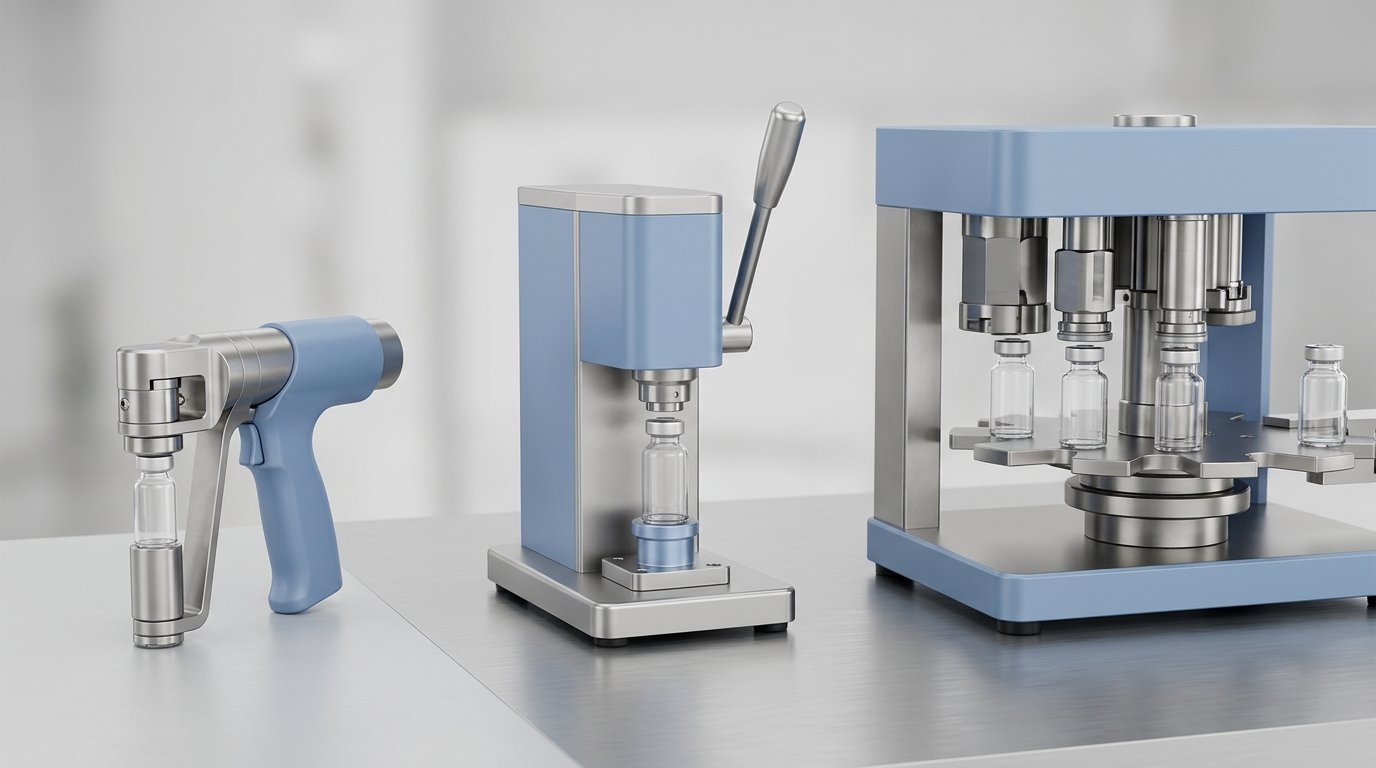
Vial sealing machines fall into four broad types: hand crimpers used one vial at a time, bench-top semi-automatic crimpers for laboratory and small-batch work, automatic single-head or turret cappers for pilot and mid-scale production, and inline rotary cappers integrated into a commercial fill-finish line. All four do the same mechanical job, rolling the skirt of an aluminium seal under the vial neck flange to compress the rubber stopper, and they differ in throughput, repeatability, and how tightly the crimp can be controlled and evidenced.
This guide describes each machine type, explains what actually sets the crimp, covers the GMP expectations that apply to capping equipment, and gives a practical basis for matching a machine to a scale of production.
Key takeaways
- Every vial sealing machine performs the same action: it presses on the seal and rolls the aluminium skirt under the vial neck flange, compressing the stopper against the glass.
- Hand crimpers give no quantitative record of crimp force, so they suit research and very small batches; bench-top semi-automatic crimpers add a fixed head height and repeatable stroke, which is what makes crimp quality reproducible enough for clinical supply.
- Automatic and inline rotary cappers run continuously at commercial speed, with seal feeding, vial handling, and reject systems built in.
- Under EU GMP Annex 1 (2022 revision), crimping is a controlled operation: vials with missing or displaced stoppers are rejected before capping, and the equipment generates non-viable particles, so it is sited and extracted accordingly.
- Crimp quality is quantified by residual seal force, one of the techniques described in USP General Chapter <1207.3>, Package Seal Quality Test Technologies.
- Machine choice does not compensate for component variation: seal and stopper dimensions have to be consistent for any capper to produce a repeatable crimp.
What a vial sealing machine does
A vial sealing machine applies and crimps the aluminium or aluminium-plastic seal that closes a stoppered vial, turning a loose assembly into a sealed, tamper-evident package. It is the last mechanical operation in the sequence described in the vial sealing process explained, and the only one that permanently commits the closure.
Mechanically the operation is simple and unforgiving. A capping head descends onto the seal with a set force while rollers or a forming collar press inward against the lower edge of the aluminium skirt and fold it under the vial’s neck flange, trapping the stopper in compression against the glass. The physics of that fold are covered in vial crimping explained. What changes between machine types is not the physics but the consistency: how precisely head height, roller geometry, and downward force are held from vial to vial, and whether that consistency can be measured and recorded.
A related but distinct family of machines applies pilfer-proof (ROPP) closures. Those roll threads and a pilfer band into a plain aluminium shell against the container’s own thread profile rather than crimping a skirt under a flange, so the tooling and control parameters are different; the two closing actions are set side by side in crimp versus screw vial closures.
The main types of vial sealing machine
The four types differ in throughput and in how much of the crimp is set by the operator rather than by the machine.
| Type | Typical setting | Operator role | Crimp repeatability |
|---|---|---|---|
| Hand crimper | Research bench, compounding, very small batch | Sets and applies the whole force by hand | Operator-dependent |
| Bench-top semi-automatic | QC lab, clinical supply, pilot batch | Loads and unloads each vial | Fixed stroke, repeatable |
| Automatic single-head or turret | Pilot to mid-scale production | Supervises, handles changeovers | Machine-set and monitored |
| Inline rotary capper | Commercial fill-finish line | Supervises, handles changeovers | Machine-set, monitored, with rejects |
Hand crimpers
A hand crimper is a plier-style tool with a die sized to a specific seal diameter. The operator places the seal on the stoppered vial, closes the jaws, and squeezes. It is inexpensive and needs no utilities, which is why it persists in research laboratories, veterinary practice, and compounding.
Its limitation is that the crimp force is whatever the operator’s hand delivers on that stroke, with no set point, no record, and no way to show that vial number forty received the same compression as vial number one. A mechanical stop or ratchet narrows the spread without eliminating it. For anything that has to be defended in a regulatory file, hand crimping is reserved for early development work.
Bench-top semi-automatic crimpers
A bench-top crimper is a fixed-frame unit, electric or pneumatic, into which the operator places one stoppered and seated vial at a time. The head descends through a set stroke to a set height and returns. Because the geometry is fixed by the machine rather than by the hand, the same crimp is delivered on every cycle for a given setup.
This is the smallest scale at which crimp quality becomes a controllable process parameter: head height and, on pneumatic units, air pressure become recordable settings that can be qualified, locked, and verified. Bench-top units are the usual choice for clinical trial material, stability batches, and small-volume products.
Automatic single-head and turret cappers
An automatic capper adds seal feeding and vial handling. Seals are delivered from a vibratory bowl or hopper to a placement station, vials index through on a star wheel or conveyor, and the head crimps as the vial passes. A single-head machine crimps one vial per cycle; a turret carries several heads on a rotating carousel.
At this level the machine is doing the whole job, so the controls that matter become the head settings (downward force, head height, roller position), the reliability of the seal feed, and the accuracy of vial centring. A seal that does not sit square on the stopper before the head descends will crimp unevenly however well the head is set.
Inline rotary cappers on a fill-finish line
On a commercial line the capper is one station in a continuous train: wash, depyrogenation tunnel, filling, stoppering, capping, then inspection, the sequence set out in the end-to-end vial fill-finish process. The capper is a rotary turret sized to the line’s throughput, fed from a seal hopper and elevator, with vials passing continuously. The subsystems inside that turret, and how inline and rotary architectures actually differ once you look at head count and cycle time, are covered in automated vial capping systems.
Two features distinguish this class. The first is integration: the capper takes vials at line speed and must not become the bottleneck, so its cycle time is matched to the filler. The second is automatic rejection: sensors before and after the station detect missing stoppers, raised stoppers, missing seals, and mis-crimped seals, and divert those vials. How seal geometry influences whether a line can hold its rated speed is covered in vial seal design and filling line speed. For sterile products the station is frequently enclosed in a restricted access barrier system or an isolator, or placed under a dedicated air supply, for the reasons set out below.
What actually sets the crimp
The crimp is set by three machine parameters and two component variables, and no machine can hold a crimp if the components move. The machine side is head height, the downward or clamping force, and the roller or collar geometry that folds the skirt. The component side is the seated stopper height and the seal’s dimensions, particularly skirt length and diameter.
A capper is set up on a specific combination of vial, stopper, and seal, and re-set whenever any of those change. That is why capping parameters are qualified per presentation rather than per machine, and why a change of closure supplier requires re-verification of the capping setup.
Crimp result is verified rather than assumed. Residual seal force, the compressive force still held by the stopper after crimping, is measured on a universal testing frame and is the most widely used quantitative indicator of crimp quality; it is among the techniques described in USP General Chapter <1207.3> and has been characterised in the PDA Journal of Pharmaceutical Science and Technology as a practical parameter for setting and controlling cappers. Whether the resulting package is leak-free is a separate question, answered by container closure integrity testing within the framework of USP <1207>.
GMP expectations for capping equipment
For sterile products, capping is a controlled operation with specific environmental and inspection expectations, not simply the last mechanical step. EU GMP Annex 1 in its 2022 revision sets out several points that shape how capping equipment is specified and sited.
- Stopper check before capping. Vials with missing or displaced stoppers are to be rejected before the capping station, because a seal crimped over a raised stopper hides the defect rather than correcting it.
- Protection until the crimp is complete. Where capping is performed outside the aseptic core as a clean process, stoppered vials are protected by a Grade A air supply until the cap has been crimped.
- Particle generation. Crimping metal generates significant non-viable particulate, so the capping station is separated and provided with adequate air extraction.
- Inspection of capped vials. Sealed vials are inspected for defects such as missing, raised, loose, or damaged seals as part of sterility assurance.
Alongside this, capping equipment is qualified like any other GMP equipment, through design, installation, operational, and performance qualification, with capping parameters established during process validation and then held under change control. Test methods for the caps themselves, as distinct from the machine, are covered by ISO 8872:2022, *Aluminium caps and aluminium/plastic caps for infusion bottles and injection vials: General requirements and test methods*.
Matching the machine to the scale
The practical rule is to choose the least complex machine that can hold and evidence the crimp your batch size requires, because complexity that cannot be justified adds qualification burden without adding control.
| Stage | Typical batch | Usual choice |
|---|---|---|
| Research and formulation | Tens of vials | Hand crimper |
| Clinical and stability supply | Hundreds to low thousands | Bench-top semi-automatic |
| Pilot and scale-up | Thousands | Automatic single-head or small turret |
| Commercial supply | Continuous | Inline rotary capper with reject system |
Three questions usually settle it. Does the batch need a recorded, reproducible crimp setting? Is the product sterile, which brings the Annex 1 expectations into play? And must capping keep pace with a filler, which rules out anything below an automatic capper?
How this works in practice at Autofits
Autofits makes the seals these machines apply rather than the machines themselves, and the two are closely coupled: a capper can only be as consistent as the seals fed into it. The range covers FlipTop aluminium-plastic seals, tear-off and tear-down aluminium seals, and aluminium pilfer-proof (ROPP) caps in 13, 20, and 32 mm sizes, listed on the products page and browsable on the by-size hub. Seals are produced to tight dimensional tolerances so that skirt length and diameter stay within a narrow band, which is what lets a customer’s capping head hold one setting across a batch, and high-speed visual inspection screens out the defects that cause feed jams and uneven crimps. Production runs under an ISO 15378:2017 quality system alongside ISO 9001:2015 and ISO 14001:2015 certification and a Drug Master File, in a 75,000 sq ft Nashik facility with an ISO Class 8 cleanroom. The certification set is on the quality page.
Frequently asked questions
What are the main types of vial sealing machine?
There are four: hand crimpers, which seal one vial at a time using operator force; bench-top semi-automatic crimpers, which apply a fixed stroke to one manually loaded vial per cycle; automatic single-head or turret cappers, which feed seals and index vials themselves; and inline rotary cappers integrated into a commercial fill-finish line with automatic reject systems. All four roll the aluminium skirt under the vial neck flange to compress the stopper.
What is the difference between a crimping machine and a capping machine?
In vial sealing the terms are interchangeable: both describe equipment that applies an aluminium or aluminium-plastic seal and rolls its skirt under the vial neck. “Capping machine” is also used for equipment that applies screw or roll-on pilfer-proof closures to bottles, which is a different mechanism.
How is crimp quality measured on a sealed vial?
The most common quantitative measure is residual seal force, the compressive force still held by the stopper after crimping, measured on a universal testing frame. It is one of the seal-quality techniques described in USP General Chapter <1207.3>, and it is used alongside inspection for missing, raised, or damaged seals and alongside container closure integrity testing, which confirms there is no leak path.
Does EU GMP Annex 1 require capping in a Grade A cleanroom?
Annex 1 does not require the capping room itself to be Grade A. Where capping is performed outside the aseptic core as a clean process, stoppered vials are to be protected by a Grade A air supply until the cap has been crimped. Annex 1 also expects vials with missing or displaced stoppers to be rejected before capping, and notes that crimping generates non-viable particles, so the station is separated with adequate air extraction.
Can one vial sealing machine handle 13 mm and 20 mm seals?
Usually yes, but only after a changeover. The capping head, dies, star wheels, and seal feed tooling are diameter-specific, so moving between 13 mm and 20 mm means changing format parts and re-setting head height and force for the new combination of vial, stopper, and seal. The change is verified before the batch runs, because the crimp is qualified per presentation rather than per machine.
Why does seal consistency matter more than machine capability?
Because the machine holds one setting and the components have to fit it. A head set for a given skirt length and seated stopper height crimps correctly only while those dimensions stay in range. Seals that vary in diameter or skirt length produce loose crimps, uneven crimps, or feed jams regardless of how good the capper is.
Related reading
- The vial sealing process explained, step by step
- Vial crimping explained: how the seal is crimped
- Where capping sits in the vial fill-finish process
- How vial seal design affects filling line speed
- EU GMP Annex 1: manufacture of sterile medicinal products
Sources
- European Commission: EudraLex Volume 4, EU GMP Annex 1 (2022 revision), Manufacture of Sterile Medicinal Products (https://health.ec.europa.eu/medicinal-products/eudralex/eudralex-volume-4_en)
- USP-NF: General Chapters <1207.3> Package Seal Quality Test Technologies and <1207> Package Integrity Evaluation, Sterile Products (https://www.usp.org/)
- ISO: ISO 8872:2022, Aluminium caps and aluminium/plastic caps for infusion bottles and injection vials, General requirements and test methods (https://www.iso.org/standard/82226.html)
- ISO: ISO 15378:2017, Primary packaging materials for medicinal products (https://www.iso.org/standard/70729.html)
- PDA Journal of Pharmaceutical Science and Technology: Quantifying the Vial Capping Process, Residual Seal Force and Container Closure Integrity (https://journal.pda.org/content/73/1/2)
*Last updated: 2026-07-31. This article is general technical information, not regulatory or compliance advice; confirm current standard editions and requirements with the issuing bodies.*
