
Contrast Media Vial Seals and Closures
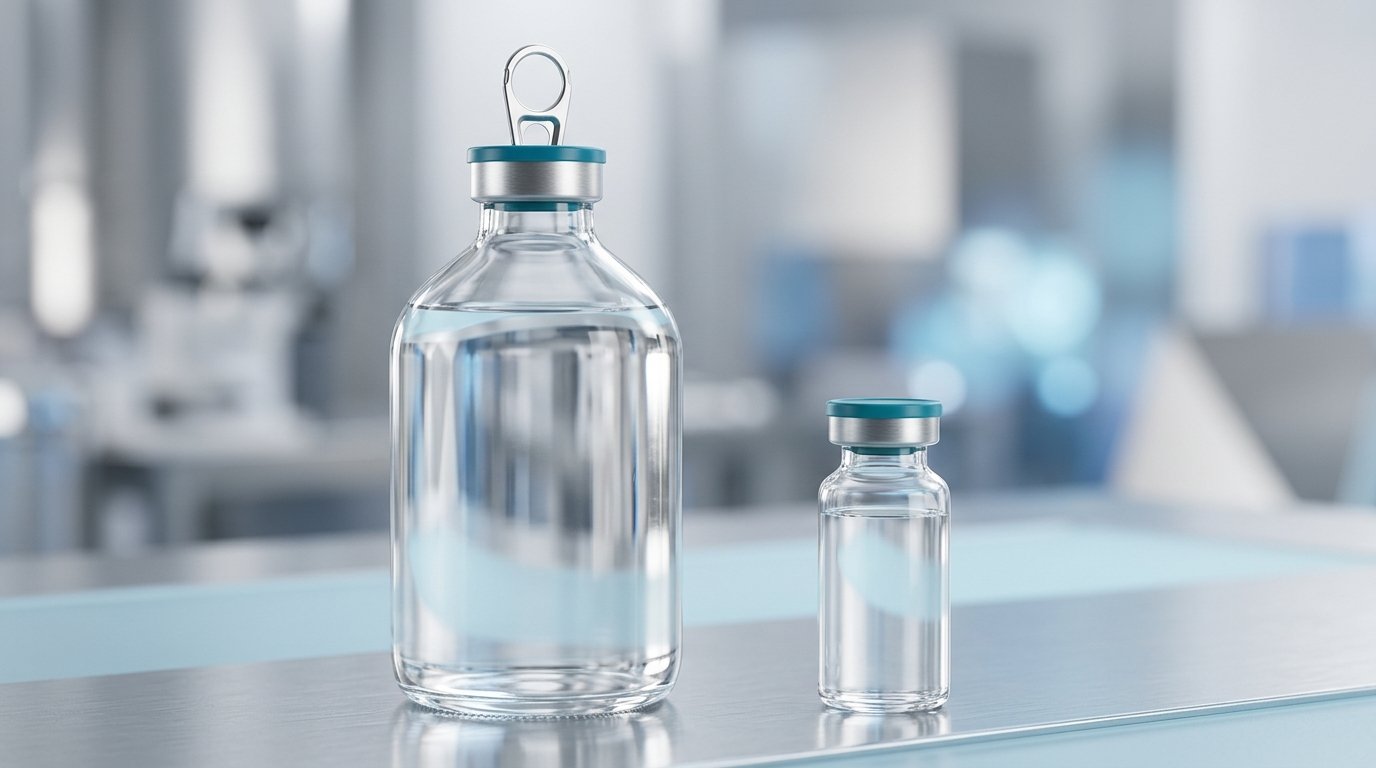
A contrast media vial seal is the closure on a large-volume imaging agent presentation, and it is chosen around three things a normal injectable does not face: fill volumes that run to a hundred millilitres or more, a spike-and-draw workflow at a power injector, and a warming step before use. Large-neck presentations are the norm, and full seal removal is often preferred over a small retained injection point so a large-bore spike can seat cleanly on the stopper.
This page is for contrast-agent formulators, packaging engineers and radiology-supply sourcing teams. It covers what imaging presentations look like, the power-injector workflow, the thermal duty from contrast warming, the Autofits closures that fit, and the standards involved.
Key takeaways
- Contrast media presentations are large. Iodinated agents for CT and angiography commonly ship in 20 mL to 150 mL vials and bottles, with larger pharmacy bulk formats; gadolinium-based MRI agents are usually smaller, in the 5 mL to 20 mL range.
- 32 mm is the working neck size for large-volume contrast, and Autofits supplies the FlipTop® Pull Ring in 32 mm for this application.
- A power injector is spiked, not needled. A large-bore spike and a fast draw favour a closure that exposes the whole stopper rather than a small central button.
- Contrast is often warmed before injection to reduce viscosity, so the closure sits at elevated temperature in a warming cabinet within the limits set by the product labelling.
- Counterfeit resistance is part of the case for a pull-ring design: the mechanism is more complex than a simple tear feature and correspondingly harder to duplicate.
- Closure references: ISO 8362-6, ISO 15378, USP <381> and USP <1207>.
What contrast media presentations look like
Contrast agents are diagnostic drugs given in far larger volumes than a typical therapeutic injectable, which pushes the whole container-closure system up a size class. A single contrast-enhanced CT study can use most of a 100 mL presentation, so the vial, the stopper and the seal all sit at the top of the range rather than at the 13 mm and 20 mm sizes that dominate elsewhere in injectables.
The three families behave differently. Iodinated contrast media for computed tomography and angiography carry high iodine concentrations and are supplied in the largest formats, often glass or polymer bottles rather than small vials. Gadolinium-based contrast agents for magnetic resonance imaging are dosed by body weight and use smaller presentations, which brings 20 mm back into play. Ultrasound contrast agents are supplied as small vials of powder or suspension that are reconstituted or activated at the point of use, and they behave more like a conventional injectable from the closure’s point of view.
Two properties of the large iodinated presentations shape the closure decision. The fluid is dense and viscous at room temperature, and it is drawn out in one fast movement rather than in small repeated doses. That is the opposite of the multidose reseal duty described on the insulin and hormones page, and it changes which access pattern makes sense.
The power-injector workflow
Contrast is loaded into a power injector through a spike and a quick-fill tube, or drawn into a syringe with a large-bore transfer device, so the closure has to give a clean, unobstructed presentation of the stopper surface. A flip-off button exposes a small central point, which is exactly right for a needle and awkward for a wide spike that needs to seat squarely and vent as the fluid leaves.
That is why large-volume contrast presentations tend towards a closure that comes off completely. Removing the whole seal exposes the full stopper face, so the spike seats centrally and the operator can disinfect the whole surface before penetration. It also removes any risk of the retained aluminium skirt fouling the spike collar on a wide-diameter neck. The trade-off is that once the seal is off there is no partial cover left, which matters little here because contrast presentations are used in a single session rather than stored part-used across days.
Speed is the other factor. A radiology suite runs to a schedule and the contrast is loaded between patients, so the opening action has to be quick, single-handed and free of tools. A pull-ring gives that: the operator lifts the aluminium ring, pulls it, and turns anticlockwise, and the whole closure detaches. The alternative mechanisms are compared on the pull ring versus tear down page.
Thermal duty from contrast warming
Iodinated contrast is frequently warmed to body temperature before injection because warming lowers its viscosity and the injection pressure needed to deliver it, so the closure spends time at elevated temperature in a warming cabinet. The ACR Manual on Contrast Media discusses contrast warming and the practical considerations around it, and the permitted temperature and duration are set by the individual product’s labelling rather than by a universal rule.
For the closure this is a low-grade but sustained thermal load, and it is different from the thermal shocks discussed elsewhere on this site. The aluminium is unaffected at these temperatures. What matters is that the residual seal force holding the stopper against the glass stays within the qualified range as the assembly warms and cools, and that the polypropylene disc does not distort in a way that makes the pull ring harder to operate. Both are questions to settle in your own stability and in-use programme, following the storage-condition framework in ICH Q1A and Q1B, rather than to assume from the closure specification alone.
Contrast agents are also typically terminally sterilised by moist heat, which puts a second thermal cycle on the sealed container before it ever reaches the imaging suite. The general framework is covered on the sterilisation validation page, and the cycle itself has to be qualified with the actual container-closure system in place.
Contrast media sit next door to the wider diagnostics portfolio, and the identification and colour-coding logic on diagnostic and IVD reagent vial seals transfers directly to a radiology stockroom. On the manufacturing side the closure is one station in a longer chain, and the vial fill-finish process shows where capping sits relative to filling, stoppering and inspection. For the largest contrast presentations the neck moves past 32 mm, so the 34 mm seal range is the one to check.
Which Autofits seals fit contrast media vials
For large-volume contrast presentations the FlipTop® Pull Ring in 32 mm is the closure Autofits supplies into this application, with the 32 mm and 34 mm Optima flip-off seals available where a retained button is preferred.
- FlipTop® Pull Ring, 32 mm (flower type): inner aluminium diameter 32.15 to 32.40 mm, polypropylene disc outer diameter 36.20 to 36.60 mm, inner aluminium height 13.20 to 13.60 mm, assembled height 14.30 to 15.30 mm, aluminium thickness 0.20 to 0.26 mm, eight fins. Maximum opening force at 32 mm is 65 N. The whole seal detaches once the disc is lifted, the ring is pulled and the closure is turned anticlockwise. Standard packing at 32 mm is 1,400 per box.
- FlipTop® Pull Ring, 20 mm (bridge type): inner aluminium diameter 20.00 to 20.60 mm, disc outer diameter 22.00 to 23.00 mm, assembled height 9.00 to 10.00 mm, six taper bridges, maximum opening force 35 N. This is the size for smaller gadolinium-based presentations that still want full seal removal.
- FlipTop® Optima flip-off, 32 mm and 34 mm: where a retained aluminium skirt and a central access point are preferred. The 32 mm Optima has an inner aluminium diameter of 32.10 to 32.90 mm, a total height of 14.30 to 15.50 mm and twelve taper bridges; the 34 mm has an inner aluminium diameter of 33.60 to 34.00 mm and eight taper bridges.
Autofits manufactures pull-ring seals in India, and the mechanism carries a practical security benefit alongside its handling one: a multi-part pull-ring closure is more complex to reproduce than a simple tear feature, which raises the bar for anyone attempting to counterfeit a high-value imaging agent. All the seals above are available Regular, Ready-to-Use (gamma or ethylene-oxide sterilised, double-bagged for aseptic areas) or Ready-to-Sterilize. Sizes are indexed on the 32 mm page and the wider by-size listing.
Relevant standards
- ISO 8362-6: caps made of aluminium-plastics combinations for injection vials, the design standard the FlipTop range follows. Vial necks follow ISO 8362-1.
- ISO 15378:2017: GMP requirements for primary packaging materials for medicinal products, the quality framework the seals are produced under.
- USP <381>: elastomeric closures for injections, the reference for the stopper the seal crimps over, including its behaviour under spike penetration.
- USP <1207>: package integrity evaluation for sterile products, the basis for demonstrating container closure integrity on the sealed presentation.
- EU GMP Annex 1: manufacture of sterile medicinal products, covering the filling and sealing environment and the inspection of sealed containers.
Frequently asked questions
What size seal does a contrast media vial use?
Large-volume iodinated contrast presentations use a large neck, and 32 mm is the working size. Smaller gadolinium-based MRI agents dosed by body weight often sit at 20 mm. Autofits supplies the FlipTop Pull Ring in 20 mm and 32 mm and the FlipTop Optima flip-off seal in 32 mm and 34 mm, so both ends of the contrast range are covered.
Why do contrast presentations use a pull-ring seal rather than a flip-off?
Contrast is loaded through a large-bore spike at a power injector rather than through a needle. A flip-off button exposes only a small central point, while a pull-ring takes the whole closure off and presents the full stopper face, so the spike seats squarely and the surface can be disinfected completely. Contrast is also used in one session rather than stored part-used, so there is little value in a retained cover.
Does contrast warming affect the closure?
Warming holds the presentation at around body temperature for a period before use, which is a sustained low-grade thermal load rather than a shock. The aluminium is unaffected at those temperatures. What needs confirming in your own programme is that the residual seal force stays in the qualified range through the warm and cool cycle and that the plastic disc does not distort enough to change the opening action. The permitted warming temperature and duration come from the product labelling.
How does a pull-ring seal open?
The operator lifts the polypropylene disc, pulls the exposed aluminium ring and turns it anticlockwise, and the whole seal detaches from the vial neck in one movement. No scissors or decapper are needed. Maximum opening force is specified at 65 N for the 32 mm size and 35 N for the 20 mm size.
Is a pull-ring closure harder to counterfeit?
A pull-ring is a multi-part mechanism with a formed ring, a fin or bridge structure and an assembled polypropylene disc, so it is more complex to reproduce than a simple perforated tear feature. That raises the practical barrier for anyone attempting to imitate the presentation of a high-value imaging agent. It complements rather than replaces serialisation and labelling controls.
Which standards apply to contrast media closures?
The aluminium-plastics seal follows ISO 8362-6 and is produced under ISO 15378:2017 GMP for primary packaging materials. The elastomeric stopper it crimps over is covered by USP <381>. Container closure integrity on the sealed presentation is demonstrated against USP <1207>, and the filling and sealing environment falls under EU GMP Annex 1 in the EU and equivalent national requirements elsewhere.
Related reading
- Vial sealing applications hub
- IV diluent and saline vial seals
- FlipTop® Pull Ring seals
- Pull ring versus tear down seals
- 32 mm vial seals
- Tamper-evident vial closures
- USP <1207>: package integrity
Sources
- Autofits FlipTop Seals dossier and engineering drawings (working/spec-sheets/)
- American College of Radiology: ACR Manual on Contrast Media (https://www.acr.org/Clinical-Resources/Contrast-Manual)
- ISO: ISO 8362-6:2010, Injection containers and accessories, Part 6: Caps made of aluminium-plastics combinations for injection vials (https://www.iso.org/standard/45641.html)
- ISO: ISO 15378:2017, Primary packaging materials for medicinal products, GMP requirements (https://www.iso.org/standard/70729.html)
- USP-NF: General Chapter <381>, Elastomeric Closures for Injections (https://www.usp.org/)
- USP-NF: General Chapter <1207>, Package Integrity Evaluation, Sterile Products (https://www.usp.org/)
*Last updated: 2026-07-31. This page is general technical information, not regulatory or compliance advice; confirm current standard editions, product labelling requirements and your own specification with Autofits and the issuing bodies.*
