
Flip-Off Cap Removal: Manual, Hand Decapper or Bench Tool Compared
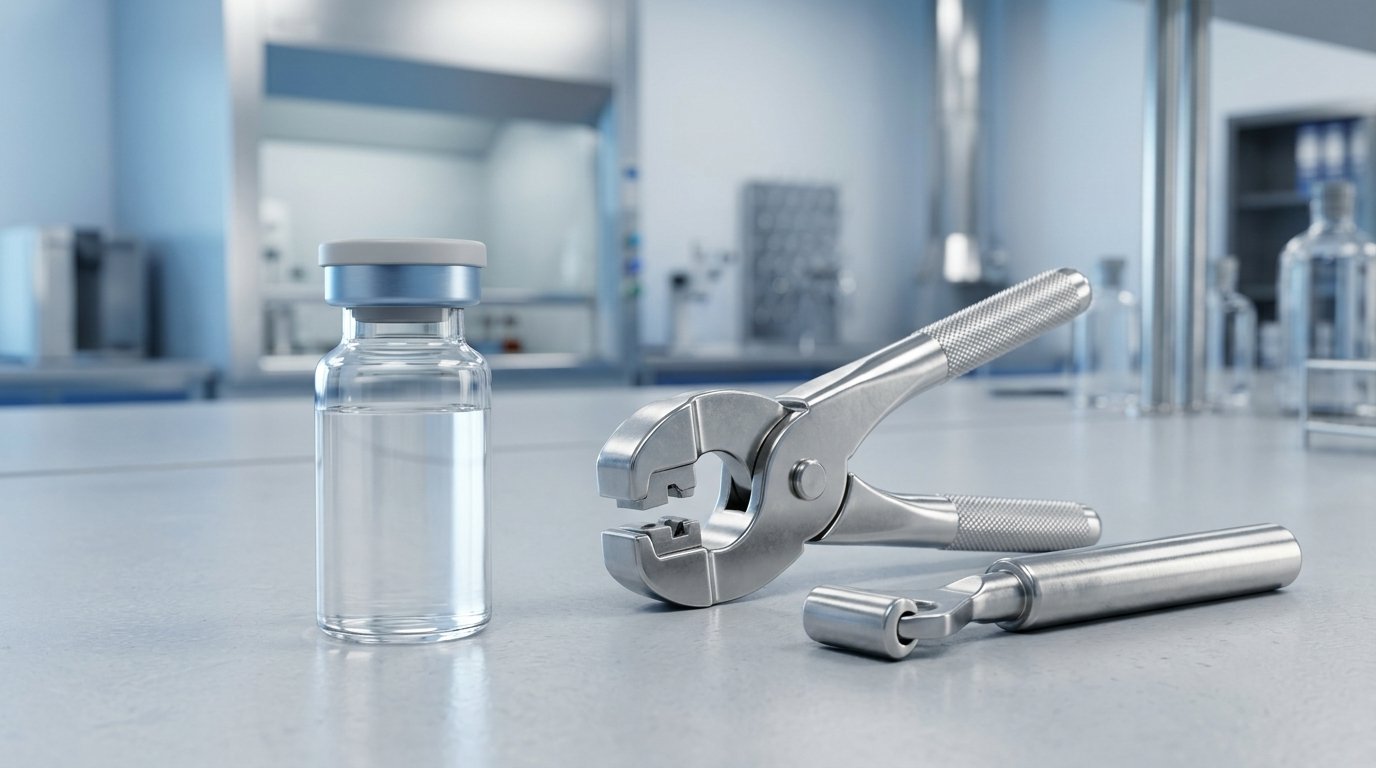
For administering a dose you do not remove a flip-off cap at all. You flip the plastic button off with a thumb, which exposes the centre of the stopper, and the aluminium skirt stays crimped on the vial where it belongs. Full removal of the aluminium is a laboratory operation, not a clinical one, and it has three realistic methods: bare hands (highest risk, avoid), a hand decapper or decrimping pliers (the normal laboratory choice), and a bench or powered decapper (for volume). The right method is decided by what you actually need off the vial and by which risks your setting can tolerate.
This page compares the methods against each other rather than teaching any one of them. Step-by-step instructions live elsewhere: how to open a vial with a metal cap covers routine opening, how to remove a metal vial cap without a tool covers the no-tool case, and how to open a vial cap covers each seal type.
Key takeaways
- Flipping the button is not removal. The button detaches; the crimped aluminium skirt stays and continues to hold the stopper against the glass.
- Full removal is rarely needed clinically. It belongs to quality control, analytical sampling, stopper recovery and waste processing.
- Bare-hand removal carries the highest risk: cut aluminium edges are sharp and prying against a glass neck invites breakage.
- A hand decapper is the standard laboratory tool, designed to peel or split the skirt in a controlled way with the vial held steady.
- Bench and powered decappers suit volume, with more consistent force and better operator protection, at the cost of setup and footprint.
- A crimper is not a decapper. One applies the seal on a capping line or bench; the other removes it. Some hand tools combine both functions.
What you are actually trying to remove
Two different things are called cap removal, and they need different methods. The first is the moulded plastic button, which is designed to come away with thumb pressure. Bridges under the disc shear, the disc leaves the cap, and a small central area of the stopper is exposed for a needle. Maximum opening force is specified by the manufacturer per size, which is why a 13 mm seal feels lighter than a 32 mm one.
The second is the crimped aluminium skirt, which is not designed to be removed by hand at all. Its job is to hold the stopper compressed against the glass for the life of the product, and it does that by being permanently deformed under the neck flange. Anything that removes it is defeating a mechanical joint, which is why tools exist. The mechanism itself is described in how flip-off caps work, and the crimping step in vial crimping explained.
The four methods compared
The table sets out what each method removes, where it belongs, and what it costs in risk.
| Method | What it removes | Tool needed | Typical setting | Speed | Main risks |
|---|---|---|---|---|---|
| Thumb flip | The plastic button only | None | Clinical, ward, pharmacy, any point of use | Immediate | Minimal; stopper must still be disinfected before needle entry |
| Bare-hand full removal | The aluminium skirt | None | Not recommended | Slow and inconsistent | Laceration from cut aluminium edges, glass breakage at the neck, stopper contamination and displacement |
| Hand decapper or decrimping pliers | The aluminium skirt | Handheld decapper | Quality control, analytical and R&D laboratories | Seconds per vial | Controlled, but still generates a sharp metal offcut; requires the vial to be held steady |
| Bench or powered decapper | The aluminium skirt | Bench-mounted or powered unit | Laboratories processing many vials | Fastest at volume | Setup and footprint; needs the correct size adaptor for the neck finish |
Two points sit behind the table. First, only the top row is part of normal drug administration. Second, every row below it destroys the closure, so the vial cannot go back to a sealed state and any remaining contents should be treated accordingly.
When full removal is legitimate
Removing the aluminium skirt is a laboratory operation with four common justifications. Analytical sampling, where the stopper has to come out to access or transfer the full contents. Stopper recovery, where the elastomeric component itself is the item under test, for example in extractables work or a functional assessment under USP <381> or USP <382>. Investigational work on a sealed unit, such as examining a suspected integrity failure. And waste or material segregation, where aluminium, glass and elastomer are separated for disposal or recycling.
Outside those cases, removal is usually a sign that the wrong closure or the wrong presentation was specified. If a workflow genuinely needs the whole top off at the point of use, an all-aluminium tear-off or tear-down seal is the closure designed for that, as compared in tear-off vs tear-down seals.
Risk, and why bare hands is the wrong answer
Three specific hazards make unaided removal a poor choice, and all three are worse under time pressure. Sharp edges come first: once the aluminium is torn or peeled, the exposed edge is thin metal, and a slip across it cuts. Glass breakage comes second: the force needed to lift a crimp is applied close to the neck, which is the part of a vial least tolerant of point loading, and a break in the hand combines glass and a sharp metal edge. Contamination comes third: the exposed stopper is the surface a needle will pass through, and fingers, tools and metal fragments over that surface defeat the reason the closure existed.
For anyone whose real question is simply how to get at the medicine, the answer is the thumb flip, followed by disinfecting the exposed stopper before needle entry, per your institution’s procedure. Nothing about a properly applied flip-off cap requires the metal to be removed for administration.
Choosing between a hand decapper and a bench unit
Volume and consistency decide it. A hand decapper is cheap, portable, and appropriate for occasional work, a handful of vials at a time, and mixed neck sizes if the tool covers them. It depends on operator technique, so the force applied and the resulting offcut vary between people.
A bench or powered decapper delivers more repeatable force, holds the vial for the operator, and is faster once set up, which matters when a stability pull or a batch investigation involves dozens of units. It needs the correct adaptor for each neck finish, so a laboratory handling 13, 20 and 32 mm vials needs the matching set. In both cases, work over a tray, wear eye protection and cut-resistant gloves as your local risk assessment requires, and dispose of metal offcuts as sharps.
Finally, confirm what the tool is. A crimper closes a vial by rolling the aluminium skirt under the neck flange; a decapper opens one. Bench crimpers and bench decappers look similar and are often sold as a pair, and using the wrong one damages the vial.
How this works in practice at Autofits
Opening force is a designed property of the seal, not an accident, and Autofits specifies a maximum per size on the FlipTop Optima: 30 N at 13 mm, 35 N at 20 mm and 28 mm, and 65 N at 32 mm. The figure scales with diameter and with the number of tapered bridges holding the disc, six on the 13 mm and 20 mm, eight on the 28 mm, and twelve on the 32 mm. The Button design carries intrinsic tamper evidence through a twelve-stem flower formed under the disc, so an opened part is visibly distinct from a sealed one. Discs are moulded in-house from polypropylene conforming to FDA 21 CFR 177.1520 and every seal passes 100% high-speed camera inspection, which is what keeps opening force consistent across a lot. Production is under ISO 9001:2015, ISO 14001:2015 and ISO 15378:2017 with Drug Master File 18100; certificates are on the quality page.
Two applications turn removal technique into a written procedure rather than a habit. On cytotoxic and oncology vials the method is a containment control, because a slip can disturb residue around the stopper. On anaesthetic vials the constraint is speed under pressure, so a clean single-handed open matters more than anything else on this page. The step-by-step for each seal type is on how to open a vial cap.
Frequently asked questions
Do you have to remove the metal part of a flip-off cap?
No. For normal use you flip off only the plastic button, which exposes the centre of the rubber stopper for a needle. The aluminium skirt stays crimped on the vial and continues to hold the stopper against the glass, which is what maintains the closure. Removing the metal is a laboratory operation, not part of administering a dose.
What tool removes an aluminium vial seal?
A decapper, also called a decrimping tool. Handheld decapping pliers are the usual laboratory choice for small numbers of vials, and bench-mounted or powered decappers are used where many vials are processed. Both need to match the vial neck size. A crimper is the opposite tool: it applies a seal rather than removing one, although some hand tools combine the two functions.
Is it safe to remove a vial cap by hand?
It is the highest-risk option and is generally avoided in laboratory practice. Torn aluminium leaves a sharp edge, prying near the neck can break the glass, and handling over the exposed stopper contaminates the surface a needle will pass through. Where the metal genuinely has to come off, use a decapper, work over a tray with eye protection, and dispose of offcuts as sharps.
Why is a 32 mm flip-off cap harder to open than a 13 mm one?
Because opening force scales with the diameter and with the number of bridges holding the plastic disc. On the Autofits FlipTop Optima the specified maximum is 30 N at 13 mm and 65 N at 32 mm, with six tapered bridges on the smaller size and twelve on the larger. A larger disc simply has more attachment points to shear.
Can a vial be resealed after the cap is removed?
Not to its original condition. The crimp is a permanent deformation of the aluminium under the neck flange, and once the button is flipped or the skirt is cut away the closure cannot be restored. That irreversibility is the tamper evidence. Re-sealing would require a fresh seal applied on a capping station, which is a manufacturing operation with its own integrity qualification.
Related reading
- How to open a vial with a metal cap
- How to remove a metal vial cap without a tool
- How flip-off caps work
- Vial crimping explained
- Flip-off seal: definition
- Tear-off vs tear-down seals
Sources
- ISO: ISO 8362-6:2010, Injection containers and accessories, Part 6: Caps made of aluminium-plastics combinations for injection vials (https://www.iso.org/standard/52806.html)
- ISO: ISO 8362-3:2001, Injection containers and accessories, Part 3: Aluminium caps for injection vials (https://www.iso.org/standard/33804.html)
- USP: USP General Chapter <382> Elastomeric Component Functional Suitability in Parenteral Product Packaging and Delivery Systems (https://www.usp.org)
- USP: USP General Chapter <1207> Package Integrity Evaluation, Sterile Products (https://www.usp.org)
- ISO: ISO 15378:2017, Primary packaging materials for medicinal products (https://www.iso.org/standard/70729.html)
*Last updated: 2026-07-31. This article is general technical information about pharmaceutical vial closures and laboratory handling, not clinical, safety or regulatory advice. Follow your institution’s standard operating procedures, local risk assessment and the product’s approved labelling.*
