
Sterile Vial Sealing: How Injectable Vials Are Sealed Sterile
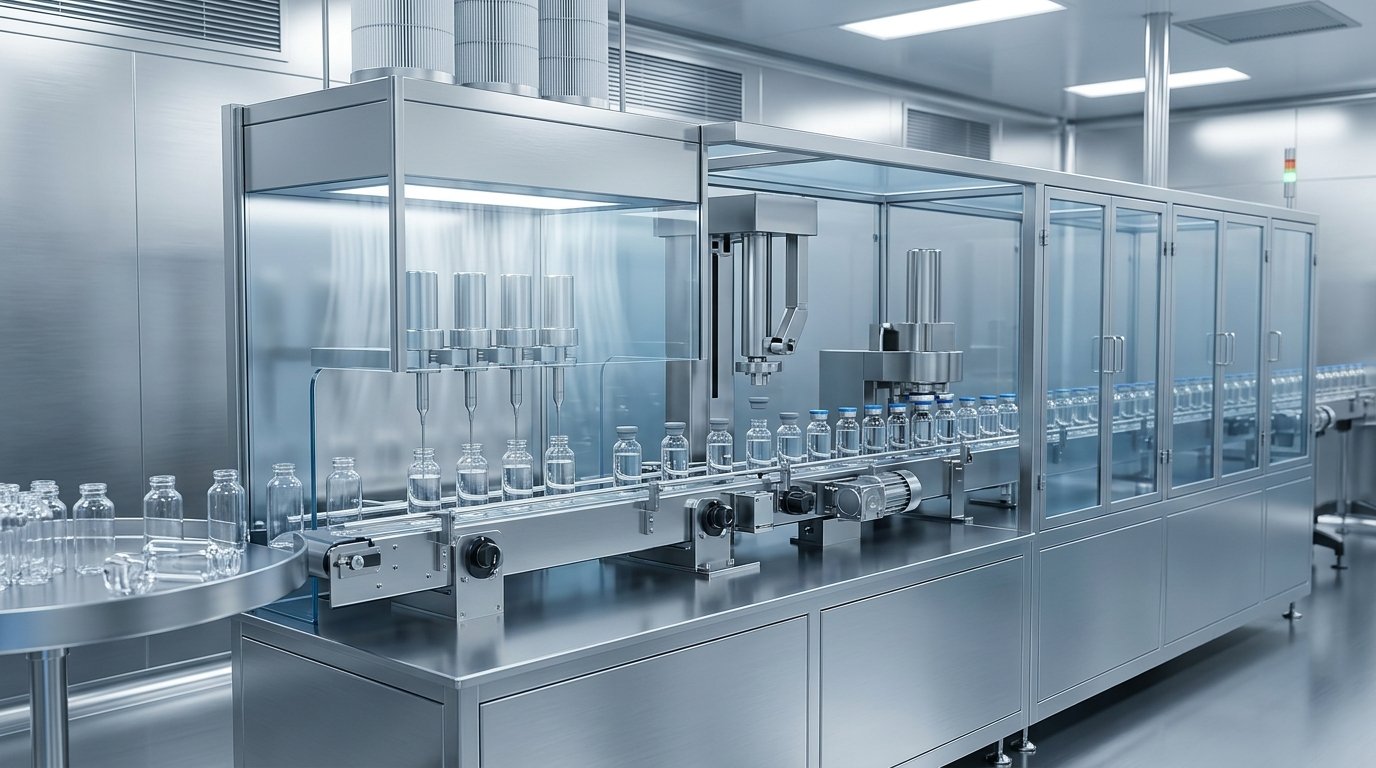
Sterile vial sealing is the process of filling, stoppering, and capping an injectable vial under controlled, aseptic conditions so that the product stays sterile from the moment it is sealed until the moment it is used. Because most injectables cannot be sterilised again once the vial is closed, the sealing step has to preserve sterility, not just close the vial. The rubber stopper forms the sterile barrier, the crimped seal holds it, and the surrounding cleanroom environment keeps the product from being contaminated before the seal is in place.
This guide explains why sterile sealing is different from ordinary sealing, how the process keeps a vial sterile, the role of the closure, and how it is controlled and verified.
Key takeaways
- Sterile vial sealing seals an injectable vial under aseptic conditions so the product stays sterile until use.
- Most injectables cannot be re-sterilised once sealed, so the sealing process itself must preserve sterility.
- The rubber stopper forms the sterile barrier; the crimped seal holds it compressed against the glass.
- Filling and stoppering happen in a classified cleanroom environment; capping is a controlled, inspected step.
- The expectations for sterile manufacturing are set by EU GMP Annex 1; the package’s integrity is verified per USP <1207>.
- A sound sterile seal depends on clean, dimensionally consistent components that crimp reliably.
Why sterile sealing is different
Sterile vial sealing is different from ordinary sealing because the product is sterile and usually cannot be sterilised again after the vial is closed, so the sealing process has to keep it sterile rather than simply close it. For a non-sterile product, a leak is a quality problem; for a sterile injectable, a contamination event or a loss of seal is a patient-safety and sterility failure.
This is why sterile injectables, from biologics to cytotoxic oncology products, are made by aseptic processing or terminal sterilisation, and why the filling and sealing steps for aseptically processed products are carried out in a tightly controlled environment. The goal is that nothing contaminates the product between sterilisation and the moment the vial is sealed, and that the sealed package then maintains sterility for the whole shelf life. The closure is central to both.
How the process keeps a vial sterile
The process keeps a vial sterile by performing the open steps (filling and stoppering) in a classified clean environment, then sealing the vial so the sterile barrier is established and held. The sequence builds on the general vial sealing process, with sterility controls layered on:
- Sterilised components. The vial, stopper, and seal are cleaned and sterilised (or supplied ready-to-use) before they enter the line; the component stream is described in full in the vial fill-finish process.
- Aseptic filling and stoppering. The drug is filled and the stopper inserted in a classified environment (for aseptic processing, the most critical operations are in the highest-grade zone), so the open vial is not exposed to contamination.
- Capping (crimping). The seal is crimped over the stopper to lock the sterile barrier in place. Capping is a controlled step and may be done in a controlled environment appropriate to the process, on the equipment described in automated vial capping systems.
- Inspection. Sealed vials are inspected for defects such as missing or damaged seals that could indicate an integrity risk.
For freeze-dried sterile products, the slotted stopper is partly seated for drying and pushed home inside the freeze-dryer before capping, as covered by ISO 8362-5.
The role of the closure in sterility
The closure is what maintains sterility after sealing: the rubber stopper forms the barrier, and the crimped seal holds the stopper compressed against the glass so the barrier stays intact for the product’s shelf life. Sterility is not a one-time event at sealing; it has to be preserved continuously, and that is the closure’s job.
- The elastomeric closure, usually a butyl rubber stopper, seals against the glass and reseals after needle penetration.
- The aluminium or aluminium-plastic seal crimps over the stopper, holding it in compression. A poor crimp can leave a leak path, an integrity failure.
- Keeping the package sealed is container closure integrity, the property addressed by USP <1207> and verified by container closure integrity testing.
So the seal that finishes a sterile vial is not just a cap; it is the component that keeps the product sterile until use, which is why its application is controlled and its integrity tested.
How sterile sealing is controlled and verified
Sterile vial sealing is controlled through the cleanroom environment and the capping parameters, and verified through inspection and container closure integrity testing. The controls reflect that the closure is part of sterility assurance.
- Environmental control. EU GMP Annex 1 sets out the expectations for sterile manufacturing, including environmental classification for the open steps and control of the capping operation.
- Capping control and inspection. Capping is treated as a critical step; sealed vials are inspected for missing, raised, or defective seals, since these can signal an integrity risk.
- Integrity testing. Container closure integrity is demonstrated within the framework of USP <1207>, confirming the sealed package has no leak path.
- Component quality. Clean, dimensionally consistent stoppers and seals are needed so the crimp is reliable; component manufacturers work to quality systems such as ISO 15378.
Seal specifications for sterile filling
Controlled dimensions for the seals used to finish sterile vials, from the Autofits engineering drawings. The nominal size follows the vial neck finish under ISO 8362-1 and the stopper of the same nominal diameter, so the size is fixed by the vial rather than chosen at the capping station.
| Size | Inner Ø aluminium (D1) | Outer Ø disc (D2) | Total seal height | Aluminium thickness | Bridges | Max opening force | Standard packing per box |
|---|---|---|---|---|---|---|---|
| 13 mm | 13.36 mm (min) | 14.99 mm (max) | 7.62–8.38 mm | 0.16–0.20 mm | 6 taper | 30 N | 15,000 (5,000 × 3 bags) |
| 20 mm | 20.22 mm (min) | 23.14 mm (max) | 9.02–9.91 mm | 0.16–0.20 mm | 6 taper | 35 N | 6,000 (2,000 × 2 bags) |
| 28 mm | 27.60–28.20 mm | 30.10–31.10 mm | 11.06–12.06 mm | 0.17–0.23 mm | 8 | 35 N | 3,000 (1,500 × 2 bags) |
| 32 mm | 32.10–32.90 mm | 35.50–36.50 mm | 14.30–15.50 mm | 0.21–0.25 mm | 12 taper | 65 N | 1,400 (700 × 2 bags) |
| 34 mm | 33.60–34.00 mm | 35.50–36.50 mm | 15.00–16.00 mm | 0.20–0.25 mm | 8 taper | On request | On request |
Figures are for the FlipTop Optima flip-off range, made as aluminium-plastics combination caps to ISO 8362-6. Where a sterile presentation calls for full removal rather than a flip button, all-aluminium tear-off and tear-down seals are made in 13, 20 and 32 mm and relate to ISO 8362-3. Every size can be reached from the by-size hub, including 13 mm, 20 mm and 28 mm.
Forms of supply for a sterile line
Ready-to-Use seals are the presentation made for aseptic filling: washed to remove particles, assembled in an ISO Class 8 cleanroom, double-lacquered, then gamma sterilized, with a shelf life of 2 years before capping. They are supplied double-bagged, so the outer bag is stripped at the airlock and the inner bag passes into the aseptic area intact, with no washing or sterilisation step needed on site. ETO sterilization is available as an alternative to gamma where the site’s validation calls for it.
Two other forms exist for lines that prepare components themselves. Ready-to-Sterilize seals arrive clean and bagged, for the customer’s own validated cycle before the components cross into the core. Regular seals are non-sterile and suit capping performed as a clean process outside the aseptic core under a Grade A air supply, which is the common arrangement, as well as terminally sterilised products. Shelf life for non-irradiated seals is 3.5 years before capping, plus 5 years after capping.
Standard packing is 15,000 per box at 13 mm (5,000 in each of three bags), 6,000 at 20 mm (2,000 in each of two bags), 3,000 at 28 mm (1,500 in each of two bags) and 1,400 at 32 mm (700 in each of two bags), in a 420 × 270 × 320 mm shipper. Tyvek bagging is available where the site’s transfer procedure calls for it, and colours are supplied matte or glossy, customised to requirement. To specify a seal for a sterile line, send the vial neck finish, the stopper reference, the nominal size, whether capping runs inside or outside the aseptic core, and the required form of supply through the contact page, or start from the product range.
How this works in practice at Autofits
Autofits supplies the seals used to finish sterile vials and produces them under conditions suited to primary packaging for sterile injectables. The range includes FlipTop Optima flip-off seals in 13, 20, 28, 32 and 34 mm, tear-off and tear-down aluminium seals and pull-ring seals in the smaller size set, and aluminium pilfer-proof (ROPP) caps; the full products page lists the range and the by-size hub sorts it by nominal size. The shell is AA8011 aluminium with an epoxy lacquer to 21 CFR 175.300 and the disc is polypropylene to 21 CFR 177.1520, moulded in house on Japanese Toyo injection machines. Production runs in a 75,000 sq ft Nashik facility that includes an ISO Class 8 cleanroom, with 100% high-speed camera inspection on the closure lines, under an ISO 15378:2017 quality system alongside ISO 9001:2015 and ISO 14001:2015 certification and Drug Master File 18100. Components are BSE/TSE-free to EMEA/410/01 rev. 3, with heavy metals held to a maximum 100 ppm total, and AQL is set at critical nil, major not more than 2.5% and minor not more than 4%. Clean, dimensionally consistent seals are what let a customer’s capping line produce a reliable sterile seal at speed. The full certification set is on the quality page.
Frequently asked questions
What is sterile vial sealing?
Sterile vial sealing is the process of filling, stoppering, and capping an injectable vial under controlled, aseptic conditions so the product stays sterile from sealing until use. Because most injectables cannot be sterilised again once the vial is closed, the sealing step has to preserve sterility, with the rubber stopper forming the barrier and the crimped seal holding it in place.
Why must vial sealing be done under aseptic conditions?
Because most sterile injectables cannot be re-sterilised after the vial is sealed, the open steps of filling and stoppering must happen in a classified clean environment so the product is not contaminated before sealing. EU GMP Annex 1 sets the expectations for these aseptic conditions and for controlling and inspecting the capping step.
What keeps a vial sterile after it is sealed?
The closure keeps the vial sterile after sealing. The rubber stopper forms the sterile barrier against the glass and reseals after a needle is withdrawn, and the crimped aluminium seal holds the stopper compressed so the barrier stays intact for the shelf life. Keeping the package sealed is container closure integrity, verified by integrity testing.
How are Ready-to-Use sterile seals prepared?
Ready-to-Use seals are washed to remove particles, assembled in an ISO Class 8 cleanroom, double-lacquered and then gamma sterilized, with ETO available as an alternative. They are supplied double-bagged so the outer bag can be removed at the airlock and the inner bag taken into the aseptic area intact, with no washing or sterilisation needed on site. Shelf life is 2 years before capping, against 3.5 years before capping for non-irradiated seals.
How is a sterile seal verified?
A sterile seal is verified by inspecting sealed vials for missing, raised, or damaged seals, and by container closure integrity testing that confirms there is no leak path, within the framework of USP <1207>. Under EU GMP Annex 1, capping is a controlled step and sealed vials are inspected as part of sterility assurance.
How are freeze-dried sterile products sealed?
For a freeze-dried sterile product, a slotted stopper is set in a raised position so vapour can escape during drying, then pushed fully home inside the freeze-dryer to seal the vial, often under vacuum or inert gas, without exposing the product to room air. An aluminium or aluminium-plastic seal is then crimped over the stopper. The slotted freeze-drying closure is covered by ISO 8362-5.
Related reading
- FlipTop Optima flip-off seals, all five sizes
- Browse seals by size
- Tear-down seals
- Vial crimping explained
- EU GMP Annex 1: manufacture of sterile medicinal products
- Container closure integrity testing
Sources
- European Commission: EudraLex Volume 4, EU GMP Annex 1, Manufacture of Sterile Medicinal Products (https://health.ec.europa.eu/medicinal-products/eudralex/eudralex-volume-4_en)
- USP-NF: General Chapter <1207>, Package Integrity Evaluation, Sterile Products (https://www.usp.org/)
- ISO: ISO 15378:2017, Primary packaging materials for medicinal products (https://www.iso.org/standard/70729.html)
- ISO: ISO 8362-6:2010, Injection containers and accessories, Part 6: Caps made of aluminium-plastics combinations for injection vials (https://www.iso.org/)
- Autofits FlipTop Seals dossier and engineering drawings (working/spec-sheets/)
*Last updated: 2026-08-18. This article is general technical information, not regulatory or compliance advice; confirm current standard editions and requirements with the issuing bodies.*
