
Aluminium vs Aluminium-Plastic Seals: Integrity, Tamper Evidence & Cost Compared
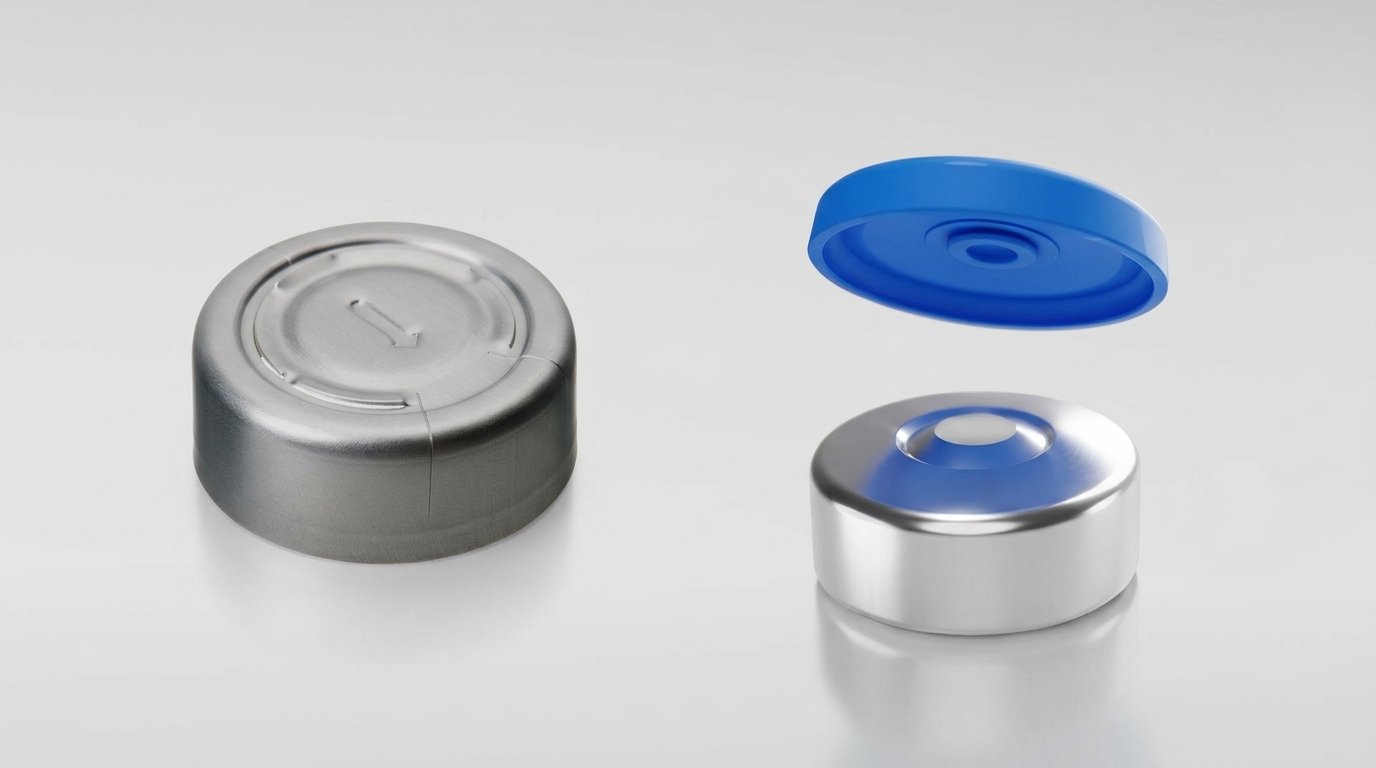
An all-aluminium seal is a single-metal crimped cap that is fully or partially torn off to open, while an aluminium-plastic (combi) seal adds a moulded plastic top over the aluminium shell to give a clean, low-particle opening and a printable, colour-coded surface. Both seal the same way at the integrity level, by crimping an aluminium skirt around the rubber stopper and the vial neck. The difference is the top: bare aluminium versus an aluminium-plus-plastic combination. For injectable vials, the aluminium-plastic flip-off design is now the dominant format, while plain aluminium tear-off and tear-down seals remain common on oral and lower-cost applications.
This page compares the two constructions on integrity, tamper evidence, opening experience, customisation, and cost so you can match the seal to the application.
Key takeaways
- Both rely on the same aluminium crimp for container closure integrity; the plastic top is an access and identification feature, not a sealing feature.
- All-aluminium seals (tear-off, tear-down) open by removing metal, which can shed particles and leave sharp edges if mishandled.
- Aluminium-plastic (combi) seals open by flipping or lifting a plastic button while the aluminium crimp stays in place, giving a cleaner, more controlled opening.
- Combi seals dominate injectable flip-offs because the plastic top enables easy, low-particle access and clear colour coding at the point of use.
- Plastic adds customisation: the disc can be printed, embossed, and colour-coded in matte or glossy finishes; the aluminium can also be coloured and printed.
- All-aluminium seals are typically simpler and lower cost; the combi seal carries the added value of the moulded plastic component.
What is the difference between aluminium and aluminium-plastic seals?
An all-aluminium seal is formed entirely from aluminium and is opened by tearing the metal, whereas an aluminium-plastic seal combines an aluminium shell with a moulded plastic top. In both cases the seal is applied by crimping the aluminium skirt under the lip of the vial, which compresses the rubber stopper and holds it in place. That crimp is what maintains container closure integrity, the sealed sterile barrier that keeps the product protected. A container closure system is only as good as the seal that secures the stopper, regardless of whether the top is metal or plastic.
All-aluminium seals come in two common forms: the tear-off seal, where the entire metal top is pulled away, and the tear-down seal, where a perforated section is torn down to open. Aluminium-plastic seals, also called combi seals, are most familiar as the flip-off seal used on injectable vials, where a plastic button flips up to expose the stopper while the aluminium crimp remains.
Which holds container closure integrity better?
Neither construction is inherently more secure, because integrity comes from the aluminium crimp around the stopper, not from the top of the seal. A correctly applied aluminium skirt, crimped to the right dimensions, compresses the elastomeric stopper against the vial to maintain the sterile barrier. Both all-aluminium and aluminium-plastic seals share this same crimping mechanism, so both can deliver equivalent integrity when applied correctly.
What matters for integrity is the consistency of the seal and the capping process, not the presence of plastic. Regulatory frameworks for sterile products treat the sealed vial as a unit: EU GMP Annex 1 sets expectations for the manufacture of sterile medicinal products and for the inspection of sealed vials, and container closure integrity is verified through container closure integrity testing methods described in USP <1207>. Because the crimp does the sealing, the choice between metal and combi tops is driven by opening, identification, and cost rather than by integrity.
How do tamper evidence and opening differ?
Both seal types provide tamper evidence, but they show it differently: an all-aluminium seal is irreversibly torn to open, while an aluminium-plastic seal flips a plastic button that cannot be reset once removed. With a tear-off or tear-down seal, the missing or broken metal is the visible evidence that the vial has been opened. With a flip-off combi seal, lifting the plastic button is a one-way action that exposes the stopper, and the button cannot be cleanly replaced.
The opening experience is where the constructions diverge most:
- All-aluminium (tear-off / tear-down): the user removes or tears metal. This works well but can shed metal particles and leave sharp edges if the seal is mishandled, which is why full metal removal is less suited to point-of-care injectable use.
- Aluminium-plastic (flip-off): the user flips a plastic button to expose the rubber stopper while the aluminium crimp stays on the vial. The needle is then inserted through the cleaned stopper. The metal stays put, so the opening is cleaner and lower in particles.
This cleaner, controlled access is the main reason combi flip-off seals dominate injectable vials. The full mechanical difference between flipping a button and removing the whole metal top is covered in flip-off vs tear-off seals.
Customisation: where plastic adds the most value
The plastic top is the most customisable surface on a vial seal: it can be printed, embossed, and supplied in a wide range of colours and either a matte or glossy finish. Colour coding on the plastic button is widely used to distinguish products, strengths, or production batches at the point of use, which reduces the chance of selection errors. The plastic disc can also carry printed text or an embossed mark for branding and identification.
All-aluminium seals are not without customisation: the metal itself can be coloured and printed. But the moulded plastic top of a combi seal gives a larger, more controllable surface for colour and print, and the colour palette on the plastic is effectively unlimited for custom requirements. For products that depend on clear visual differentiation, such as injectable ranges with many strengths, that customisation is a practical advantage of the aluminium-plastic format.
Cost and application fit
All-aluminium seals are generally the simpler, lower-cost option, while aluminium-plastic seals carry the added value and cost of the moulded plastic component and its customisation. The right choice depends on the application rather than on cost alone.
| Factor | All-aluminium seal (tear-off / tear-down) | Aluminium-plastic (combi / flip-off) seal |
|---|---|---|
| Construction | Single aluminium component | Aluminium shell plus moulded plastic top |
| Integrity mechanism | Aluminium crimp over stopper | Aluminium crimp over stopper (identical) |
| Opening | Tear off or tear down the metal | Flip the plastic button, crimp stays on |
| Particle / sharp-edge risk at opening | Higher if mishandled | Lower (no metal removed) |
| Tamper evidence | Torn or missing metal | One-way flipped plastic button |
| Surface for print / colour | Metal can be coloured and printed | Large plastic disc, printable, embossable, wide colour range |
| Finish options | Metal finish | Matte or glossy plastic disc |
| Typical applications | Oral medicines, lower-cost lines | Injectable vials, vaccines, where clean access matters |
| Relative cost | Lower | Higher (added plastic component) |
In practice, oral medicines and cost-sensitive lines often use plain aluminium tear-off or tear-down seals, while injectable and vaccine vials use aluminium-plastic flip-off seals for clean access and colour coding. The two are not competitors so much as different tools for different closure requirements.
How this works in practice at Autofits
Autofits manufactures both constructions: aluminium-plastic FlipTop® seals (including the FlipTop Optima flip-off seals, Pull Ring, and Tear Down sub-ranges) and plain aluminium tear-off seals and tear-down seals, across 13 mm, 20 mm, and 32 mm sizes. On the combi seals, the plastic disc is offered in matte or glossy finishes and can be printed and embossed, with colour available on both the plastic and the metal. Production runs under an ISO 15378:2017 quality system in a 75,000 sq ft Nashik facility with an ISO Class 8 cleanroom and high-speed visual inspection, so seals of either construction are made under the same GMP-aligned controls. You can review the certifications on the quality page and see the full closure range on the product hub.
The construction choice tends to follow the application. Cost-led, non-parenteral fills such as diagnostic and IVD reagent vials and research and lab reagent vials are where an all-aluminium tear-off earns its place. IV diluent and saline presentations usually want the plastic disc instead, for the controlled injection point and the colour coding that stops a diluent being confused with the drug it reconstitutes.
Frequently asked questions
Are aluminium-plastic seals more secure than all-aluminium seals?
Not inherently. Both seal types maintain container closure integrity through the same mechanism: an aluminium skirt crimped around the rubber stopper and vial neck. The plastic top on a combi seal is an access and identification feature, not part of the sterile seal, so a correctly applied seal of either type can deliver equivalent integrity.
Why do injectable vials use flip-off (aluminium-plastic) seals?
Injectable vials use aluminium-plastic flip-off seals because the plastic button can be flipped to expose the stopper while the aluminium crimp stays on the vial. This gives clean, low-particle access at the point of use and a clear colour-coded surface for distinguishing products and strengths, which suits sterile injectable handling better than removing the whole metal top.
Can all-aluminium seals be colour coded?
Yes. Aluminium seals can be coloured and printed, so all-aluminium tear-off and tear-down seals can carry colour coding and printed marks. The moulded plastic top on a combi seal simply offers a larger, more flexible surface for colour and print, with an effectively unlimited colour range for custom requirements.
Which costs less, aluminium or aluminium-plastic seals?
All-aluminium seals are generally lower cost because they are a single metal component with no moulded plastic part, though the metal specification still matters, as aluminium grades used in vial caps sets out. Aluminium-plastic seals carry the added material and processing of the plastic top, along with its customisation options, so they typically sit at a higher cost. The right choice depends on the application rather than cost alone. Once the type is settled, the specification-level comparison walks the RFQ line by line: which ISO part applies, what appears on each bill of materials, and which dimensions are controlled on each.
What is a combi seal?
A combi seal is an aluminium-plastic seal: an aluminium shell crimped over the rubber stopper with a moulded plastic top. The flip-off seal used on injectable vials is the most common combi seal. The plastic top provides easy opening, tamper evidence, and a printable, colour-codable surface, while the aluminium crimp maintains container closure integrity.
Related reading
- What an aluminium-plastic (combi) seal is
- Flip-off seals explained
- Tear-off seals explained
- Flip-off vs tear-off seals compared
- ISO 15378:2017 and GMP-aligned packaging quality
Sources
- USP: USP-NF and General Chapters, including <1207> Package Integrity Evaluation, Sterile Products (https://www.usp.org/)
- European Commission / EMA: EU GMP Annex 1, Manufacture of Sterile Medicinal Products (https://health.ec.europa.eu/medicinal-products/eudralex/eudralex-volume-4_en)
- ISO: ISO 15378:2017, Primary packaging materials for medicinal products (https://www.iso.org/standard/70729.html)
*Last updated: 2026-06-10. This article is general technical information, not regulatory or compliance advice; confirm current standard editions and product specifications with the relevant standards bodies and your supplier.*
