
Pilfer-Proof Cap vs Flip-Off Seal: Closure Types Compared
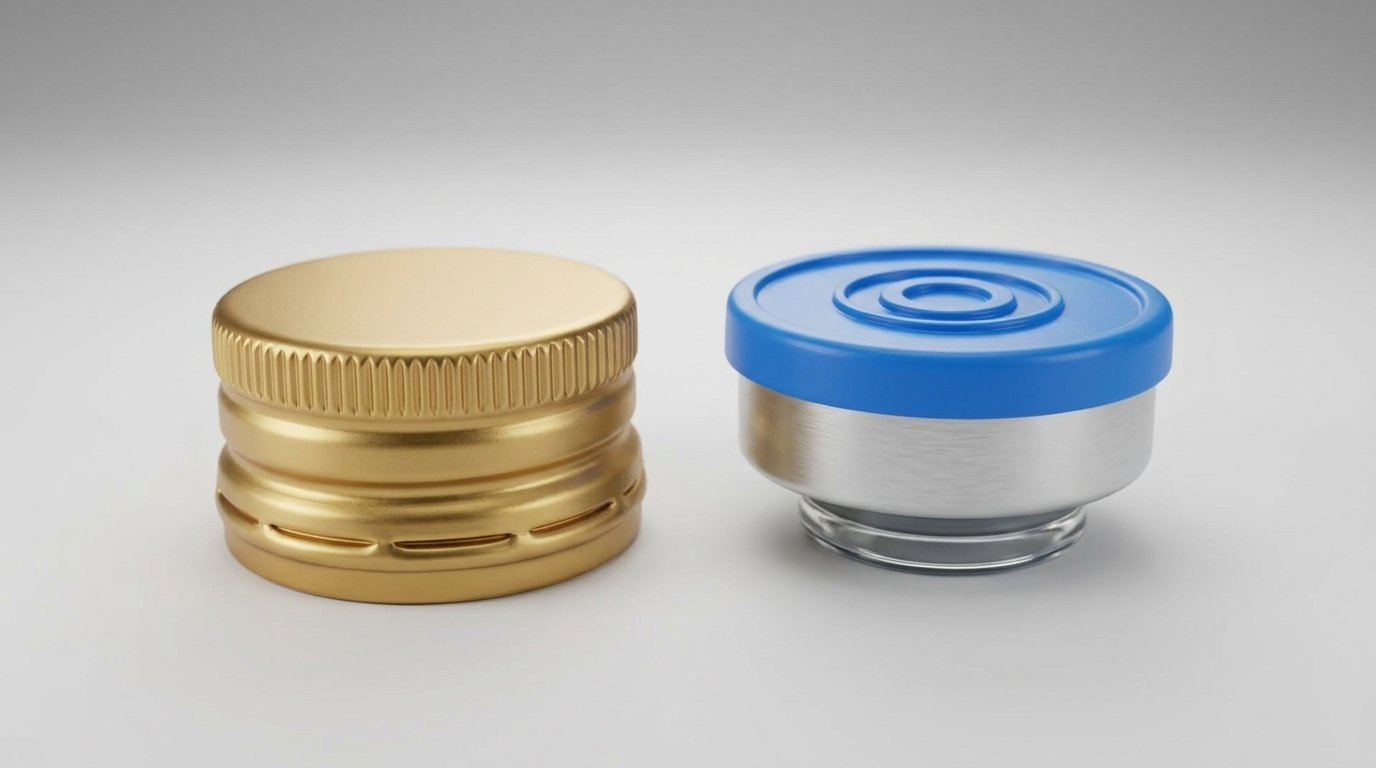
A pilfer-proof (ROPP) cap and a flip-off seal are both tamper-evident aluminium closures, but they seal different containers in different ways. A pilfer-proof cap is a roll-on aluminium cap threaded onto a bottle neck, with a tear-off pilfer band that shows if the cap has been opened. A flip-off seal is an aluminium-plastic combination seal crimped over the rubber stopper of an injectable vial, with a plastic flip button that exposes the stopper while the aluminium skirt stays crimped in place. The short version: pilfer-proof caps close threaded bottles (often oral liquids); flip-off seals close stoppered injectable vials.
This page compares the two closure types on construction, the container each is built for, how each provides tamper evidence, how each is opened, and where each is typically used.
Key takeaways
- Pilfer-proof (ROPP) = roll-on pilfer-proof aluminium cap, formed onto a threaded bottle neck during capping, with a tear-off pilfer band.
- Flip-off seal = aluminium-plastic combination seal, crimped over the rubber stopper of an injectable vial, with a plastic flip-top button.
- Different containers: pilfer-proof caps suit threaded bottles; flip-off seals suit small stoppered glass vials for injectables.
- Different tamper evidence: a ROPP cap separates a pilfer band from the cap when first opened; a flip-off seal’s broken plastic button and crimped skirt show prior access.
- Different opening: a ROPP cap unscrews and breaks its band; a flip-off seal’s button flips off to expose the stopper for needle entry, with no unscrewing.
- Both are aluminium-based tamper-evident closures, so the right choice depends on the container and the dosage form, not on which is “more secure.”
Pilfer-proof (ROPP) cap vs flip-off seal: the core difference
The core difference is the sealing principle. A pilfer-proof cap is threaded (rolled) onto a bottle, while a flip-off seal is crimped over a stopper on a vial. ROPP stands for roll-on pilfer-proof: the cap starts as a plain aluminium shell that is placed over the bottle and then formed, by rollers in the capping head, to follow the threads moulded into the bottle neck. The same operation forms a separate pilfer band at the base of the cap.
A flip-off seal works differently. The vial is first closed with a rubber (elastomeric) stopper, and the aluminium-plastic seal is then crimped down over the stopper and the vial neck. The aluminium skirt holds the stopper compressed against the glass, which is what maintains container closure integrity on a sterile injectable. The plastic flip button sits on top and is removed at the point of use.
So one closure relies on threads and a rolled-on fit (bottle), and the other relies on a crimp over a stopper (vial). That single distinction drives every other difference below.
How each closure is built and used
A pilfer-proof cap closes a threaded bottle and is opened by unscrewing; a flip-off seal closes a stoppered vial and is opened by flipping a button to reach the stopper. The table below sets them side by side.
| Attribute | Pilfer-proof (ROPP) cap | Flip-off seal |
|---|---|---|
| Closure type | Threaded roll-on aluminium cap | Crimped aluminium-plastic combination seal |
| Sealing principle | Rolled (formed) onto bottle threads | Crimped over a rubber stopper on the vial neck |
| Typical container | Bottle (glass or plastic) with a threaded neck | Small stoppered glass injectable vial |
| Stopper involved | No separate stopper; cap seals against the bottle (often with a liner/wad) | Yes; the aluminium seal secures a rubber stopper |
| Tamper-evidence feature | Tear-off pilfer band that separates from the cap on first opening | Plastic flip button plus the crimped aluminium skirt; both show prior access |
| Opening action | Unscrew the cap; the pilfer band breaks away and stays on the neck | Flip the plastic button off to expose the stopper; skirt stays crimped |
| Re-closure | Can be loosely re-threaded after opening (no longer tamper-intact) | Not re-closed; access is via needle through the exposed stopper |
| Material | Aluminium | Aluminium shell plus moulded plastic top |
| Typical dosage forms | Oral liquids, syrups, and other bottled products | Injectable medicines and vaccines in vials |
| Customisation | Colour and print on aluminium | Colour, print, and emboss on the plastic disc; colour/print on the metal |
Tamper evidence: how each one shows it has been opened
A pilfer-proof cap proves first opening by separating its pilfer band from the cap body, while a flip-off seal proves it through the removed plastic button and the permanently crimped aluminium skirt. Both designs make the first opening visible and irreversible, which is the purpose of a tamper-evident closure under pharmaceutical packaging expectations.
On a ROPP cap, the lower ring (the pilfer band) is connected to the cap by small bridges. When the cap is unscrewed for the first time, those bridges break and the band stays behind on the bottle neck. A separated band tells the next handler the pack was opened.
On a flip-off seal, the plastic button is scored so it tears away cleanly when flipped. Once removed, it cannot be put back, and the aluminium skirt remains crimped on the vial. A vial that arrives with its button already off, or with a disturbed crimp, signals that the closure was accessed. Both approaches align with the broad regulatory expectation that primary closures for medicines provide tamper evidence; the ISO 15378:2017 quality framework governs how such packaging materials are manufactured.
Opening experience and applications
A pilfer-proof cap is unscrewed like a normal bottle cap (breaking its band), whereas a flip-off seal is opened by flipping a button to expose the stopper for a needle, with no unscrewing involved. The opening experience follows directly from the container.
A bottle with a ROPP cap is opened by hand: twist, the band snaps, and the contents are poured or dosed. This suits oral liquids and syrups where the user pours or measures a dose. A flip-off sealed vial is not poured. The user flips off the plastic button, wipes the now-exposed rubber stopper, and draws the dose through the stopper with a needle and syringe. The aluminium skirt is left in place because removing it is unnecessary and the crimp maintains the closure. For a fuller walkthrough, see how to open a vial sealed with a flip-off metal cap.
On applications: pilfer-proof caps are common on bottled and oral-liquid products, while flip-off seals are the standard closure for injectable vials and vaccines. The two are not usually interchangeable, because a threaded cap cannot seal a stoppered vial and a crimped vial seal cannot thread onto a bottle.
How this works in practice at Autofits
Autofits manufactures both closure families: aluminium-plastic FlipTop Optima flip-off seals for injectable vials (in 13 mm, 20 mm, and 32 mm) and aluminium pilfer-proof (ROPP) caps. The plastic disc on the flip-off seals is available in matte or glossy finish and can be printed and embossed, the metal can be coloured and printed, and the closures are produced under an ISO 15378:2017 quality system alongside ISO 9001:2015 and ISO 14001:2015 certification and a Drug Master File (DMF). Production runs in a 75,000 sq ft Nashik facility with an ISO Class 8 cleanroom and high-speed visual inspection, at a scale of roughly 2.4 billion seals per year. You can review the full set of certifications on the quality page.
The two closures rarely compete for the same fill. Sterile injectables stay with the flip-off, which is the pattern across multidose vaccine vials and anaesthetic presentations. ROPP caps belong on larger threaded non-parenteral bottles, which is where they appear in veterinary product lines that carry oral dosing alongside injectables.
Frequently asked questions
What is the difference between a pilfer-proof cap and a flip-off seal?
A pilfer-proof (ROPP) cap is a threaded aluminium cap rolled onto a bottle neck with a tear-off pilfer band, used mostly for oral liquids. A flip-off seal is an aluminium-plastic seal crimped over the rubber stopper of an injectable vial, with a plastic button that flips off to expose the stopper. The cap closes a bottle by threads; the seal closes a vial by a crimp over a stopper.
Is a pilfer-proof cap the same as a ROPP cap?
Yes. ROPP stands for roll-on pilfer-proof, which is exactly what a pilfer-proof cap is: a plain aluminium shell that is rolled (formed) onto the bottle’s threads during capping, creating both the seal and a tear-off pilfer band that shows tamper evidence.
Which is used for injectable vials, a flip-off seal or a pilfer-proof cap?
Flip-off seals are used for injectable vials. The aluminium-plastic flip-off seal is crimped over the rubber stopper to hold container closure integrity, and the plastic button is flipped off so the dose can be drawn through the stopper with a needle. Pilfer-proof caps are used on threaded bottles, not on stoppered injectable vials.
Do both closures provide tamper evidence?
Yes. A pilfer-proof cap shows tamper evidence by separating its pilfer band from the cap body on first opening. A flip-off seal shows it through the removable plastic button and the permanently crimped aluminium skirt. In both cases the first opening is visible and cannot be reversed.
Can a pilfer-proof cap and a flip-off seal be used interchangeably?
Not normally. A threaded ROPP cap requires a bottle with a moulded thread, while a flip-off seal requires a vial closed with a rubber stopper. The two work on different containers and seal by different principles (threads versus a crimp), so the closure is chosen to match the container and dosage form.
Related reading
- What a pilfer-proof (ROPP) cap is
- Autofits pilfer-proof (ROPP) caps: sizes and finishes
- What a flip-off seal is
- FlipTop Optima flip-off seals for injectable vials
- Flip-off vs tear-off seals compared
- ISO 15378:2017 and primary packaging quality
Sources
- ISO: ISO 15378:2017, Primary packaging materials for medicinal products (https://www.iso.org/standard/70729.html)
- ISO: ISO 11418 series, Containers and accessories for pharmaceutical preparations (https://www.iso.org/search.html?q=ISO%2011418)
*Last updated: 2026-06-10. This article is general technical information about pharmaceutical packaging closures, not regulatory or compliance advice; confirm current standard editions with ISO.*
