
Bridge-Type vs Button-Type Flip-Off Seals: How the Sub-Types Differ
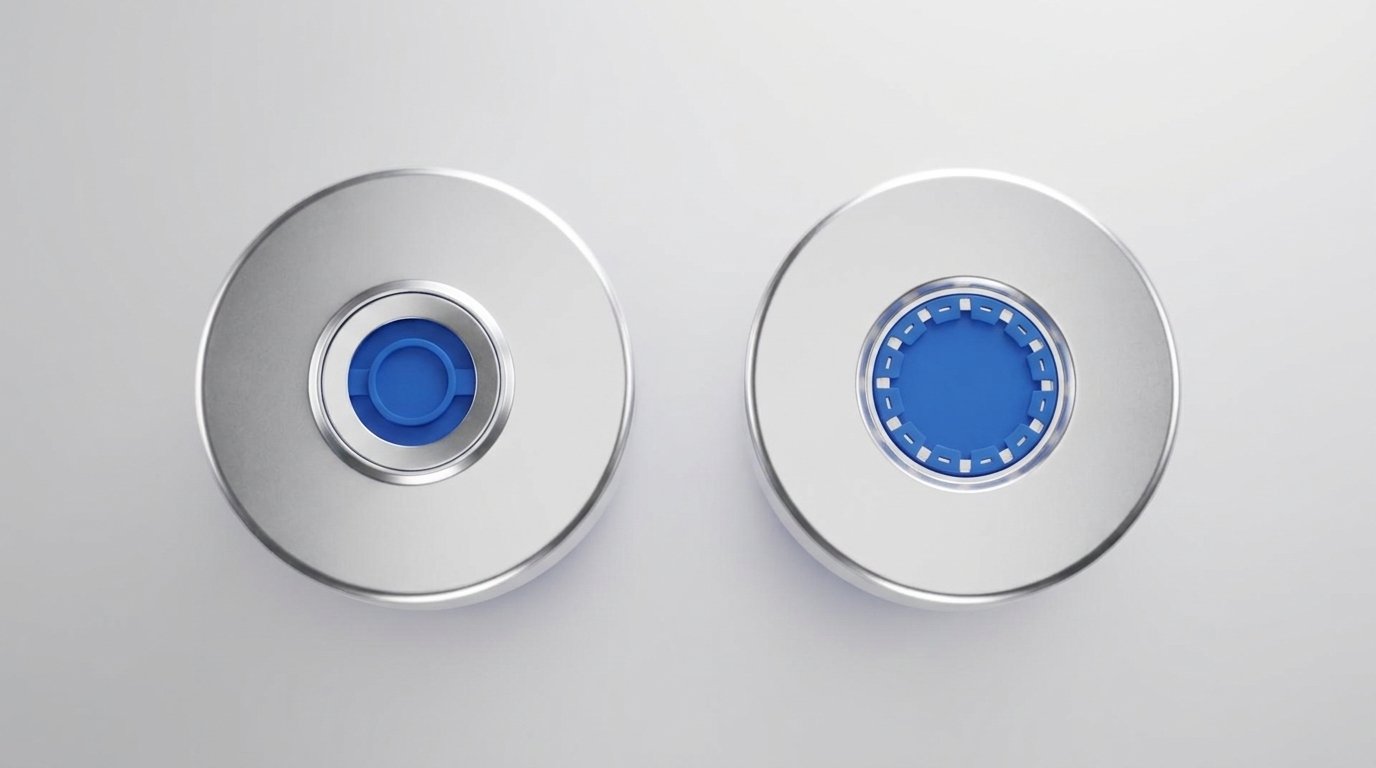
Bridge-type and button-type are two designs of the plastic flip feature on an aluminium-plastic flip-off seal. They seal a vial in the same way (an aluminium shell crimped over the rubber stopper) and differ only in how the plastic top is shaped and how you grip and flip it open: a button-type has a raised central button you press or pull up, while a bridge-type has a flat or bridged top section you lift from an edge. Flower and scoreline variants are further versions of the same flip feature. The seal mechanism and the container closure integrity it provides are unchanged across all of them; the sub-type is chosen for opening feel, customer preference in a given market, and capping-line behaviour.
This page explains the structural difference between the sub-types, why different regulated markets prefer different ones, and how the choice affects the user opening experience and the fill-finish line.
Key takeaways
- All flip-off sub-types share the same core: an aluminium shell crimped over the stopper, with a plastic flip-top that flips up to expose the stopper while the aluminium crimp stays in place for tamper evidence.
- Button-type: a raised central plastic button that the user presses or lifts to start the flip.
- Bridge-type: a flatter top, often with a bridged or recessed section, lifted from an edge rather than a central button.
- Flower and scoreline variants are additional versions of the flip feature, typically defined by the tear or break line moulded into the plastic.
- The sub-type does not change the seal’s container closure integrity; the integrity comes from the aluminium crimp over the stopper, which is common to all of them.
- Different regulated markets and customers prefer different sub-types for reasons that are often based on long-standing customer requirements rather than a single documented technical rule.
- Seal and button geometry can affect capping-line throughput and reject rates, so the sub-type is also a fill-finish engineering choice, not only a cosmetic one.
What is a flip-off seal sub-type?
A flip-off seal sub-type is a specific design of the plastic flip feature on an aluminium-plastic combination seal. The aluminium shell, the crimp over the stopper, and the sealing function are the same across sub-types; only the moulded plastic top and its tear or break feature change. A flip-off seal is an aluminium-plastic combination seal made of an aluminium shell crimped over the vial’s rubber stopper, topped by a moulded plastic disc that flips up to expose the stopper for needle access. Because the aluminium crimp stays on the vial after the plastic flips, the seal provides tamper evidence and helps maintain container closure integrity regardless of which sub-type is used.
The plastic top can be moulded in several ways. The most common families are the button-type and the bridge-type, with flower and scoreline designs as further variations. Each defines how the user engages the plastic and how it separates to expose the stopper.
Bridge-type vs button-type: the structural difference
The difference is in the plastic flip feature. A button-type seal has a raised central plastic button that the user presses or lifts to begin the flip; a bridge-type seal has a flatter top, often with a bridge of plastic or a recessed disc, that the user lifts from an edge or tab rather than from a central button. In both cases the plastic separates along a moulded line and folds back to reveal the stopper, while the aluminium skirt remains crimped on the vial.
Flower-type and scoreline designs are variations on the same idea. A scoreline design defines the break with a moulded score or weakened line in the plastic, so the top opens cleanly along that path. A flower-type design uses a petal-like split pattern. All of these are ways of shaping the same flip feature; they change the look and the opening action, not the underlying aluminium-plastic seal or its crimp onto the stopper.
| Aspect | Button-type | Bridge-type | Flower / scoreline variants |
|---|---|---|---|
| Flip feature | Raised central plastic button | Flatter or bridged top, lifted from an edge | Moulded score line or petal-split pattern |
| How it opens | Press or pull the central button up | Lift the plastic from an edge or tab | Separates along the moulded score or split |
| Underlying seal | Aluminium shell crimped over stopper | Aluminium shell crimped over stopper | Aluminium shell crimped over stopper |
| Tamper evidence | Aluminium crimp stays on vial | Aluminium crimp stays on vial | Aluminium crimp stays on vial |
| Container closure integrity | From the crimp, not the sub-type | From the crimp, not the sub-type | From the crimp, not the sub-type |
| Customisation (colour, print, emboss) | On the plastic top | On the plastic top | On the plastic top |
The point of the table: every sub-type seals the vial the same way. The choice between them is about opening feel, customer and market preference, and how the design runs on a capping line, not about whether the seal protects the product.
Why different regulated markets prefer different sub-types
Different regulated markets and customers prefer different flip-off sub-types, and the preference is often based on long-standing customer requirements and regional convention rather than a single documented technical rule. A flip-off seal is a primary packaging component in direct contact with the closure system, so once a drug manufacturer qualifies a particular seal design with its filling line and its regulatory filings, it tends to keep that design. The container closure system is part of how a product’s integrity is demonstrated, which is why packaging components are controlled under quality systems aligned with standards such as ISO 15378 and the broader sterile-manufacturing expectations of EU GMP Annex 1.
In practice, that means market preference is partly historical: a sub-type that became standard with one set of customers in a region tends to stay standard there, because changing a qualified closure design triggers re-validation work. Sub-type designs are frequently developed around specific pharmaceutical customers’ standards, so a manufacturer often produces several sub-types in parallel to match what each regulated market and customer base already specifies. The underlying reason a given market settled on one design over another is often not clearly documented; it reflects accumulated customer requirements as much as any single performance advantage.
How the choice affects opening feel and capping-line behaviour
The sub-type changes how the seal feels to open and how it runs on a high-speed capping line. The opening action differs because a central button, an edge-lift bridge, and a scoreline each engage the user’s grip differently; the line behaviour differs because button height, top profile, and dimensional consistency affect centering and crimping at the capping station. For the end user, the difference is mainly ergonomic: a raised button is easy to locate and press, while a flatter bridge-type relies on an edge or tab. The integrity and tamper evidence are identical because they come from the aluminium crimp.
On the fill-finish line, seal and button geometry matter more than they appear to. Consistent dimensions and a predictable top profile help the seal feed, center, and crimp cleanly at high speed, which affects throughput and reject rates. Seal design choices can have a real effect on capping-line speed and reliability, so the sub-type is a fill-finish engineering decision as well as a user-facing one. This is also why dimensional consistency and visual inspection are central to producing any sub-type to specification.
How this works in practice at Autofits
Autofits manufactures aluminium-plastic FlipTop® seals across 13, 20, and 32 mm sizes, including its FlipTop Optima range, which is offered in several flip-feature sub-types: bridge type with a groove, bridge type without a groove, button type, and flower or scoreline type. These sub-type options were developed around specific pharmaceutical customers’ standards, so a customer can select the design its market and filling line already expect. The plastic disc is available in matte or glossy finish and can be printed and embossed (the metal can also be printed and coloured), so the chosen sub-type can also carry product-specific branding and colour coding.
Production runs in a 75,000 sq ft Nashik (Maharashtra) plant that includes an ISO Class 8 cleanroom, with high-speed visual inspection on the closure lines, under an ISO 15378:2017 quality system alongside ISO 9001:2015 and ISO 14001:2015 certification and a Drug Master File (DMF). That dimensional control and inspection are what let any sub-type run cleanly on a customer’s capping line. You can review the full set of certifications on the quality page.
Where the sub-type choice bites hardest is on products whose tamper evidence has to be unambiguous. Cytotoxic and oncology vial seals are the clearest case, because a compounding pharmacist has to confirm an unused vial before drawing a hazardous dose, and anaesthetic vial closures are close behind, since the vial is opened under time pressure. On a multidose presentation such as an insulin or hormone vial, the flower formed under the button disc is what shows the seal has already been lifted.
Frequently asked questions
What is the difference between bridge-type and button-type flip-off seals?
The difference is the shape of the plastic flip feature. A button-type seal has a raised central plastic button you press or lift to open it; a bridge-type seal has a flatter or bridged top that you lift from an edge or tab. Both use the same aluminium shell crimped over the rubber stopper, so they seal the vial and provide tamper evidence in exactly the same way.
Do bridge-type and button-type seals differ in container closure integrity?
No. Container closure integrity on a flip-off seal comes from the aluminium shell crimped over the stopper, which is common to all sub-types. The bridge, button, flower, and scoreline designs only change the plastic flip feature and the opening action, not the seal’s ability to maintain the sterile barrier.
What are flower-type and scoreline flip-off seals?
Flower-type and scoreline seals are further variations of the plastic flip feature on an aluminium-plastic seal. A scoreline design opens along a moulded score or weakened line, and a flower-type uses a petal-like split pattern. Like bridge and button designs, they sit on the same crimped aluminium shell and do not change how the vial is sealed.
Why do different markets use different flip-off sub-types?
Preference is largely driven by long-standing customer requirements and regional convention. Once a drug manufacturer qualifies a particular seal design with its filling line and regulatory filings, changing it requires re-validation, so qualified designs tend to persist. Sub-types are often developed around specific customers’ standards, and the original reason a market chose one design is frequently not clearly documented.
Does the seal sub-type affect filling line speed?
It can. Button height, top profile, and dimensional consistency affect how a seal feeds, centers, and crimps at a high-speed capping station, which influences throughput and reject rates. A well-controlled, dimensionally consistent design supports faster, more reliable capping, so the sub-type is a fill-finish engineering consideration, not only a cosmetic one.
Can flip-off sub-types be customised with colour or printing?
Yes. The plastic top of any sub-type can be moulded in custom colours and printed or embossed, and the metal part can be coloured and printed as well. This lets manufacturers use colour coding and branding on bridge, button, flower, or scoreline designs without changing how the seal functions.
Related reading
- What a flip-off seal is
- How flip-off caps work
- How vial seal design affects filling line speed
- Flip-off vs tear-off seals compared
- Bridge-type with groove seal
- Bridge-type without groove seal
- Button-type flip-off seal
- Flower-type flip-off seal
Sources
- ISO: ISO 15378:2017, Primary packaging materials for medicinal products (https://www.iso.org/standard/70729.html)
- European Commission: EudraLex Volume 4, EU GMP Annex 1, Manufacture of Sterile Medicinal Products (https://health.ec.europa.eu/medicinal-products/eudralex/eudralex-volume-4_en)
*Last updated: 2026-06-10. This article is general technical information about packaging design, not regulatory or compliance advice; confirm current standard editions and your own qualification requirements with the relevant authorities.*
