
Primary Packaging for Vials: The Vial, the Stopper and the Seal Matched to One Neck
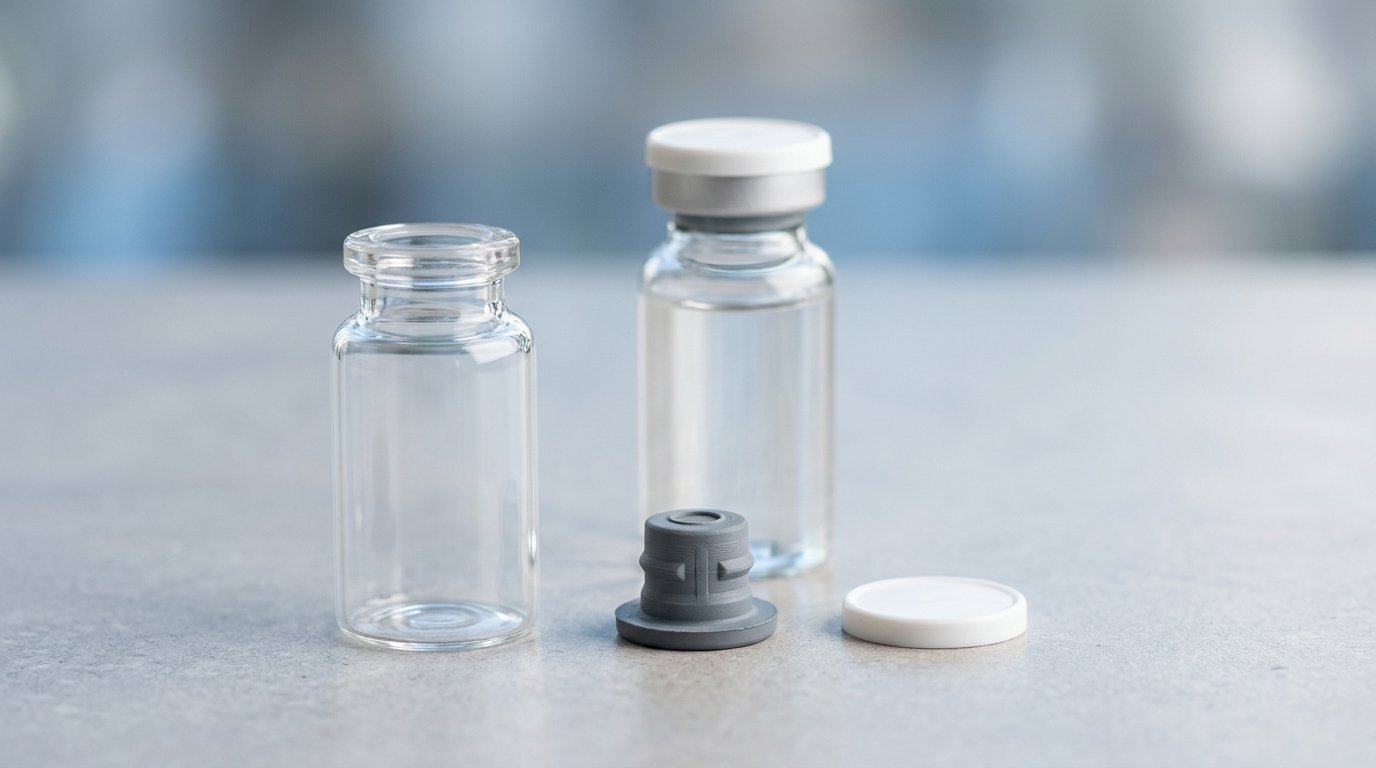
Primary packaging for a vial usually means the container closure system around the drug: the glass vial, the elastomeric stopper seated in its mouth, and the aluminium or aluminium-plastic seal crimped over both. The vial and stopper touch the product; the seal holds the stopper under compression so the system stays closed. All three are built to one nominal neck size. Autofits makes the seal: FlipTop aluminium-plastic and all-aluminium seals from 13 to 34 mm, matched to the vial and stopper the customer has already qualified.
Key takeaways
- A vial’s primary packaging is the vial, the stopper and the seal. The vial and stopper are in direct contact with the drug.
- The aluminium seal does not touch the drug. FDA’s definitions class it as a secondary component that forms part of the container closure system; in supplier qualification it is handled with the vial and stopper as part of the primary pack.
- Neck size links the parts. A 20 mm vial neck takes a 20 mm stopper and a 20 mm seal, and the same rule holds at 13, 28 and 32 mm.
- Stoppers are qualified against USP <381> and Ph. Eur. 3.2.9. Seals follow ISO 8362-6 (aluminium-plastic) or ISO 8362-3 (all-aluminium).
- Autofits makes the seal only. The vial and the stopper come from the customer’s own qualified suppliers.
- Seals come Regular, Ready-to-Use or Ready-to-Sterilize; standard designs typically start from 50,000 pieces per size and colour, confirmed on enquiry.
What counts as primary packaging for a vial
The working test is contact: a component that is or may be in direct contact with the dosage form is primary, and one that never is counts as secondary. That is how the US FDA’s May 1999 guidance on container closure systems draws the line, and it puts the glass vial and the rubber stopper firmly in the primary group.
The aluminium seal is where buyers get conflicting answers, and both come from real usage:
- Under the FDA definitions the seal is a secondary packaging component, because it does not touch the drug. The same guidance counts secondary components that give extra protection as part of the container closure system, and the seal is exactly that: without it the stopper would lift and the system would open.
- In supplier qualification, the seal is usually handled as part of the primary pack and bought from a supplier certified to ISO 15378, the GMP standard for primary packaging materials; Autofits holds that certification. The ISO 8362-3 catalogue description agrees with FDA that aluminium caps are not primary packaging materials in direct contact with the preparation.
In practice the seal is qualified with the vial and stopper as one system, under the same change control.
Buyers also ask about primary packaging for vials in Akylux. Empty glass vials usually reach the filler in fluted polypropylene (Akylux) trays; those trays are secondary packaging and never touch the drug.
The three parts and what governs each
| Part | Contacts the drug | Typical material | Main requirements | Who supplies it |
|---|---|---|---|---|
| Vial | Yes | Type I borosilicate glass, tubing or moulded | USP <660>, Ph. Eur. 3.2.1, neck to ISO 8362-1 (tubing) or ISO 8362-4 (moulded) | The customer’s glass supplier |
| Stopper | Yes | Typically a chlorobutyl or bromobutyl rubber compound | USP <381>, USP <382>, Ph. Eur. 3.2.9, dimensions to ISO 8362-2 (injection vial closures) or ISO 8362-5 (freeze-drying) | The customer’s stopper supplier |
| Seal | No | AA8011 aluminium, epoxy lacquer, polypropylene disc | ISO 8362-3 (aluminium caps), ISO 8362-6 (aluminium-plastic caps) | Autofits, 13 to 34 mm |
Seals by vial neck size
Choose the neck size from the vial drawing, then the seal family from how the vial will be opened, and check the seal height against the seated stopper. The seal columns below come from the Autofits engineering drawings.
| Vial neck and stopper size | Autofits seal families | Seal inner diameter | Total seal height (Optima) | Max opening force |
|---|---|---|---|---|
| 13 mm | FlipTop Optima, FlipTop Tear-Down, tear-off | 13.36 mm min | 7.62 to 8.38 mm | 30 N |
| 20 mm | FlipTop Optima, Pull Ring, FlipTop Tear-Down, tear-off, tear-down | 20.22 mm min | 9.02 to 9.91 mm | 35 N |
| 28 mm | FlipTop Optima | 27.60 to 28.20 mm | 11.06 to 12.06 mm | 35 N |
| 32 mm | FlipTop Optima, Pull Ring, FlipTop Tear-Down, tear-off | 32.10 to 32.90 mm | 14.30 to 15.50 mm | 65 N |
| 34 mm | FlipTop Optima | 33.60 to 34.00 mm | 15.00 to 16.00 mm | On request |
Diameter and height are for the FlipTop Optima; every format per size is on the vial seals by size page.
Matching the seal to the rest of the pack
The vial fixes the size, the stopper fixes the height the seal has to cover, and the person opening the vial settles the seal family. In practice:
- The stopper compound is the drug maker’s decision, made in compatibility and extractables work on the formulation; halobutyl rubbers (chlorobutyl, bromobutyl) are the usual starting point. What matters for the seal is the stopper’s flange thickness and how high it sits once seated, because a harder compound compresses less under the capping head. The term itself is defined on the elastomeric closure glossary page.
- Freeze-dried products use a freeze-drying stopper that sits partly open during the cycle, so the seal has to crimp cleanly over a stopper pushed home in the chamber. See the lyophilised products page.
- Biologics put extra weight on residual seal force through cold storage, which depends on the stopper compound and the crimp together. See the biologics page.
- Clinical use decides the seal. A flip-off top leaves the stopper face for repeated needle access; a pull ring or tear-down removes the seal entirely; a tear-off seal is all-aluminium with no plastic.
How the vial, stopper and seal are specified as one system, and where each Autofits seal page fits, is laid out on the vial closures page.
Seal materials and quality
Seal materials are fixed by the Autofits specification. The aluminium is AA8011 conforming to EN 15088:2005, with an epoxy lacquer conforming to 21 CFR 175.300. The polypropylene disc conforms to 21 CFR 177.1520 and is moulded in-house on Toyo injection machines. Heavy metals (hexavalent chromium, cadmium, mercury and lead) are held to a maximum 100 ppm total, and seal components are BSE/TSE-free. Seals pass 100% high-speed camera inspection, with an AQL of critical nil, major not more than 2.5% and minor not more than 4%.
The stopper’s own qualification, against USP <381>, USP <382> and Ph. Eur. 3.2.9, sits with the stopper supplier and the drug maker. The drug maker confirms functional suitability in the final assembled pack, using the production seal and crimp.
Forms of supply
Seals are supplied in three forms. Regular seals are for crimping outside controlled environments; Autofits does not recommend washing seals, because collision and abrasion create particles. Ready-to-Use seals are gamma or ETO sterilised, assembled in an ISO Class 8 cleanroom and double-bagged for aseptic areas, and typically add 1 to 2 weeks for sterilisation and release. Ready-to-Sterilize seals are cleaned and bagged for the customer’s own cycle. Non-irradiated seals carry 3.5 years of shelf life before capping plus 5 years after; Ready-to-Use seals carry 2 years before capping.
Ordering seals for vial primary packaging
Send the vial neck drawing, the drawing of the stopper you use, the product type and the delivery form, and the matching seal drawing comes back with the quotation. Standard designs typically start from 50,000 pieces per size and colour and typically ship 2 to 3 weeks from order confirmation. For a capping trial on your own vials and stoppers, ask for standard seal samples: typically 200 to 500 pieces per size, dispatched typically within 5 working days. All of these are confirmed on enquiry through the contact page.
How this works in practice at Autofits
A buyer qualifying vial primary packaging usually already has a glass supplier and a qualified stopper, so Autofits starts from those two drawings rather than from a catalogue size. The seal comes from the drawing-controlled range in 13, 20, 28, 32 and 34 mm, made in Nashik, India, in a 75,000 sq ft facility that produces more than 2.4 billion seals a year. The quality system is certified to ISO 9001:2015, ISO 14001:2015 and ISO 15378:2017, supported by a Drug Master File (DMF 18100) and CFDA registration; certificates are on the quality page.
Frequently asked questions
What is primary packaging for vials?
Primary packaging for a vial is the glass vial, the rubber stopper seated in its mouth and the aluminium or aluminium-plastic seal crimped over them. The vial and stopper are in direct contact with the drug. The seal holds the stopper under compression, and the three parts together form the container closure system.
Is a flip-off seal primary or secondary packaging material?
It depends on the definition in use. Under US FDA guidance a component that never contacts the drug is a secondary packaging component, so the seal is secondary, but the same guidance includes it in the container closure system because it protects the closure. In supplier qualification the seal is usually handled as part of the primary pack, bought from a supplier certified to ISO 15378. Either way, it is qualified together with the vial and stopper.
Which rubber is used for vial stoppers?
Most injectable vial stoppers are made from halobutyl rubber, either chlorobutyl or bromobutyl, because both have low permeability to oxygen and water vapour. The compound is chosen through compatibility and extractables studies on the specific drug, and the stopper is tested against the compendial chapters the product needs, such as USP 381 and Ph. Eur. 3.2.9.
Does Autofits supply vials or stoppers?
No. Autofits makes aluminium and aluminium-plastic vial seals from 13 to 34 mm, and aluminium pilfer-proof caps for bottles. The glass vial and the rubber stopper come from the customer’s own suppliers, and the seal is matched to their neck and stopper drawings.
What do I need to send when ordering vial seals?
Send the vial neck drawing or nominal neck size, the drawing of the stopper the seal will crimp over, the product type (liquid, freeze-dried or powder), the seal family and colour, and the delivery form: Regular, Ready-to-Use or Ready-to-Sterilize. Order volume and destination complete the quotation.
Why are primary packaging vials shipped in Akylux trays?
Empty glass vials are shipped from the glass maker in fluted polypropylene trays, often called Akylux trays, because the material sheds no paper fibres, can be wiped clean and tolerates condensation. The vials are the primary packaging; the trays that carry them are secondary packaging and never touch the drug.
Related reading
- Vial closures: stopper, seal and neck specified together
- Vial seals by size
- Elastomeric closure: definition
- ISO 8362-1: the vial neck standard
- Primary packaging: definition
Sources
- Autofits FlipTop Seals dossier, engineering drawings and company brochure
- US FDA: Guidance for Industry, Container Closure Systems for Packaging Human Drugs and Biologics, May 1999 (https://www.fda.gov/media/70788/download)
- ISO: ISO 15378:2017, Primary packaging materials for medicinal products (https://www.iso.org/standard/70729.html)
- ISO: ISO 8362-2, Injection containers and accessories, Part 2: Closures for injection vials (https://www.iso.org/standard/87251.html)
- ISO: ISO 8362-3:2001, Aluminium caps for injection vials (https://www.iso.org/standard/33804.html)
- ISO: ISO 8362-6:2010, Caps made of aluminium-plastics combinations for injection vials (https://www.iso.org/standard/52806.html)
- USP-NF: General Chapters <381>, <382> and <660> (https://www.usp.org/)
- EDQM: European Pharmacopoeia chapters 3.2.1 and 3.2.9 (https://www.edqm.eu/)
*Last updated: 2026-09-15. This page is general technical and product information, not regulatory or compliance advice; typical values are indicative, and quantities, lead times and specifications are confirmed with the quotation.*
