
FlipTop vs Traditional Flip-Off Seal: What Is Actually Different
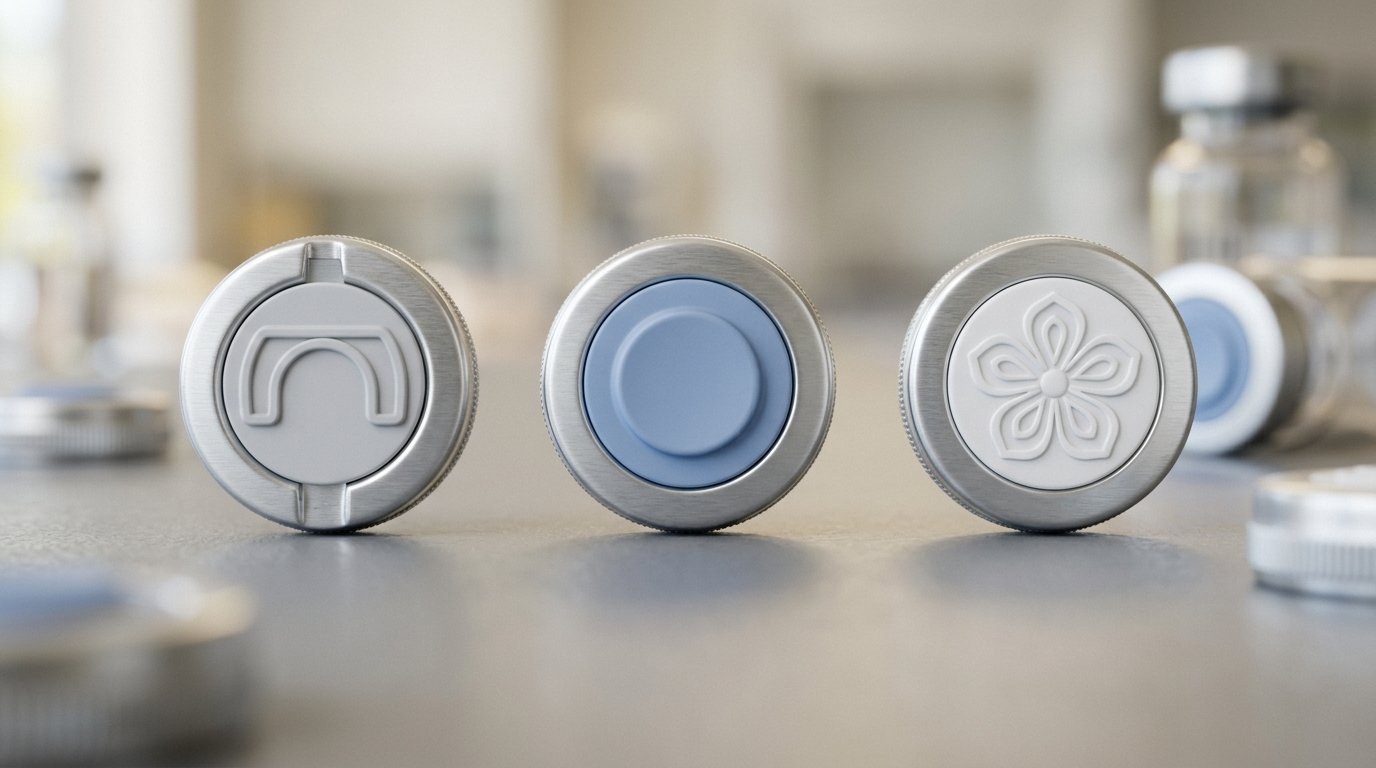
FlipTop is a brand name, not a different kind of closure. FlipTop is the Autofits range of aluminium-plastics combination caps for injection vials, the closure style the industry generally calls a flip-off seal. Flip-Off is a registered trademark of West Pharmaceutical Services, Inc. and identifies that company’s own seals. Both brands describe products built to the same construction principle and the same standards family, so a comparison between them is a comparison of ranges, designs and supply options rather than of closure types.
This page separates the naming from the engineering: what the generic category is called in the standards, who owns which trademark, what sits inside the FlipTop range, and which specification differences are worth checking when a drawing says one thing and a catalogue says another.
Key takeaways
- The generic category has a formal name. ISO 8362-6 calls it a cap made of an aluminium-plastics combination; ISO 8362-7 covers the version whose plastic does not overlap the aluminium.
- Flip-Off is a registered trademark of West Pharmaceutical Services, Inc., listed alongside Spectra on West’s own seals pages. Autofits has no affiliation with, endorsement from, or connection to West.
- FlipTop is the Autofits brand and covers three product lines: Optima, Pull Ring and Tear-Down.
- Construction is common to the category: an aluminium shell crimped over a rubber stopper, with a moulded plastic top that is removed at the point of use.
- Real differences between ranges are in the detail: which neck sizes are offered, which top designs, the specified opening force, colour and decoration options, and the supply forms.
- Specify to the standard and the drawing. A brand name in a purchase order does not define a dimension; a controlled drawing does.
Why the naming is confusing
Buyers meet three overlapping names for one closure: a trademark, a generic description, and a standards term. Search traffic and tender documents use flip-off, flip-top, flip cap and flip-up more or less interchangeably to describe the closure style. On top of that sits at least one registered brand: West Pharmaceutical Services lists Flip-Off as a trademark or registered trademark in the United States and other jurisdictions on its seals pages. Underneath both sits the neutral standards language, which never uses any of these words and instead describes a cap made of an aluminium-plastics combination.
Autofits uses FlipTop as the brand for its own aluminium-plastics combination caps. The distinction matters in two practical situations: when a specification is being written and needs to be supplier-neutral, and when a page or a datasheet refers to a competitor’s branded product. In the first case, use the ISO reference. In the second case, name the brand and its owner. The category itself is defined in the flip-off seal glossary entry.
What is inside the FlipTop range
FlipTop is not one part. It is three product lines that share an aluminium-plastics construction but open in three different ways. The FlipTop Optima is the general-purpose flip-off seal: the plastic button is flipped up, the bridges shear, and a small central area of the stopper is exposed for a needle while the aluminium stays crimped. The FlipTop Pull Ring is opened by pulling an aluminium ring and turning anticlockwise, which removes the whole seal. The FlipTop Tear-Down is opened by twisting anticlockwise so the seal tears down and comes off, a pattern mostly used for oral presentations.
Within the Optima line there are three top designs. Bridge is the standard flip button connected by tapered bridges that shear on opening. Button carries intrinsic tamper evidence through a twelve-stem flower formed under the button disc, so an opened part looks visibly different. Flower is the petalled variant. Those designs are compared in bridge type vs button type, and the difference between the Pull Ring and Tear-Down mechanisms in pull ring vs tear down.
Brand, category and standard: the comparison
The table separates what a brand name tells you from what the standard and the drawing tell you.
| Attribute | FlipTop (Autofits brand) | Flip-Off (West trademark) | The generic category |
|---|---|---|---|
| Status of the name | Product brand of Autofits Packaging Pvt. Ltd. | Registered trademark of West Pharmaceutical Services, Inc. | Descriptive term, not owned |
| Standards term | Cap made of an aluminium-plastics combination | Cap made of an aluminium-plastics combination | ISO 8362-6, or ISO 8362-7 without overlap |
| Construction | Aluminium shell plus moulded plastic top | Aluminium shell plus moulded plastic top | Aluminium shell plus moulded plastic top |
| Sealing principle | Crimped over a rubber stopper | Crimped over a rubber stopper | Crimped over a rubber stopper |
| Lines within the brand | Optima, Pull Ring, Tear-Down | West lists Flip-Off Seals, Flip-Off CCS and Flip-Off Plus RU on its seals page | Not applicable |
| What defines the dimensions | The controlled drawing for the size ordered | The supplier’s own specification | The ISO part plus the vial neck finish |
| What a buyer should quote | Neck size, top design, finish, colour, supply form | Confirm directly with that supplier | The ISO part and the neck standard |
The last row is the practical takeaway. A brand tells you who made the seal. It does not tell you the inner diameter, the disc height, the bridge count, or the opening force, and those are the numbers that decide whether a seal fits a vial and runs on a line.
The specification points that actually vary between ranges
Four things vary meaningfully between one manufacturer’s aluminium-plastics range and another’s: available neck sizes, top designs, specified opening force, and supply forms. Neck sizes matter because the seal has to match the vial finish, which follows ISO 8362-1 for tubing vials. A range that stops at 20 mm cannot serve a 32 mm diluent vial.
Top designs matter because they change opening feel, tamper-evidence behaviour, and how the part presents to a top-down inspection camera. Opening force matters because it is the number a clinical user experiences, and it scales with diameter and bridge count rather than with the brand on the box. Supply form matters because a plant that has no in-house washing capability needs seals that arrive washed and sterilized, and that changes both the price and the qualification work. Those four points, rather than the brand on the carton, are what a like-for-like quotation has to hold constant.
How this works in practice at Autofits
The FlipTop Optima is an AA8011 aluminium shell with an epoxy lacquer coating and an injection-moulded polypropylene button, offered in 13, 20, 28, 32 and 34 mm neck sizes across Bridge, Button and Flower designs, in glossy, matte, embossed or printed finishes and a wide colour range. Maximum opening force is specified per size, 30 N at 13 mm, 35 N at 20 mm and 28 mm, and 65 N at 32 mm. The design follows ISO 8362-6 and the vial neck follows ISO 8362-1. Production is under ISO 9001:2015, ISO 14001:2015 and ISO 15378:2017 with Drug Master File 18100, in a 75,000 sq ft Nashik facility, with in-house polypropylene moulding, automated washing, ISO Class 8 cleanroom assembly and 100% high-speed camera inspection. Seals ship Regular, Ready-to-Use or Ready-to-Sterilize, with double-bagged options for aseptic areas. The full certificate set is on the quality page.
Naming aside, the specification that matters is the one the drug product imposes. The vial sealing applications hub maps that out category by category, and the two most common landing points from this page are multidose vaccine vial seals and insulin and hormone closures. If the question underneath the naming is really about where to buy, Indian versus global vial seal suppliers compares the two sourcing routes on cost, lead time and regulatory documentation.
Frequently asked questions
Is FlipTop the same thing as a flip-off seal?
FlipTop is the Autofits brand name for its aluminium-plastics combination caps, which is the closure style widely described as a flip-off seal. The construction is the same as any other seal in that category: an aluminium shell crimped over a rubber stopper with a moulded plastic top. What a brand name adds is a specific range of sizes, top designs, finishes and supply forms, defined by that manufacturer’s drawings.
Who owns the Flip-Off trademark?
Flip-Off is a trademark or registered trademark of West Pharmaceutical Services, Inc. in the United States and other jurisdictions, as stated on West’s own seals pages. It identifies West’s products. Autofits is an independent manufacturer with no affiliation to West, and uses the FlipTop brand for its own seals.
Can I write flip-off in a purchase specification?
You can, but it is better to add the standard reference. ISO 8362-6 describes caps made of aluminium-plastics combinations, and ISO 8362-7 covers the version without an overlapping plastics part. Naming the ISO part, the vial neck size, the top design, the finish and the supply form makes a specification supplier-neutral and comparable across quotations.
What is the difference between FlipTop Optima, Pull Ring and Tear-Down?
They differ in how the vial is opened. Optima is flipped: the plastic button lifts and a central injection point is exposed while the aluminium stays crimped. Pull Ring is opened by pulling an aluminium ring and turning anticlockwise, removing the whole seal. Tear-Down is opened by twisting anticlockwise so the seal tears down and comes away. All three are aluminium-plastics constructions crimped over a stopper.
Does a brand name affect container closure integrity?
No. Integrity is a function of the crimp geometry, the stopper, the vial neck finish and the capping parameters, verified by container closure integrity testing on the sealed vial. A brand indicates the manufacturer and their range; it does not substitute for dimensional conformance to the vial and stopper, or for the integrity data generated on your own filled product.
Related reading
- Flip-off seal: definition and how it works
- FlipTop seals: the full range
- Bridge type vs button type flip-off seals
- Flip-off vs flip-up: are they the same closure?
- Indian vs global vial seal suppliers: how the sourcing routes compare
- ISO 8362-6: aluminium-plastics combination caps
Sources
- West Pharmaceutical Services: Seals product family and trademark notice, “Flip-Off, and Spectra are trademarks or registered trademarks of West Pharmaceutical Services, Inc. in the United States and other jurisdictions” (https://www.westpharma.com/products/vial-containment-solutions/seals)
- ISO: ISO 8362-6:2010, Injection containers and accessories, Part 6: Caps made of aluminium-plastics combinations for injection vials (https://www.iso.org/standard/52806.html)
- ISO: ISO 8362-7:2006, Injection containers and accessories, Part 7: Injection caps made of aluminium-plastics combinations without overlapping plastics part (https://www.iso.org/standard/43551.html)
- ISO: ISO 8362-1:2018, Injection containers and accessories, Part 1: Injection vials made of glass tubing (https://www.iso.org/standard/74398.html)
- ISO: ISO 15378:2017, Primary packaging materials for medicinal products (https://www.iso.org/standard/70729.html)
*Last updated: 2026-07-31. This article is general technical information about pharmaceutical vial closures, not regulatory or compliance advice. Flip-Off and Spectra are trademarks or registered trademarks of West Pharmaceutical Services, Inc., used here only to identify that company’s products; Autofits is not affiliated with, endorsed by, or connected to West Pharmaceutical Services, Inc. FlipTop is a brand of Autofits Packaging Pvt. Ltd.*
