
Vial Seal Regulatory Compliance Pack: Every Standard in One List
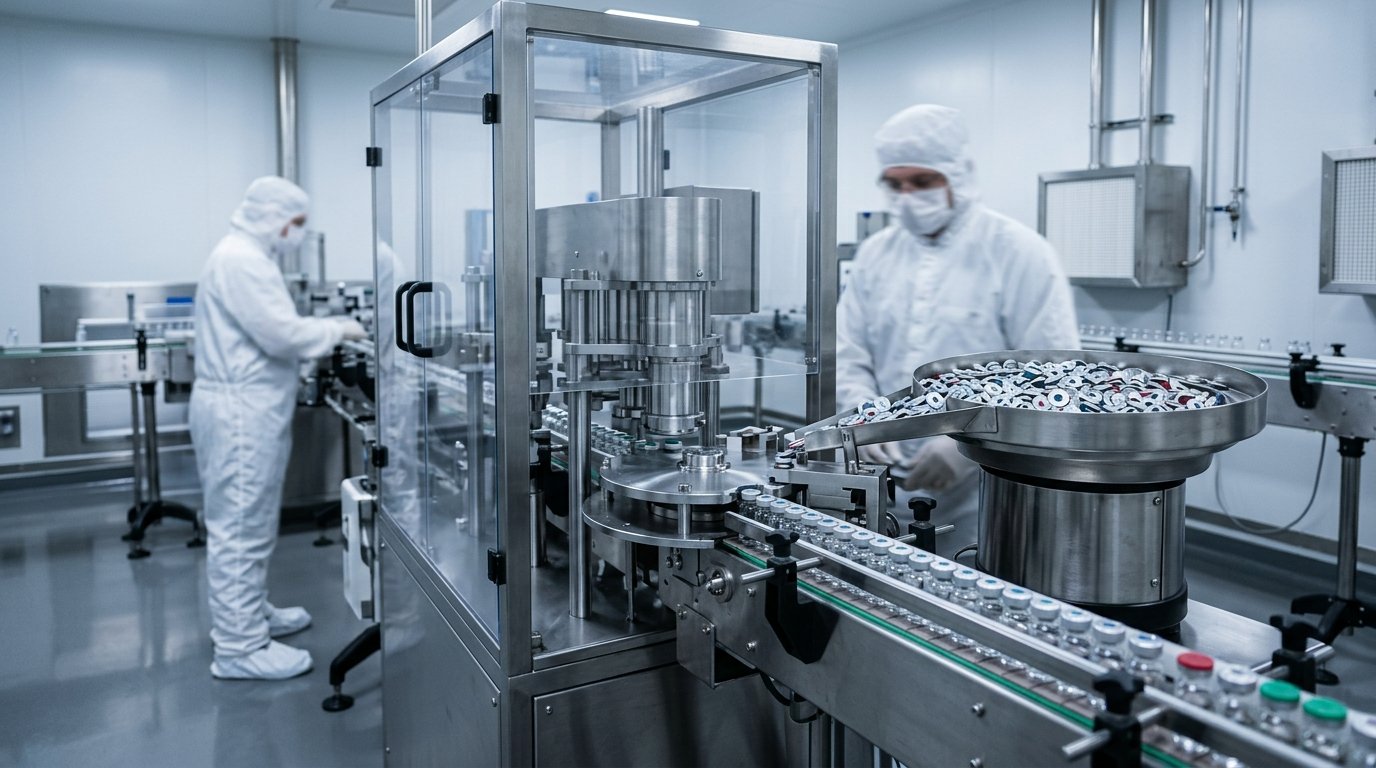
Autofits vial seals are made under an ISO 15378:2017 quality system and follow ISO 8362-6 for aluminium-plastic seals and ISO 8362-3 for all-aluminium seals, with materials that conform to 21 CFR 175.300, 21 CFR 177.1520 and EC 1895/2005 and are BSE/TSE-free to EMEA/410/01 rev. 3. Around that core sit the pharmacopoeial chapters, GMP guidelines and national regulations that govern the vial, the stopper and the filled product. This pack lists each one that bears on the seal in a single place, with what it requires and how the Autofits range relates to it, and links to a page explaining each.
Key takeaways
- The seal’s own standards: ISO 15378 for the quality system, ISO 8362-6 and ISO 8362-3 for the cap.
- Material conformance: aluminium AA8011 with epoxy lacquer to 21 CFR 175.300; polypropylene to 21 CFR 177.1520 and EC 1895/2005; heavy metals maximum 100 ppm total.
- A seal does not touch the drug. Under FDA definitions a stopper overseal is a packaging component that is not in direct contact with the dosage form, while still part of the container closure system.
- Stopper chapters (USP <381>, USP <382>, Ph. Eur. 3.2.9) apply to the rubber stopper, not the seal.
- Product-level tests (USP <788>, USP <1207>, EU GMP Annex 1) apply to the filled, sealed vial; the seal’s cleanliness, dimensions and crimp feed into them.
- Regulatory filing: Drug Master File DMF 18100.
Where the seal sits in the container closure system
A vial seal holds the stopper in place and protects it; it does not touch the product, and that decides which requirements fall on it. The FDA guidance on container closure systems lists stopper overseals among packaging components and defines a secondary packaging component as one that is not and will not be in direct contact with the dosage form. The container closure system includes such components where they provide additional protection to the drug product. The ISO catalogue description of ISO 8362-3 likewise notes that aluminium caps are not considered to be made of primary packaging materials for direct contact with the preparation.
In practice that splits the requirements three ways: standards the seal itself is built to, standards for the stopper and vial it closes, and tests the drug manufacturer runs on the sealed container.
Standards the seal is built to
| Standard | What it requires | How the Autofits range relates |
|---|---|---|
| ISO 15378 | A quality management system for primary packaging materials for medicinal products, applying ISO 9001 with GMP requirements added | Certified to ISO 15378:2017, certificate 21.GGCS.IN.151175 |
| ISO 9001 and ISO 14001 | Quality management and environmental management systems | Certified to ISO 9001:2015 (21.GGCS.IN.091174) and ISO 14001:2015 (21.GGCS.IN.140169) |
| ISO 8362-6 | Forms, dimensions and requirements for caps made of aluminium-plastics combinations for injection vials | FlipTop Optima, Pull Ring and Tear-Down seals follow ISO 8362-6 |
| ISO 8362-3 | Forms, dimensions and requirements for aluminium caps for injection vials | All-aluminium tear-off and tear-down seals relate to ISO 8362-3 |
| BSE/TSE, EMEA/410/01 rev. 3 | Minimising the risk of transmitting animal spongiform encephalopathy agents via medicinal products | Seal components declared BSE/TSE-free |
Material conformance
Each material in the seal carries its own conformance statement, drawn from the Autofits product dossier.
| Material | Conforms to | What the reference covers |
|---|---|---|
| Aluminium AA8011 | EN 15088:2005, EN 10204 3.1 certification, tested to BS EN 485-2:2008; REACH and RoHS | Alloy delivery conditions, inspection documentation and mechanical testing, as stated in the dossier |
| Epoxy lacquer | 21 CFR 175.300 | US FDA regulation for resinous and polymeric coatings |
| Polypropylene disc | 21 CFR 177.1520; EC 1895/2005; IS 10910 and IS 10909 | US FDA regulation for olefin polymers; EU restriction on the epoxy derivatives BADGE, BFDGE and NOGE, which are not used |
| Heavy metals | Chromium VI, cadmium, mercury and lead, maximum 100 ppm total, per EN 602 and 94/62/EC | EN 602 sets the chemical composition of wrought aluminium for food-contact articles; 94/62/EC sets a 100 ppm combined limit for these four metals in packaging |
Standards for the stopper and the vial the seal closes
| Standard | What it requires | How the Autofits range relates |
|---|---|---|
| ISO 8362-1 | Form, dimensions and capacities of injection vials made of glass tubing | Seal sizes are matched to these neck finishes |
| ISO 8362-4 | Injection vials made of moulded glass | Seal sizes are matched to these neck finishes |
| ISO 8362-2 | Shapes, dimensions and requirements of closures (stoppers) for injection vials | The seal is crimped over a stopper of this kind; stopper flange thickness sets the seal height |
| ISO 8362-5 | Freeze-drying closures for injection vials | Seals are crimped once the stopper is fully seated after lyophilisation |
| USP <381> | Physico-chemical and biological reactivity tests for elastomeric components in injectable packaging | Applies to the stopper, which the drug maker qualifies with its stopper supplier; not to the seal |
| USP <382> | Functional suitability of elastomeric components in their packaging and delivery system | Tested on the stopper in its closure system, so trials should use the production seal and crimp |
| Ph. Eur. 3.2.9 | Rubber closures for containers of aqueous parenteral preparations, powders and freeze-dried powders | Applies to the stopper, which the drug maker qualifies with its stopper supplier; not to the seal |
| USP <660> | Hydrolytic resistance and classification of glass containers | Applies to the vial |
Tests and guidelines for the sealed product
| Standard | What it requires | How the Autofits range relates |
|---|---|---|
| USP <788> | Limits on sub-visible particulate matter in injections | Tested on the drug product; seals are washed on a fully automated line and pass 100% camera inspection |
| USP <1207> | A framework for evaluating package integrity of sterile products | The integrity of the capped vial is demonstrated by the drug manufacturer; seal dimensions are held to the drawing |
| CCIT methods | Deterministic and probabilistic methods for container closure integrity | Run on the filled, sealed container |
| EU GMP Annex 1 | GMP for sterile medicinal products, including a contamination control strategy and container closure integrity | Ready-to-Use seals are assembled in an ISO Class 8 cleanroom, sterilised by gamma or ETO and double-bagged |
| Sterilisation validation | Validation of gamma irradiation and ethylene oxide cycles | RTU seals are sterilised by gamma irradiation or ETO |
| Extractables and leachables | Assessment of compounds that can migrate from packaging into the drug | Material conformance for lacquer and polypropylene is documented; studies are run on the product’s own system |
| ICH Q1A and Q1B | Stability testing of the drug product, including in its marketed container closure system | Run by the drug manufacturer with the production seal; separately, seal stock is used within its shelf life before capping (3.5 years non-irradiated, 2 years RTU) |
Regulatory frameworks
| Framework | What it requires | How the Autofits range relates |
|---|---|---|
| Type III Drug Master File | A confidential file on a packaging material that a drug applicant can reference | Autofits holds DMF 18100 |
| 21 CFR Part 211 | US cGMP for finished pharmaceuticals, including container and closure controls | Applies to the drug manufacturer; supplier documents support its component controls |
| CDSCO | India’s drug regulator, enforcing the Drugs and Cosmetics Act and Rules and GMP under Schedule M | Autofits manufactures in Nashik, India, under ISO 15378 |
Every standard above has its own page in the standards library.
How to use this pack
Match each requirement in your own specification to a row, then collect the evidence the row points to.
- Start with your specification. List the standards your product file names for the closure system.
- Find the row. Each one says whether the requirement falls on the seal, the stopper, the vial or the filled product.
- Collect the evidence. For seal rows, that is a certificate or a material declaration; certificate numbers and the declarations available are on the quality certificates page.
- Plan the product tests. Rows under the sealed product are your own studies; run them with production seals and your production crimp.
What to send with a compliance enquiry
- The products and sizes being qualified
- The markets the product is filed in
- The standards your specification names for the closure
- Declarations or questionnaires you need completed
- Whether a DMF reference is needed for a submission
Contact Autofits with the list above.
Frequently asked questions
Is a flip-off seal primary or secondary packaging?
Under the FDA’s container closure guidance, a stopper overseal such as a flip-off seal is a packaging component that is not in direct contact with the dosage form, which the guidance defines as a secondary packaging component. It is still part of the container closure system because it holds and protects the stopper, so it is specified and qualified with the vial and stopper.
Which ISO standards apply to vial seals?
ISO 8362-6 covers caps made of aluminium-plastics combinations, including flip-off seals, and ISO 8362-3 covers all-aluminium caps. ISO 15378 covers the quality system of a manufacturer of primary packaging materials for medicinal products. Autofits is certified to ISO 15378:2017, ISO 9001:2015 and ISO 14001:2015.
Do USP <381> and Ph. Eur. 3.2.9 apply to the aluminium seal?
No. Both apply to the rubber stopper, the elastomeric component that contacts the drug. The aluminium seal is crimped over the stopper and does not contact the product, so its compliance is shown through its cap standard, its quality system and its material declarations.
What tests are required for vial flip caps?
The seal is specified by its drawing, including dimensions and maximum opening force, passes 100% camera inspection and is released against AQL, and its materials are covered by conformance declarations. Tests such as container closure integrity and particulate matter are carried out by the drug manufacturer on the filled, sealed vial, using the production seal and crimp.
Does Autofits have a Drug Master File?
Yes. Autofits holds Drug Master File DMF 18100. A drug applicant can reference a packaging DMF in its own submission, and the arrangements for doing so are confirmed on request.
Related reading
- Quality certificates and registrations
- Standards library
- ISO 15378 explained
- ISO 8362-6: aluminium-plastic caps
- EU GMP Annex 1 and vial closures
Sources
- Autofits FlipTop Seals dossier: materials, standards followed, certifications
- U.S. FDA: Guidance for Industry, Container Closure Systems for Packaging Human Drugs and Biologics, May 1999 (https://www.fda.gov/media/70788/download)
- ISO: ISO 15378:2017, Primary packaging materials for medicinal products (https://www.iso.org/standard/70729.html)
- ISO: ISO 8362-3:2001, Aluminium caps for injection vials (https://www.iso.org/standard/33804.html)
- ISO: ISO 8362-6:2010, Caps made of aluminium-plastics combinations for injection vials (https://www.iso.org/standard/52806.html)
- eCFR: 21 CFR 177.1520, Olefin polymers (https://www.ecfr.gov/current/title-21/chapter-I/subchapter-B/part-177/subpart-B/section-177.1520)
- EMA: EMA/410/01 rev. 3, Note for guidance on minimising the risk of transmitting animal spongiform encephalopathy agents (https://www.ema.europa.eu/en/minimising-risk-transmitting-animal-spongiform-encephalopathy-agents-human-veterinary-medicinal-products-scientific-guideline)
- European Commission: EudraLex Volume 4, EU GMP guidelines, Annex 1 (https://health.ec.europa.eu/medicinal-products/eudralex/eudralex-volume-4_en)
*Last updated: 2026-09-15. This pack is general technical and regulatory information about the Autofits range, not regulatory advice for a specific product or submission.*
