
Vial Seal Sizing FAQs: Sizes, Dimensions, Opening Force and Packing
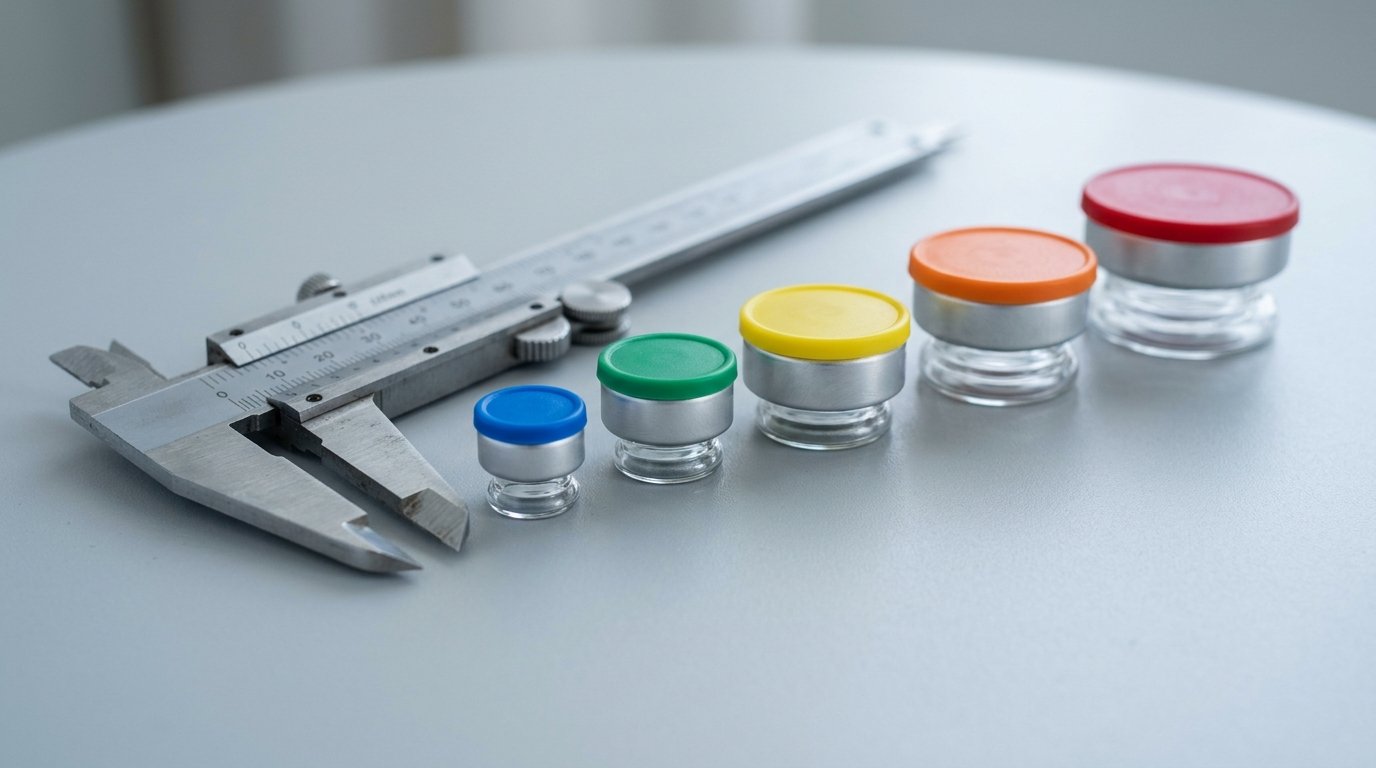
A vial seal is sized by the vial neck it closes, not by the volume in the vial: a 13 mm seal fits a 13 mm crown and stopper, a 20 mm seal a 20 mm crown. Autofits makes FlipTop Optima flip-off seals in 13, 20, 28, 32 and 34 mm, with maximum opening force specified at 30 N for 13 mm, 35 N for 20 and 28 mm, and 65 N for 32 mm. The answers below give the drawing dimensions, aluminium thickness, bridge counts and box quantities for each size, and say plainly where a number, such as weight per piece, is confirmed on the drawing rather than published.
Sizes and vial necks
The seal, the stopper and the vial neck share one nominal size. How that chain works is set out in how to choose a vial cap size, and the full dimension set is on the seal sizing guide.
Which seal designs come in which sizes at Autofits?
The FlipTop Optima flip-off seal is made in 13, 20, 28, 32 and 34 mm, in bridge, button and flower designs. The FlipTop Pull Ring is made in 20 and 32 mm, the FlipTop Tear-Down in 13, 20 and 32 mm, and all-aluminium tear-off seals in 13, 20 and 32 mm, with an all-aluminium tear-down seal at 20 mm. For threaded bottles, aluminium pilfer-proof (ROPP) caps are made in 22, 25, 28, 35 and 38 mm.
How do I tell whether my vial takes a 13 mm or a 20 mm seal?
Measure the outside diameter of the crown, the flange at the top of the vial neck, or read it from the vial drawing. A crown of about 13 mm takes a 13 mm stopper and seal, and a crown of about 20 mm takes 20 mm components. The seal has to pass over the stopper flange and the crown: the inner diameter of the Autofits 13 mm Optima is at least 13.36 mm, and of the 20 mm Optima at least 20.22 mm. Confirm the vial’s neck finish against its drawing before ordering.
Does the seal size change with the vial’s fill volume or dose?
No. The seal size follows the neck finish, and neck finishes are shared across vials of different capacities, so two vials holding different volumes, or different doses of the same drug, can take the same seal. Equally, two vials of the same volume from different makers can have different necks. A question such as which cap suits a 1000 mg vial is answered by measuring that vial’s crown, not by the dose.
Why is the stopper wider than the opening of the vial neck?
That is by design. The stopper’s plug sits inside the bore of the neck, while its flange is wider and rests on the flat top of the crown. When the seal is crimped, its aluminium skirt rolls under the crown and holds the flange compressed against that surface, which is what makes the closure tight. A stopper that is tilted, lifted or missing before capping is rejected rather than crimped.
When are 28 mm, 32 mm and 34 mm seals used?
These sizes close vials and bottles with wider necks than the common 13 and 20 mm finishes, typically larger-volume presentations. At Autofits, 28 and 34 mm are made as FlipTop Optima flip-off seals, and 32 mm is made as Optima, Pull Ring, Tear-Down and tear-off. As with the smaller sizes, the choice is made by measuring the container’s crown and matching the stopper, not by volume.
Is there a 30 mm vial seal?
Not in the Autofits range. The flip-off range steps from 28 mm to 32 mm and then 34 mm. If a specification or tender asks for a 30 mm seal, measure the crown or check the vial drawing against the 28, 32 and 34 mm sizes before placing an order.
Dimensions and tolerances
All values below are from the Autofits engineering drawings, in millimetres. The drawing for the exact design is supplied with the quotation. Per-size pages start at products by size.
What are the dimensions of a 13 mm flip-off seal?
On the FlipTop Optima 13 mm drawing, the inner diameter of the aluminium seal is 13.36 mm minimum, the outer diameter of the disc is 14.99 mm maximum, the disc height is 2.90 to 3.30 mm, the inner aluminium height is 6.15 to 6.40 mm, and the total seal height is 7.62 to 8.38 mm. Aluminium thickness is 0.16 to 0.20 mm, with six tapered bridges.
What are the dimensions of a 20 mm flip-off seal?
On the FlipTop Optima 20 mm drawing, the inner diameter of the aluminium seal is 20.22 mm minimum, the outer disc diameter is 23.14 mm maximum, the disc height is 3.20 to 3.60 mm, the inner aluminium height is 7.37 to 7.62 mm, and the total seal height is 9.02 to 9.91 mm. Aluminium thickness is 0.16 to 0.20 mm, with six tapered bridges.
What are the dimensions of 28, 32 and 34 mm flip-off seals?
The 28 mm Optima has an inner aluminium diameter of 27.60 to 28.20 mm, a disc diameter of 30.10 to 31.10 mm, an inner aluminium height of 8.70 to 9.30 mm and a total height of 11.06 to 12.06 mm. The 32 mm has an inner diameter of 32.10 to 32.90 mm, a disc of 35.50 to 36.50 mm and a total height of 14.30 to 15.50 mm. The 34 mm has an inner diameter of 33.60 to 34.00 mm, a disc of 35.50 to 36.50 mm and a total height of 15.00 to 16.00 mm.
How thick is the aluminium in a vial seal?
It depends on the size. On the FlipTop Optima drawings the aluminium is 0.16 to 0.20 mm thick at 13 and 20 mm, 0.17 to 0.23 mm at 28 mm, 0.21 to 0.25 mm at 32 mm and 0.20 to 0.25 mm at 34 mm. The 20 mm Pull Ring and the 13 mm flip-top Tear-Down are drawn at 0.18 to 0.22 mm, and the 32 mm Pull Ring and 32 mm Tear-Down at 0.20 to 0.26 mm.
How many bridges does a flip-off seal have?
The bridges are the narrow links in the seal top that break when the flip-off disc is lifted. The 13 and 20 mm FlipTop Optima seals have six tapered bridges, the 28 mm has eight, the 32 mm has twelve tapered bridges and the 34 mm has eight tapered bridges. All-aluminium tear-off seals at 13 and 20 mm have two bridges. The number of bridges is one of the things that sets the opening force.
Do tear-off and pull-ring seals share the flip-off dimensions?
No, each design has its own drawing. The 20 mm all-aluminium tear-off seal has an inner diameter of 20.00 to 20.60 mm, a perforation diameter of 9.70 to 10.50 mm and a total height of 7.40 to 8.00 mm. The 20 mm FlipTop Pull Ring has an inner diameter of 20.00 to 20.60 mm, a disc of 22.00 to 23.00 mm and a total height of 9.00 to 10.00 mm. Because heights differ, capping settings are checked when a line changes from one design to another.
Opening force
Opening force is the force needed to break the bridges and lift the disc. The values here are maximums from the Autofits product dossier; the design choices behind them are covered in how flip-off caps work.
What is the maximum opening force for a 13 mm flip-off seal?
Autofits specifies a maximum opening force of 30 N for its 13 mm flip-off seals. If your own specification quotes a limit taken from ISO 8362-6, the standard for aluminium-plastic caps, compare that figure with the current edition of the standard and with the value on the Autofits drawing before approval, so both documents state the same requirement.
What opening forces apply at 20, 28 and 32 mm?
The maximum opening force is 35 N for the 20 mm and 28 mm flip-off seals and 65 N for the 32 mm seal. A value for the 34 mm seal is not published and is confirmed on enquiry. These are maximums: a seal that opens with less force passes, and a seal that needs more than the stated force fails.
Why does a 32 mm seal need more force to open?
Opening force varies with the number of bridges and the size of the disc. The 32 mm FlipTop Optima carries twelve tapered bridges against six at 13 and 20 mm, and a disc of 35.50 to 36.50 mm, so more material has to break when it is flipped. That is why its maximum is 65 N while the 13 mm seal’s is 30 N.
Weight, packing and fit on the line
Box quantities below are standard packing. Bagging and carton detail are on packaging and shipping specs.
Is there a published weight per piece for a 20 mm flip-off seal?
Weight per piece is not part of the published Autofits specification, so it is confirmed on the drawing for the exact design rather than quoted as a general figure. It is set by the aluminium thickness and height, the disc diameter and height, and the top design, which is why a bridge, button and flower seal of the same size can differ. For line planning, the box quantities below are the reliable figures.
How many seals come in a box of each size?
Standard packing is 15,000 seals per box at 13 mm (three bags of 5,000), 6,000 per box at 20 mm, 3,000 at 28 mm (two bags of 1,500) and 1,400 at 32 mm (two bags of 700). The shipper box measures 420 × 270 × 320 mm. Tyvek bagging is available, and a standard quantity for 34 mm is confirmed on enquiry.
Why do some 13 mm seals crimp better than others?
Crimp quality depends on the fit between the seal, the stopper flange and the crown, and on capper settings. The skirt has to be long enough to reach under the crown but not so long that it folds. The 13 mm Optima’s total height is 7.62 to 8.38 mm and the 13 mm flip-top Tear-Down’s is 6.80 to 8.30 mm, so a seal is checked against the actual stopper flange thickness and crown, and the capper is set in a trial.
Pilfer-proof caps
ROPP caps close threaded bottles rather than stoppered vials. The full range is on pilfer-proof caps.
Which bottle volumes does each ROPP cap size typically suit?
Autofits makes aluminium roll-on pilfer-proof caps in 22, 25, 28, 35 and 38 mm. Typically, 22 mm closes small bottles of about 10 to 60 ml, 25 mm about 30 to 125 ml, 28 mm about 100 to 500 ml, 35 mm wider necks of about 150 to 500 ml, and 38 mm wide-mouth bottles of about 200 ml to 1 litre. These ranges are typical, and the bottle drawing decides.
How is an ROPP cap size matched to a bottle?
The cap’s nominal size matches the diameter of the bottle’s pilfer-proof neck finish. Because the cap is supplied unthreaded and rolled onto the neck during capping, the thread pitch, the bead that holds the pilfer band and the neck height all have to suit the cap’s shell height, so the match is confirmed against the bottle drawing and a capping trial rather than the nominal size alone.
Related reading
Sources
- Autofits engineering drawings and FlipTop seals dossier, for dimensions, bridge counts, opening forces and packing
- ISO: ISO 8362-1, Injection vials made of glass tubing (https://www.iso.org/standard/74398.html)
- ISO: ISO 8362-6, Caps made of aluminium-plastics combinations for injection vials (https://www.iso.org/standard/52806.html)
- ISO: ISO 8362-3, Aluminium caps for injection vials (https://www.iso.org/standard/33804.html)
*Last updated: 2026-09-15. Dimensions are from the Autofits engineering drawings; the controlled drawing for your design is supplied with the quotation. Typical values are indicative and confirmed on enquiry.*
