
Vial Seals for Contract Manufacturers and CDMOs
A contract filling site seals many clients’ products on the same lines, so it needs a seal supplier that covers every common size and opening type, offers sterile supply, and can document each seal for each client’s dossier. Autofits makes FlipTop® aluminium-plastic seals from 13 to 34 mm in three opening types, all-aluminium tear-off and tear-down seals, and aluminium pilfer-proof caps, in Regular, Ready-to-Sterilise and Ready-to-Use form, under ISO 15378:2017 and Drug Master File 18100.
Key takeaways
- One source for the range: FlipTop Optima (13 to 34 mm), Pull Ring (20, 32 mm), Tear-Down (13, 20, 32 mm), tear-off and tear-down seals, ROPP caps (22 to 38 mm).
- Sterile supply: Ready-to-Use seals, gamma or ETO sterilised and double-bagged for aseptic areas, and Ready-to-Sterilise seals for sites that sterilise in house.
- Per-client identity: colours, glossy or matte finish, printing and embossing, so each client’s product can be told apart on the line.
- Per-client documents: a DMF each client can reference, ISO 15378 certification, drawings and material declarations.
- Consistency: 100% high-speed camera inspection and AQL critical nil, major not more than 2.5%, minor not more than 4%, tailorable to a client’s specification.
What a contract filling site needs from a seal supplier
A contract development and manufacturing organisation (CDMO) has more seal specifications to manage than a single-product drug maker, and each one belongs to a client who files it. That changes what matters in a supplier.
| What the site needs | Why | What Autofits offers |
|---|---|---|
| Several sizes and lines from one source | Each client’s vial and route of administration sets the seal; one qualified supplier is one audit | 13, 20, 28, 32, 34 mm in flip-off, pull-ring and tear-down designs, plus all-aluminium seals and ROPP caps |
| Sterile supply | Aseptic lines need sterile components, and sterilising in house adds validation work | Ready-to-Use (gamma or ETO, double-bagged) and Ready-to-Sterilise |
| A distinct look for each client | Colour, finish and marking keep products apart on shared lines and in the warehouse | A wide range of colours, glossy, matte, embossed or printed |
| Documents for each client’s filing | The client’s dossier describes the container closure; the site’s qualification file holds the supplier evidence | DMF 18100, ISO 15378:2017, drawings, material and BSE/TSE declarations |
| Batch-to-batch consistency | A seal that varies causes capping faults on high-speed lines | 100% camera inspection, AQL limits tailorable to the client’s specification |
Matching the seal to each client product
Most client products fall into one of four closure needs, and each has a seal in the range.
- Injectable, multi-entry or single-entry: FlipTop® Optima, in Bridge, Button or Flower design, keeps the aluminium crimped and exposes a needle port.
- Oral liquid or oral vaccine in a vial: FlipTop® Pull Ring, often marked “For Oral Use Only”, or FlipTop® Tear-Down, used mainly for oral vaccinations; both come off whole by hand.
- All-aluminium specification: tear-off seals at 13, 20 and 32 mm and tear-down seals.
- Bottles: aluminium pilfer-proof caps at 22, 25, 28, 35 and 38 mm.
Freeze-dried products have their own closure needs; see lyophilization vial seals. The steps of a fill-finish line, and where the seal is applied, are covered in the vial fill-finish process.
Documents for each client’s dossier
Each client files its own product, so each client needs the seal data for its own dossier. Under the CTD format the ICH M4Q guideline asks in section 3.2.P.7 for the materials of construction of each primary packaging component, its specification and critical dimensions. For a seal from Autofits, that is:
- the engineering drawing for the size and design, with tolerances;
- materials: AA8011 aluminium to EN 15088:2005, epoxy lacquer to 21 CFR 175.300, polypropylene to FDA 21 CFR 177.1520 and EC 1895/2005;
- Drug Master File 18100, which the client references so the regulator can review the packaging data;
- BSE/TSE-free statement to EMEA/410/01 rev. 3, and heavy metals at a maximum 100 ppm total.
The full list is on the quality certificates page, and the standards behind it in the regulatory compliance pack.
Colour and marking across clients
Colour on a FlipTop seal comes from the moulded polypropylene disc and, where specified, a pigmented lacquer on the aluminium, so it is built into the part rather than applied as a label. A site running several clients can give each product its own colour and finish, and add a printed cautionary statement where one is needed. How colour coding is used for strengths and products is on the vial seals by colour page, and the wider options on the custom seals page.
In practice at Autofits
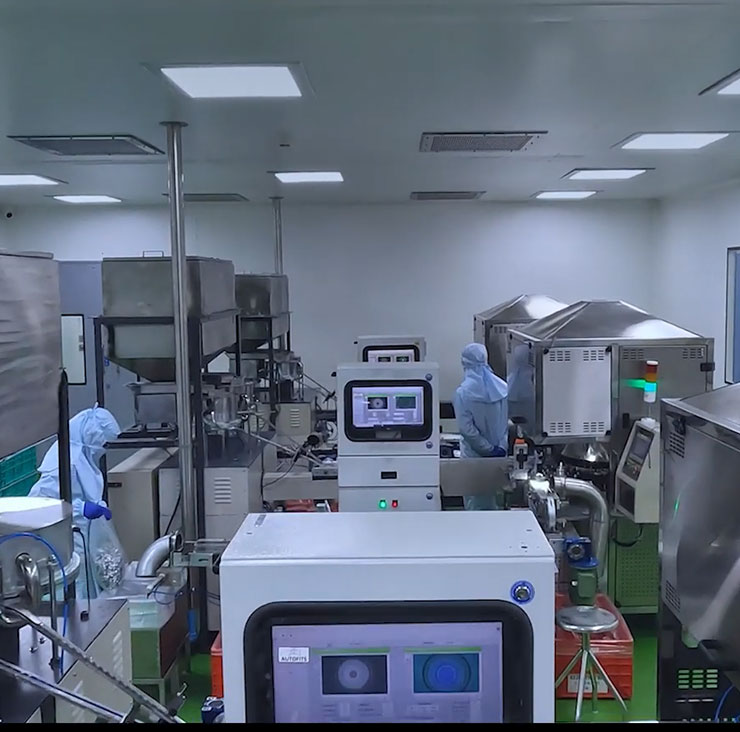
All of these seals come from one plant: a 75,000 sq ft site in Nashik, Maharashtra, with in-house polypropylene moulding on Toyo injection machines, fully automated washing, ISO Class 8 cleanroom assembly and 100% camera inspection. A contract site auditing Autofits as a supplier audits that one plant for the whole range. The plant is described on the factory page.
Frequently asked questions
What does a CDMO need from a vial seal supplier?
Several sizes and seal types from one qualified source, sterile supply for aseptic lines, colours and markings to keep each client’s product distinct, and documents each client can use in its own dossier.
Can Autofits supply ready-to-use seals to a contract filling site?
Yes. FlipTop seals are available Ready-to-Use, sterilised by gamma irradiation or ETO and double-bagged for aseptic areas, or Ready-to-Sterilise for sites that sterilise components in house.
Can each client of a CDMO reference the Autofits DMF?
A Drug Master File is referenced by the company filing the product, with the holder’s authorisation. Autofits holds Drug Master File 18100.
What seal sizes does Autofits make?
FlipTop Optima at 13, 20, 28, 32 and 34 mm; Pull Ring at 20 and 32 mm; Tear-Down at 13, 20 and 32 mm; all-aluminium tear-off seals at 13, 20 and 32 mm; and pilfer-proof caps at 22, 25, 28, 35 and 38 mm.
How are seals kept consistent across batches?
Every seal passes 100% high-speed camera inspection, and sampling follows AQL limits of critical nil, major not more than 2.5% and minor not more than 4%, which can be tightened to a client’s specification.
Sources
- ICH: M4Q, The Common Technical Document, Quality
- Autofits FlipTop Seals dossier, engineering drawings and certification records
*Last updated: 2026-11-06. Product and supply information only, not regulatory advice.*
