
Vial Closures: Stopper, Seal and Vial Neck Specified as One System
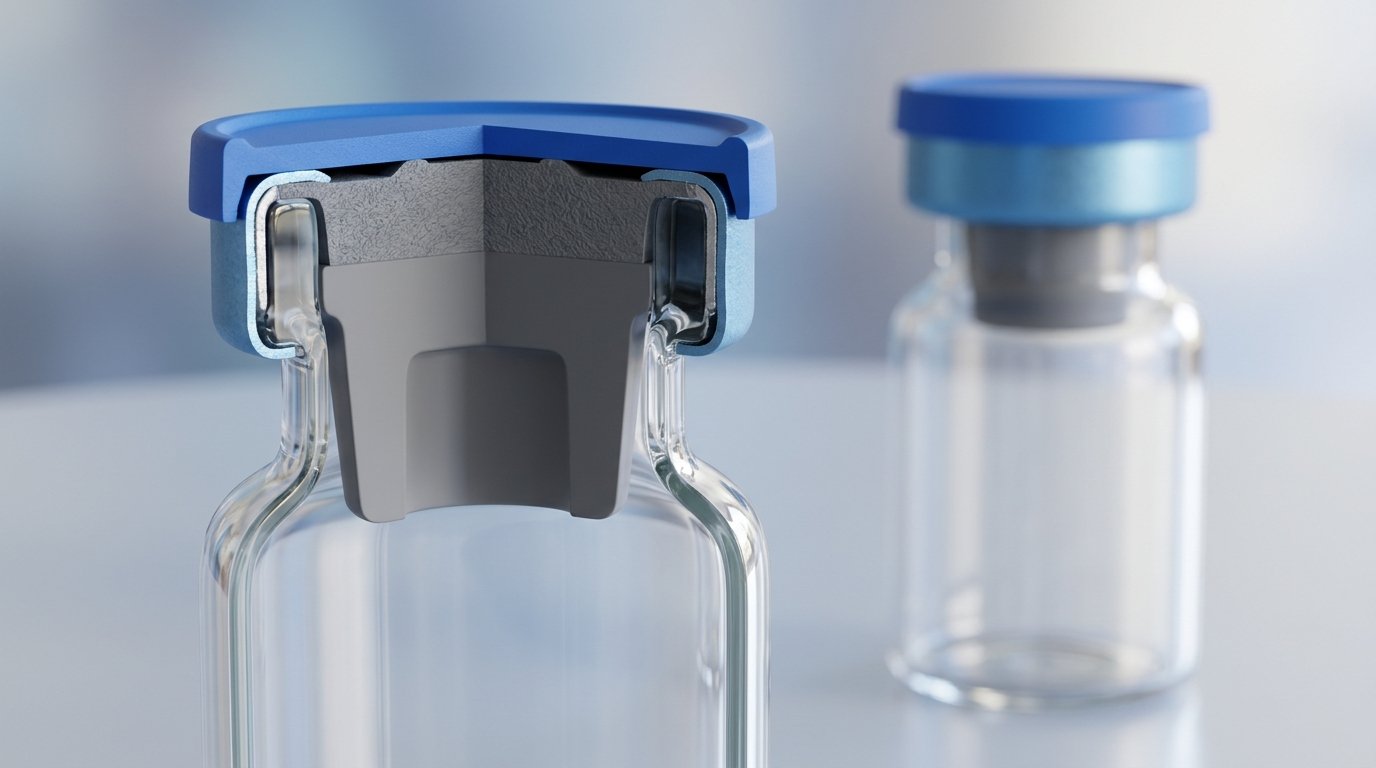
A vial closure is the rubber stopper and the crimped aluminium or aluminium-plastic seal that together close an injection vial, and it only works when both are specified against the vial neck they sit on. The neck sets the nominal size, the stopper forms the barrier, and the seal holds the stopper in compression and shows whether the vial has been opened. Autofits makes the seal: FlipTop, tear-off and tear-down seals from 13 to 34 mm, matched to the customer’s vial neck and to the stopper they have already qualified.
Key takeaways
- A vial closure has two parts, the stopper and the seal, and one reference, the vial neck defined for glass tubing vials in ISO 8362-1.
- Size is shared. A 13 mm neck takes a 13 mm stopper and a 13 mm seal; the same holds at 20, 28 and 32 mm, with seals also at 34 mm.
- Closure type is named after the seal: flip-off, pull-ring, tear-down or tear-off.
- The seal dimensions that decide fit are the inner diameter, the height and the aluminium thickness; opening force varies with the bridge count.
- Integrity is proved on the assembled, capped vial, not on either part alone.
- Stoppers are qualified against USP <381> and Ph. Eur. 3.2.9; seals are made to drawings under ISO 8362-3 or ISO 8362-6.
- Autofits makes the seal. The vial and the stopper come from the customer’s own qualified suppliers.
How a vial closure works
The stopper seals and the seal holds. After filling, the stopper is pressed into the vial mouth so its plug sits inside the neck bore and its flange rests on the flat land of the glass. A seal is then placed over it, and a capping head rolls the lower edge of the aluminium under the neck flange. The rolled aluminium traps the stopper flange between metal and glass, keeping it compressed for the life of the product.
That compression is called residual seal force. Too little and the stopper can relax away from the glass; too much and the flange can be damaged or the glass stressed. The capping set-up is tuned to the stopper and seal pair, which is one reason a change to either part is checked on the line. How integrity is confirmed on the finished vial is covered on the vial closure integrity page.
The specification chain
Each part is dimensioned from the one below it, so the closure is specified from the vial upwards.
| Layer | What is specified | Standard it relates to | Who supplies it |
|---|---|---|---|
| Vial neck | Nominal size, flange diameter and thickness, neck bore | ISO 8362-1 (tubing vials), ISO 8362-4 (moulded vials) | Glass supplier |
| Stopper | Compound, design (plug or freeze-drying), plug diameter, flange diameter and thickness | ISO 8362-2, ISO 8362-5; USP <381>, Ph. Eur. 3.2.9 | Stopper supplier |
| Seal | Design, inner diameter, height, aluminium thickness, bridges, colour | ISO 8362-3 (aluminium), ISO 8362-6 (aluminium-plastic) | Autofits, to drawing |
| Capping | Capping head set-up and residual seal force | Qualified on the filling line | Filler |
| Integrity | Container closure integrity of the capped vial | USP <1207> | Filler, with component data from suppliers |
The stopper as a component is defined on the elastomeric closure glossary page. How the three parts are classified as primary packaging, and the stopper and seal combinations by size, are on the primary packaging for vials page.
Types of vial closure
Vial closures are named by the seal, because the seal decides how the vial is opened and what tamper evidence it shows.
- Flip-off. A polypropylene disc on an aluminium shell flips away to expose the stopper face; the aluminium stays crimped. This is the FlipTop Optima range in bridge, button and flower designs.
- Pull-ring. Once the disc is detached, the aluminium ring is pulled and turned anticlockwise, and the whole seal comes away. See FlipTop Pull Ring.
- Twist tear-down. The disc is riveted to the aluminium; turning it anticlockwise tears the seal away. Used mainly for oral vaccination. See FlipTop Tear-Down.
- Tear-off. An all-aluminium seal whose centre is torn out along a perforation. See tear-off seals.
- Tear-down, all-aluminium. A metal-only seal with a section that tears down. See tear-down seals.
Seal dimensions that decide the fit
The seal has to clear the seated stopper flange, then roll under the neck, so its inner diameter and height matter more than its nominal size. Figures below come from the Autofits engineering drawings.
| Design | Size | Inner diameter of aluminium | Total height | Aluminium thickness | Bridges |
|---|---|---|---|---|---|
| FlipTop Optima | 13 mm | 13.36 mm min | 7.62 to 8.38 mm | 0.16 to 0.20 mm | 6 taper |
| FlipTop Optima | 20 mm | 20.22 mm min | 9.02 to 9.91 mm | 0.16 to 0.20 mm | 6 taper |
| FlipTop Optima | 28 mm | 27.60 to 28.20 mm | 11.06 to 12.06 mm | 0.17 to 0.23 mm | 8 |
| FlipTop Optima | 32 mm | 32.10 to 32.90 mm | 14.30 to 15.50 mm | 0.21 to 0.25 mm | 12 taper |
| FlipTop Optima | 34 mm | 33.60 to 34.00 mm | 15.00 to 16.00 mm | 0.20 to 0.25 mm | 8 taper |
| FlipTop Pull Ring | 20 mm | 20.00 to 20.60 mm | 9.00 to 10.00 mm | 0.18 to 0.22 mm | 6 taper |
| FlipTop Pull Ring | 32 mm | 32.15 to 32.40 mm | 14.30 to 15.30 mm | 0.20 to 0.26 mm | 8 fins |
| Tear-off | 20 mm | 20.00 to 20.60 mm | 7.40 to 8.00 mm | 0.16 to 0.20 mm | 2 |
| Tear-down, all-aluminium | 20 mm | 20.50 to 20.70 mm | 7.50 to 8.50 mm | 0.18 to 0.22 mm | 2 taper |
Maximum opening force is 30 N at 13 mm, 35 N at 20 and 28 mm and 65 N at 32 mm, and varies with the number of bridges. Every size and format is indexed on the seals by size page.
Choosing a vial closure
Work through four decisions in order, and test the result on the actual vial before volume orders.
- Neck size, read from the vial drawing, not inferred from fill volume.
- Stopper compound and design, from compatibility work on the drug and whether the product is freeze-dried.
- Seal design, from how the vial will be used: repeated needle access, full removal for oral use, or a metal-only specification.
- Delivery form, from the filling line: Regular, Ready-to-Use (gamma or ETO sterilised, double-bagged) or Ready-to-Sterilize.
A common error is changing one part in isolation. A harder stopper compound sits taller after capping; a different glass supplier’s flange can be thicker within tolerance. Either can move the crimp, so the pair is rechecked when one side changes.
Materials and quality
For fit, the controls that matter are the ones that keep seal dimensions inside the drawing from batch to batch. Seals are drawn from AA8011 aluminium (EN 15088:2005) in the thickness bands shown above, discs are moulded in-house on Toyo injection machines, and every seal is checked by high-speed camera before release against a critical-nil AQL. The stopper’s qualification sits with its supplier and the drug maker; what the seal needs from it is the flange diameter, flange thickness and seated height. Material conformity, heavy-metal limits and BSE/TSE status for the seals are listed on the primary packaging for vials page.
Ordering seals for a vial closure
Send the vial neck drawing, the drawing of the stopper you use, the seal design and colour, and the delivery form, and the matching seal drawing comes back with the quotation. Before committing, run a capping trial on your own vials and stoppers: standard seal samples of typically 200 to 500 pieces per size usually leave within 5 working days. Quantities and lead times are confirmed on enquiry through the contact page.
How this works in practice at Autofits
Autofits works from the customer’s vial and stopper drawings, so the seal is checked against the actual flange and seated stopper height rather than against a nominal size alone. The plant in Nashik, India, covers 75,000 sq ft, assembles Ready-to-Use seals in an ISO Class 8 cleanroom, and produces more than 2.4 billion seals a year. It holds ISO 9001:2015, ISO 14001:2015 and ISO 15378:2017 certification, a Drug Master File (DMF 18100) and CFDA registration.
Frequently asked questions
What is the lid of a vial called?
The lid of an injection vial is called a vial closure. It has two parts: a rubber stopper pushed into the vial mouth, and an aluminium or aluminium-plastic seal crimped over the stopper and under the neck flange. The coloured plastic top that flips off is the disc of a flip-off seal, not a separate lid.
How do you close a vial?
After filling, a rubber stopper is pressed into the vial mouth. An aluminium seal is placed over it and a capping head rolls the seal’s lower edge under the vial neck flange. The crimp keeps the stopper compressed against the glass, which holds the vial closed and sterile until it is opened.
What are the types of vial closures?
Vial closures are named by their seal. Flip-off seals expose the stopper face when a plastic disc is flipped away. Pull-ring and twist tear-down seals come off completely. Tear-off seals are all aluminium with a centre torn out along a perforation, and all-aluminium tear-down seals tear a section away.
What do FDA guidelines expect of a container closure system?
US FDA guidance expects a container closure system to be suitable for its intended use, which covers protection of the drug, compatibility with it, safety of the materials, and performance, including drug delivery. For a vial, that means the stopper, seal and vial are assessed together, including container closure integrity of the capped vial.
What do I need to specify for a vial closure?
Specify the vial neck from its drawing, the stopper compound and design, the compendial chapters the stopper must meet, the seal design, colour and finish, and the delivery form. Include the product type, whether it is freeze-dried, and the target markets. The stopper comes from its own supplier; the seal is quoted against the vial and stopper drawings.
Does Autofits supply the complete vial closure?
No. Autofits makes the seal: aluminium and aluminium-plastic vial seals from 13 to 34 mm. The rubber stopper and the glass vial come from the customer’s own suppliers, and the seal is matched to their stopper and neck drawings.
Related reading
- Elastomeric closure: definition
- Primary packaging for vials
- Vial closure integrity
- FlipTop Optima flip-off seals
- Seals by size
Sources
- Autofits FlipTop Seals dossier and engineering drawings
- ISO: ISO 8362-1:2018, Injection containers and accessories, Part 1: Injection vials made of glass tubing (https://www.iso.org/standard/74398.html)
- ISO: ISO 8362-2, Injection containers and accessories, Part 2: Closures for injection vials (https://www.iso.org/standard/87251.html)
- ISO: ISO 8362-6:2010, Caps made of aluminium-plastics combinations for injection vials (https://www.iso.org/standard/52806.html)
- USP-NF: General Chapters <381> and <1207> (https://www.usp.org/)
- US FDA: Guidance for Industry, Container Closure Systems for Packaging Human Drugs and Biologics, May 1999 (https://www.fda.gov/media/70788/download)
*Last updated: 2026-09-15. This page is general technical and product information, not regulatory or compliance advice; typical values are indicative, and closure drawings and quantities are confirmed with the quotation.*
