
Vial Seal Colour Chart: Colours, Finishes and How a Shade Is Matched
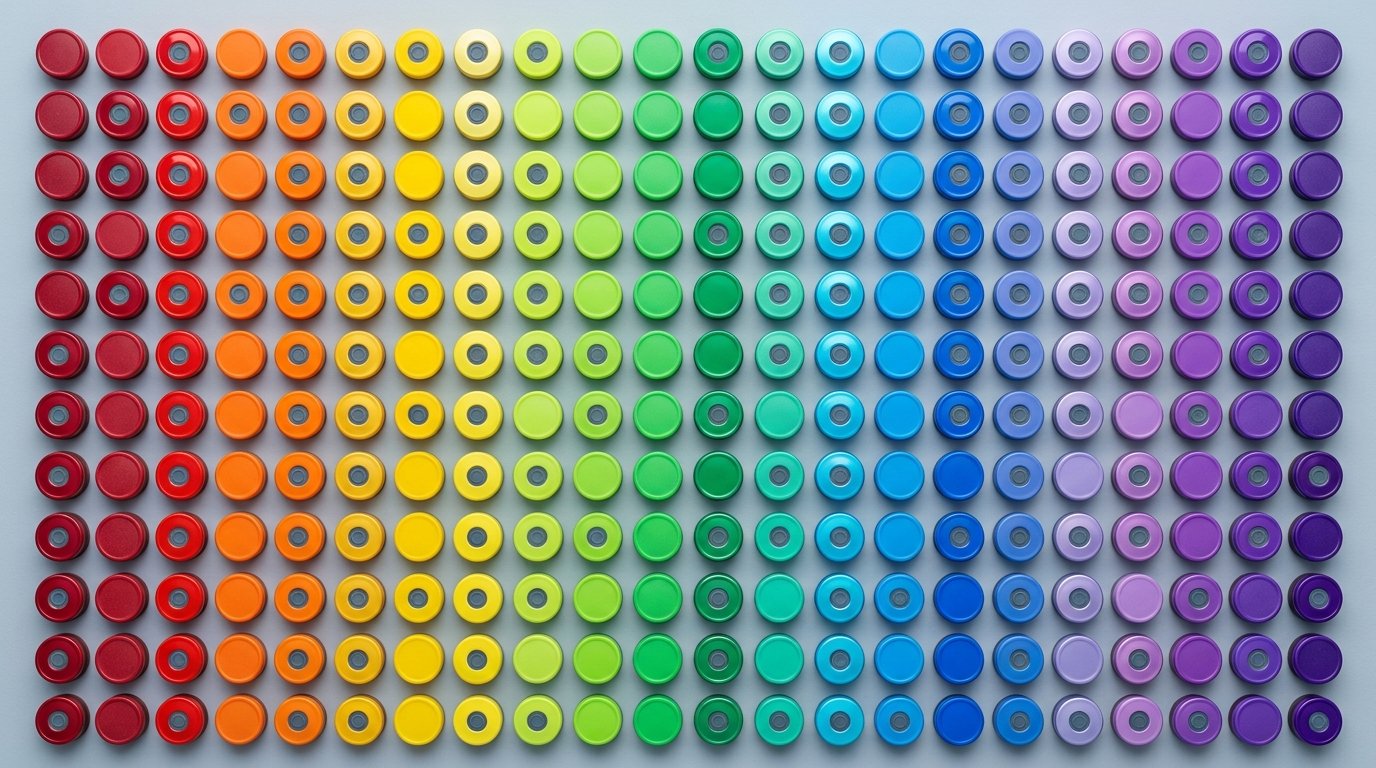
Autofits vial seals are available in a wide range of colours, matte or glossy, customised to requirement: the polypropylene disc is coloured, the aluminium is coloured by pigmenting its epoxy lacquer, and pilfer-proof caps are coloured the same way. Rather than a fixed swatch list, each colour is matched to the buyer’s own reference and typically approved against a sample. This chart sets out what can be coloured on each product line, the finish choices, the rules in some markets that limit cap colour and print, and what to send to match a specific shade.
Key takeaways
- Colour range: a wide range of colours, matte or glossy, customised to requirement.
- Two coloured surfaces on aluminium-plastic seals: the polypropylene disc and the lacquered aluminium.
- Colours are matched to a reference, not picked from a numbered list, and typically confirmed on a sample before production.
- Colour meaning is not standardised across markets. The same disc colour can signal different products at different companies.
- In the United States, a black cap overseal and ferrule on a vial is reserved for concentrated potassium chloride, under USP General Chapter <7>.
- Custom colours typically start from 100,000 pieces with a typical lead time of 4 to 6 weeks including approval.
The colour chart by product line
What can be coloured depends on the construction: a seal with a plastic disc has two surfaces to colour, an all-aluminium seal or cap has one.
| Product line | Disc or button colour | Aluminium colour | Finish | Marking |
|---|---|---|---|---|
| FlipTop Optima (Bridge, Button, Flower) | Wide range, customised to requirement | Pigmented epoxy lacquer | Glossy or matte | Embossed or printed |
| FlipTop Pull Ring | Wide range, customised to requirement | Pigmented epoxy lacquer | Matte or glossy | Often marked “For Oral Use Only” or “Flip Top & Tear” |
| FlipTop Tear-Down | Wide range, customised to requirement | Pigmented epoxy lacquer | Matte or glossy | Print and emboss confirmed on enquiry |
| Tear-off and tear-down (all-aluminium) | No disc | Pigmented epoxy lacquer | Matte or glossy | Print and emboss confirmed on enquiry |
| Pilfer-proof (ROPP) caps | No disc | Pigmented epoxy lacquer | Plain, printed or chamfered | Printed |
The lacquer on the aluminium conforms to 21 CFR 175.300, and the disc is polypropylene conforming to 21 CFR 177.1520 and EC 1895/2005; colour is carried within those materials. Finish detail for pilfer-proof caps is on the ROPP cap finishes page.
Colour decisions a specification has to settle
A colour specification is more than one shade: it fixes each coloured surface, the finish, and anything printed on top.
| Decision | Options | What to weigh |
|---|---|---|
| Disc colour | Wide range, matched to reference | Difference from other products and strengths in your own range; the black restriction in US-market injectables |
| Aluminium colour | Plain lacquer or pigmented lacquer | A second colour on the skirt adds a cue visible from the side of a tray |
| Disc and aluminium together | Same colour or two colours | A two-colour seal increases the number of distinguishable combinations in a large portfolio |
| Finish | Matte or glossy | Gloss and matte reflect light differently, which changes how the colour and any print read under ward or line lighting |
| Print on the disc | Artwork, position, ink colour | Legibility against the disc colour; limits on the top surface in some markets |
| Emboss | Artwork, position | Offered as an embossed finish on the FlipTop Optima |
Rules that limit colour and print on vial caps
Colour meaning on vial seals is not standardised across markets, but a few specific rules do apply; the published examples below are from the United States.
| Source | What it says | Where it applies |
|---|---|---|
| USP General Chapter <7>, Labeling, “Ferrules and Cap Overseals” | A black closure system on a vial, meaning a black cap overseal and black ferrule, is used only for Potassium Chloride for Injection Concentrate | Injectable products for the US market |
| USP General Chapter <7>, as summarised in FDA guidance (May 2022) | If no cautionary statement is required, the top surface of the vial, including the ferrule and cap overseal, should remain blank; lot numbers can appear on the side of the ferrule | Injectable products for the US market |
| FDA, Safety Considerations for Container Labels and Carton Labeling Design to Minimize Medication Errors (May 2022) | Colour differentiation within a manufacturer’s own line can help; colour coding that assigns a fixed meaning is generally to be avoided, because users may stop reading the label, colours look different under different lighting, and some people have colour vision deficiency | Non-binding recommendations to US sponsors |
| The marketing authorisation holder’s own scheme | Assigns colours to products and strengths within one company’s range | Only inside that company’s portfolio |
The practical reading is that a seal colour is a cue chosen by the product owner, checked against any market rule, and never a substitute for the label. For a longer look at how house schemes work and where they fail, see seal colour coding in pharma; to browse the seal range by colour, see vial seals by colour.
How a specific shade is matched
Send a physical reference, get a matched sample back, approve it, and keep the approved sample as the standard for later deliveries.
| Reference you send | How well it works | Watch for |
|---|---|---|
| A previously approved seal or disc | Best: same material and a known finish | State whether the finish should also match |
| A plastic colour chip or moulded part | Good for the disc colour | Plastic and lacquered aluminium can read differently side by side |
| The colour reference from your artwork standard | Workable | A printed reference on paper may not match a moulded or lacquered surface exactly |
| A colour described in words | Not a reference | “Mid blue” means different things to different people |
The sequence that avoids rework:
- Reference. Send the physical reference and state matte or glossy.
- Matched sample. Ask for a sample in the matched colour before production.
- Approval. Sign off the sample under the lighting your inspection uses.
- Retained standard. Keep an approved sample as the colour standard for incoming checks on later lots.
Colour is also an inspection criterion at Autofits: a lacquer or disc colour outside the normal colour range is classed as a major defect, released against an AQL of not more than 2.5%.
Colour, print and emboss can all be specified together in one custom seal quote request, and the wider options are on the custom seals page.
Order terms for colour
A standard design in a standard colour and a matched custom colour are ordered on different terms. Values are typical and confirmed on enquiry.
| Order | Typical MOQ | Typical lead time |
|---|---|---|
| Standard design, standard colour | From 50,000 pieces per size and colour | 2 to 3 weeks from order confirmation |
| Custom colour | From 100,000 pieces | 4 to 6 weeks, including artwork approval |
| Custom print or emboss | From 100,000 pieces | 4 to 6 weeks, including artwork approval |
Every colour counts as its own quantity, so a range of four strengths in four colours is four quantities. Full terms are on the MOQ and lead times page.
What to send with a colour enquiry
- Product line, design and size
- Physical colour reference for the disc and, if different, for the aluminium
- Matte or glossy finish
- Print or emboss artwork with its position
- The market the product is sold in, so any cap colour or print rule can be checked
- Quantity per colour
Contact Autofits with the list above.
Frequently asked questions
Is there a universal colour code for vial seals?
No. Vial seal colours carry no single meaning across companies or markets; a colour is chosen by the product owner for its own range. A few specific rules exist, such as the US rule that a black cap overseal and ferrule on a vial is used only for concentrated potassium chloride injection.
Why are black caps not used on most injectable vials?
In the United States, USP General Chapter <7> reserves a black closure system on a vial, a black cap overseal with a black ferrule, for Potassium Chloride for Injection Concentrate. The black cap alerts the user to the concentrated product, so FDA guidance says black cap overseals and ferrules should not be used on any other drug product.
Does Autofits publish a numbered colour list?
Colours are matched to the buyer’s own reference rather than chosen from a numbered swatch list. The seals are available in a wide range of colours, matte or glossy, customised to requirement, and a matched colour is typically approved on a sample before production.
Can the disc and the aluminium be different colours?
Both surfaces can be coloured: the polypropylene disc in its own colour and the aluminium through a pigmented epoxy lacquer. Whether a given two-colour combination suits your seal design is confirmed on enquiry, and the combination is approved on a sample.
What is the minimum order for a custom seal colour?
A custom colour typically starts from 100,000 pieces, with a typical lead time of 4 to 6 weeks including artwork approval. A standard design in a standard colour typically starts from 50,000 pieces per size and colour. Both are confirmed on enquiry.
Related reading
- Vial seals by colour
- Seal colour coding in pharma
- Custom seals
- Custom seal quote request
- FlipTop Optima flip-off seals
Sources
- Autofits FlipTop Seals dossier: colours, finishes, lacquer and polypropylene specifications
- U.S. FDA: Safety Considerations for Container Labels and Carton Labeling Design to Minimize Medication Errors, Guidance for Industry, May 2022 (https://www.fda.gov/media/158522/download)
- USP: General Chapter <7>, Labeling, section on ferrules and cap overseals, USP-NF (https://www.usp.org/)
- eCFR: 21 CFR 175.300, Resinous and polymeric coatings (https://www.ecfr.gov/current/title-21/chapter-I/subchapter-B/part-175/subpart-C/section-175.300)
*Last updated: 2026-09-15. Colours are matched to customer reference and confirmed per order; order quantities and lead times are typical. Regulatory references describe US requirements and FDA recommendations and are not regulatory advice for a specific product.*
