
Standard vs Premium Vial Closure Systems: A Buying Guide
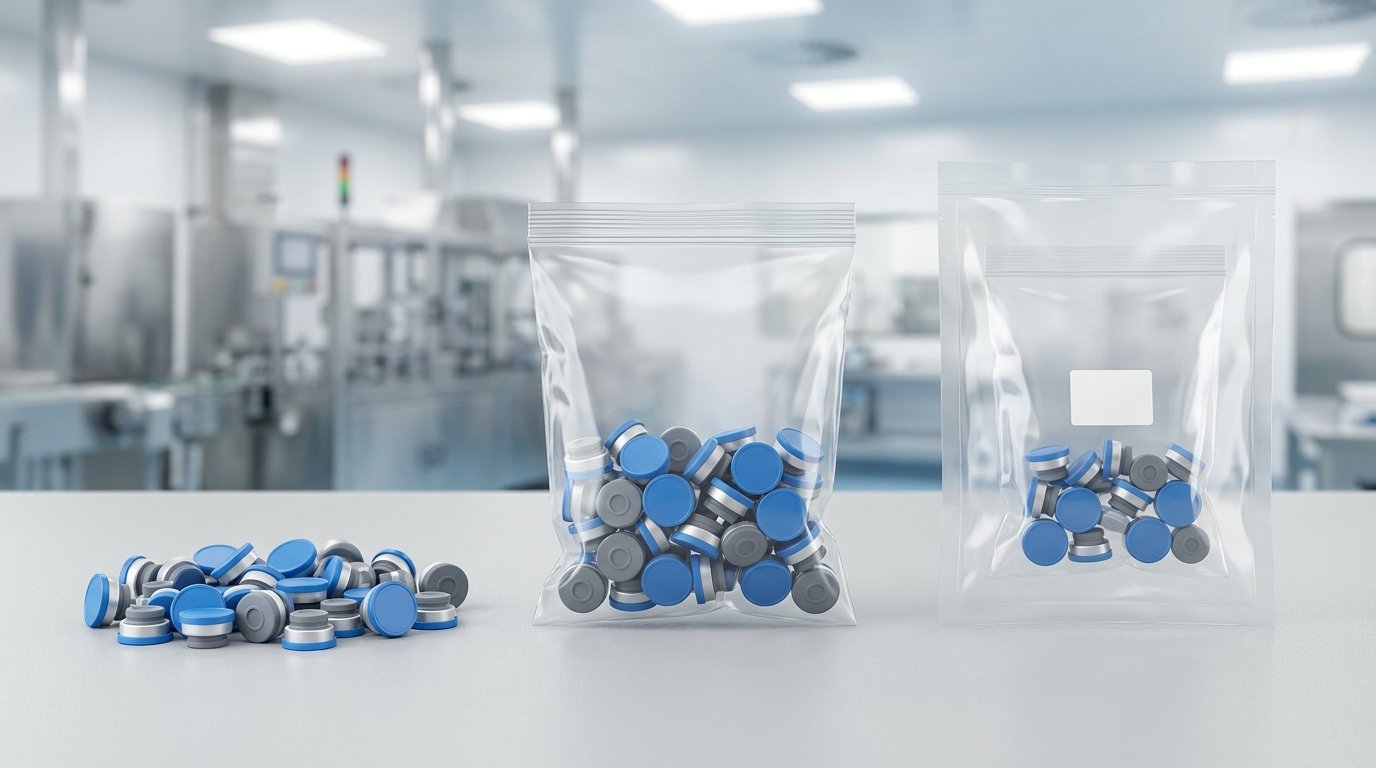
The choice described as standard versus premium is really a choice about how much processing the supplier has already done. Regular closures arrive unwashed and unsterilized, and your plant does everything. Ready-to-sterilize closures arrive after a validated pharmaceutical wash, with defined bioburden, endotoxin and particulate limits, and your plant sterilizes them. Ready-to-use closures arrive washed and sterilized, packed for direct entry into the aseptic core. The unit price rises across those three levels, and the work and risk that sit inside your own facility fall. Brand names sit on top of this ladder rather than replacing it: Westar is West Pharmaceutical Services’ name for its ready-to-sterilize and ready-to-use processing, and Datwyler describes its equivalents as RFS, RTU and RTP.
This guide sets out what changes at each level, which criteria should decide it, and what to ask a supplier before committing a programme.
Key takeaways
- Three supply levels, not two grades. Regular, ready-to-sterilize and ready-to-use describe the processing state of the component, not its quality class.
- The seal itself does not change. The same alloy, lacquer, dimensions and drawing apply at every level; what changes is washing, sterilization and packaging.
- Cost moves in two directions. A higher unit price buys back cleanroom floor space, wash and sterilization validation, in-process testing and operator time.
- Brand names map onto the ladder. Westar is West’s trademarked processing designation; Datwyler lists RFS, RTU and RTP; Autofits supplies Regular, Ready-to-Sterilize and Ready-to-Use.
- Annex 1 is the reason this matters. The 2022 revision of EU GMP Annex 1 frames sterile manufacture around a documented contamination control strategy, and how components enter the aseptic area is part of it.
- Ask for the validation package, not the label. A supply form is only as good as the sterilization validation and the bioburden and endotoxin data behind it.
What actually changes between the levels
Nothing about the closure’s geometry or materials changes; the processing history and the packaging change. A Regular seal is manufactured, inspected and packed. It carries no washing claim, no bioburden specification, and no sterility claim. Your plant washes it, controls particulate, sterilizes it, and validates all of that.
A ready-to-sterilize seal has been through a validated pharmaceutical wash designed to bring bioburden, endotoxin and particulate within stated limits, and it is packed so that it can be transferred into your sterilizer. You still own the sterilization step and its validation, but you no longer own the wash.
A ready-to-use seal has been washed and then sterilized by a validated process, typically gamma irradiation or ethylene oxide for aluminium and aluminium-plastic components, and packed in a way that allows transfer into the aseptic area, commonly double-bagged so the outer bag is removed at each cleanliness step. Your plant introduces it directly. The sterilization method itself, and what has to be demonstrated for it, is covered in sterilization validation for vial closures.
Comparison of the three supply levels
The table is the decision in one view. Read the last two rows first, because they are where the money actually is.
| Criterion | Regular | Ready-to-Sterilize | Ready-to-Use |
|---|---|---|---|
| Washed by | Your plant | The supplier, validated process | The supplier, validated process |
| Sterilized by | Your plant | Your plant | The supplier, validated process |
| Bioburden and endotoxin limits | Set and tested in-house | Specified by the supplier | Specified by the supplier |
| Particulate control | In-house | Supplier-controlled wash | Supplier-controlled wash |
| Packaging | Bulk polybag | Bagged for transfer into your sterilizer | Double-bagged for staged entry into the aseptic area |
| Entry point into your plant | Warehouse, then wash suite | Warehouse, then sterilizer | Staged entry to the aseptic core |
| Validation you own | Wash, sterilization, hold times | Sterilization, hold times | Incoming control, transfer and hold times |
| Cleanroom and equipment footprint | Largest | Reduced | Smallest |
| Unit price | Lowest | Middle | Highest |
| Best suited to | Plants with existing wash and sterilization capability and steady volumes | Plants with sterilization capacity but limited wash capability | Aseptic lines, small batches, clinical supply, new facilities |
The criteria that should decide it
Five questions settle this for most buyers, and none of them is the unit price on its own.
Do you already have validated wash and sterilization capability? If the equipment, the utilities and the validation package exist and are running at less than full capacity, Regular supply uses an asset you have already paid for. If they do not exist, building them for one component is rarely the cheaper path.
How large and how frequent are the batches? High-volume routine production absorbs in-house preparation efficiently. Clinical supply, small batches, and frequent product changeovers do not, because the setup, cleaning and testing overhead is charged against a small number of units.
What does the contamination control strategy say? Annex 1 expects sterile manufacture to be governed by a documented contamination control strategy, and how components cross into the aseptic area is part of that document. Fewer preparation steps inside the facility means fewer interventions to justify. The general framework is in sterile vial sealing.
Who carries the validation burden? Ready-to-use supply moves the wash and sterilization validation to the supplier, which means your qualification work shifts to supplier audit, incoming control and transfer studies. That is a different kind of work, not an absence of work.
What happens if supply is interrupted? A plant with in-house wash and sterilization can fall back to Regular material. A plant built around ready-to-use supply has fewer options, so second-source qualification matters more.
Where brand names fit
Supplier programmes are branded, but they describe positions on the same ladder. West Pharmaceutical Services uses the Westar name for its ready-to-sterilize and ready-to-use processing of elastomeric components, describing Westar RS components as having been through a validated pharmaceutical wash process to defined limits for bacterial endotoxin, bioburden and particulate matter, and Westar RU components as having been washed and then sterilized. Datwyler lists RFS, RTU and RTP configurations for its vial components with steam and gamma sterilization.
The practical consequence is that a tender comparing “Westar RS” against “ready-to-sterilize” against “RFS” is comparing three names for a similar position, and the comparison has to be made on the underlying evidence: which wash process, validated to what limits, tested how often, and documented in what form. Ask for the specification and the validation summary rather than matching brand names.
What to ask a supplier before committing
Request seven items and the comparison becomes objective. The controlled drawing for the exact size and design. The material declarations for alloy, lacquer and plastic. The wash process description with its bioburden, endotoxin and particulate limits. The sterilization validation summary, including method, dose or cycle, and the sterility assurance level claimed. The packaging configuration and how many bag layers are removed at which cleanliness grade. The shelf-life and re-sterilization position. And the AQL plan with critical, major and minor definitions.
Add two questions specific to closures: how the part has been shown to run at your target capping rate, and how container closure integrity was demonstrated on your vial, stopper and seal combination. Those are covered in container closure integrity testing and vial closure supplier selection.
How this works in practice at Autofits
Autofits supplies its seals in all three forms. Regular seals suit customers who wash and sterilize in-house. Ready-to-Sterilize seals are washed on a fully automated line and packed for the customer’s own sterilization. Ready-to-Use seals are sterilized by gamma irradiation or ethylene oxide and assembled and bagged in an ISO Class 8 cleanroom, with double-bagged options for aseptic areas and Tyvek bagging available as an alternative to the standard polybag. The seal itself is unchanged across the three: an AA8011 aluminium shell conforming to EN 15088:2005 with EN 10204 3.1 certification, an epoxy lacquer to 21 CFR 175.300, and, on the FlipTop Optima, a polypropylene button to FDA 21 CFR 177.1520 moulded in-house. Every seal passes 100% high-speed camera inspection. Standard AQL is critical nil, major not more than 2.5% and minor not more than 4%, tailorable to specification, under ISO 9001:2015, ISO 14001:2015 and ISO 15378:2017 with Drug Master File 18100. Certificates are on the quality page, the company background and manufacturing scale on the about page, and the leadership responsible for the quality system and the AQL on the team page.
Where the supply level earns its cost is on the products that cannot absorb a closure failure. A high-value biologic fill and a cytotoxic oncology presentation both justify Ready-to-Use seals and a fuller documentation pack, while a commodity IV diluent is usually specified at the level the line and the AQL actually require. If the question underneath this one is where to buy rather than what grade to buy, Indian versus global vial seal suppliers compares the two sourcing routes on cost, lead time and documentation.
Frequently asked questions
What is the difference between ready-to-sterilize and ready-to-use closures?
Ready-to-sterilize components have been washed by the supplier under a validated process to defined bioburden, endotoxin and particulate limits, and the customer performs the sterilization. Ready-to-use components have been washed and then sterilized by the supplier under a validated process, and are packed so they can be transferred directly into the aseptic area. The difference is which party owns the sterilization step and its validation.
Is a premium closure a better-quality seal?
Not in terms of the part itself. The alloy, lacquer, plastic, dimensions and drawing are the same across supply forms from a given manufacturer. What a higher supply level buys is processing that has already been done and validated by the supplier, which removes steps, equipment and validation work from your own facility. Quality of the component is set by the specification and the quality system, not by the supply form.
Does ready-to-use supply save money?
It depends on what your facility already owns. Ready-to-use seals carry a higher unit price, and the saving comes from avoided wash and sterilization equipment, cleanroom space, utilities, in-process testing, operator time and validation. Plants that already run validated wash and sterilization at spare capacity often find Regular supply cheaper overall; plants without that capability, or running small or frequent batches, usually do not.
Is Westar a type of seal?
No. Westar is West Pharmaceutical Services’ trademarked designation for its ready-to-sterilize and ready-to-use processing of elastomeric components, applied to items such as stoppers, plungers, and lined seals and caps for cartridge systems. It describes a processing and quality level rather than a closure design, and other manufacturers use their own names for equivalent positions.
What documents prove a ready-to-use claim?
Ask for the sterilization validation summary, including the method, the dose or cycle, and the sterility assurance level claimed; the wash process specification with its bioburden, endotoxin and particulate limits; the routine monitoring and release testing regime; the packaging configuration and bag-removal sequence; and the shelf-life position for the sterilized pack. A label alone is not evidence.
Related reading
- Sterilization validation for vial closures
- EU GMP Annex 1 and sterile manufacture
- Sterile vial sealing explained
- Vial closure supplier selection
- Indian vs global vial seal suppliers: cost, lead time and documentation
- FlipTop Optima flip-off seals
Sources
- West Pharmaceutical Services: Westar stoppers, describing the Westar RS validated pharmaceutical wash and the limits it is designed to meet (https://www.westpharma.com/products/vial-containment-solutions/stoppers/westar-pharmaceutical-stoppers)
- West Pharmaceutical Services: Sterilized elastomeric components, ready to use (https://www.westpharma.com/products/quality-enhancements/sterilized-elastomeric-component-primary-packaging-ready-to-use)
- Datwyler Healthcare: Sealing solutions for vials, listing RFS, RTU and RTP configurations with steam and gamma sterilization (https://healthcare.datwyler.com/resources/sealing-solutions-vials)
- European Commission: EudraLex Volume 4, EU GMP Annex 1, Manufacture of Sterile Medicinal Products (https://health.ec.europa.eu/medicinal-products/eudralex/eudralex-volume-4_en)
- ISO: ISO 15378:2017, Primary packaging materials for medicinal products (https://www.iso.org/standard/70729.html)
- USP: USP General Chapter <1207> Package Integrity Evaluation, Sterile Products (https://www.usp.org)
*Last updated: 2026-07-31. This article is general technical information about pharmaceutical vial closures, not regulatory or compliance advice; confirm current standard editions, supplier specifications and validation packages directly. Westar is a trademark or registered trademark of West Pharmaceutical Services, Inc., used here only to identify that company’s processing designation; Autofits is not affiliated with West Pharmaceutical Services, Inc.*
