
USP <382>: Elastomeric Component Functional Suitability for Injectables
 United States Pharmacopeia and National Formulary (USP-NF) by the U.S. Pharmacopeial Convention.
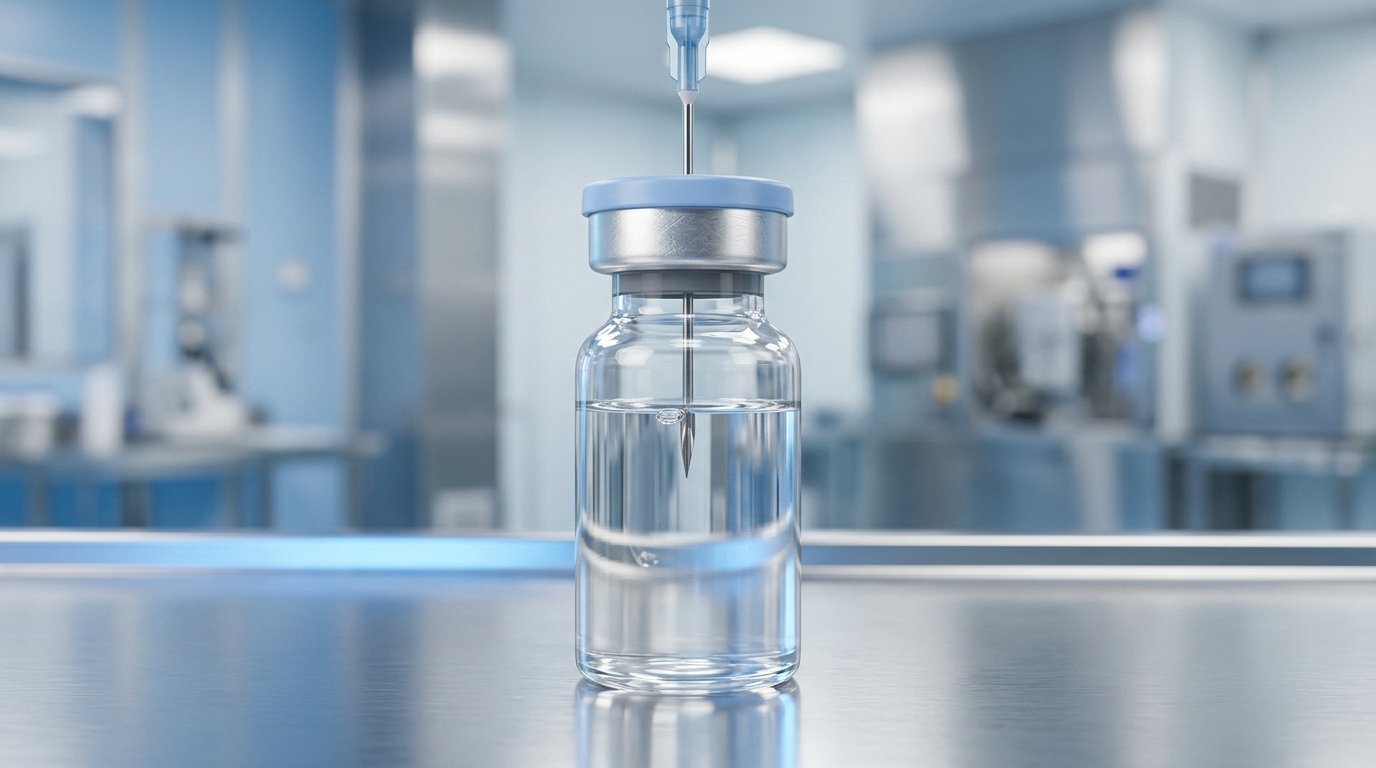
An elastomeric component is the rubber part (most commonly a vial stopper, but also the rubber in cartridges and prefilled-syringe systems) that seals the container and that the needle passes through to withdraw or deliver the drug. <382> is concerned with whether that component performs its mechanical job reliably across the package’s life: piercing, resealing, and holding the seal.
USP published <382> to separate functional performance from material identity and safety. The functionality content that historically sat within <381> was moved into the dedicated <382> chapter, which lets manufacturers and drug makers address fit-for-purpose performance explicitly. <382> was incorporated into the USP-NF in 2020 with a multi-year transition period and became the official chapter on 1 December 2025. A further Revision Bulletin, posted 30 January 2026 and official 1 February 2026, superseded that version, so the December 2025 text is no longer the one in force and the current USP-NF text is the controlling reference. Because functional behaviour depends on the whole package, <382> is applied to the component as used with its specific vial and seal rather than to the rubber alone.
What USP <382> tests
USP <382> covers the functional attributes that determine whether an elastomeric component performs safely in clinical use and on the filling line. For a vial-and-stopper system, the functional characteristics generally associated with elastomeric component suitability are:
Penetrability (penetration force)
The force required to push a hypodermic needle through the stopper. If penetrability is too high, the needle can bend, the vial can be pushed off a benchtop, or the stopper can dislodge; too low, and seal performance may be compromised. The attribute confirms the component pierces predictably with a standard needle.
Self-sealing capacity
Whether the stopper reseals after the needle is withdrawn so that the container does not leak. This matters most for multiple-dose presentations, where the stopper is pierced more than once and must continue to maintain the seal between withdrawals. Multiple-dose formats are routine in veterinary medicine, where one vial serves a herd, and the trade-offs are set out in single-dose versus multi-dose vials.
Contribution to package integrity
The component’s role in keeping the container sealed. Functional suitability is assessed with the component in its intended packaging or delivery system, because the stopper, the glass vial, and the aluminium seal that crimps over the stopper work together to maintain the barrier. Container closure integrity itself is evaluated under USP <1207>.
Fragmentation (coring): tested under <381>, not <382>
Whether the needle, on piercing, cuts loose fragments of rubber that can fall into the drug product. Coring is a patient-safety concern because a fragment in an injectable could be administered. Fragmentation testing is specified under USP <381>, not <382>. Section 5.1 *Fragmentation* was removed from <382> by a Revision Bulletin published 25 April 2025, before the chapter became official on 1 December 2025, so <382> as it stands carries no fragmentation section.
The removal followed FDA letters to USP dated 14 June and 30 July 2024 objecting to that section. The specific objection was the increase in the particle size threshold for fragmentation detection, from 50 µm in <381> to 150 µm in <382>, with a lack of sufficient supporting safety data cited as the basis for the concern. The FDA’s position was that the 50 µm detection limit should be maintained and that microscopic examination with an acceptance criterion of not more than 5 should be introduced. The controlling method and acceptance limit therefore sit in the <381> text of the current USP-NF.
The specific test methods, sample numbers, and acceptance limits are defined in the current USP-NF text, and the applicable attributes depend on the system type and on whether the product is single-dose or multiple-dose. Those methods were revised, and what changed is summarised in the note on the new USP <382> testing requirements.
How USP <382> relates to USP <381>
USP <381> and USP <382> are two halves of qualifying an elastomeric component: <381> addresses the material, <382> addresses the function. A component is not fully characterised by either chapter alone. When <382> became official, the functionality tests that had historically sat in <381> were moved to <382> so the two chapters do not overlap.
The division is not total, and the exception is the one packaging QA teams ask about most. The revised <381>, official the same day of 1 December 2025, retains the fragmentation test but omits penetrability and self-sealing capacity, which now sit in <382>. Section 5.1 *Fragmentation* was struck from <382> by a Revision Bulletin published 25 April 2025, before the chapter became official on 1 December 2025, after the FDA objected that the particle size threshold for fragmentation detection rose from 50 µm in <381> to 150 µm in <382> without sufficient supporting safety data.
A further Revision Bulletin, posted 30 January 2026 and official 1 February 2026, carries the text now in force. It aligned the penetration requirements between the chapters: it set needle self-sealing capacity at 1.0 times the maximum number of scheduled penetrations, down from the 1.5 times originally specified, after stakeholder feedback that the higher figure produced unrealistic leak-test failures. Qualification protocols written against the 1.5 times figure should be rechecked against the current USP-NF text.
| Aspect | USP <381> | USP <382> |
|---|---|---|
| Focus | The elastomeric material | The component’s function in its system |
| Typical tests | Physicochemical (such as turbidity, reducing substances), extractables-related material requirements, and fragmentation | Penetrability, self-sealing, package-integrity contribution (per current USP-NF) |
| Question answered | Is the rubber compound suitable and safe? | Does the component perform reliably in use? |
| Evaluated on | The material/component | The component in its packaging or delivery system |
USP <381>, elastomeric components in injectable packaging, establishes that the rubber compound meets its physicochemical material requirements. It tells you the material is appropriate and that what could migrate from it is controlled. USP <382> then confirms the component made from that material performs its mechanical functions. In practice a drug manufacturer qualifying a stopper looks at both: <381> for material suitability and <382> for functional suitability, alongside extractables and leachables work for the specific formulation. Citations: USP-NF.
Why functional suitability matters for fill-finish
Functional suitability connects directly to filling-line reliability and to sterility assurance. On a fill-finish line, the stopper is placed and the aluminium seal is crimped over it at high speed; a closure with inconsistent dimensions or unsuitable functional behaviour can mis-seat, core, or fail to reseal, generating rejects and integrity risks.
The closure does not act alone. The elastomeric stopper provides the resealing barrier, and the aluminium or aluminium-plastic seal crimps over it to hold the stopper in place and maintain compression on the glass. That combined assembly is what keeps the container closure system sealed for the product’s shelf life, and the way the two components are matched is set out in rubber stopper and aluminium seal pairing. Defective sealing of vials is treated as a container closure integrity risk under sterile-manufacturing expectations, which is why both the closure’s functional suitability and the seal’s correct application are scrutinised. Container closure integrity test methods that verify this are described in USP <1207>.
Because functional performance is a property of the whole package, a stopper that passes <382> with one vial and seal configuration should be re-evaluated if the vial geometry, seal design, or crimp parameters change.
How this works in practice at Autofits
Autofits manufactures the aluminium and aluminium-plastic seals that complete the container-closure system that an elastomeric component helps form: FlipTop Optima flip-off seals, tear-off and tear-down aluminium seals, and aluminium pilfer-proof (ROPP) caps in 13, 20, and 32 mm sizes. The full range is on the Autofits products page. The aluminium seal crimps over the rubber stopper and the vial neck, holding the stopper in compression so it can maintain its seal between needle penetrations. Autofits produces these seals under an ISO 15378:2017 quality system (alongside ISO 9001:2015, ISO 14001:2015, and a Drug Master File) in a 75,000 sq ft Nashik facility with an ISO Class 8 cleanroom and high-speed visual inspection on the closure lines. Dimensional consistency in the seal supports reliable crimping and capping, which is part of how the assembled package preserves the integrity that functional suitability under USP <382> depends on. The full certification set is on the quality page.
Frequently asked questions
What does USP <382> test?
USP <382> tests the functional suitability of elastomeric components used with injectables: how the component performs in its assembled system. For a vial stopper, the functional attributes generally associated with the chapter include penetrability (the force to pierce the stopper with a needle), self-sealing capacity (whether the stopper reseals after the needle is withdrawn), and the component’s contribution to keeping the container sealed. Fragmentation (coring) is not one of them: that section was removed from <382> before the chapter became official, and the fragmentation test remains under USP <381>. The exact attributes, methods, and acceptance limits are defined in the current USP-NF.
When did USP <382> become official?
USP <382> became official on 1 December 2025, after being incorporated into the USP-NF in 2020 with a multi-year transition period. A further Revision Bulletin, posted 30 January 2026 with an official date of 1 February 2026, supersedes that version and is the text now in force. It set needle self-sealing capacity at 1.0 times the maximum number of scheduled penetrations, down from the 1.5 times originally specified. The current USP-NF text is the controlling reference for its requirements.
What is the difference between USP <381> and USP <382>?
USP <381> covers the elastomeric component’s material requirements (physicochemical properties), answering whether the rubber compound is suitable and safe. USP <382> covers the component’s functional performance in its system, such as penetrability and self-sealing. The functionality tests that used to sit in <381> were moved to <382>, with the exception of fragmentation, which <381> retains. A component is qualified using both: <381> for the material, <382> for function.
Is USP <382> mandatory?
USP general chapters numbered below 1000, such as <382>, are generally considered enforceable for products with a USP monograph in the United States when the chapter is referenced by the monograph or the General Notices. <382> became official on 1 December 2025, and the text now in force is a later Revision Bulletin official 1 February 2026. In practice, functional suitability testing of elastomeric components is a standard part of qualifying an injectable packaging system regardless, because functional failures carry patient-safety and sterility risk. Confirm applicability for a specific product with current USP-NF and your regulatory requirements.
What is coring in a vial stopper?
Coring is when a needle, on piercing a rubber closure, cuts loose a small fragment of the rubber that can fall into the drug product. Because that fragment could be drawn up and injected, coring is a patient-safety concern. The fragmentation test that measures this sits under USP <381>, not <382>: it counts how many fragments a closure generates over repeated piercings and requires the count to stay within an acceptable limit. Section 5.1 *Fragmentation*, drafted for <382>, was removed by a Revision Bulletin published 25 April 2025, before that chapter became official on 1 December 2025, so <382> as it stands carries no fragmentation requirement. The FDA had objected that the particle size threshold for fragmentation detection rose from 50 µm in <381> to 150 µm in <382> without sufficient supporting safety data.
Does USP <382> apply to the aluminium seal?
USP <382> applies to the elastomeric closure (the rubber stopper), not the aluminium seal directly. However, functional suitability, especially self-sealing and package integrity, is evaluated with the closure in its actual container-closure system, which includes the aluminium or aluminium-plastic seal that crimps over the stopper. The seal’s correct application is part of what allows the assembled package to maintain integrity.
Related reading
- USP <381>: elastomeric components in injectable packaging
- USP <1207>: container closure integrity for sterile products
- Vial closure integrity: what holds the package sealed
- ISO 15378:2017: GMP quality for primary packaging
- FlipTop Optima flip-off seals for vials
Sources
- USP: United States Pharmacopeia and National Formulary (USP-NF), General Chapters <381> Elastomeric Components in Injectable Pharmaceutical Product Packaging/Delivery Systems and <382> Elastomeric Component Functional Suitability in Parenteral Product Packaging/Delivery Systems (https://www.usp.org/)
- USP: General Chapter <1207>, Package Integrity Evaluation, Sterile Products (https://www.usp.org/)
- USP-NF: Accelerated Revisions by Official Date, listing <382> as a Revision Bulletin posted 30-Jan-2026, official 01-Feb-2026 (https://www.uspnf.com/official-text/accelerated-revisions-official-date)
- USP: General Chapter <382> Revision Bulletin notice, posting date 30 January 2026, official date 1 February 2026, needle self-sealing capacity set at 1.0 times the maximum scheduled penetrations (https://www.uspnf.com/sites/default/files/usp_pdf/EN/USPNF/revisions/gc-382-rb-notice-20260130.pdf)
- USP: General Chapter <382> Revision Bulletin, published 25 April 2025, removing Section 5.1 Fragmentation (https://www.uspnf.com/sites/default/files/usp_pdf/EN/USPNF/revisions/gc-382-rb-notice-20250425.pdf)
- USP-NF: notice of intent to revise <381> and <382> (https://www.uspnf.com/notices/381-382-nitr-20250211)
*Last updated: 2026-08-18. This article is general regulatory information, not legal or compliance advice; confirm current chapter text, methods, and acceptance criteria with USP-NF.*
