
USP <1207> Explained: Container Closure Integrity for Sterile Products
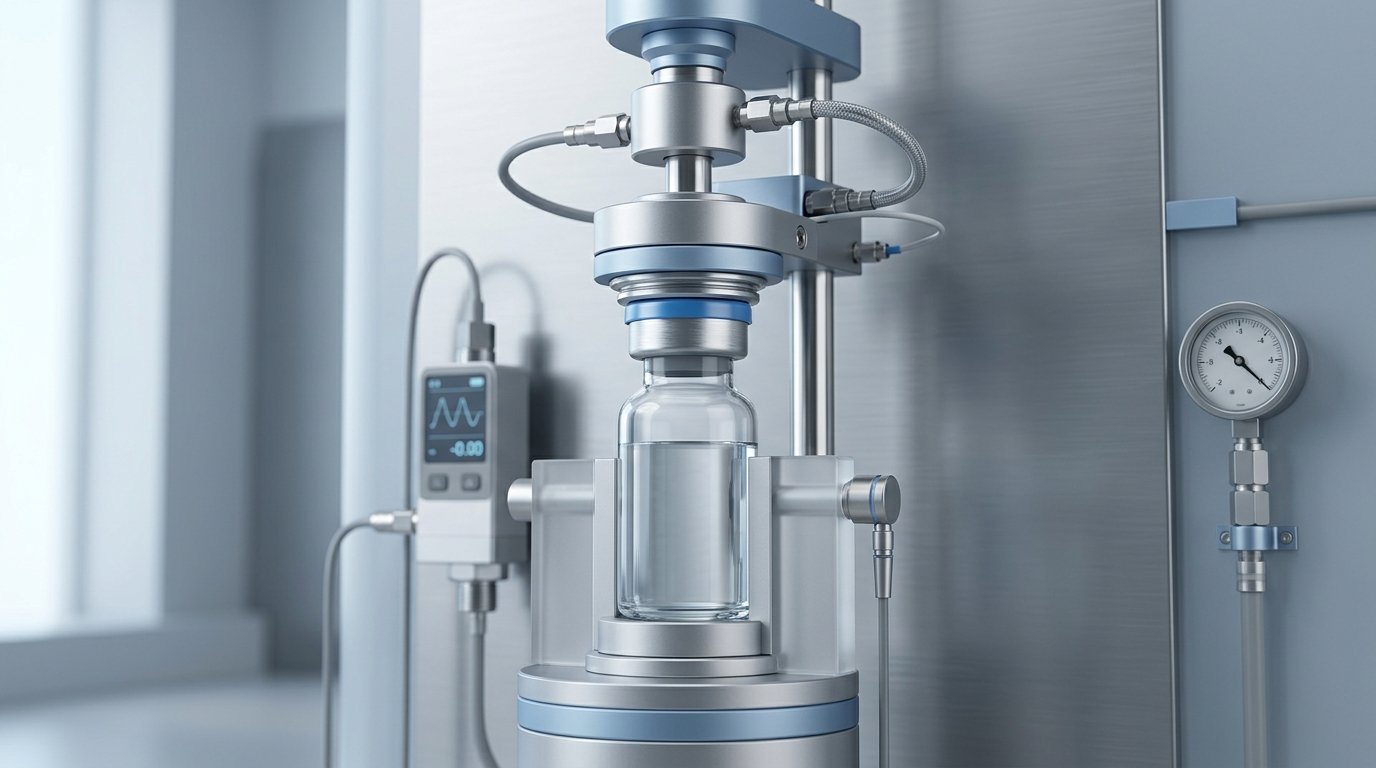
USP General Chapter <1207> is the informational chapter that frames how a sterile product’s package is evaluated for container closure integrity (CCI), the ability of the closed container to maintain a sterile barrier and keep contents within specification. It does not set a single pass/fail test. Instead it gives manufacturers a framework for choosing and validating leak-test methods, distinguishes deterministic from probabilistic approaches, defines the concept of a maximum allowable leakage limit, and promotes a package integrity strategy that runs across the product lifecycle. In short, it is the reference a pharmaceutical company turns to when it has to prove that a sealed vial stays sealed.
This guide explains what USP <1207> covers, why container closure integrity matters for sterile products, the difference between deterministic and probabilistic leak tests, and the main families of CCI test methods.
Key takeaways
- USP <1207> is informational (a chapter numbered above <1000> in the USP-NF), so it gives guidance and a framework rather than a mandatory single test.
- Its subject is container closure integrity (CCI): the package’s ability to maintain a sterile barrier and protect product quality over shelf life.
- It favours deterministic leak-test methods (measuring a quantitative physical parameter) over probabilistic ones (where detection depends on a chain of variable conditions).
- It introduces the maximum allowable leakage limit (MALL): the largest leak a package can have while still protecting the product.
- It promotes a lifecycle approach, with CCI considered in package design and qualification, during stability, and at release as appropriate. That lifecycle is hardest to evidence on deep-cold products such as cell and gene therapies, where the package is qualified at one temperature and used at another.
- The integrity of an injectable vial depends on the whole container closure system (vial, stopper, and the aluminium seal that crimps the stopper in place), not the container alone.
What is USP <1207>?
USP General Chapter <1207>, “Package Integrity Evaluation: Sterile Products,” is an informational chapter in the United States Pharmacopeia: National Formulary (USP-NF) that describes how to evaluate and assure container closure integrity for sterile drug products. It is published and maintained by the United States Pharmacopeia (USP). Because its chapter number is above <1000>, it is informational under USP conventions: it provides guidance, best practices, and a vocabulary for CCI rather than a compendial requirement that a product must pass to be released.
Container closure integrity is the ability of a sealed container to prevent the ingress of microorganisms and, where relevant, the loss of headspace, vacuum, or product. For a sterile injectable, an integrity failure can mean a loss of sterility or a change in the product’s physical and chemical condition, which is why CCI is treated as part of sterility assurance rather than a standalone packaging check. Integrity is a property of the whole container closure system, not of the vial alone, and how the components combine to produce it is set out in vial closure integrity.
USP <1207> is supported by three sub-chapters that go deeper into method selection and the underlying technologies: <1207.1> Package Integrity Testing in the Product Life Cycle: Test Method Selection and Validation, <1207.2> Package Integrity Leak Test Technologies, and <1207.3> Package Seal Quality Test Technologies. Together they give manufacturers a structured way to select, develop, and validate an appropriate CCI test for a given package, and to evaluate seal quality on the closures and seals that hold a container closed. The individual methods are set out in more detail in the guide to container closure integrity testing.
Why container closure integrity matters for sterile products
For a sterile product, container closure integrity is a direct contributor to sterility assurance: a package that does not maintain its barrier can let microorganisms in and let critical product attributes drift out of specification. Sterility is established at manufacture, but it has to be maintained for the entire shelf life, and the package is what maintains it.
CCI also matters beyond microbial ingress. Many injectables are sealed under vacuum or with a specific headspace, freeze-dried (lyophilised) products in particular, and a leak can change moisture content, allow oxygen ingress, or cause loss of fill. Regulators treat CCI as part of the broader contamination control and sterility assurance expectations for sterile manufacturing, and CCI testing increasingly substitutes for older sterility-based package challenge tests in stability and release programs. That headspace dependence is why integrity is treated as a design input on lyophilised vial products and on oxygen-sensitive biologics, rather than as an end-of-line check.
Deterministic versus probabilistic leak tests
USP <1207> divides leak-test methods into two categories and expresses a preference for deterministic methods, because they measure a quantitative physical parameter under controlled conditions, whereas probabilistic methods rely on a sequence of variable events and give a less reproducible result. This distinction is one of the chapter’s central concepts.
A deterministic method measures a defined physical quantity (for example, a change in pressure, a flow of tracer gas, or an electrical signal) that is predictably related to leakage. Because the result is quantitative and the conditions are controlled, deterministic methods tend to be more sensitive, more repeatable, and easier to validate.
A probabilistic method detects leaks through a chain of sequential and dependent events, each with its own probability, so a result depends on factors that are harder to control. Dye ingress and microbial immersion are classic examples: whether a defect is detected can depend on the dye or organism finding and passing through the leak path under the test conditions. These methods can still be useful, but they generally carry greater uncertainty.
| Aspect | Deterministic methods | Probabilistic methods |
|---|---|---|
| Basis of detection | Quantitative physical measurement | Chain of sequential, variable events |
| Typical examples | Vacuum decay, helium leak (mass spectrometry), high-voltage leak detection | Dye ingress, microbial immersion, bubble test |
| Reproducibility | Higher | Lower |
| Ease of validation | Easier (quantitative, controlled) | Harder (more variables) |
| USP <1207> framing | Generally preferred | Acceptable but less favoured |
Container closure integrity test methods
The main CCI test method families discussed in the USP <1207> framework are helium leak detection, vacuum decay, high-voltage leak detection (HVLD), and dye ingress, spanning highly sensitive deterministic methods and traditional probabilistic ones. Method choice depends on the package, the product, the required sensitivity, and the stage of the lifecycle.
Helium leak detection
Helium leak detection uses helium as a tracer gas and a mass spectrometer to measure the rate at which it escapes a package. It is a deterministic method capable of very high sensitivity, which makes it well suited to method development, package design comparison, and establishing the leakage limit for a given container closure system. It is typically a laboratory method rather than a high-throughput line test.
Vacuum decay
Vacuum decay places the package in a sealed test chamber, evacuates the chamber, and monitors pressure over time; a rise in pressure indicates a leak. It is a deterministic, non-destructive method that suits many rigid and semi-rigid containers, including vials, and is widely used for stability testing and as a release test.
High-voltage leak detection (HVLD)
High-voltage leak detection applies a high-voltage probe across a container and detects the change in electrical signal that a leak path (a crack or an incomplete seal carrying conductive liquid) produces. It is a deterministic method used particularly for liquid-filled containers, including vials and prefilled syringes, and can be applied non-destructively.
Dye ingress
Dye ingress immerses the package in a coloured dye solution, often under vacuum and pressure cycles, then inspects for dye that has entered through a leak. It is a probabilistic method and is destructive, but it remains common because it is low-cost and visual. Under the USP <1207> framework it is generally treated as a less preferred option where a validated deterministic method is available.
The maximum allowable leakage limit and the lifecycle approach
USP <1207> introduces the maximum allowable leakage limit (MALL): the greatest leakage rate a specific package can have while still protecting the product from microbial ingress and maintaining required physical and chemical conditions. Rather than asking whether a package leaks at all, the framework asks whether any leak is below the limit that would compromise the product. The MALL is product- and package-specific and is established during package and method development, often using sensitive deterministic methods such as helium leak detection.
The chapter also frames CCI as a lifecycle activity rather than a single event. Integrity is designed into the container closure system, verified during package and process qualification, monitored through stability studies, and confirmed at appropriate points such as release. This mirrors the quality risk management and contamination control thinking applied across sterile manufacturing under ICH and GMP expectations. The stability leg of it runs alongside the ICH Q1A(R2) stability programme, and EU GMP Annex 1 restates the same expectation as a GMP requirement. Where components are supplied pre-sterilised, it also connects to sterilization validation.
Seal specifications that feed a CCI qualification
A CCI qualification is run against a named container closure system, so the seal in that system has to be specified by size, controlled dimensions and opening force, not just by name. The figures below are the values for the FlipTop Optima aluminium-plastic range, which is the seal format used on most crimped injectable vials. Total seal height and aluminium thickness are the two dimensions that determine how the crimping head forms the skirt, and opening force is the downstream check that the crimp was neither loose nor over-tight.
| Size | Total seal height (mm) | Aluminium thickness (mm) | Max opening force (N) | Standard packing per box |
|---|---|---|---|---|
| 13 mm | 7.62–8.38 | 0.16–0.20 | 30 | 15,000 (5,000 × 3 bags) |
| 20 mm | 9.02–9.91 | 0.16–0.20 | 35 | 6,000 (2,000 × 2 bags) |
| 28 mm | 11.06–12.06 | 0.17–0.23 | 35 | 3,000 (1,500 × 2 bags) |
| 32 mm | 14.30–15.50 | 0.21–0.25 | 65 | 1,400 (700 × 2 bags) |
| 34 mm | 15.00–16.00 | 0.20–0.25 | Available on request | Available on request |
Shipper box dimensions are 420 × 270 × 320 mm across the range. Maximum opening force moves with the bridge count on the seal design, so a Bridge, Button or Flower variant of the same size can sit at a different point within the range, which is why a CCI qualification names the design as well as the size. Inner and outer diameters, disc height and bridge counts for each size are listed on the seal size index. Where the closure has to be removed whole rather than flipped, the pull-ring and tear-down formats use the same aluminium-plastic construction, and the all-aluminium tear-off seals are the alternative where no plastic disc is wanted in the system.
How a compliant supply supports a CCI programme
A CCI result belongs to the drug product, but the seal has to be reproducible enough that the result holds across lots, and that reproducibility is what a supplier documents.
Quality system and registrations. Manufacture runs under ISO 9001:2015, ISO 14001:2015 and ISO 15378:2017, the GMP standard for primary packaging materials. A Drug Master File (DMF 18100) and CFDA registration B20200000501 are on record for filings that need to reference the component. The seals are made to ISO 15378:2017 and ISO 8362-6 for aluminium-plastics combination caps, with all-aluminium seals relating to ISO 8362-3 and vial necks to ISO 8362-1, which is the dimensional chain a crimped closure has to match.
Acceptance quality limits. Release is against AQL critical nil, major NMT 2.5% and minor NMT 4%, tailorable to a customer’s own plan, on top of 100% high-speed camera inspection of every seal. For CCI the relevant defects are the ones that produce a leak path: an out-of-round shell, an incomplete skirt, or a misaligned disc. Full-population camera inspection is what catches those before they reach a capping head.
Material compliance. The shell is AA8011 aluminium conforming to EN 15088:2005 with EN 10204-3.1 certification and tested to BS EN 485-2:2008, so the temper and thickness that govern how the skirt forms are certified rather than assumed. The coating is an epoxy lacquer conforming to 21 CFR 175.300, and the disc is polypropylene to IS 10910 and IS 10909, FDA 21 CFR 177.1520 and EC 1895/2005, with BADGE, NOGE and BFDGE not used. Components are BSE/TSE-free to EMEA/410/01 rev. 3, and heavy metals are held to a maximum of 100 ppm total under EN 602 and EC 94/62.
Forms of supply. Regular, Ready-to-Use and Ready-to-Sterilize. Ready-to-Use seals are washed, assembled in an ISO Class 8 cleanroom, sterilised by gamma irradiation or ETO and double-bagged for aseptic transfer, which keeps the seal presentation consistent with the one used in the CCI qualification run. Ready-to-Sterilize seals are cleaned and bagged for the customer’s own validated cycle.
Shelf life. Non-irradiated seals carry 3.5 years before capping plus 5 years after capping. Ready-to-Use seals carry 2 years before capping. Those figures set the window across which a qualified seal presentation stays the qualified presentation.
Certificate packs, dimensional drawings for a named size and samples for a bridging CCI study can be requested through the contact page.
How this connects to the seal in practice at Autofits
For an injectable vial, container closure integrity depends on the complete system: the glass vial, the elastomeric stopper, and the aluminium or aluminium-plastic seal that crimps the stopper down and holds the compression that keeps the barrier closed. A correctly designed and consistently produced seal is part of what allows a package to pass CCI testing. Autofits manufactures a range of vial seals and caps, including aluminium-plastic FlipTop® seals, tear-off and tear-down aluminium seals, and aluminium pilfer-proof caps, under an ISO 15378:2017 quality system, alongside ISO 9001:2015 and ISO 14001:2015 certification and a Drug Master File (DMF 18100). Production runs in a 75,000 sq ft Nashik facility with an ISO Class 8 cleanroom and high-speed visual inspection on the closure lines, controls that support the dimensional consistency a crimped seal needs to contribute to a reliable closure. You can review the full set of certifications on the quality page.
Frequently asked questions
Is USP <1207> mandatory?
USP <1207> is an informational chapter, so it provides guidance and a framework rather than a mandatory pass/fail test. That said, demonstrating container closure integrity for sterile products is a regulatory expectation, and manufacturers commonly use the methods and principles described in <1207> to meet it.
What is the difference between deterministic and probabilistic leak tests?
A deterministic method measures a defined physical quantity, such as a pressure change or tracer-gas flow, that is predictably related to leakage, giving a quantitative and reproducible result. A probabilistic method detects leaks through a chain of variable events, as in dye ingress or microbial immersion, so its result is less reproducible. USP <1207> generally favours deterministic methods.
What are the main container closure integrity test methods?
The main CCI method families are helium leak detection (a highly sensitive deterministic tracer-gas method), vacuum decay (a deterministic pressure-based method), high-voltage leak detection or HVLD (a deterministic method for liquid-filled containers), and dye ingress (a traditional probabilistic immersion method). Method choice depends on the package, the product, and the required sensitivity.
What is the maximum allowable leakage limit (MALL)?
The maximum allowable leakage limit is the largest leak a specific package can have while still protecting the product from microbial ingress and maintaining its required physical and chemical condition. It is product- and package-specific and is established during package and method development, often using sensitive deterministic methods.
Does the vial seal affect container closure integrity?
Yes. For an injectable vial, integrity depends on the whole container closure system, and the aluminium seal crimps the stopper in place and holds the compression that keeps the sterile barrier closed. A poorly applied or poorly designed seal can compromise integrity, which is why seal quality and dimensional consistency matter for CCI.
What seal data should be recorded in a CCI qualification?
Record the seal size, the design variant (Bridge, Button, Flower, pull-ring or tear-down), the total seal height and aluminium thickness from the component drawing, the maximum opening force, and the form of supply used in the run. For the FlipTop Optima range the controlled heights are 7.62 to 8.38 mm at 13 mm, 9.02 to 9.91 mm at 20 mm, 11.06 to 12.06 mm at 28 mm, 14.30 to 15.50 mm at 32 mm and 15.00 to 16.00 mm at 34 mm, with maximum opening forces of 30 N, 35 N, 35 N and 65 N at 13, 20, 28 and 32 mm respectively. Recording the form of supply matters because a Ready-to-Use sterilised seal and a Regular seal are not interchangeable in a qualified system.
Do ready-to-use seals change the CCI qualification?
The form of supply is part of the qualified configuration, so a change from Regular to Ready-to-Use, or a change of sterilisation method between gamma irradiation and ETO, should be assessed rather than assumed equivalent. Ready-to-Use seals are washed, cleanroom-assembled, sterilised and double-bagged, and carry a shelf life of 2 years before capping against 3.5 years before capping plus 5 years after capping for non-irradiated seals, so the stock-rotation window changes as well.
Related reading
- Container closure integrity testing (CCIT) methods
- Vial closure integrity: how the components combine
- USP <382>: functional suitability of elastomeric closures
- EU GMP Annex 1 and sterile product manufacturing
- FlipTop Optima flip-off seals for crimped vials
- Seals by vial size: 13, 20, 28, 32 and 34 mm
- Quality systems and certifications
Sources
- USP: General Chapter <1207>, Package Integrity Evaluation, Sterile Products, in USP-NF (https://www.usp.org)
- USP: United States Pharmacopeia, National Formulary (USP-NF) (https://www.usp.org/products/usp-nf)
- ICH: Quality Guidelines (Q9 Quality Risk Management) (https://www.ich.org/page/quality-guidelines)
- Autofits Packaging Pvt. Ltd.: FlipTop Seals product dossier and engineering drawings (dimensions, opening force, packing, forms of supply, shelf life, material declarations)
*Last updated: 2026-08-18. This article is general regulatory information, not legal or compliance advice; confirm the current USP-NF text and applicable editions with USP and your quality and regulatory function.*
