
Pharmaceutical Sealing Solutions for Vials and Bottles: Seal Types, Sizes and Delivery Forms
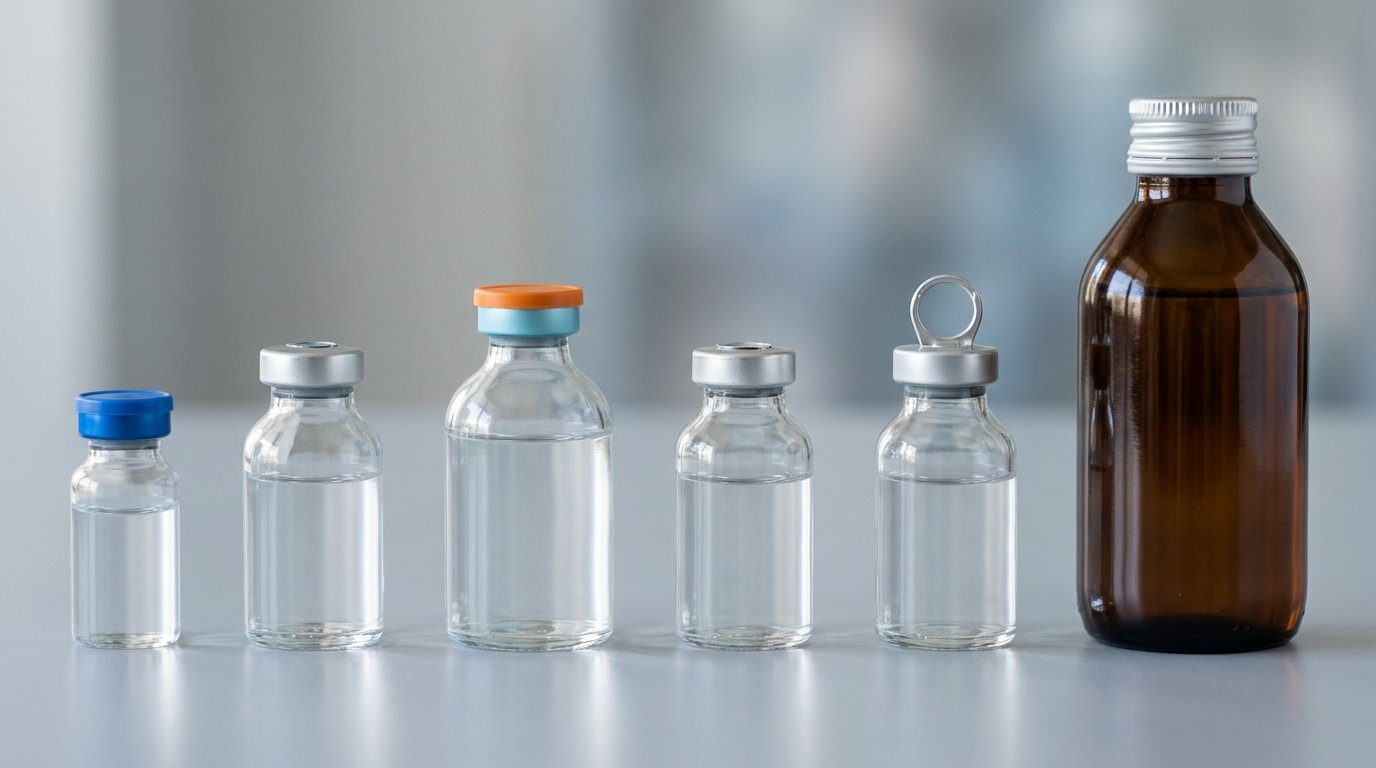
Autofits’ pharmaceutical sealing solutions are the closures that seal a filled medicine container: aluminium-plastic and all-aluminium seals for injection vials from 13 to 34 mm, and aluminium roll-on pilfer-proof caps for bottles from 22 to 38 mm. The sealing solutions for vials are five seal designs, each crimped over the rubber stopper to hold the sterile barrier closed and each opening in its own way. Seals are supplied Regular, Ready-to-Use or Ready-to-Sterilize. These are packaging closures, not the gaskets, O-rings and mechanical seals used inside process equipment.
Key takeaways
- Five vial seal designs: FlipTop Optima flip-off, FlipTop Pull Ring, FlipTop Tear-Down, all-aluminium tear-off and all-aluminium tear-down.
- Vial sizes 13, 20, 28, 32 and 34 mm, depending on design. ROPP caps 22, 25, 28, 35 and 38 mm for oral liquid bottles.
- Three delivery forms: Regular, Ready-to-Use (gamma or ETO sterilised, double-bagged) and Ready-to-Sterilize.
- Maximum opening force is 30 N at 13 mm, 35 N at 20 and 28 mm and 65 N at 32 mm.
- Capacity: more than 2.4 billion seals a year and 250 million pilfer-proof caps a month.
- Standard designs typically start from 50,000 pieces per size and colour, typically 2 to 3 weeks from order confirmation, confirmed on enquiry.
Sealing solutions for vials and bottles: what the range closes
The range closes three kinds of container, and the container decides which part of the range applies.
- Injection vials with a crimp neck. Glass tubing or moulded vials with a rubber stopper, closed with a crimped seal. Most injectables sit on 13 or 20 mm necks; larger vials use 28, 32 or 34 mm.
- Vials for oral use. Some oral products, including oral vaccines, are filled into vials and need a seal that comes off entirely.
- Threaded bottles. Syrups, suspensions and other oral liquids in glass or PET bottles, closed with an aluminium pilfer-proof cap rolled onto the neck.
For crimped vial seals, the aluminium does the holding and the rubber stopper does the sealing. How the stopper, seal and vial neck are specified together is on the vial closures page.
Vial sealing solutions at a glance
| Design | Construction | How it opens | Tamper evidence | Sizes |
|---|---|---|---|---|
| FlipTop Optima | Aluminium shell with polypropylene flip-off disc | Disc flips off, stopper face exposed, aluminium stays | A missing disc shows the vial has been opened; the Button design adds intrinsic tamper evidence from a 12-stem flower under the disc | 13, 20, 28, 32, 34 mm |
| FlipTop Pull Ring | Aluminium shell with polypropylene disc and pull ring | Disc lifts, ring pulls, whole seal comes away | Seal removed entirely | 20, 32 mm |
| FlipTop Tear-Down | Polypropylene disc riveted to the aluminium | Disc opens, then turns anticlockwise to tear the seal off | Seal removed entirely | 13, 20, 32 mm |
| Tear-off | All aluminium | Metal centre torn away to expose the stopper | Torn metal | 13, 20, 32 mm |
| Tear-down | All aluminium | A section of the seal tears down | Torn metal | 20 mm |
| Pilfer-proof (ROPP) cap | Aluminium shell with EPE, latex or PVC liner, rolled onto the bottle thread | Unscrews | Pilfer band breaks on first opening | 22, 25, 28, 35, 38 mm |
The aluminium-plastic designs are combination caps under ISO 8362-6, described in depth on the combi seals page. The all-aluminium seals relate to ISO 8362-3. How each design shows interference is compared on the tamper-evident vial seals page.
Matching the sealing solution to the application
The drug and the way it is given decide the design; the vial decides the size. Typical matches:
| Application | Typical sealing solution | Why |
|---|---|---|
| Multidose injectables and vaccines | FlipTop Optima, 13 or 20 mm | Stopper stays covered by aluminium and is entered repeatedly through the exposed face |
| Standard crimp-top serum vials | FlipTop Optima, tear-off or tear-down | Covered on the serum vial seals page |
| Freeze-dried products | FlipTop Optima, often Ready-to-Use | Crimped after the stopper is seated in the freeze-dryer; see lyophilisation vial seals |
| Oral vaccines in vials | FlipTop Tear-Down | The whole seal twists off so the contents can be dispensed |
| Products for oral use from a vial | FlipTop Pull Ring | Seal detaches completely; often marked for oral use only |
| Metal-only specification | Tear-off or tear-down | No plastic component on the vial |
| Larger vials and veterinary packs | FlipTop Optima 28, 32 or 34 mm; Pull Ring 32 mm | Wider necks; maximum opening force rises to 65 N at 32 mm |
| Syrups and oral liquids in bottles | ROPP caps, commonly 28 mm | Reclosable with a pilfer band |
Delivery forms
The delivery form follows what the filling line does before capping. All vial seal designs are available in all three.
| Form | Condition on arrival | Typical use | Shelf life before capping | Typical timing |
|---|---|---|---|---|
| Regular | Non-sterile, bagged | Crimping outside controlled environments, such as non-sterile oral products; washing seals on receipt is not recommended, because collision and abrasion create particles | 3.5 years, plus 5 years after capping | Standard lead time |
| Ready-to-Use (RTU) | Washed, assembled in an ISO Class 8 cleanroom, gamma or ETO sterilised, double-bagged | Aseptic filling, where the outer bag is removed at the airlock | 2 years | Typically adds 1 to 2 weeks |
| Ready-to-Sterilize (RTS) | Clean and bagged for the customer’s own cycle | Lines with a validated in-house sterilisation step | Confirmed with the quotation | Standard lead time |
The standard 420 × 270 × 320 mm box holds a count that changes with the seal: 15,000 at 13 mm, 6,000 at 20 mm, 3,000 at 28 mm and 1,400 at 32 mm. Tyvek bags can replace the standard bags.
Choosing a sealing solution in five steps
- Read the neck from the vial or bottle drawing. It fixes the size.
- Decide how the container is opened: needle access through a flip-off, full removal, or unscrewing.
- Set the colour, finish and marking, which can be standard or custom; the options are on the custom seals page.
- Choose the delivery form from what happens on the line before capping.
- Confirm on your line with samples and capping trials before volume orders.
Materials and quality
One qualified material set runs across every design, so moving between designs does not change the material documentation.
| Material or control | Specification |
|---|---|
| Aluminium | AA8011 to EN 15088:2005, EN 10204 3.1 certificate, REACH and RoHS compliant |
| Lacquer | Epoxy, to 21 CFR 175.300, pigmentable |
| Plastic disc | Polypropylene to 21 CFR 177.1520 and EC 1895/2005, moulded in-house on Toyo machines |
| Heavy metals | Hexavalent chromium, cadmium, mercury and lead: 100 ppm maximum in total |
| Animal origin | BSE/TSE-free, EMEA/410/01 rev. 3 |
| Inspection | Automated washing, then 100% high-speed camera inspection |
| Release AQL | Critical nil; major 2.5% maximum; minor 4% maximum |
Ordering
Send the container drawing or neck size, the design, colour, delivery form and annual volume, and the matching drawing comes back with the quotation. For a first order of a standard design, plan on a typical minimum of 50,000 pieces per size and colour and a typical 2 to 3 weeks after the order is confirmed. If the line needs a trial first, ask for standard samples: a typical 200 to 500 pieces per size, usually on their way within 5 working days. Every figure is confirmed on enquiry through the contact page.
How this works in practice at Autofits
Autofits Packaging Pvt. Ltd. makes the whole sealing range in one 75,000 sq ft facility at MIDC Malegaon, Sinnar, Nashik, with more than 300 staff. The plant produces more than 2.4 billion seals a year and 250 million aluminium pilfer-proof caps a month, and supplies more than 150 pharmaceutical companies. Design and development are in-house, standard designs are held for a fast start, and customisation is made to requirement. The quality system is certified to ISO 9001:2015, ISO 14001:2015 and ISO 15378:2017, with a Drug Master File (DMF 18100) and CFDA registration.
Frequently asked questions
What are pharmaceutical sealing solutions?
In medicine packaging, sealing solutions are the closures that seal a filled container: crimped aluminium or aluminium-plastic seals over the rubber stopper of an injection vial, and aluminium pilfer-proof caps on bottles. The same phrase is also used for gaskets and mechanical seals inside process equipment, which are a different product.
Which sealing solution suits which kind of vial?
Multidose injectables and vaccines usually take a FlipTop Optima flip-off seal, which leaves the stopper face open for repeated needle access. Oral products filled into vials take a FlipTop Pull Ring or FlipTop Tear-Down seal, which comes off completely. A tear-off or all-aluminium tear-down seal suits a specification that allows no plastic on the vial.
Which sealing solution is used for oral liquid bottles?
Oral liquids in threaded glass or PET bottles are usually closed with aluminium roll-on pilfer-proof caps. The cap is formed onto the bottle thread during capping and has a pilfer band that breaks on first opening. Autofits makes them in 22, 25, 28, 35 and 38 mm, with EPE, latex or PVC liners.
What is the difference between Ready-to-Use and Ready-to-Sterilize seals?
Ready-to-Use seals arrive already sterilised by gamma irradiation or ETO, assembled in an ISO Class 8 cleanroom and double-bagged, so they can go straight into an aseptic filling area. Ready-to-Sterilize seals arrive clean and bagged for the customer to sterilise in its own validated cycle before use.
What sizes do vial seals come in?
Autofits vial seals come in 13, 20, 28, 32 and 34 mm, matched to the nominal vial neck size. FlipTop Optima covers all five sizes, Pull Ring 20 and 32 mm, FlipTop Tear-Down and tear-off 13, 20 and 32 mm, and the all-aluminium tear-down 20 mm.
How many seals can Autofits supply?
Autofits produces more than 2.4 billion seals a year and 250 million aluminium pilfer-proof caps a month from its Nashik facility. Standard designs are held for a fast start, and supply schedules for large annual volumes are agreed with the quotation.
Related reading
- Vial closures: stopper, seal and neck specified together
- FlipTop Optima flip-off seals
- Serum vial seals
- Lyophilisation vial seals
- Custom seals
Sources
- Autofits FlipTop Seals dossier, engineering drawings and company brochure
- ISO: ISO 8362-6:2010, Caps made of aluminium-plastics combinations for injection vials (https://www.iso.org/standard/52806.html)
- ISO: ISO 15378:2017, Primary packaging materials for medicinal products (https://www.iso.org/standard/70729.html)
- eCFR: 21 CFR 175.300, Resinous and polymeric coatings (https://www.ecfr.gov/current/title-21/chapter-I/subchapter-B/part-175/subpart-C/section-175.300)
*Last updated: 2026-09-15. This page is general technical and product information, not regulatory or compliance advice; typical values are indicative, and quantities, lead times and drawings are confirmed with the quotation.*
